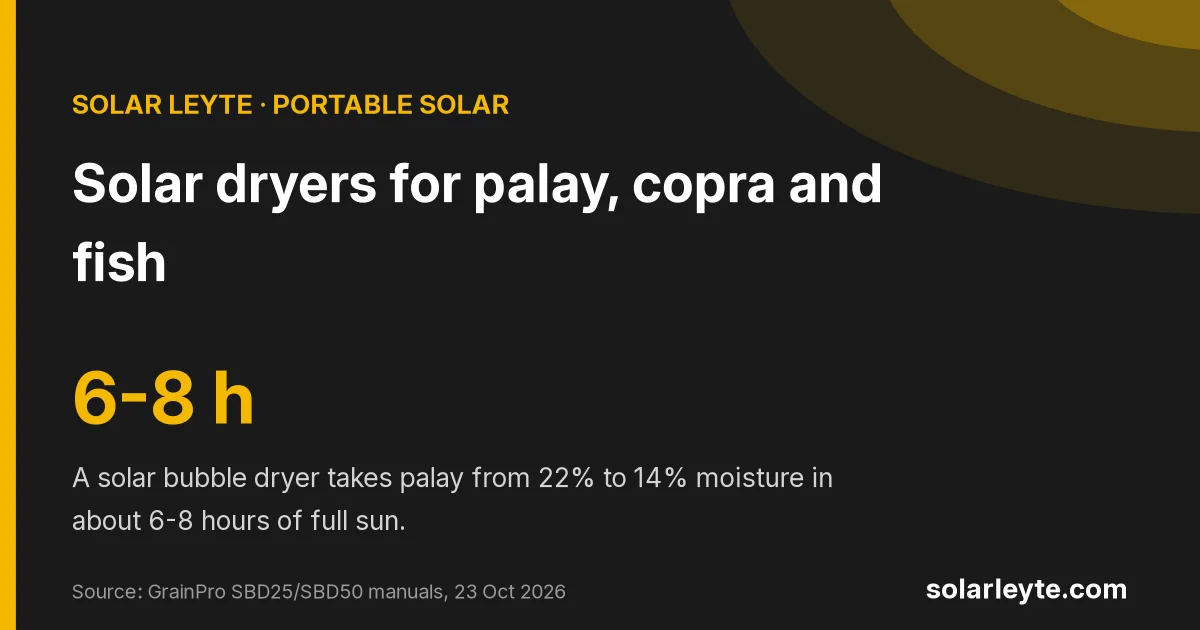
A solar dryer is a covered drying bed that traps the sun's heat and uses a small fan to carry the moisture away, so your palay, copra or fish dries without sitting on the highway or getting soaked by a sudden shower. For palay and corn, the solar bubble dryer from IRRI and GrainPro holds 500 kg or 1,000 kg per batch and runs its fans on one or two 100 W solar panels. On a full sunny day it takes paddy from 22% to 14% moisture in about 6 to 8 hours (GrainPro SBD25 manual). For fish, fruit and root crops, PHilMech's multi-commodity solar tunnel dryer lists at ₱230,000 to ₱250,000 with trays (PHilMech).
Neither one dries at night or in steady rain without a backup heater. In Naval, December and January are the wettest and least sunny months. Below: the main types, real specs and costs, moisture targets, and two worked examples.
Last checked: 23 October 2026. Costs are what each source published (years noted) and can change.
The main types of solar dryer, compared
Type | Batch size | Power needed | Published cost | Best for |
|---|---|---|---|---|
Concrete drying pavement (MPDP) | Depends on pavement size | None | Varies by size (built by DA/LGU) | Palay and corn in the dry season |
Solar bubble dryer SBD25 | 500 kg paddy | 1 × 100 W panel, 12 V fan | Not published (ask GrainPro) | Small farmers, seed palay |
Solar bubble dryer SBD50 | 1,000 kg paddy | 2 × 100 W panels, two 12 V fans | Not published (ask GrainPro) | Farmer groups, contract drying |
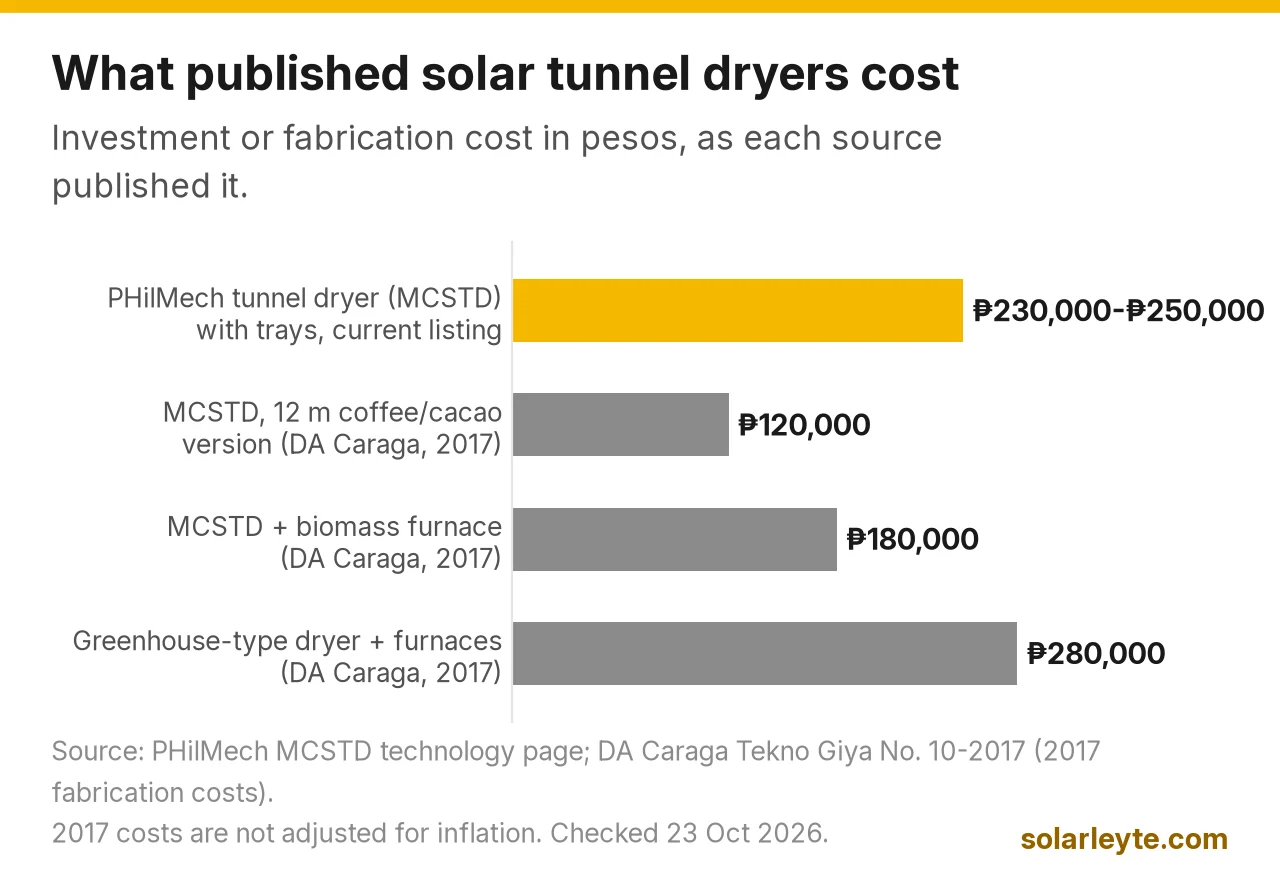
PHilMech multi-commodity solar tunnel dryer | Tray loads (see below) | 5 fans, 35–38 W each, 220 V | ₱230,000–₱250,000 with trays | Fish, banana, cassava, mango |
Tunnel dryer with biomass furnace (2017 design) | 300–400 kg coffee/cacao beans | Fans plus a furnace | ₱180,000 (2017) | Drying into the evening and rainy days |
Greenhouse-type solar dryer with furnace (2017 design) | 600–800 kg coffee/cacao beans | Fans plus furnaces | ₱280,000 (2017) | Bigger co-ops |
Sources: GrainPro SBD25 and SBD50 manuals, PHilMech, a 2021 PhilGEPS notice for the fan spec, and the DA Caraga 2017 coffee and cacao postharvest booklet for the furnace designs. The 2017 costs are fabrication costs from that year, so expect higher prices today.
Why not just dry palay on the road?
Because it's illegal on national roads and it costs you money. DPWH Department Orders No. 41 (2013) and No. 52 (2003) and Section 23 of PD 17 (the Revised Philippine Highway Act) ban drying farm produce on public highways. The DPWH says violators can be fined up to ₱1,000 or jailed for up to six months (GMA News).
PHilMech also points out the quality hit. Vehicles break the grains, so the palay sells for less, and animals can contaminate it when nobody is watching (PHilMech). The legal alternative is the concrete multi-purpose drying pavement that many barangays already have. It costs nothing to run, but PHilMech notes it is practically useless in the wet season, and a sudden shower can soak the whole batch.
That's where a covered solar dryer helps. IRRI says the bubble dryer "completely eliminates the re-wetting of grains during rain and losses due to animals, spillage and cars running over the grains" (IRRI Rice Knowledge Bank).
How dry is dry enough?
Crop | Target | What happens if it's wetter | Source |
|---|---|---|---|
Palay (paddy) | 14% moisture or lower (wet basis) | Mould and quality loss in storage | |
Copra | 6.0% gets the base price | 6.1% to 13.9% gets price deductions; 14% and above is rejected |
The copra grades in the same BAFS bulletin are Grade 1 at 6–7.9% moisture, Grade 2 at 8–10.9% and Grade 3 at 11–13.9%. The bulletin also explains why it matters beyond price: damp, badly dried copra grows the moulds that make aflatoxin. A cheap grain moisture meter pays for itself fast. IRRI's own advice is to "use a moisture tester for monitoring the drying process."
The solar bubble dryer (SBD) for palay and corn
The solar bubble dryer is a long plastic tunnel. The sun heats the grain through the clear top, and a small 12 V fan inflates the tunnel and pushes the damp air out. IRRI, the University of Hohenheim and GrainPro developed it, and it has been sold since September 2014.
Spec | SBD25 | SBD50 |
|---|---|---|
Capacity (paddy) | 500 kg | 1,000 kg |
Size (L × W) | 15 × 2 m | 26 × 2 m |
Drying area | 25 m² | 50 m² |
Solar panel | 1 × 100 W | 2 × 100 W |
Fan | One 12 V DC ventilator | Two 12 V DC ventilators |
Battery | AGM, optional | AGM 12 V 70 Ah, optional |
Warranty | 1 year | 1 year |
Source: GrainPro SBD25 and SBD50 instruction manuals. There's also a grid-powered 220 V version, but IRRI recommends the 12 V solar version to avoid electrocution in wet fields.
How fast is it? GrainPro rates both models at an average 0.5% moisture drop per hour for paddy and corn. IRRI says 0.5 to 1% per hour in daytime, depending on the weather. Skin-dry grain reaches 14% in one sunny day; wetter grain or cloudy weather can take two days. Drying stops at night and in rain, but if you keep the tunnel inflated, the grain stays safe inside. With open sun drying you'd have to gather and bag it.
How much does it cost? GrainPro doesn't publish a price. Its site says "prices vary depending on the product, quantity, and your location" and asks buyers to request a price list (GrainPro). IRRI lists GrainPro Philippines in Subic Bay Freeport as the place to buy. Many units in the Philippines go to farmer groups through government programmes. For example, the DA regional office in the Cordillera bought 12 SBDs for cooperatives and an LGU after a PhilRice team demonstrated it to farmers (Rice Today). If you're in a farmers' association, ask your DA regional field office or municipal agriculturist before buying one yourself.
Tips from IRRI: set it up where nothing shades it all day, clear sharp stones first, and mix the grain every hour. Use a deep-cycle battery, not a car battery. IRRI warns a starter battery "will break within one year." Store the tunnel away from rats, which "like to nibble on the plastic." If you're new to small 12 V setups, our MPPT vs PWM charge controller guide and small solar panels guide explain the parts.
Worked example 1: one harvest through a bubble dryer
Example with stated assumptions, not a quote. Say your harvest is 3 tonnes of wet palay at 22% moisture, and you want it at 14%.
- Water to remove: 1,000 kg at 22% has 780 kg of dry matter. At 14% that becomes 780 ÷ 0.86 ≈ 907 kg, so each tonne loses about 93 kg of water. (Solar Leyte calculation.)
- SBD50 (1 t per batch): on sunny days, 6–8 hours per batch, so about 3 sunny days for the 3 tonnes. If it's cloudy and each batch takes two days, plan on about 6 days.
- SBD25 (500 kg per batch): 6 batches, so about 6 sunny days, or up to 12 if it's cloudy.
That's why IRRI and GrainPro pitch the bigger unit at groups that share it or run contract drying.
PHilMech's multi-commodity solar tunnel dryer for fish, fruit and root crops
For products dried on trays, like danggit, dilis, banana chips, cassava or mango, the PHilMech multi-commodity solar tunnel dryer (MCSTD) is the local design to know. It's a 2 m × 17 m tunnel: a 7.2 m black heat collector, then a 9.8 m drying bed where the trays sit. PHilMech adapted it from a University of Hohenheim design and builds it with locally available materials. It lists the investment cost at ₱230,000 to ₱250,000 with the tray package (PHilMech).
A 2021 government purchase spells out the parts: five 220 V axial fans at 35–38 W each, plus 32 stainless or 54 food-grade plastic trays. That order's approved budget was ₱393,000, but it also included a stainless steel smokehouse (PhilGEPS).
How much fits depends on the product. In PHilMech's early trials, a drying floor of 22.3 m² held about 250 kg of mango, and the dryer brought tilapia and mango chips down to a safe moisture level (PHilMech). For coffee and cacao, DA Caraga's 2017 booklet gives a 12 m version a capacity of 240–320 kg of beans, running at 40–50 °C on 90 W of fans (DA Caraga).
For the rainy season, the same booklet shows a version with a biomass furnace (₱180,000 in 2017, of which ₱80,000 was the furnace and ducts) for "drying during evenings and continuous rainy weather." It also shows a bigger greenhouse-type dryer with furnaces that holds 600–800 kg (₱280,000 in 2017).
Worked example 2: running the tunnel dryer's fans
Example with stated assumptions. The five fans draw up to 5 × 38 W = 190 W. Over an 8-hour drying day:
- Energy: 190 W × 8 h = 1.52 kWh a day.
- On BILECO power: 1.52 kWh × ₱18.93/kWh (BILECO's September 2026 rate, the latest on PRESYO-PH) = about ₱28.77 a day, or about ₱575 for 20 drying days a month. A business or co-op account may pay a different rate.
- On solar instead: a 100 W panel in Naval makes about 0.41 kWh a day on average (PVGIS, from our small solar panels guide). So 1.52 kWh needs roughly 400 W of panels on an average day, plus an inverter, because these fans run on 220 V AC. The fans only run when the sun is up, which is when the panels produce. (Solar Leyte estimate.)
The power bill is small either way. What a solar setup really buys you is drying through a brownout, or in a spot with no grid line.
Which months work best in Leyte and Biliran?
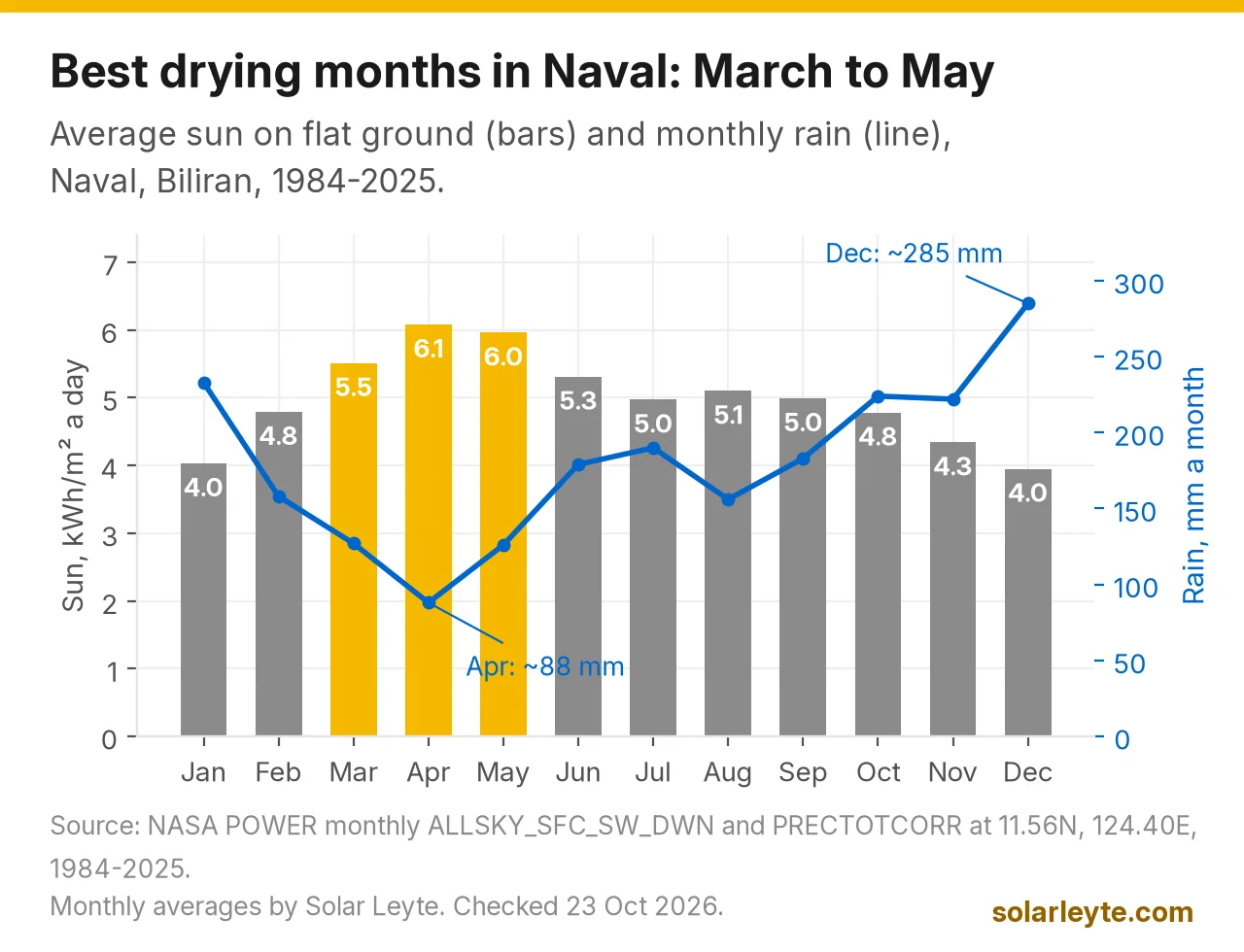
Solar drying is a dry-season tool here. Using NASA POWER satellite data for Naval (averages for 1984–2025):
Months | Sun on flat ground (kWh/m² a day) | Rain (mm a month) | What it means for drying |
|---|---|---|---|
March–May | 5.5–6.1 | 88–127 | Best: strong sun, the least rain |
June–September | 5.0–5.3 | 156–190 | Good on sunny days; keep the tunnel closed for showers |
October–November | 4.3–4.8 | 222–224 | Slower; expect two-day batches |
December–February | 4.0–4.8 | 158–285 | Hardest: December is the wettest month (about 285 mm) |
Source: NASA POWER monthly data for 11.56°N, 124.40°E (all-sky surface solar radiation and corrected rainfall), averaged by Solar Leyte. April is the sunniest month at about 6.1 kWh/m² a day, and December the dullest at about 4.0. Over a year Naval gets roughly 2,170 mm of rain.
So if your main harvest lands in the wet months, a covered dryer still beats the open pavement, but you'll want a furnace-assisted design or a mechanical dryer for long rainy spells. PAGASA expects the current El Niño to last into the first half of 2027 (see our El Niño 2026 post), so keep an eye on its outlooks when you plan drying. For the milling step after drying, our solar rice mill guide covers mill sizes and power.
Which one should you choose?
- You dry palay or corn on your own and your barangay has a drying pavement: keep using it in the dry season. A bubble dryer is mainly insurance against surprise rain.
- Your farmers' group dries several tonnes a season: an SBD50 shared or run for contract drying makes more sense than several small units. Ask the DA about group programmes first.
- You make dried fish, banana chips or other tray products: a tunnel dryer like PHilMech's MCSTD, with stainless or food-grade trays.
- You need to dry through the rainy months: look at designs with a biomass furnace, and budget for one.
- You want the fans on solar: a 12 V bubble dryer already comes with its own panel. For 220 V tunnel-dryer fans or a processing shed, size a small solar system around the fan load (see our solar battery price guide if you also want it running through brownouts).
FAQ
How much is a solar bubble dryer in the Philippines? GrainPro doesn't publish a price. It quotes by product, quantity and location. Farmer groups often get units through DA programmes, so ask your DA regional field office or municipal agriculturist first.
Does a solar dryer work when it rains? Drying mostly stops in rain and at night, but a closed, inflated bubble dryer keeps the grain from getting wet again. To actually keep drying through long rainy spells, you need a design with a biomass furnace or a mechanical dryer.
Is drying palay on the highway illegal? Yes, on national roads. DPWH orders and Section 23 of PD 17 ban it, and the DPWH says violators can be fined up to ₱1,000 or jailed for up to six months.
What moisture should palay and copra reach? Palay should be at 14% or lower. Copra gets the base price at 6.0%, takes deductions from 6.1% to 13.9%, and is rejected at 14% and above.
Solar Leyte is run by MACC Systems & Energy Solutions Inc., a solar installer in Naval, Biliran.
Want solar for your dryer fans or processing shed? Get a free quote from MACC
Tell us what you dry, how many hours the fans or machines run, and whether you're on BILECO or LEYECO. We'll size the solar and show you the savings math. No obligation.
- Call/Text: 0955 723 5093
- Email: official@macc-inc.com or benjie@macc-inc.com
- Website: www.macc-inc.com
- Request a quote online: solarleyte.com/quote
- Office: Brgy. Talustusan, Naval, Biliran 6543
Sources (all checked 23 October 2026 unless stated)
- GrainPro, Solar Bubble Dryer 25 instruction manual (500 kg; 15 × 2 m; 25 m²; 100 W panel; 12 V ventilator; 0.5%/h average; 6–8 h from 22% to 14% in full sun; 1-year warranty)
- GrainPro, Solar Bubble Dryer 50 instruction manual (1,000 kg; 26 × 2 m; 50 m²; 2 × 100 W; two 12 V ventilators; AGM 12 V 70 Ah; 1-year warranty)
- GrainPro, home page, ordering and pricing FAQ ("Prices vary depending on the product, quantity, and your location")
- IRRI Rice Knowledge Bank, The Solar Bubble Dryer (0.5–1%/h; one or two days; rain and night; 12 V recommendation; deep-cycle battery; rats; commercialised September 2014; GrainPro Philippines)
- IRRI Rice Today, Enriching the indigenous gems of the Philippine Cordillera (DA-RFO-CAR bought 12 SBDs)
- PHilMech, Multi-Commodity Solar Tunnel Dryer (2 × 17 m; 7.2 m collector; 9.8 m drying bed; ₱230,000–₱250,000 with tray package)
- PhilGEPS, Supply and delivery of multi-commodity solar tunnel dryer and smokehouse, ref. 8233181 (2021) (five 35–38 W 220 V fans; 32 stainless or 54 plastic trays; ABC ₱393,000 including smokehouse)
- PHilMech (then BPRE), 2002 project story on the MCSTD (22.3 m² floor ≈ 250 kg mango; tilapia and mango chips trials)
- DA Caraga, Postharvest Technologies for Coffee and Cacao (Tekno Giya 10-2017) (MCSTD 240–320 kg, 90 W, ₱120,000; with biomass furnace ₱180,000; greenhouse type 600–800 kg, ₱280,000; 2017 fabrication costs)
- PHilMech, feature on the multi-purpose drying pavement and highway drying (DPWH DO 41 s. 2013, DO 52 s. 2003, PD 17 Sec. 23; wet-season limits)
- GMA News, Senators tell DPWH to resolve palay-drying issue (16 November 2018; PD 17 Sec. 23 text; fine up to ₱1,000 or up to six months)
- DA-BAFS, PNS/BAFS 290:2025 Paddy and milled rice, grading and classification (maximum moisture 14%, wet basis)
- DA-BAFS, Ensuring the Safety and Quality of Copra (technical bulletin) (6.0% base; 6.1–13.9% deductions; 14% rejected; grade moisture ranges; aflatoxin)
- NASA Langley, POWER project (monthly ALLSKY_SFC_SW_DWN and PRECTOTCORR for Naval, 1984–2025; monthly averages by Solar Leyte)
- ICSC, PRESYO-PH national table (BILECO, September 2026, ₱18.93/kWh, the latest month available on 23 October 2026)
- PVGIS output for a 100 W panel in Naval (0.41 kWh a day), as used in our small solar panels guide
- Water removed, batch days, fan energy and cost, and panel sizing are Solar Leyte calculations from the figures above.