Rice milling is one of the few farm loads that already wants to run in the sun. Palay is dried and milled by day; compressors and night aircons are not. That makes solar a better technical fit for a huller than for a freezer — but the pesos still depend on the motor size, how many days you mill, and whether you are on BILECO/LEYECO or on diesel.
This post sizes three paths with numbers you can check: Philippine seller listings for small electric mills (Goldpeak, Melko, ToolsSavvy — checked 15 October 2026), PHilMech village mill and huller specs, a Satake one-pass nameplate, the LAMPCO / One Meralco Foundation 5.1 kWp co-op solar mill case, FAO's domestic solar-milling note for off-grid islands, PRESYO-PH September 2026 co-op rates, and PVGIS output for Naval, Biliran. Bill and solar figures are Solar Leyte calculations. Nothing here is a MACC installed price or quote — and we do not claim MACC sells rice mills or hullers.
If you also run fans for livestock, see our poultry and piggery solar guide. Irrigation pumps are in the solar water pump price guide. Battery and hybrid inverter pesos are in those price posts.
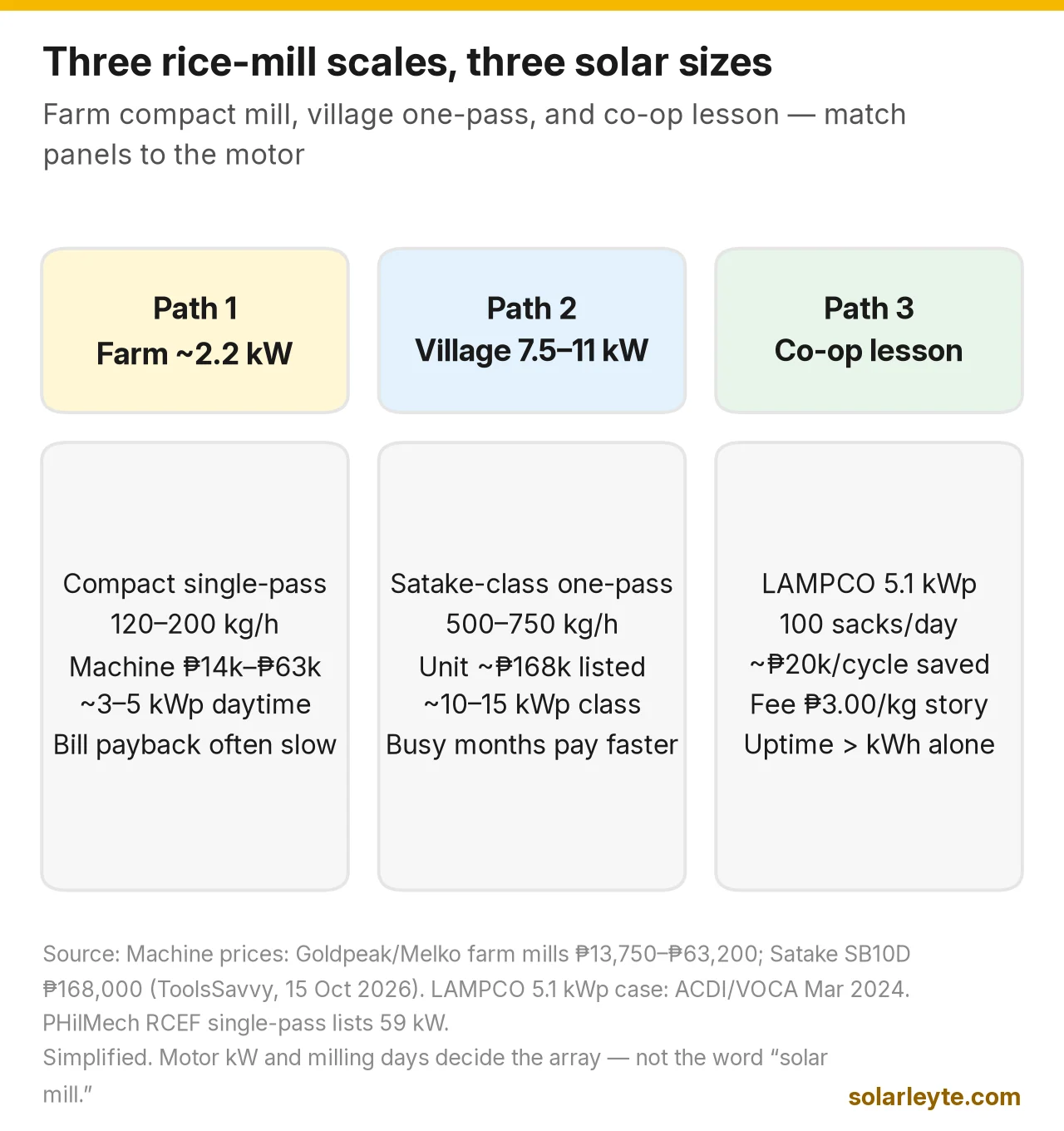
Path 1: A small farm or barangay mill (~2.2–3 HP)
Most "rice mill" listings sold to farms in the Philippines are compact single-pass machines with a 2.2 kW to 3 HP electric motor (about 2.2–2.2 kW continuous nameplate). They hull and polish in one pass at roughly 120–200 kg of paddy per hour.
PH retail examples checked 15 October 2026:
Machine (seller) | Motor / power | Capacity (seller) | List price | Notes |
|---|---|---|---|---|
Yamata 6N70 (Goldpeak) | 3 HP | (not stated on page) | ₱13,750 | Compact unit |
Brolly RMILL5 6N-40 (Goldpeak) | 2.2 kW required | up to 120 kg/h; <15 kWh/t | ₱14,080 | Engine not included |
Brolly RMILL6 6N-40 (Goldpeak) | 2.2 kW required | up to 120 kg/h; <15 kWh/t | ₱18,150 | Includes 7.5 HP engine (diesel/gasoline path) |
Brolly RMILL1 (Goldpeak) | 3.0 HP; 220–240 V | rice 165–200 kg/h | ₱19,030 | Electric consumption listed 10.9–11.3 (units unclear on page) |
Brolly RMILL2 combined mill/pulverizer (KHM) | 3.0 HP | rice 165–200 kg/h | ₱25,300 | Also mills millet/flour |
Melko 6N80 / 6NF4-D Diamond II | match 1.8–2.2 kW | 150–200 kg/h | ₱63,200 | Stainless; gas/diesel engine options |
Sources: Goldpeak Tools PH product pages for Yamata 6N70, Brolly RMILL1 / RMILL5 / RMILL6; KHM Megatools for RMILL2; Melko Philippines for 6N80. Prices and stock change — re-check before you order. The RMILL6's included 7.5 HP engine is for running without the co-op; for a solar/hybrid path you usually want the electric motor version (RMILL5-class) or a separate 220 V motor matched to the mill.
PHilMech's emerging brown rice impact huller is smaller still: 0.75 HP single-phase, about 200 kg/h input, impeller type, 98 kg — aimed at "just in time" brown rice, not commercial white rice. Specs: PHilMech brown rice impact huller.
What the electricity looks like (Solar Leyte)
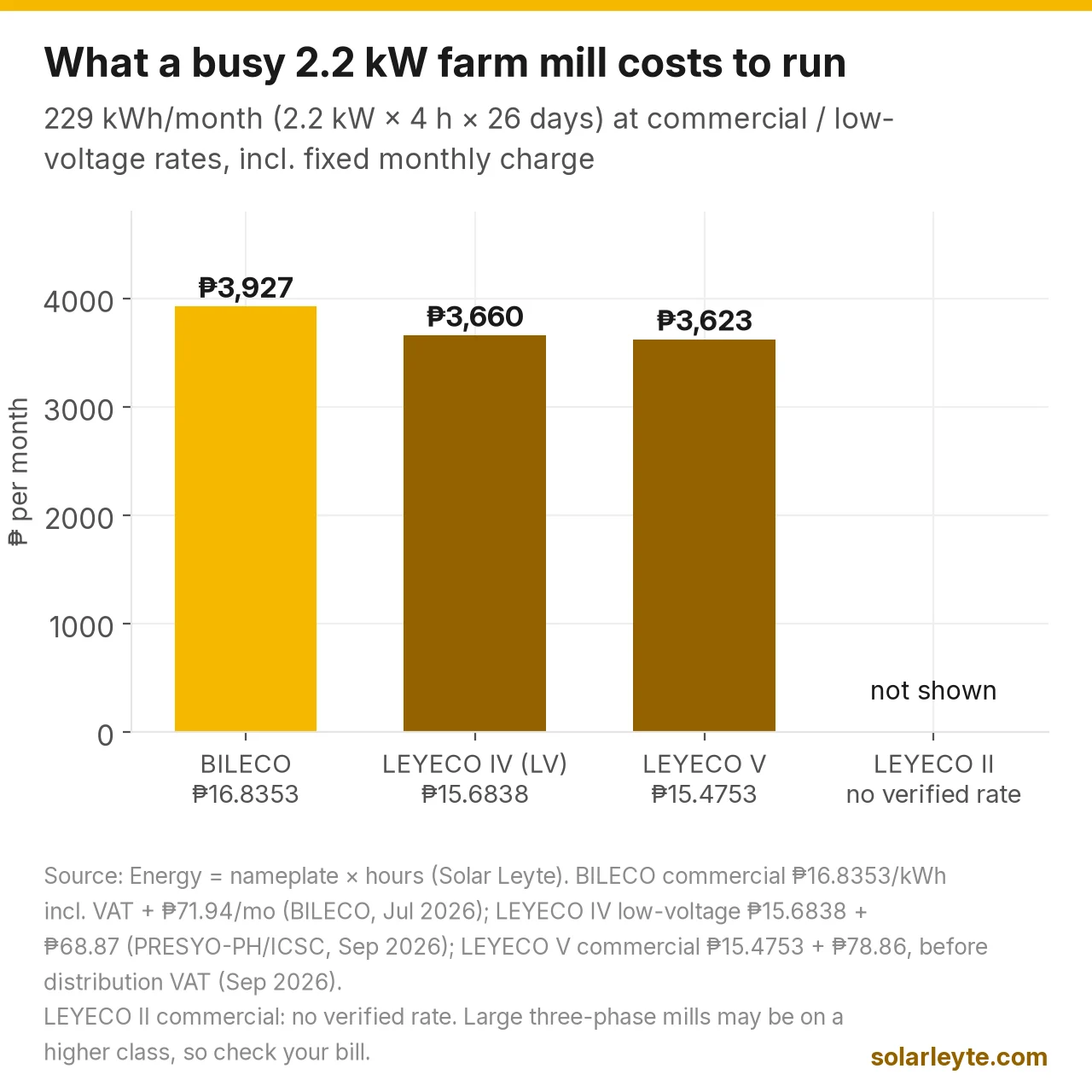
Assume a 2.2 kW nameplate mill, running 4 hours a day on 26 milling days a month (a busy custom-mill month, not a once-a-season home batch):
Figure | |
|---|---|
Energy per day | 2.2 kW × 4 h = 8.8 kWh |
Energy per month | 8.8 × 26 = 229 kWh |
Throughput at 120 kg/h | ~12,500 kg paddy/month |
A rice mill is a business, so it is billed on the commercial or low-voltage rate, not the residential one. At those rates:
Co-op | Rate class and ₱/kWh | Fixed per month | Bill for 229 kWh (Solar Leyte) |
|---|---|---|---|
BILECO | Commercial ₱16.8353, VAT included (July 2026) | ₱71.94 | ≈ ₱3,927 |
LEYECO IV | Low-voltage ₱15.6838 (Sep 2026) | ₱68.87 | ≈ ₱3,660 |
LEYECO V | Commercial ₱15.4753, before distribution VAT (Sep 2026) | ₱78.86 | ≈ ₱3,623 plus VAT |
LEYECO II | Commercial: no verified figure | Unknown | Unknown |
Fixed monthly charges are included in the bills above. Big mills with three-phase motors may be on a higher rate class, so check the class on your own bill. If you only mill eight days after harvest, the monthly kWh drops to about 70 kWh (about ₱1,250 at BILECO's commercial rate, fixed charge included). That seasonal pattern is normal on small Leyte and Biliran farms; do not size solar on a 26-day spreadsheet if your real calendar is harvest weeks.
Brolly lists power consumption under 15 kWh per ton of product for the 6N-40. At 120 kg/h that implies under about 1.8 kWh per hour of milling — lower than the 2.2 kW nameplate if the motor is not fully loaded. We use the nameplate × hours as the conservative bill estimate above; your clamp meter on a real run is better.
What size solar for Path 1
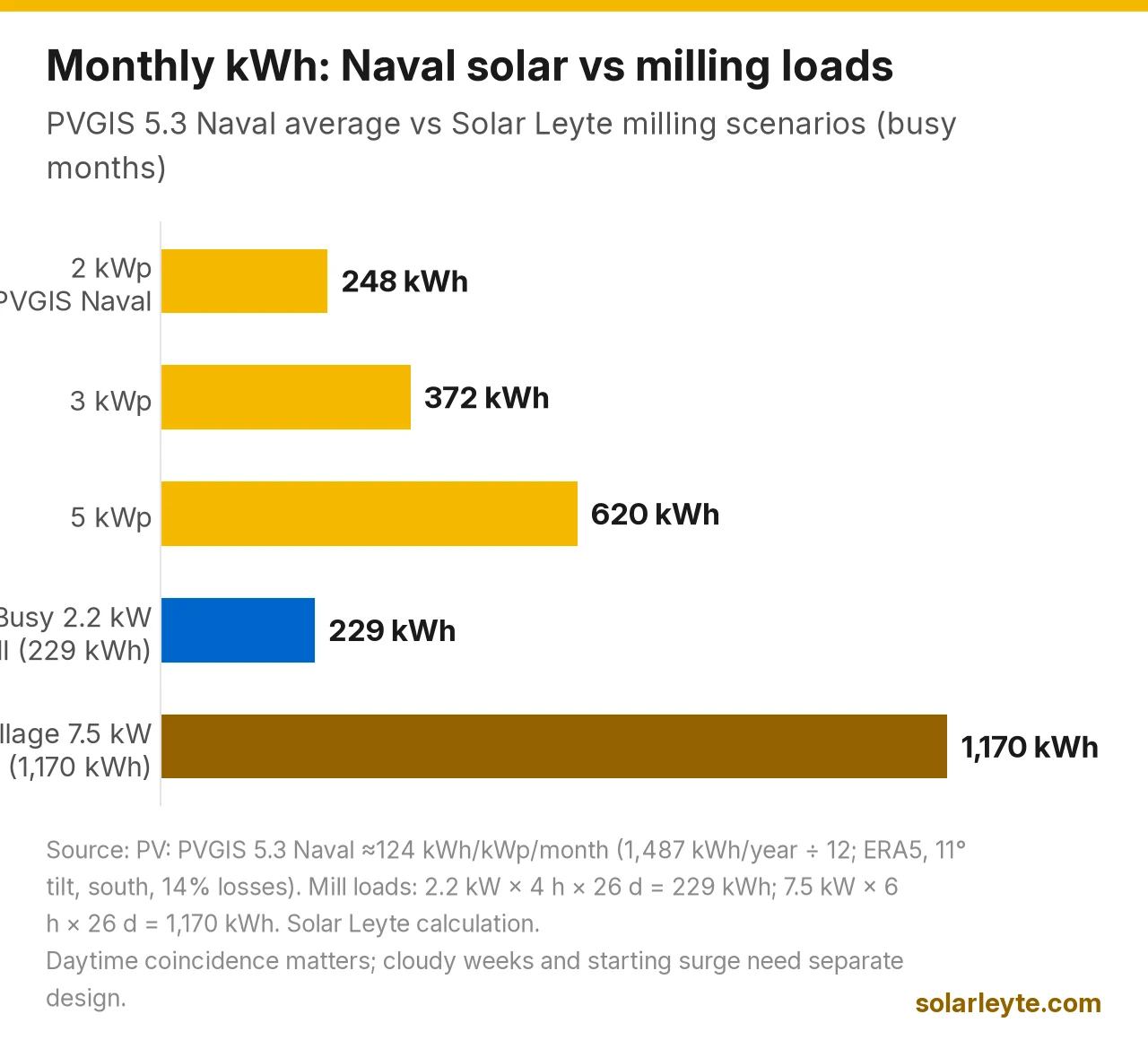
PVGIS 5.3 for Naval, Biliran, puts 1 kWp at about 124 kWh a month (1,487 kWh/year ÷ 12; ERA5, 11° tilt, south, 14% losses — same basis as our earlier posts).
Array | Typical monthly generation (Naval) | vs 229 kWh mill month |
|---|---|---|
2 kWp | ≈ 248 kWh | Roughly matches a busy month |
3 kWp | ≈ 372 kWh | Margin for lights, a small pump, cloudy weeks |
5 kWp | ≈ 620 kWh | Room for other farm loads |
Because milling is a daytime load, zero-export or net-metered grid-tie can offset most of those kWh when you mill under the sun. Plain grid-tie still shuts off in a brownout — mid-sack, when farmers are waiting. A hybrid inverter with a battery keeps the mill (and the queue) going through Visayas yellow/red alerts; see our Visayas grid alerts post and hybrid inverter prices.
Honest payback on bills alone: about ₱3,540–₱3,860 a month saved on energy (the fixed charge stays), and only if you mill ~26 days and solar covers nearly all of it. Parts for a small hybrid in the 3 kW class are often in the mid-₱100,000s before labour (see our 3 kW and 5 kW price posts — those are household builds, not rice-mill quotes). At that spend, simple payback on parts alone is about three to four years at best, and longer once you add labour and count the months you mill fewer than 26 days. The stronger Path 1 cases in Eastern Visayas are: (1) you mill most days as a custom mill, (2) you are displacing a diesel genset, or (3) you need brownout continuity so customers do not leave. Seasonal home batches rarely justify a dedicated hybrid on kWh savings alone — share the array with the house and pump instead.
Path 2: A village one-pass or impeller mill (~7.5–11 kW)
Custom mills that serve a barangay usually step up to one-pass machines with a 7.5 kW or 11 kW motor, or to multi-motor village mills.
Machine / spec | Power | Capacity | PH list / note |
|---|---|---|---|
Satake SB10D (ToolsSavvy.ph) | 7.5 kW (14 HP engine alt.) or 11 kW (18 HP) | 500–550 kg/h long grain at 7.5 kW; 650–750 at 11 kW | ₱168,000 (was ₱200,000; checked 15 Oct 2026) |
PHilMech impeller mill for brown rice | 2 × 5 HP prime movers; page lists power requirement 6.26 kWh | input 300 kg/h; hulling 293 kg/h | Village-level; commercialised tech page |
PHilMech RCEF single-pass rice mill | 59 kW | input 700–900 kg; ≥0.5 t/h output | Co-op / RCEF scale — not a farm rooftop |
Sources: ToolsSavvy Satake SB10D; PHilMech impeller mill; PHilMech RCEF single-pass. The RCEF 59 kW line is a different project class (often with grants and three-phase service). Do not size a household hybrid quote against it.
Busy village month (Solar Leyte)
Assume 7.5 kW running 6 hours a day, 26 days:
Figure | |
|---|---|
Energy per day | 45 kWh |
Energy per month | 1,170 kWh |
BILECO commercial bill (₱16.8353 + ₱71.94) | ≈ ₱19,770 |
LEYECO IV low-voltage bill (₱15.6838 + ₱68.87) | ≈ ₱18,420 |
LEYECO V commercial bill (₱15.4753 + ₱78.86, before VAT) | ≈ ₱18,180 |
LEYECO II commercial bill | Unknown: no verified rate |
A 10 kWp array at Naval generates about 1,240 kWh/month on the PVGIS average — in the same ballpark as that milling load if hours stay daytime. 15 kWp (~1,860 kWh/month) leaves margin for elevators, lights and cloudy weeks. Inverter size must match motor starting surge (often several times running amps); a 10–15 kW hybrid or a properly sized VFD-friendly setup needs an installer who has done motors, not only house aircons. Parts ranges for large arrays are in our 10 kW price post — again, parts lists, not a MACC rice-mill package.
At about ₱18,000–₱20,000 a month of milling electricity, energy-only payback on a large daytime array is much more plausible than Path 1 — if the mill really runs those hours. Confirm with last year's bills and a motor nameplate photo before anyone sells you 20 kWp.
A 2022 design study for a 23 kW combine mill in Arayat, Pampanga (IRE Journals) proposed a 25 kWp off-grid-type PV design with a bill of materials around ₱1.66 million and a calculated payback of about six years against that site's ~₱9,000/month electricity — useful as a published academic reference, not a Leyte quote. Copy: IRE 1703785 PDF.
Path 3: Co-op and off-grid lessons (not a price list)
Two published Philippine cases matter more for strategy than for a peso-per-watt shop list:
LAMPCO (Laak, Davao de Oro) — 5.1 kWp solar on a co-op mill. After Typhoon Pablo left the mill on irregular borrowed power, USAID's Cooperative Development Program and the One Meralco Foundation put in a 5.1-kilowatt solar PV system. ACDI/VOCA (March 2024) reports the mill rose to 100 sacks per day (more than double the intermittent-power rate), saved about ₱20,000 per milling cycle on electricity, and could offer farmers ₱3.00/kg including the separator — cheaper than the old separator rate. Source: ACDI/VOCA LAMPCO solar rice mill. Takeaway for Biliran and Leyte co-ops: solar here is as much about service hours and milling fees as about the kWh line on the bill.
FAO INVESTA (Philippines rice value chain). FAO's clean-energy brief flags solar-powered domestic rice milling (huller and polisher class, about 120 kg/day capacity in their case framing) as financially attractive especially where mills run on diesel in off-grid or island areas — and estimates technical potential in the low thousands of installations. Adoption stays low for awareness, spare parts and credit reasons. Source: FAO costs and benefits of clean energy in the PH rice value chain. For Maripipi, Higatangan and other weak-grid barangays, read this next to our off-grid solar post.
A DC solar PV rice huller kit (~550 W motor, 45–50 kg/h, modular panels, suggested retail about US$2,500 on Engineering for Change) is sold mainly for Pacific / NGO channels, not as a common Tacloban shelf item. Useful as a size benchmark for brown-rice hulling on pure DC, not as a verified Eastern Visayas store price. Source: Engineering for Change — Solar PV Rice Huller.
Running cost at BILECO and LEYECO rates
Here are the business rates a mill pays, next to the residential rates (PRESYO-PH, ICSC's tracker, September 2026) for context only. Use the commercial or low-voltage column for a mill.
Co-op | Commercial / low-voltage (for a mill) | Residential, context only (Sep 2026) |
|---|---|---|
BILECO (Biliran) | ₱16.8353 + ₱71.94/month, VAT included (BILECO, July 2026) | ₱18.93 |
LEYECO IV | Low-voltage ₱15.6838 + ₱68.87/month (PRESYO-PH, Sep 2026) | ₱16.97 |
LEYECO V | ₱15.4753 + ₱78.86/month, before distribution VAT (Sep 2026) | ₱16.38 |
LEYECO II | No verified figure | ₱14.05 |
Higher rates make each milled kWh more valuable to offset. BILECO's commercial rate is the highest of the four business rates above. Rate trackers (residential): BILECO, LEYECO II, LEYECO IV/V.
Grid-tie, hybrid or diesel?
Situation | Better fit | Why |
|---|---|---|
Grid mill, mills only at harvest, house already needs solar | Share a house/farm array; Path 1 motor on a timed daytime run | Pure mill-only hybrid rarely pays on kWh alone |
Custom mill open most days, daytime queue | Grid-tie or hybrid sized to motor kW | Daytime load matches PV; hybrid if brownouts kill the queue |
Island / weak line / diesel genset today | Hybrid or off-grid with battery; size to motor + autonomy days | FAO case; diesel ₱/kWh is usually the real competitor |
Co-op aiming at milling fees and farmer service | Treat solar like LAMPCO: uptime and ₱/kg fee, not only bill savings | 5.1 kWp was enough to change their service story |
RCEF-scale 59 kW single-pass | Separate industrial / grant design | Not a residential hybrid quote |
Net metering (export credit) helps if you generate more than you mill that day — rules and co-op steps are in our net metering guide and the BILECO / LEYECO II posts. A business mill on a commercial meter may still need an ERC Certificate of Compliance; households and some medical facilities have a narrower COC track under DOE DC2026-08-0017 — details in our plug-and-play / zero-export post. Electrical permit and CFEI still apply for most rooftop work; see the permit and CFEI guide.
Before you ask for a quote
- Photograph the motor nameplate (kW or HP, volts, phase, FLA) and the mill model sticker.
- Bring 12 months of bills (or genset fuel logs) and note milling days per month.
- Say whether the mill is single-phase 220 V or three-phase.
- List what else shares the meter (house, pump, shop).
- Decide what must finish during a brownout (finish the sack? run the whole afternoon?).
- For co-ops: write target sacks/day and milling fee ₱/kg — solar value may sit there more than on the kWh line.
Licences and paperwork checks: how to choose a solar installer in Leyte and Biliran. Honest whole-system payback framing: is solar worth it.
FAQ
How many kW is a solar rice mill? There is no single answer. Farm compact mills are often about 2.2 kW (3 HP). Village one-pass machines are commonly 7.5–11 kW. PHilMech's RCEF single-pass listing is 59 kW. Match solar and inverter to the nameplate, not to the marketing word "solar mill."
Can solar run a rice mill during a brownout? Only with a battery (hybrid or off-grid) sized for the motor and the hours you need. Plain grid-tie inverters shut down when the co-op line is dead.
Is solar cheaper than diesel for milling? Often on islands and weak-grid barangays — that is the FAO domestic-milling case. On a stable BILECO or LEYECO line with few milling days, compare real fuel logs and bills; do not assume.
How much does a rice mill machine cost in the Philippines? Compact farm units we checked on 15 October 2026 listed about ₱13,750 to ₱63,200. A Satake SB10D one-pass was listed at ₱168,000. Solar panels, inverter and battery are extra.
Will a 5 kW solar system run my rice mill? A 5 kWp array makes about 620 kWh/month at Naval — enough energy for a busy 2.2 kW mill month, with margin. It will not start an 11 kW village mill; the inverter and surge rating have to match the motor.
Solar Leyte is run by MACC Systems & Energy Solutions Inc., a solar installer in Naval, Biliran.
Get a free solar quote for your rice mill or farm from MACC
Send us a photo of your mill motor nameplate, your last BILECO or LEYECO bills (or genset fuel use), and how many days a month you mill. We'll size panels and inverter around the motor — and say honestly if sharing a house array is enough. No obligation. We do not sell rice mill machines.
- Call/Text: 0955 723 5093
- Email: official@macc-inc.com or benjie@macc-inc.com
- Website: www.macc-inc.com
- Request a quote online: solarleyte.com/quote
- Office: Brgy. Talustusan, Naval, Biliran 6543
Sources (all checked 15 October 2026)
- Goldpeak Tools PH: Yamata 6N70 (₱13,750), Brolly RMILL1 (₱19,030, 3 HP, 165–200 kg/h), Brolly RMILL5 (₱14,080, 2.2 kW, <15 kWh/t), Brolly RMILL6 (₱18,150, with 7.5 HP engine)
- KHM Megatools: Brolly RMILL2 (₱25,300, 3 HP)
- Melko Philippines: 6N80 single rice mill (₱63,200, 1.8–2.2 kW, 150–200 kg/h)
- ToolsSavvy.ph: Satake SB10D (₱168,000; 7.5 / 11 kW; 500–750 kg/h)
- PHilMech: impeller mill for brown rice (2×5 HP, 300 kg/h input); brown rice impact huller (0.75 HP, 200 kg/h); RCEF single-pass rice mill (59 kW)
- ACDI/VOCA: LAMPCO solar-powered rice mill with One Meralco Foundation (5.1 kWp; ₱20,000/cycle savings; 100 sacks/day; ₱3.00/kg)
- FAO INVESTA: Costs and benefits of clean energy technologies in the Philippines' rice value chain (solar domestic milling ~120 kg/day case framing)
- IRE Journals: Off-grid PV design for electric rice mill, Arayat, Pampanga (23 kW mill; 25 kWp proposal; ~₱1.66M; ~6-year payback)
- Engineering for Change: Solar PV Rice Huller (PSS) (550 W; 45–50 kg/h; ~US$2,500 MSRP)
- Rates: BILECO's own commercial rate post (July 2026); LEYECO IV low-voltage and LEYECO V commercial from PRESYO-PH / ICSC, national tracker (September 2026)
- Solar output: European Commission JRC, PVGIS 5.3 Naval, Biliran
- DOE: DC2026-08-0017
- Related Solar Leyte posts: poultry/piggery, water pump, off-grid, 3 kW, 5 kW, 10 kW, hybrid inverter, battery, Visayas alerts