Short answer: an indoor solar light is a small battery lamp with its own little solar panel outside. In Philippine stores we found them from ₱399 (an Akari solar lamp, 68 lumens) to ₱3,499 (a three-bulb solar lighting kit with radio), with "100W to 300W" solar ceiling lights at ₱1,490 to ₱1,990 (checked 2 November 2026). How long one lasts at night depends on its battery in watt-hours (Wh), not the watts printed on the box. Most of these lights store between about 4 and 40 Wh. That's enough for a room light through a brownout night, not enough to light a whole house like your normal bulbs.
The other thing to know: in Leyte and Biliran sun, the small panels that come with these lights often need two days or more to refill an empty battery in December. Buy one for brownouts or a spot with no wiring, not to cut your BILECO or LEYECO bill.
Last checked: 2 November 2026. Prices are listed prices on the store pages in our Sources and change often. Runtimes and charging days are Solar Leyte calculations with the assumptions stated, not our own test results. We don't sell these lights and don't recommend a brand.
The three kinds of indoor solar light
- Solar lamps and lanterns. One unit with a built-in battery, often with USB-C charging too. Good for a bedside, a sari-sari store counter or a go-bag.
- Solar ceiling or pendant lights. A lamp that hangs or mounts inside, with a cable to a separate panel on the roof or by a window. Usually comes with a remote and timer.
- Solar home lighting kits. A battery box with two to four bulbs on long cables, a panel, and USB outputs for phones. This is the closest thing to "solar for the whole house" in this price range. It's the same idea as the solar home systems that co-ops install for off-grid households (see our solar subsidy guide).
For outdoor lights like street and flood lights, see our solar street light price guide instead.
Indoor solar light prices in the Philippines (checked 2 November 2026)
Product (store) | Type | Listed price | Light output | Battery (as listed) | Battery in Wh | Panel | Maker's runtime |
|---|---|---|---|---|---|---|---|
Akari Solar Lamp ASL-9086 (Akari Store) | Lamp, solar or USB-C | ₱399 | 68 lm | 3.7 V 1,200 mAh | 4.4 Wh | Not stated | Up to 10 h (daylight mode) |
Akari Solar Handy Light ARL-9404FG (Akari Store) | Lantern + torch | ₱899 | 384 lm high, 80 lm low | 2 × 3.7 V 2,400 mAh | 17.8 Wh | 1.5 W | 5 h high, 7 h low |
Grand SCL 100W / 200W / 300W (Grand Philippines) | Ceiling light, separate panel | ₱1,490 / ₱1,790 / ₱1,990 | Claims 10,000 / 20,000 / 30,000 lm | Not stated | Not stated | Not stated | 8 to 12 h |
Checkway MW-X5 (Checkway Electrotech) | Kit: 3 × 3 W bulbs, radio | ₱3,499 | Not stated | 7,500 mAh lithium | About 28 Wh if 3.7 V (our assumption) | 5 W | Not stated |
Philips SP010P (Signify Philippines) | Hanging indoor kit | No price listed | 700 lm | Li-ion NMC, size not listed | Not stated | 2 W | 3, 6 or 12 h modes |
Battery Wh = volts × mAh ÷ 1,000 (Solar Leyte calculation). The Philips kit is sold through Signify's dealers, so ask a dealer for the price.
For comparison, here are two plug-in rechargeable emergency lights (no solar panel) from the same Akari store:
Product | Listed price | Light output | Battery | Battery in Wh | Maker's runtime |
|---|---|---|---|---|---|
Akari Emergency Light AELG-L411 | ₱1,099 | 200 lm one lamp, 400 lm both | 4 V 2.2 Ah lead-acid | 8.8 Wh | 6 h one lamp, 3 h both |
Akari Emergency Light AELG-L413 | ₱1,799 | 1,120 lm one lamp, 2,040 lm both | 4 × 3.7 V 2,000 mAh | 29.6 Wh | 4.5 h one lamp, 3.5 h both |
For short brownouts on a grid-connected house, a plug-in emergency light does the same job and refills from the wall. Solar makes sense when brownouts last days (after a typhoon) or there's no wiring at all.
The "100W" problem: watts on the box vs the battery inside
Many solar ceiling lights are sold as "100W", "200W" or "300W". That number is not what the light draws. You can tell from the battery.
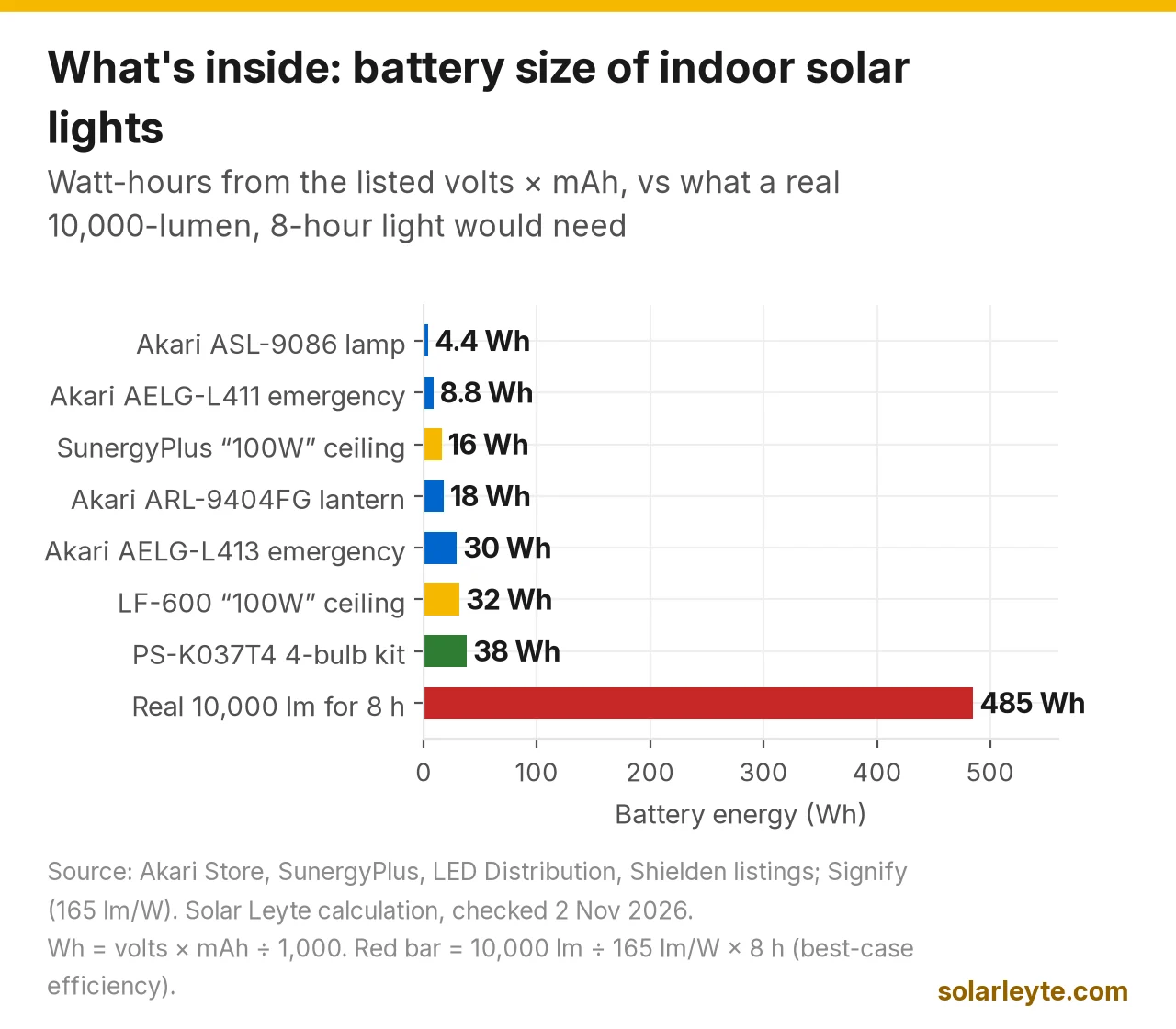
One maker's spec table (SunergyPlus) shows what's inside a typical "100W" solar ceiling light: a 6 V 8 W panel and a 3.2 V 5,000 mAh battery. That's 16 Wh. A real 100 W lamp would empty 16 Wh in under 10 minutes. Spread over a 10-hour night, 16 Wh supports an average of about 1.6 W. Another seller's "100W" light (LF-600-100W) lists its own output honestly as 980 lumens, with a 9 W panel and a 32 Wh battery.
Now the brightness claims. ENERGY STAR says an old 100 W incandescent bulb gave about 1,600 lumens. The Grand SCL "100W" is listed at 10,000 lumens, more than six of those bulbs. Even at the best efficiency Signify quotes for its Philips indoor solar light range (165 lumens per watt), 10,000 lumens for 8 hours would need a battery of about 485 Wh (Solar Leyte calculation). That's power-station size, like the units in our EcoFlow price guide, not something that fits inside a ₱1,490 ceiling lamp. Grand doesn't publish the battery size, so we can't say what is inside. Ask the seller for the battery's volts and mAh before you buy.
How to compare without being fooled:
- Ignore the watts on the box.
- Find the battery volts and mAh, and work out Wh (volts × mAh ÷ 1,000).
- Look for lumens from the maker. For a room, a normal LED bulb at home gives about 800 lumens (an old 60 W bulb, per ENERGY STAR).
- Check the panel watts. The battery can only be refilled as fast as the panel allows.
How many hours will it light?
The simple rule: hours = battery Wh ÷ watts of the bulbs that are on. Real runtime is a bit shorter because of losses and because the light switches off before the battery is completely flat.
Worked example 1 (maker's figures, our maths): a 4-bulb lighting kit, the PS-K037T4, has a 3.2 V 12,000 mAh LiFePO4 battery and four 2 W bulbs.
- Battery: 3.2 × 12,000 ÷ 1,000 = 38.4 Wh
- All four bulbs (8 W): 38.4 ÷ 8 = about 4.8 hours. The maker says 5 hours.
- One bulb (2 W): 38.4 ÷ 2 = about 19 hours. The maker says 20 hours.
So the maker's numbers add up. If a light claims 12 hours at full brightness from a tiny battery, something is off.
Worked example 2: the Akari ARL-9404FG lantern on high uses 4.2 W. Its battery is 17.8 Wh, so 17.8 ÷ 4.2 = about 4.2 hours, close to Akari's 5 hours. On low, Akari says 7 hours.
How long the panel takes to refill it in Leyte and Biliran
This is where many buyers get disappointed.
A rough daily refill: panel watts × peak sun hours × 0.5. The 0.5 is our assumption for losses, heat, dust and a panel that isn't pointed perfectly (the same allowance we used in our solar power bank guide). Peak sun hours for Naval come from NASA's satellite data: about 3.86 a day in December, 6.09 in April, 4.95 for the year.
Panel | Wh back per day, December | Wh back per day, April | Wh back per day, year average |
|---|---|---|---|
1.5 W (Akari ARL-9404FG) | 2.9 | 4.6 | 3.7 |
2 W (Philips SP010P) | 3.9 | 6.1 | 5.0 |
5 W (Checkway MW-X5) | 9.7 | 15.2 | 12.4 |
8 W (PS-K037T4 kit) | 15.4 | 24.4 | 19.8 |
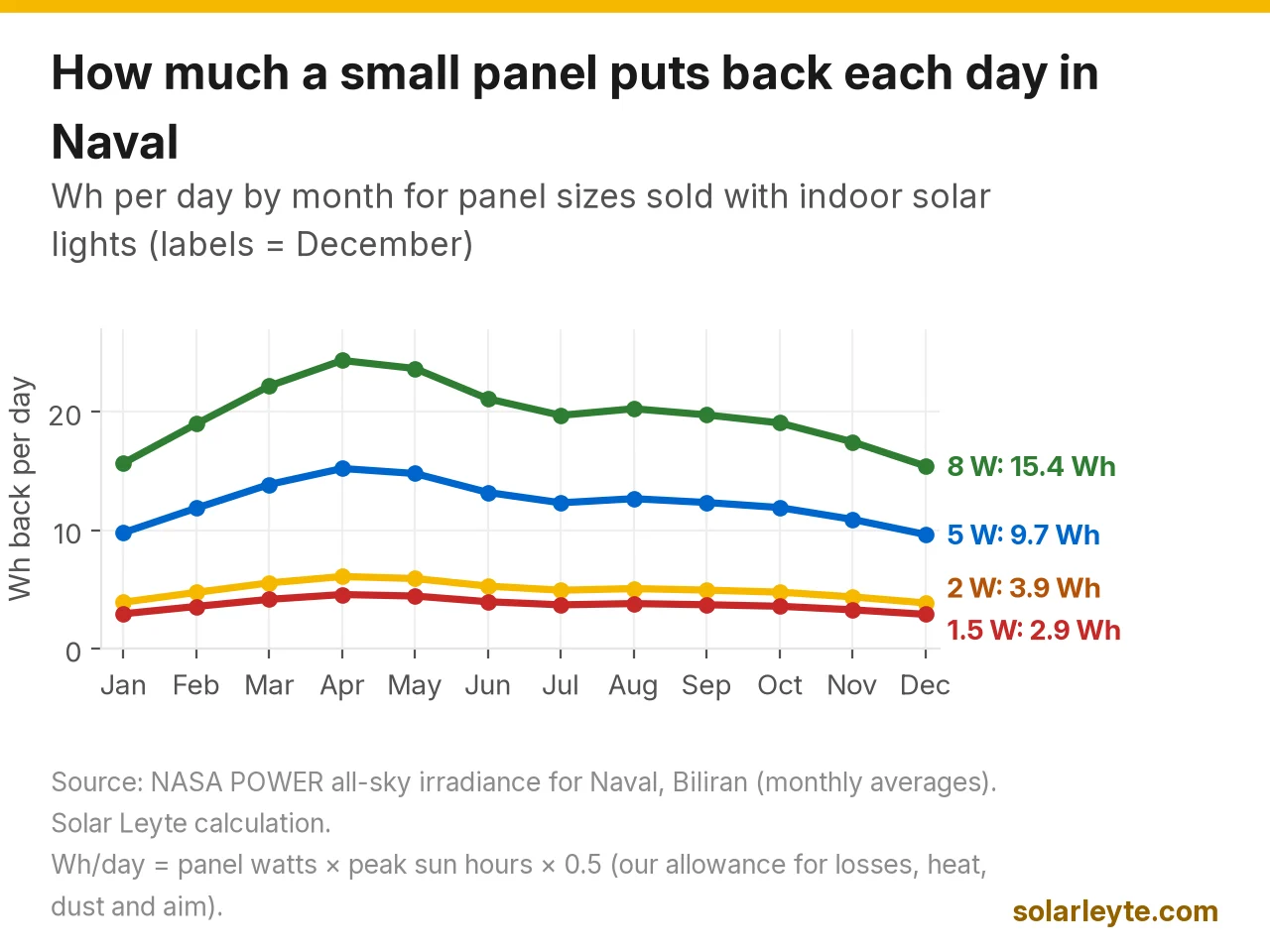
Solar Leyte calculation: panel watts × NASA POWER sun for Naval × 0.5 (our loss assumption).
What this means in practice (examples, same assumptions):
- The 8 W kit in December gets back about 15.4 Wh a day. That's about 2 hours of all four bulbs, or about 7.7 hours of one bulb. Refilling an empty 38.4 Wh battery takes about 2.5 days in December and about 1.6 days in April.
- The 1.5 W lantern gets back about 2.9 Wh a day in December. Refilling its 17.8 Wh battery from empty takes about 6 days of sun. Its "5 hours" charging time only makes sense on USB.
- Rainy days hurt. Output drops a lot under heavy cloud (see our rainy-day guide). Charge by USB before a typhoon if your light allows it.
Tip: run one bulb at a time on low when you can. Sulit, it lasts several times longer.
Is a solar light cheaper than a normal bulb?
Not if you already have a BILECO or LEYECO line.
Worked example 3: a normal 6 W LED bulb (Firefly lists one at 840 lumens) on for 6 hours a night uses 6 × 6 × 30 = 1.08 kWh a month.
- At BILECO's October 2026 residential rate (₱19.3628/kWh): about ₱21 a month.
- At LEYECO IV's October 2026 residential rate (₱17.0099/kWh): about ₱18 a month.
A ₱1,490 solar ceiling light would take about 6 years to "pay back" ₱21 a month (Solar Leyte calculation), and the bulb gives far more light than many solar lamps. So the reason to buy one is light during brownouts, light in places with no wiring (a kubo, a farm shed, a sari-sari store extension), or for off-grid homes. To cut your lighting bill, the cheaper move is switching every bulb to LED. Our paano makatipid sa kuryente guide covers that.
Buying tips for indoor solar lights
- Ask for battery volts, mAh and type. No battery spec on the listing means you can't check the runtime claim.
- Put the panel where the sun is. The cable should reach from the lamp to a sunny roof or wall. A panel behind window glass, under the eaves or under a coconut tree gets much less.
- Check the IP rating. IP20 (like the Philips SP010P) means indoor only. If the lamp will hang under an open porch or in a kitchen with steam, pick IP65.
- Mind the heat. Philips rates its indoor solar kit for 0 to 45 °C. Don't leave the battery unit on a hot metal roof or in a closed car.
- Warranty and store. Signify gives the Philips SP010P range a 2-year warranty. For cheaper lights, buy from a store that will accept a return if the battery dies early.
Need more than a few lights? See what a 50 to 200 W panel can run in our small solar panels guide, or compare every option in the solar generators and portable power guide.
FAQ
Do solar lights work inside the house?
Only the lamp goes inside. The panel needs direct sun outside, on a cable, or you carry the lamp out to charge. It won't charge on a table indoors.
How long do indoor solar lights last at night?
Divide the battery's Wh by the watts of the light. Most lamps and kits we checked store about 4 to 40 Wh. The PS-K037T4 kit's 38.4 Wh, for example, runs four 2 W bulbs for about 5 hours or one bulb for about 19 to 20 hours.
Is a "100W" solar ceiling light really 100 watts?
No. The battery is the giveaway. One maker's "100W" light has a 16 Wh battery and an 8 W panel, which can only supply about 1.6 W on average over a 10-hour night. Compare lumens and battery Wh, not the watts on the box.
Are solar lights safe to use indoors?
The lamp runs on low-voltage DC, so there's no mains wiring to do. Look after the battery: keep it within the maker's temperature range (0 to 45 °C for the Philips kit) and stop using it if it swells or gets damaged.
Solar Leyte is run by MACC Systems & Energy Solutions Inc., a solar installer in Naval, Biliran.
Get a free solar quote from MACC
Want lights, fans and a phone charger that keep going through a long brownout? Tell us what you want to keep running and send a photo of your latest BILECO or LEYECO bill. We'll reply with options sized to it. No obligation.
- Call/Text: 0955 723 5093
- Email: official@macc-inc.com
- Website: www.macc-inc.com
Sources (all checked 2 November 2026)
- Akari Store (Akari Philippines official store), product pages with listed price and specs: Solar Lamp ASL-9086 (₱399; 3 W, 68 lm; 3.7 V 1,200 mAh; up to 10 h daylight, 7 h warm white, 4 h cool white); Solar Handy Light ARL-9404FG (₱899; lantern 4.2 W, 384/80 lm; 2 × 18650 3.7 V 2,400 mAh; 5.5 V 1.5 W panel; 5 h high, 7 h low); Emergency Light AELG-L411 (₱1,099; 200/400 lm; 4 V 2.2 Ah sealed lead-acid; 6 h/3 h); Emergency Light AELG-L413 (₱1,799; 1,120/2,040 lm; 4 × 3.7 V 2,000 mAh; 4.5 h/3.5 h).
- Grand Philippines, Grand SCL Solar Ceiling LED Light 100/200/300 W: ₱1,490 / ₱1,790 / ₱1,990; claimed 10,000 / 20,000 / 30,000 lm; battery life 8 to 12 h; battery size not listed.
- Checkway Electrotech, Solar Lighting Kit MW-X5: ₱3,499; 7,500 mAh lithium battery; 5 W 6 V panel; three 3 W LED bulbs (3.7 V).
- Signify Philippines, Philips Essential SmartBright Solar Indoor Suspended SP010P LED7/765: 700 lm; Li-ion NMC; 5 V 2 W panel; 3/6/12-hour modes; IP20; 0 to +45 °C. Signify solar indoor category FAQ: efficacy reaches 165 lm/W; 2-year warranty across the range; sold through Signify's authorised dealers.
- SunergyPlus maker spec table, Solar Ceiling Light NL-HP-S11: "100W" model with 6 V 8 W panel and 3.2 V 5,000 mAh LiFePO4.
- LED Distribution, Solar Ceiling Light LF-600-100W: marked power 100 W, 980 lm, 6 V 9 W panel, 3.2 V 10,000 mAh battery.
- Shielden, PS-K037T4 solar lighting system: 8 W 6 V panel; 3.2 V 12,000 mAh LiFePO4; 4 × 2 W bulbs; 20 h with one bulb, 5 h with four.
- ENERGY STAR, Learn About Brightness: 60 W incandescent = 800 lm; 100 W = 1,600 lm.
- Firefly Electric, Firefly Lighting price list (PDF): FBI206DL LED A-bulb, 6 W, 840 lm.
- NASA Langley Research Center, POWER Data Access: daily all-sky surface irradiance for Naval (11.56° N, 124.40° E), 2001 to 2025, monthly averages from our off-grid solar guide: December 3.86, April 6.09, year 4.95 kWh/m² a day.
- BILECO, October 2026 Effective Rate: residential ₱19.3628/kWh.
- LEYECO IV, October 2026 Rates: residential ₱17.0099/kWh.
- Battery Wh, runtimes, refill days, the 485 Wh figure and peso figures: Solar Leyte calculations from the figures above.