A solar power bank is a normal power bank with a very small solar panel on the case. Buy it as a power bank and treat the solar part as a bonus. A 20,000 mAh bank stores about 74 Wh. The panels on the models we checked are rated 0.5 to 2 W, with one folding model at about 6 W. In Naval's sun, a 2 W panel would need about 7 days of perfect, all-day sun to fill a 20,000 mAh bank, and closer to two weeks in real use. Anker says the same about its own solar bank: even in clear weather, it takes several days to reach 50%.
In Philippine stores, solar power banks we found cost ₱899 to ₱3,995 (checked 29 October 2026). For a brownout, the useful part is the battery you filled from the wall the day before.
Last checked 29 October 2026. Prices are listed prices from the store pages in the Sources and change often. Charging times and peso figures are Solar Leyte calculations with the assumptions stated, not test results. We don't sell power banks and don't recommend a brand.
Quick answer: mAh, Wh and solar charging time
Listed capacity | Energy in the cells (at 3.7 V) | Days to fill with a 2 W case panel, perfect sun | Days, realistic (half of that output) |
|---|---|---|---|
10,000 mAh | 37 Wh | 3.5 | 7 |
20,000 mAh | 74 Wh | 7.0 | 14 |
30,000 mAh | 111 Wh | 10.6 | 21 |
40,000 mAh | 148 Wh | 14.1 | 28 |
50,000 mAh | 185 Wh | 17.6 | 35 |
Solar Leyte calculation. Wh = mAh × 3.7 V ÷ 1,000, the formula CAAP gives for checking power banks. Sun: 5.26 peak-sun hours a day, Naval's yearly average from PVGIS (2019–2023). "Realistic" assumes half the rated panel output reaches the battery.
What "20,000 mAh" really means
mAh tells you charge, not energy. To compare power banks with each other, or with a power station, convert to watt-hours (Wh):
Wh = mAh × cell voltage ÷ 1,000
Power bank cells are lithium-ion at about 3.6 to 3.8 V, so makers and airlines use 3.7 V. BAVIN lists its PC1197 as "20000mAh 74Wh" and its PC1172 as "10000mAh, 37Wh". A few brands rate their cells at 3.6 or 3.8 V, so the same 20,000 mAh can be 72 or 76 Wh.
Not all of it reaches your phone
The mAh on the box is the capacity of the cells inside. Some energy is lost raising 3.7 V to the 5 V (or 9 V) your phone takes. Xiaomi is one of the few brands that prints both figures: its Power Bank 20000 has "20000mAh 3.7V 74Wh" of cells and a rated capacity of "13000mAh (5V)". That's 65 Wh out, about 88% of what's in the cells. Cheaper banks often do worse.
How many phone charges?
Example (assumptions labelled): a Samsung Galaxy A16 has a 5,000 mAh battery. At a typical 3.85 V that's about 19 Wh. Allow about 20% more for charging losses in the phone, so call it 23 Wh per full charge (our assumption). Then:
- a 10,000 mAh bank (about 33 Wh usable at 88%) gives about 1.4 full charges
- a 20,000 mAh bank (about 65 Wh usable) gives about 2.8 full charges
That's why a 20,000 mAh bank is described as "about 3 phone charges", not 4.
How long the case panel takes to fill it
This is the part the listings skip. A solar panel's watt rating is measured in lab sun (1,000 W per square metre, cells at 25 °C). Real sun in Biliran gives the same energy as about 4.25 peak-sun hours a day in December and 6.22 in April, flat on the ground, per PVGIS for Naval. The yearly average is 5.26.
So the best a panel can do in a day is: panel watts × peak-sun hours. For a 2 W panel on an average day that's 2 × 5.26 = 10.5 Wh, and only if the bank sits in full sun from morning to late afternoon, with nothing shading it.
In real use you'll get less. The cells get very hot lying in the sun (hot cells make less power), the tiny charge circuit loses some, and most of us put it out for a few hours, not the whole day. We assume half the rated output reaches the battery. That's our assumption, not a measured figure.
The listed panels, worked out
Power bank (store) | Capacity | Panel rating on the listing | Best case, average day | Realistic, average day | Realistic, December |
|---|---|---|---|---|---|
BAVIN PC1172 | 10,000 mAh / 37 Wh | 5 V / 0.5 W | 14 days | 28 days | 35 days |
BAVIN PC1117 (10,000 mAh option of the PC1118 listing) | 10,000 mAh / 37 Wh | 5.5 V × 182 mA = 1.0 W | 7 days | 14 days | 17 days |
BAVIN PC1118 | 20,000 mAh / 74 Wh | 5.5 V × 350 mA = 1.9 W | 7.3 days | 15 days | 18 days |
BAVIN PC1197 | 20,000 mAh / 74 Wh | 9 V × 167 mA = 1.5 W | 9.4 days | 19 days | 23 days |
BAVIN PC1251 | 30,000 mAh / 111 Wh | 5.5 V / 1.5 W | 14 days | 28 days | 35 days |
BAVIN PC1250 | 40,000 mAh / 148 Wh | 5.5 V / 2 W | 14 days | 28 days | 35 days |
BAVIN PC1119 (1 + 3 folding panels) | 20,000 mAh / 74 Wh | 5.5 V × 1,100 mA = 6.05 W | 2.3 days | 4.7 days | 5.8 days |
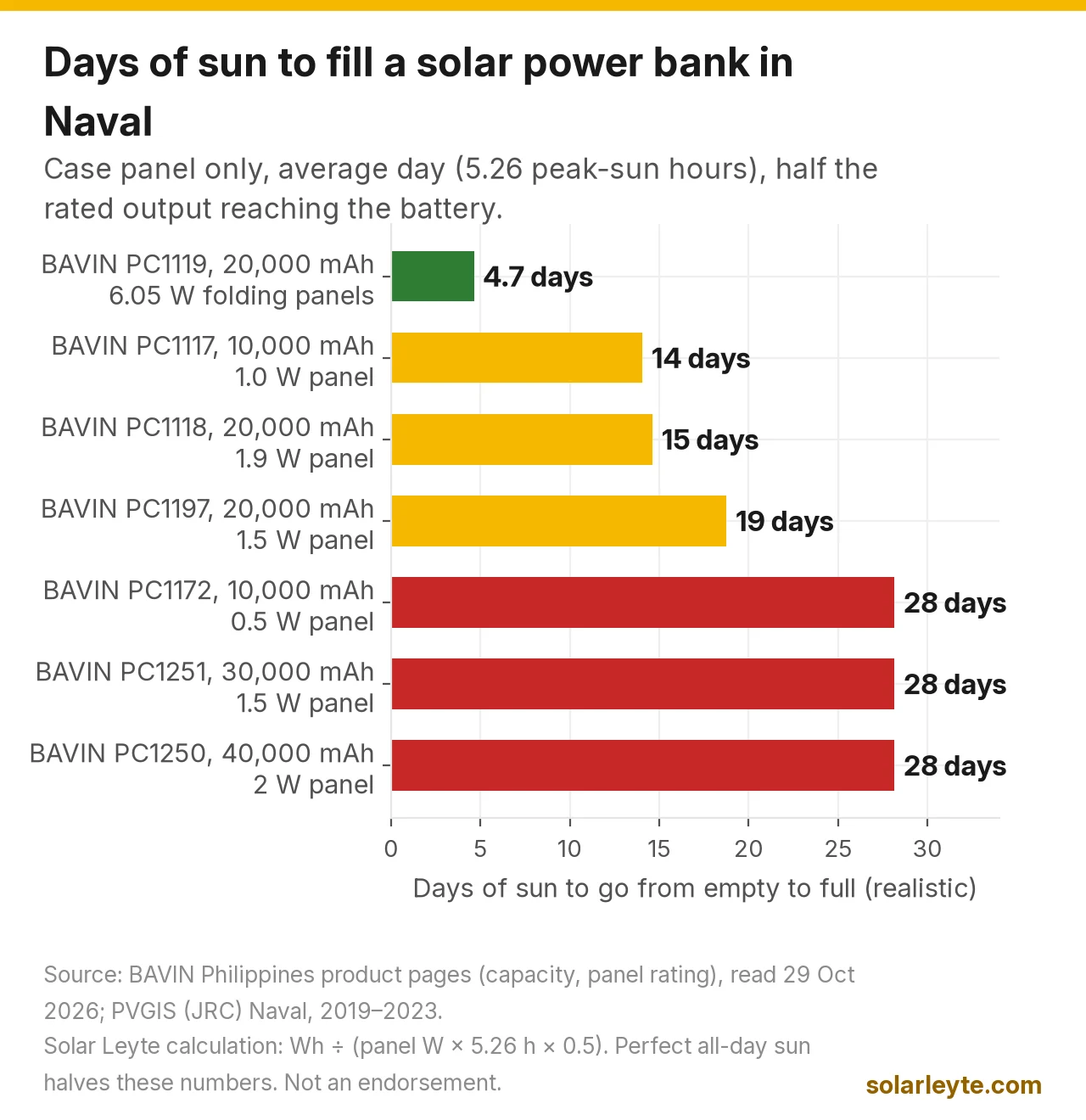
Panel ratings and capacities from the BAVIN Philippines product pages (PC1172, PC1118/PC1117, PC1197, PC1251, PC1250, PC1119), read 29 October 2026; Wh at 3.7 V where the page gives only mAh. Days = Wh ÷ (panel W × peak-sun hours), Solar Leyte calculation. We use BAVIN here only because its PH store prints the panel rating; most listings don't.
What that means day to day: the PC1118's 1.9 W panel adds about 5 Wh on a realistic day. That's roughly a fifth of one phone charge. Enough to keep a phone alive for texts if you're stuck without power for days, but not a way to keep the bank full.
The only model that changes the picture is the one with fold-out panels. At about 6 W, it could add roughly 16 Wh on a realistic day, around two-thirds of a phone charge. If you really want to charge from the sun, a separate 10 to 20 W foldable USB panel does far more (see our small solar panels guide).
Solar power bank prices in the Philippines (checked 29 October 2026)
Power bank | Capacity | Store | Listed price | ₱ per Wh |
|---|---|---|---|---|
BAVIN PC1117 | 10,000 mAh / 37 Wh | ₱1,199 | ₱32 | |
BAVIN PC1172 | 10,000 mAh / 37 Wh | ₱1,499 | ₱41 | |
Persona PB5103 | 20,000 mAh / 74 Wh | ₱899 | ₱12 | |
BAVIN PC1118 | 20,000 mAh / 74 Wh | ₱2,799 | ₱38 | |
BAVIN PC1197 | 20,000 mAh / 74 Wh | ₱2,999 | ₱41 | |
BAVIN PC1119 (folding panels) | 20,000 mAh / 74 Wh | ₱2,999 | ₱41 | |
Promate SolarTank-20PDQi | 20,000 mAh / 74 Wh | ₱3,995 | ₱54 | |
BAVIN PC1251 | 30,000 mAh / 111 Wh | ₱3,199 | ₱29 | |
BAVIN PC1250 (with hand crank) | 40,000 mAh / 148 Wh | ₱3,849 | ₱26 |
Listed sale prices on 29 October 2026; the BAVIN pages also show much higher "regular" prices that we ignore. Persona and Promate pages don't state the panel rating. ₱ per Wh = price ÷ Wh at 3.7 V, Solar Leyte calculation.
For comparison, the LiFePO4 power stations in our EcoFlow and solar generator price comparison work out to about ₱29 to ₱70 per Wh, and they have AC outlets and accept 100 W-plus of solar. Per Wh, a solar power bank isn't cheaper. It's just smaller.
How to spot a fake mAh number
You can check a listing with two numbers it usually shows: mAh and weight.
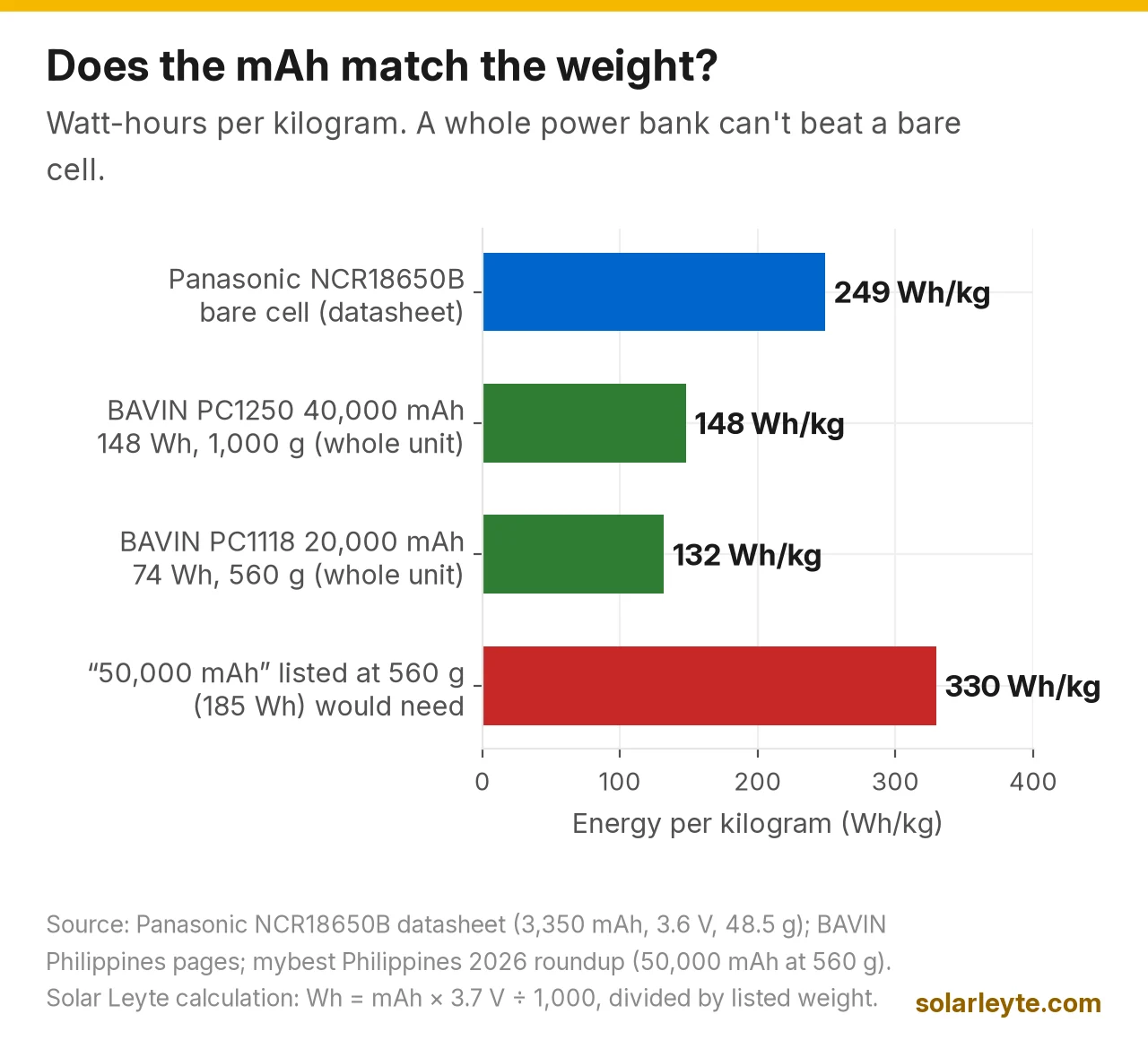
Good lithium-ion cells hold about 250 Wh per kilogram. Panasonic's NCR18650B, one of the denser common cells, is 3,350 mAh at 3.6 V in 48.5 g: 12.06 Wh ÷ 0.0485 kg = about 249 Wh/kg, for the bare cell with no case.
Worked check: a real 50,000 mAh bank holds 50,000 × 3.7 ÷ 1,000 = 185 Wh. At 249 Wh/kg, the cells alone weigh at least 185 ÷ 249 = 0.74 kg, before the case, panel and circuit board. One PH roundup (mybest Philippines, 2026) lists a 50,000 mAh bank at 560 g. To fit 185 Wh into 560 g, the whole bank would need about 330 Wh/kg, which is more than the bare cell above. So either the mAh or the weight in that listing is wrong. Ask the seller before you buy.
For comparison, the 40,000 mAh BAVIN PC1250 is listed at 148 Wh and 1,000 g, about 148 Wh/kg for the whole unit. That's believable.
Two more red flags:
- No Wh figure anywhere. Real labels often print Wh, and Philippine Airlines wants a clear capacity label before you board.
- A real 50,000 mAh bank can't fly. 185 Wh is over CAAP's 160 Wh ceiling for anything carried on board (below).
Taking one on a flight from Tacloban
Under CAAP Advisory Circular 18-005 (7 March 2025), power banks count as spare batteries and go in carry-on only, never checked bags:
Power bank size | CAAP rule |
|---|---|
Up to 100 Wh (up to about 27,000 mAh at 3.7 V) | Allowed in carry-on; the airline sets how many |
Over 100 Wh up to 160 Wh | Only with the airline's prior approval, maximum two |
Over 160 Wh | Not allowed on board at all |
Philippine Airlines is stricter: only power banks up to 100 Wh, maximum two per passenger, and no charging the power bank during the flight. So the 30,000 and 40,000 mAh banks in our table (111 Wh and 148 Wh) won't fly on PAL. Check your airline before packing.
Is a solar power bank worth it for brownouts?
Yes, as a power bank. Rarely for the solar part. Charging a 20,000 mAh bank from the wall costs very little:
Example: 74 Wh ÷ 85% charger efficiency (our assumption) = 0.087 kWh. At BILECO's July 2026 residential rate of ₱18.3407 per kWh, that's about ₱1.60 per full charge. So the panel saves you about ₱1.60 every time it fills the bank, which takes a week or two. More on rates in our BILECO rate guide.
Where a solar power bank does make sense:
- Typhoon and disaster bags. If the grid is down for a week, a little sun every day keeps a phone alive for texts and calls. Fill the bank from the wall before the storm.
- Fishing trips, farms, hiking. A rugged, splash-proof case is often worth more than the panel.
- Short planned brownouts. Charge everything before the cut. Our Visayas grid alert guide explains how warnings work.
If you need to run a router, fan or lights through a brownout, a power bank is the wrong size. See UPS and power stations for WiFi and Starlink, or start with the solar generators and portable power guide.
Tips if you use the panel
- Lay it flat facing the sky, from about 9 am to 3 pm, with no shade on the panel.
- Don't leave it on a car dashboard. Lithium batteries don't like heat. Anker's PowerCore Solar page says a high-temperature light comes on when the bank is over its working temperature, and you should let it cool before using it.
- If you don't use it for months, charge it at least every 3 months, as Anker advises for its own solar bank.
FAQ
Can a solar power bank charge from sunlight alone?
Yes, slowly. With a 1.5 to 2 W panel, a 20,000 mAh bank needs about 7 to 9 days of perfect all-day sun in Naval, and two weeks or more in normal use. Anker says its own solar bank takes several days to reach 50% even in clear weather.
How many Wh is a 20,000 mAh power bank?
About 74 Wh at 3.7 V (20,000 × 3.7 ÷ 1,000). Some brands use 3.6 or 3.8 V, giving 72 or 76 Wh. Around 65 Wh of that reaches your phone on a good bank.
Is a 50,000 mAh solar power bank real?
Real ones exist, but they're heavy: at least 0.74 kg of cells for 185 Wh, plus the case. If a listing says 50,000 mAh but weighs about half a kilo, the number doesn't add up. A real one is also over CAAP's 160 Wh on-board limit.
What is the best solar power bank in the Philippines?
We don't pick a brand. Check: a printed Wh figure, a weight that matches the capacity, the panel rating, a USB-C input for fast wall charging, and a warranty from a PH store. If solar charging matters, look for fold-out panels, or buy a separate panel.
Can I bring a solar power bank on a plane?
In carry-on only. Up to 100 Wh is allowed; 100 to 160 Wh needs airline approval under CAAP rules, and PAL allows only up to 100 Wh. Over 160 Wh is banned.
Related guides
- Solar generators and portable power: the full guide
- EcoFlow and solar generator prices in the Philippines
- Small solar panels (50 W to 200 W) and what they can run
- Can you use a car battery for solar?
Solar Leyte is run by MACC Systems & Energy Solutions Inc., a solar installer in Naval, Biliran.
Get a free solar quote from MACC
Tired of brownouts and want more than a power bank? Tell us what you want to keep running and send a recent BILECO or LEYECO bill. We'll suggest a battery and system size, with no obligation.
- Call/Text: 0955 723 5093
- Email: official@macc-inc.com or benjie@macc-inc.com
- Website: www.macc-inc.com
- Request a quote online: solarleyte.com/quote
- Office: Brgy. Talustusan, Naval, Biliran 6543
Sources (all checked 29 October 2026)
- BAVIN Philippines official store, product pages with capacity, panel rating, weight and listed price: PC1172 10,000 mAh (37 Wh, 5 V/0.5 W panel, ₱1,499); PC1118 20,000 mAh and PC1117 10,000 mAh (5.5 V/350 mA and 5.5 V/182 mA panels; ₱2,799 and ₱1,199); PC1197 20,000 mAh (74 Wh, 9 V/167 mA, 1.5 W; ₱2,999); PC1119 20,000 mAh (5.5 V/1,100 mA, 1 + 3 folding panels; ₱2,999); PC1251 30,000 mAh (5.5 V/1.5 W; ₱3,199); PC1250 40,000 mAh (148 Wh, 5.5 V/2 W, 1,000 g; ₱3,849).
- Promate Philippines, SolarTank-20PDQi 20,000 mAh: ₱3,995.
- Silicon Valley PH, Persona PB5103 20,000 mAh solar power bank: ₱899.
- Anker Japan, PowerCore Solar 20000 (A1650): solar charging to 50% takes several days even in clear weather; high-temperature indicator; charge at least every 3 months when stored.
- Xiaomi, Power Bank 20000 (Integrated Cable) specs: cell capacity 20,000 mAh 3.7 V 74 Wh; rated capacity 13,000 mAh (5 V).
- Samsung Philippines, Galaxy A16 specs: 5,000 mAh battery (typical).
- European Commission JRC, PVGIS monthly radiation for Naval, Biliran (11.563° N, 124.397° E, PVGIS-ERA5, 2019–2023), horizontal plane: 4.25 (December) to 6.22 (April) kWh/m² a day, yearly average 5.26.
- Panasonic, NCR18650B datasheet: typical 3,350 mAh, 3.6 V nominal, maximum 48.5 g.
- mybest Philippines, 10 Best Solar Power Banks in the Philippines 2026: lists a 50,000 mAh solar power bank at 560 g.
- CAAP, Advisory Circular 18-005, Guidelines for the Safe Transport of PEDs Powered by Lithium Batteries (7 March 2025): carry-on only; up to 100 Wh; 100–160 Wh with operator approval, maximum two; over 160 Wh prohibited; power banks count as spare batteries. CAAP, Holy Week reminder: check your power bank capacities: Wh = (mAh × voltage) ÷ 1,000.
- Philippine Airlines, Important Travel Advisory: Power Banks on Board: up to 100 Wh only, maximum two, capacity label required, no charging the power bank in flight.
- BILECO, July 2026 effective rates: residential ₱18.3407/kWh.
- All Wh conversions, charging days, phone-charge counts, ₱ per Wh and peso figures are Solar Leyte calculations from the figures above.