On 18 November 2026, Philippine shops listed 51.2 V 314Ah lithium (LiFePO4) batteries, the size sold as "16 kWh", at ₱106,000 to ₱153,100. The cheapest in-stock or orderable units were a Dyness PowerBrick Max at ₱107,000 and a Letovo house-brand powerwall at ₱108,000. Deye was ₱128,800, GoodWe ₱125,000 (pre-order) and Hopetrek ₱140,000 to ₱153,100. That works out to roughly ₱6,600 to ₱9,500 per kWh of nominal capacity.
These are battery-only prices. You still need a 48 V hybrid inverter, panels, cables, breakers and installation. And not all of the 16 kWh is usable: the datasheets we checked allow 14.4 to 15.3 kWh.
Last checked: 18 November 2026 (Philippine time). Prices and stock change often, so get the exact model, price and warranty in writing before you pay. Listing a shop here isn't an endorsement, and Solar Leyte earns nothing from these links. No MACC prices appear below.
What "314Ah" actually means
314Ah is the size of the cell inside, not the size of the battery. Sixteen 3.2 V cells in series make a 51.2 V pack, and 51.2 V × 314 Ah = 16,077 Wh, or about 16.08 kWh. That's why "314Ah", "16 kWh" and "16.08 kWh" all describe the same class of battery.
The voltage matters as much as the amp-hours. WattCycle PH lists a 12 V 314Ah battery at ₱32,999 (out of stock on 18 November). At 12.8 V that's only about 4 kWh, a quarter of the energy of a 51.2 V 314Ah pack. Always compare kWh, not Ah.
314Ah battery prices in the Philippines (18 November 2026)
Battery (as listed) | Seller | Listed price | ₱ per nominal kWh | Warranty (per listing) | Stock on 18 Nov |
|---|---|---|---|---|---|
Dyness PowerBrick SC, 16.08 kWh | JFL Solar | ₱106,000 | ₱6,592 | 5 years | Currently unavailable |
Dyness PowerBrick Max, 16.08 kWh | JFL Solar | ₱107,000 | ₱6,654 | 5 years | Available to order |
LETOVO Powerwall 51V 314AH IP65 | Letovo PH | ₱108,000 | ₱6,716 | 10 years | In stock |
SRNE Powerwall 51V 314AH IP65 | Letovo PH | ₱110,000 | ₱6,841 | 5 years | Sold out |
LVTOPSUN Powerwall 51V 314AH | Letovo PH | ₱110,000 | ₱6,841 | 5 years | Sold out |
51.2V 314Ah LiFePO4 (brand not stated) | Beyond Power | ₱117,600 | ₱7,313 | Not on listing (store badge: 1 year) | In stock |
"SUNGROW" Powerwall 51V 314AH IP65 | Letovo PH | ₱120,000 | ₱7,463 | 10 years | In stock |
LVTOPSUN Powerwall 51V 314AH | Letovo PH | ₱125,000 | ₱7,774 | 10 years | In stock |
GoodWe Lynx A G4, 16.1 kWh | JFL Solar | ₱125,000 | ₱7,764 | Manufacturer's | Pre-order |
DEYE 51.2V 314Ah | Beyond Power | ₱128,800 | ₱8,010 | Not on listing (store badge: 1 year) | In stock |
Hopetrek ESS-LB16-W01 | Beyond Power | ₱140,000 | ₱8,706 | Not on listing (store badge: 1 year) | In stock |
Hopetrek ESS-LB16-W02 (IP65) | Beyond Power | ₱145,800 | ₱9,067 | Not on listing (store badge: 1 year) | In stock |
Hopetrek ESS-LB16-W01 | Beyond Hygiene Asia | ₱147,000 (VAT incl.) | ₱9,142 | 5 years | In stock |
Hopetrek ESS-LB16-W02 (IP65) | Beyond Hygiene Asia | ₱153,100 (VAT incl.) | ₱9,521 | 10 years | In stock |
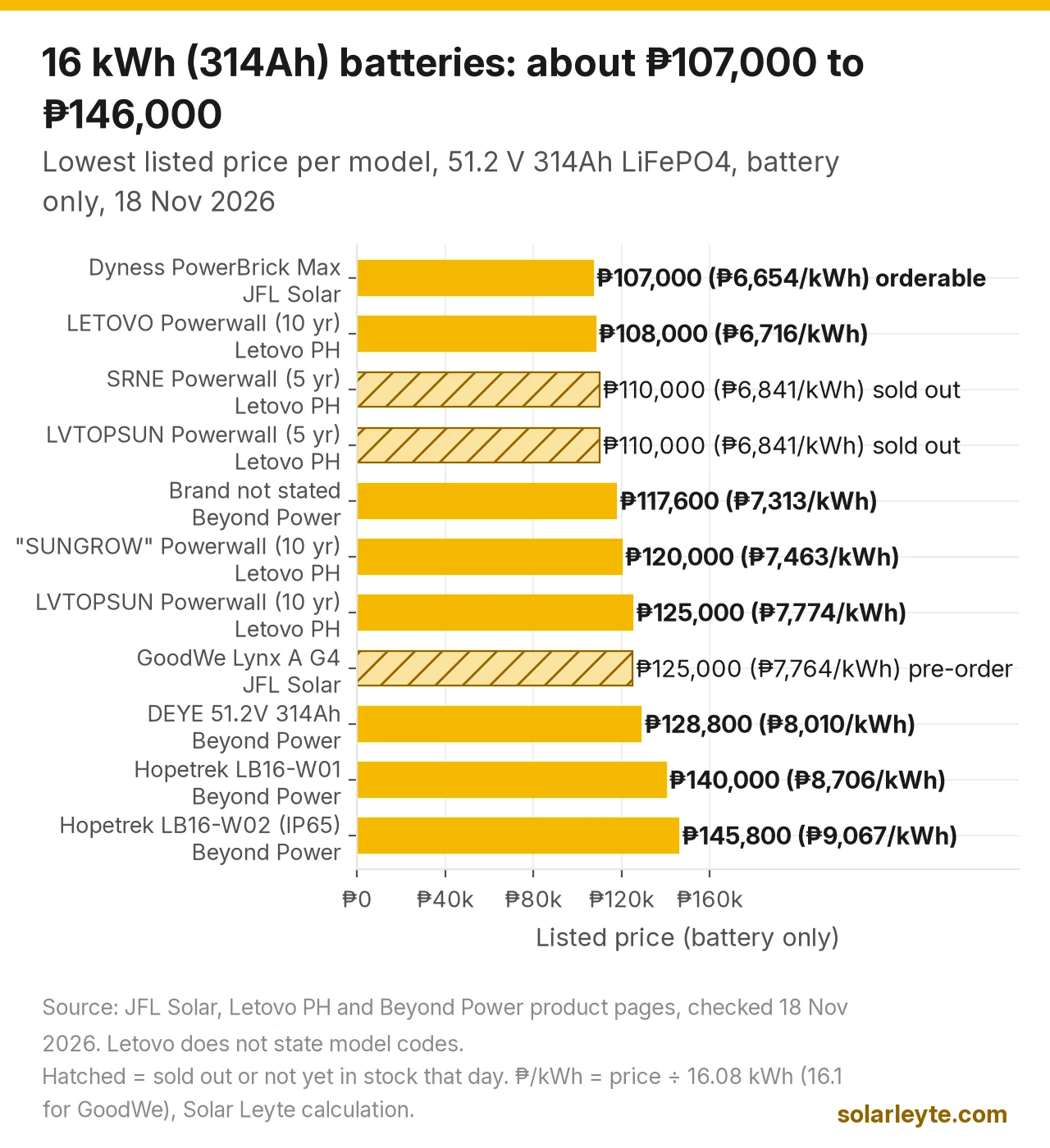
₱ per nominal kWh is a Solar Leyte calculation: price ÷ 16.08 kWh (16.1 kWh for the GoodWe). Beyond Power's pages show a generic "1-Year Warranty" store badge rather than a battery warranty, so ask for the maker's warranty in writing. Letovo lists "51V" without a model number or capacity in kWh, so we used 51.2 V × 314 Ah. JFL prices are pickup prices.
Three things stand out:
- The same battery costs different amounts at different shops. The Hopetrek LB16-W01 was ₱140,000 at Beyond Power and ₱147,000 (VAT included) at Beyond Hygiene Asia, a ₱7,000 gap for the same model code.
- Warranty length moves the price. At Letovo, the LVTOPSUN 314Ah with a 10-year warranty was ₱125,000, and the 5-year version was ₱110,000 (sold out). Hopetrek's IP65 W02 carries 10 years against 5 for the indoor W01.
- Two Letovo listings need questions. The "SUNGROW" powerwall has no model code. Sungrow's SH-RS hybrids use high-voltage batteries (see our hybrid inverter price guide), so ask Letovo for the exact model and datasheet before you buy it. The same goes for any listing that doesn't name a model.
Usable kWh: the number to compare
A battery's nominal kWh isn't what you get. Each maker sets a depth of discharge (DoD) to protect the cells, and the datasheets give different usable figures for the same 314Ah cell size.
Model | Nominal | Usable (maker's figure) | Max continuous charge | Cycle life (maker's test) | Weight | Enclosure |
|---|---|---|---|---|---|---|
Dyness PowerBrick Max | 16.08 kWh | 15.28 kWh (95% DoD) | 200 A (140 A recommended) | ≥8,000 | 116 kg | IP20, indoor |
GoodWe Lynx A G4 | 16.1 kWh | ≥14.9 kWh | 157 A | ≥10,000 (test data) | ≤122 kg | IP65 |
Deye SE-F16 | 16 kWh | 14.4 kWh (90% DoD) | 160 A | ≥6,000 (70% end of life) | 109 kg | IP21 |
Hopetrek ESS-LB16-W01 | 16.08 kWh | 14.4 kWh (90% DoD) | 200 A | ≥8,000 | 120 kg | IP20 |
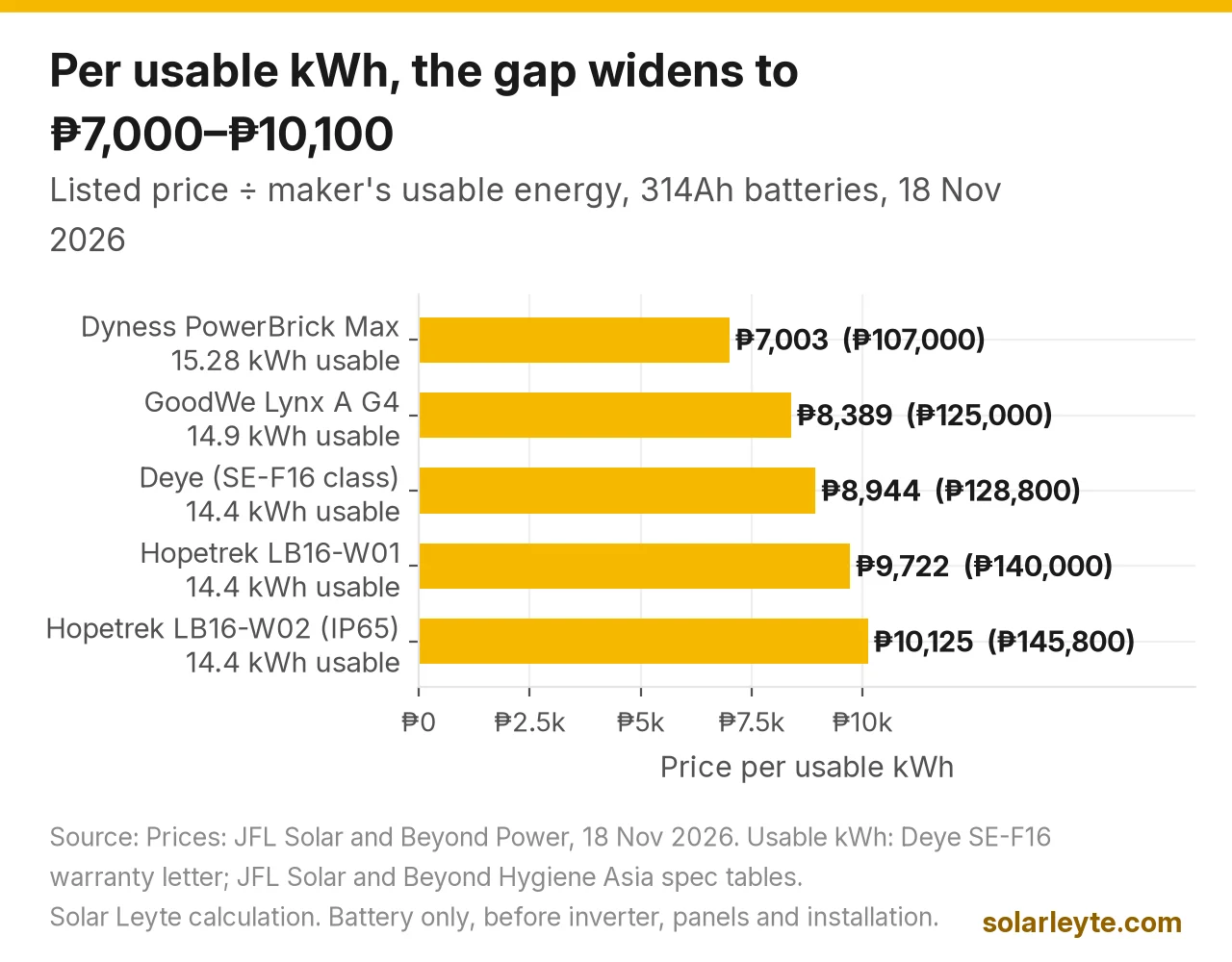
Dyness, GoodWe and Hopetrek figures are from the JFL Solar and Beyond Hygiene Asia spec tables; Deye's are from Deye's SE-F series brochure and SE-F16 warranty letter. Beyond Power's Deye listing doesn't name the model; Deye's 51.2 V 314Ah models are the SE-F16 and SE-F16 Max, so confirm which one you're getting.
On a usable-kWh basis the order changes a little. Our calculation: Dyness PowerBrick Max ₱7,003 per usable kWh, GoodWe ₱8,389, Deye (Beyond Power) ₱8,944, Hopetrek W01 ₱9,722 and Hopetrek W02 ₱10,125, both at Beyond Power.
Weight is easy to forget. At 109 to 122 kg, one of these needs a solid concrete wall or a floor mount, and at least two people to move it. If you're in Biliran or a smaller Leyte town, ask for the freight cost to your barangay before you pay.
What one 16 kWh battery runs overnight
Worked example A (assumptions labelled). A 1.0 HP inverter split aircon labelled at 870 W by the DOE (Boston Bay ABT1122-1HPS) runs 8 hours overnight. We assume the rest of the house (fridge, lights, fans, Wi-Fi, TV) averages 300 W for 12 night hours.
- Aircon: 870 W × 8 h = 6.96 kWh
- Rest of house (our assumption): 300 W × 12 h = 3.6 kWh
- Total: 10.56 kWh, inside the 14.4 kWh usable on a Deye SE-F16 or Hopetrek, with about 3.8 kWh to spare
Run two such aircons and the total becomes 17.52 kWh, which is more than one battery holds. You'd need a second unit, or fewer aircon hours. All four models above can run in parallel (Hopetrek up to 4 units, GoodWe 30, Deye 32, Dyness 50, per their specs). An inverter aircon at its full 870 W for all 8 hours is a worst case, so most nights will use less.
The inverter has to keep up too. A 6 kW hybrid at full load pulls roughly 125 A from a 51.2 V battery (6,000 W ÷ 51.2 V ÷ 95% efficiency, our estimate), which all four batteries above can supply. When charging, set the inverter's battery charge current at or below the battery's limit, for example 160 A for the Deye SE-F16. Our Solis and Sungrow price guides list the charge currents of common hybrids.
How many panels refill it?
Worked example B. PVGIS (European Commission) estimates that each 1 kWp of panels in Naval, Biliran makes about 4.07 kWh a day on average across the year and 3.67 kWh a day in December (tilt 11°, facing south, 14% system loss).
- To put 14.4 kWh back into the battery on an average day: 14.4 ÷ 4.07 ≈ 3.5 kWp of panels
- On a December day: 14.4 ÷ 3.67 ≈ 3.9 kWp
That's surplus solar, on top of whatever the house uses during the day. If daytime use is another 10 kWh (our assumption), the array needs about (14.4 + 10) ÷ 4.07 ≈ 6.0 kWp on an average day, or ≈ 6.6 kWp in December. Our electricity calculator helps you work out your daily kWh from your bill first.
What a stored kWh costs over the warranty
Worked example C (battery only). Deye's warranty letter covers the SE-F16 for 10 years or 50 MWh of energy delivered, whichever comes first, with at least 70% of its energy left.
- ₱128,800 ÷ 50,000 kWh ≈ ₱2.58 per kWh delivered, if the battery reaches its full warranty throughput
- 50,000 kWh ÷ 14.4 kWh ≈ 3,472 full cycles, about 9.5 years at one full cycle a day
For comparison, BILECO's October 2026 residential rate was ₱19.3628 per kWh. But ₱2.58 isn't your saving. It leaves out the panels that charge the battery, the inverter, installation and conversion losses, and it assumes you use the battery fully every day. It does show why a battery that cycles daily pays back far better than one that waits for brownouts.
Warranty fine print worth reading
From Deye's SE-F16 warranty letter (other brands have similar clauses, so ask for theirs):
- The warranty starts on the installation date or six months after production, whichever is earlier
- The battery should be installed within six months of production. If it sits in storage and deep-discharges, the warranty is void
- Running it without inverter communication can shorten the warranty
- The BMS is covered for 10 years, other accessories for 5
So ask the seller for the production date on the label. A battery that sat in a warehouse for a year may already have used up part of its warranty. For storage and charging habits, see our battery care guide.
Is a 314Ah battery right for you?
It makes sense if:
- You want aircon or a water pump through evening brownouts, not just lights and fans
- You use most of your power at night and have, or plan, 6 kWp or more of panels
- You'd rather have one 16 kWh unit than three 5 kWh ones (fewer cables, one BMS)
A smaller battery may be enough if:
- You only need the fridge, lights, fans and Wi-Fi for a 4-hour brownout. That's under 1 kWh, as our battery price and sizing guide shows
- Your wall or roof space can't take 110 to 120 kg
- Your hybrid inverter is 3 kW or smaller
Before you buy, check that the battery is on your inverter maker's compatibility list, or that the seller can show the two communicating (CAN or RS485). Our battery brands comparison covers Pylontech, Dyness and Deye warranties in more detail. For a full system price with installation, request a quote.
Frequently asked questions
How much is a 314Ah battery in the Philippines?
On 18 November 2026, 51.2 V 314Ah LiFePO4 batteries were listed at ₱106,000 to ₱153,100. The cheapest available ones were the Dyness PowerBrick Max (₱107,000, JFL Solar) and Letovo's own powerwall (₱108,000). Deye was ₱128,800 and Hopetrek ₱140,000 to ₱153,100.
How much is a Deye 16 kWh battery in the Philippines?
Beyond Power listed a DEYE 51.2V 314Ah battery at ₱128,800 (in stock) on 18 November 2026. Deye's 314Ah models are the SE-F16 and SE-F16 Max: 16 kWh nominal, 14.4 kWh usable at 90% DoD, 10-year warranty or 50 MWh.
Ilang oras tatagal ang 16 kWh na battery sa brownout?
Depende sa load. Sa 14.4 kWh na magagamit, kaya ng isang 870 W na 1 HP inverter aircon ang 8 oras (6.96 kWh) kasama ang 300 W na ibang gamit sa loob ng 12 oras (3.6 kWh), at may matitira pang mga 3.8 kWh. Kung dalawang aircon, kulang na ang isang battery.
Is a 12 V 314Ah battery the same as a 51.2 V 314Ah?
No. A 12.8 V 314Ah battery holds about 4 kWh. A 51.2 V 314Ah battery holds about 16 kWh, four times as much. Compare kWh, and match the battery voltage to your inverter (48 V class for most home hybrids).
Can I add a second 314Ah battery later?
Usually, yes. Dyness, GoodWe, Deye and Hopetrek all list parallel connection in their specs. Ask your installer to confirm the second unit is the same model and can be paired with the first before you buy it.
Solar Leyte is run by MACC Systems & Energy Solutions Inc., a solar installer in Naval, Biliran.
Get a free solar quote from MACC
Thinking about a 16 kWh battery for brownouts? Send us a recent BILECO or LEYECO bill and tell us what you want running when the power goes out. We'll send a free, no-obligation written quote.
- Call/Text: 0955 723 5093
- Email: official@macc-inc.com
- Website: www.macc-inc.com
- Or use the site quote form: /quote
Related guides
- Solar panel price in the Philippines: how to read a quote
- Grid-tie vs hybrid solar
- Solar battery prices and brownout sizing
- Tesla Powerwall price in the Philippines
- Hybrid inverter prices: Deye, SRNE, Sungrow and more
- BILECO rate per kWh 2026
Sources (all checked 18 November 2026)
- JFL Solar: Dyness PowerBrick Max (314Ah) ₱107,000 pickup, "Available to order", spec table (16.08 / 15.28 kWh, 95% DoD, 140 A recommended / 200 A max, ≥8,000 cycles, 116 kg, IP20, up to 50 in parallel), "5 Years Warranty"; Dyness PowerBrick SC ₱106,000, "Currently unavailable"; GoodWe Lynx A G4 16 kWh (GW16.1-BAT-LV-G10) ₱125,000, "Available on pre-order", spec table (16.1 kWh, ≥14.9 kWh usable, 157 A charge, ≥10,000 cycles test data, ≤122 kg, IP65, up to 30 in parallel).
- Letovo PH: LETOVO Powerwall 51V 314AH IP65 (10 years) ₱108,000; SRNE Powerwall 51V 314AH IP65 (5 years) ₱110,000, sold out; LVTOPSUN Powerwall 51V 314AH (5 years) ₱110,000, sold out; "SUNGROW" Powerwall 51V 314AH IP65 (10 years) ₱120,000; LVTOPSUN Powerwall 51V 314AH (10 years) ₱125,000. Stock from each product's availability flag.
- Beyond Power: 51.2V 314Ah LiFePO4 (LIPO4 51.2V 314AH) ₱117,600; DEYE 51.2V 314Ah ₱128,800; Hopetrek ESS-LB16-W01 ₱140,000; Hopetrek ESS-LB16-W02 ₱145,800; all "In stock — ready to ship".
- Beyond Hygiene Asia: Hopetrek ESS-LB16-W01 ₱147,000 VAT inclusive (14.4 kWh usable, 90% DoD, 200 A, ≥8,000 cycles, 120 kg, IP20, up to 4 in parallel, 5 years); Hopetrek ESS-LB16-W02 ₱153,100 VAT inclusive (IP65, 10 years).
- WattCycle PH: 12V 314Ah Mini LiFePO4 ₱32,999, sold out.
- Deye: SE-F5/F12/F16 series brochure, 23 Jan 2026 (PDF) (SE-F16: 314 Ah, 16 kWh, 90% DoD, 160 A charge / 230 A discharge, ≥6,000 cycles, 109 kg, IP21, 10 years / 50 MWh, up to 32 in parallel); SE-F16 limited warranty (PDF) (start date, six-month install rule, 70% energy, 50 MWh, 14.4 kWh usable, BMS 10 years).
- DOE, energy label issuances for air conditioners, Jan–Jun 2024 (PDF): Boston Bay ABT1122-1HPS, 870 W.
- PVGIS 5.3, European Commission JRC: Naval (11.56° N, 124.40° E), 1 kWp, 14% loss, 11° tilt, south, PVGIS-ERA5 2005–2023: 4.07 kWh/day yearly average, 3.67 kWh/day in December. Run on 18 November 2026.
- BILECO, October 2026 effective rate: residential ₱19.3628 per kWh (still the newest posted on 18 November 2026).
- Worked examples and ₱ per kWh figures: Solar Leyte calculations from the figures above, with the assumptions stated in each example.