A good rechargeable emergency light costs ₱230 to ₱1,800 in Philippine stores, and the number that matters most is the battery size in watt-hours (Wh), not the watts on the box. On 9 November 2026 we found plug-in models from ₱229.75 (Omni AEL-010) to ₱1,800 (Firefly FEL205L), and solar-charged ones from ₱900 (Firefly FEL559). The bigger lamps hold about 27 to 30 Wh, enough for a whole brownout night on low or a few hours on full. For businesses, boarding houses and apartments, the Fire Code adds one rule that decides what you can buy: the emergency light must switch on by itself and keep the required light for at least 1.5 hours.
Para sa bahay, a plug-in lamp is usually enough for the normal brownout here in Leyte and Biliran. A solar one earns its place when the power is out for days, like after a typhoon. Below are the prices, the battery math, and the rules for anyone running a store, paupahan or office.
Last checked: 9 November 2026. Prices are sellers' listed prices on that date. Fire Code text is from the BFP's 2019 Revised IRR of RA 9514.
Emergency light prices in the Philippines (November 2026)
We only list lamps where the seller publishes the battery. Wh is volts × amp-hours, our calculation from the listed battery.
Model (seller) | Listed price | Battery (as listed) | Battery size | Lamp power | Runtime (maker) | Charge time |
|---|---|---|---|---|---|---|
Omni AEL-010 (Office Warehouse) | ₱229.75 | 700 mAh, volts not stated | not stated | 1.5 W | 3 h high, 6 h low | 6 h |
Omni AEL-200 (Office Warehouse) | ₱349.75 | 1,200 mAh, volts not stated | not stated | 1 W + 2 W | 7 h lamp, 6.5 h torch | 6 h |
Omni AEL-T30 (DIY Hardware) | ₱399.50 | 1,200 mAh, volts not stated | not stated | 2.6 W | 4 h high, 8 h low | 10 h |
Firefly FEL207L Dual Optic Mini (FELCO Store) | ₱720 | 4 V 1.6 Ah lead-acid | 6.4 Wh | 2 × 1 W | not stated | 20–24 h |
Firefly FEL208L Dual (FELCO Store) | ₱1,000 | 4 V 2 Ah lead-acid | 8 Wh | not stated | 2.5 h | 20–24 h |
Akari AELG-L411 (Akari Store) | ₱1,099 | 4 V 2.2 Ah sealed lead-acid | 8.8 Wh | 1.5 W | 6 h one lamp, 3 h both | up to 24 h |
Firefly FEL201L Twinhead (FELCO Store) | ₱1,600 | 6 V 4.5 Ah lead-acid | 27 Wh | 24 LEDs × 0.06 W | 32 h one head, 17 h both | 20–24 h |
Akari AELG-L413 (Akari Store) | ₱1,799 | 4 × 3.7 V 2,000 mAh lithium-ion | 29.6 Wh | 3 W | 4.5 h one lamp, 3.5 h both | up to 12 h |
Firefly FEL205L Dual Optic (FELCO Store) | ₱1,800 | 6 V 4.5 Ah lead-acid | 27 Wh | 2 × 3 W | 2.5 h | 20–24 h |
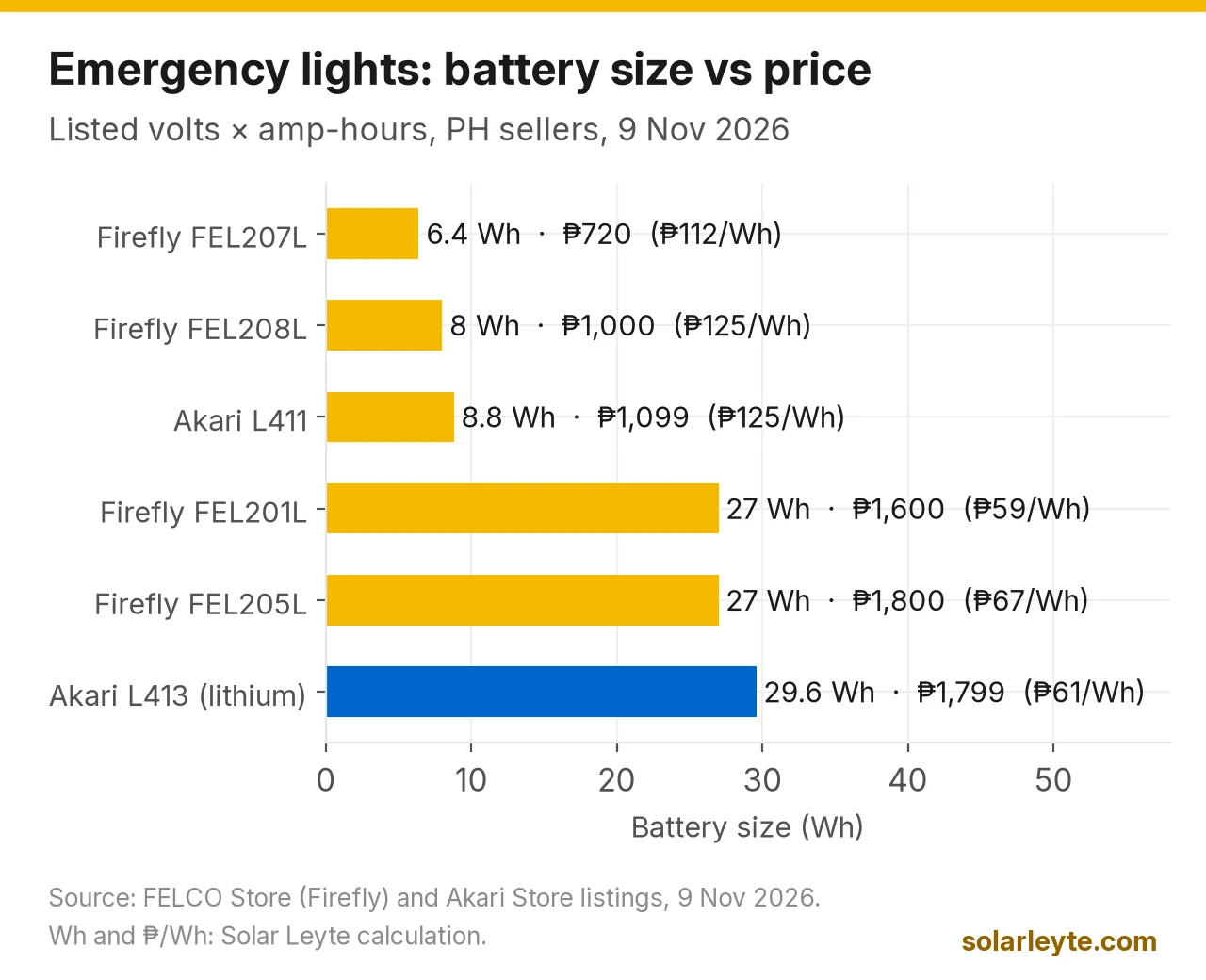
What the table tells you:
- Price per Wh drops by half at the top end. The 27 to 30 Wh lamps work out to about ₱59 to ₱67 per Wh, against about ₱112 to ₱125 per Wh for the 6 to 9 Wh ones (our calculation). If you'll use it every brownout, the bigger battery is better value.
- Omni doesn't publish the battery voltage, so we can't give its Wh. Its runtimes are fine for a short brownout, and it's the cheapest way to get a light that's ready in the drawer.
- Long runtime usually means dim. The FEL201L's 32 hours comes from tiny LEDs. The FEL205L's two 3 W lamps are much brighter but last 2.5 hours on the same 27 Wh battery. Akari is the only brand here that lists lumens: the L413 gives 1,120 lumens on one lamp, between an old 60 W bulb (800 lumens) and a 100 W bulb (1,600 lumens), per ENERGY STAR.
For indoor solar lamps and lanterns (the ₱399 to ₱3,499 kind with a separate panel), see our indoor solar light guide.
How long will an emergency light last? A quick check
You can sanity-check any runtime claim with one division: battery Wh ÷ lamp watts = the most hours you can get. Real lamps give less because of the driver and because a battery should not be run completely flat.
Worked example 1 (example only, using the listed specs):
- Firefly FEL205L: 27 Wh ÷ 6 W (both lamps) = 4.5 hours at most. Firefly says 2.5 hours, so the claim is conservative. Good sign.
- Akari AELG-L413: 29.6 Wh ÷ 3 W = about 9.9 hours at most; Akari says 4.5 hours on one lamp. That suggests the lamp draws more than 3 W on full brightness, which fits its high lumen rating.
- A "100W" solar floodlight: Kantt lists its KA-FLPMP100W portable solar emergency floodlight (₱2,850) at 100 W with a 3.7 V battery and a 5 to 6 hour life span, but no battery capacity. A real 100 W for 5.5 hours would need 550 Wh, which at 3.7 V is about 149 Ah (our calculation). That's power-station territory, not a hand-carry lamp. Treat the "100W" as a model name and ask for the mAh.
If a seller can't tell you the battery's volts and mAh, you can't check their hours.
Plug-in or solar emergency light?
Plug-in (AC rechargeable) lamps sit on the wall charging and switch on by themselves when the power cuts. Every Firefly and Akari unit above lists automatic switch-on at power failure. For the usual few-hour brownout, that's all you need.
The catch is the recharge time. The lead-acid lamps list 20 to 24 hours to fully charge. After a long outage, if the power comes back for only a few hours before the next interruption, a lead-acid lamp starts the next night only partly charged. The lithium Akari L413 lists up to 12 hours, half the time. If your barangay gets rotating brownouts, lithium is worth the extra.
Solar-charged lamps make sense when the grid is down for days. After a strong typhoon, the co-op may take a long time to restore lines in the barrios, and a plug-in lamp is useless once it's flat. Two notes from the listings:
- Firefly's FEL559 solar torch light (₱900) has two 4 V 0.9 Ah lead-acid batteries, about 7.2 Wh, and a 4 W lamp that lasts 1.5 hours on high or 4 hours on low. Firefly itself notes that solar charging "depends on intensity of sunlight". It's a backup torch, not a room light for the whole night.
- Small solar panels refill small batteries slowly, especially on cloudy days after a storm. Put the panel in full sun, not behind glass.
Our take: one plug-in lamp per room for everyday brownouts, plus one solar lantern or a solar power bank in the typhoon kit. If you want the fan and WiFi on too, you've moved beyond emergency lights: see inverter and battery backup without solar or a portable power station.
Emergency light requirements under the Fire Code
If you run a business, an apartment, a boarding house or a dorm, the emergency light isn't just comfort. The 2019 Revised Implementing Rules and Regulations (RIRR) of RA 9514, the Fire Code of the Philippines, set the rules in Section 10.2.5.11 (Illumination of Means of Egress). The main points, in plain words:
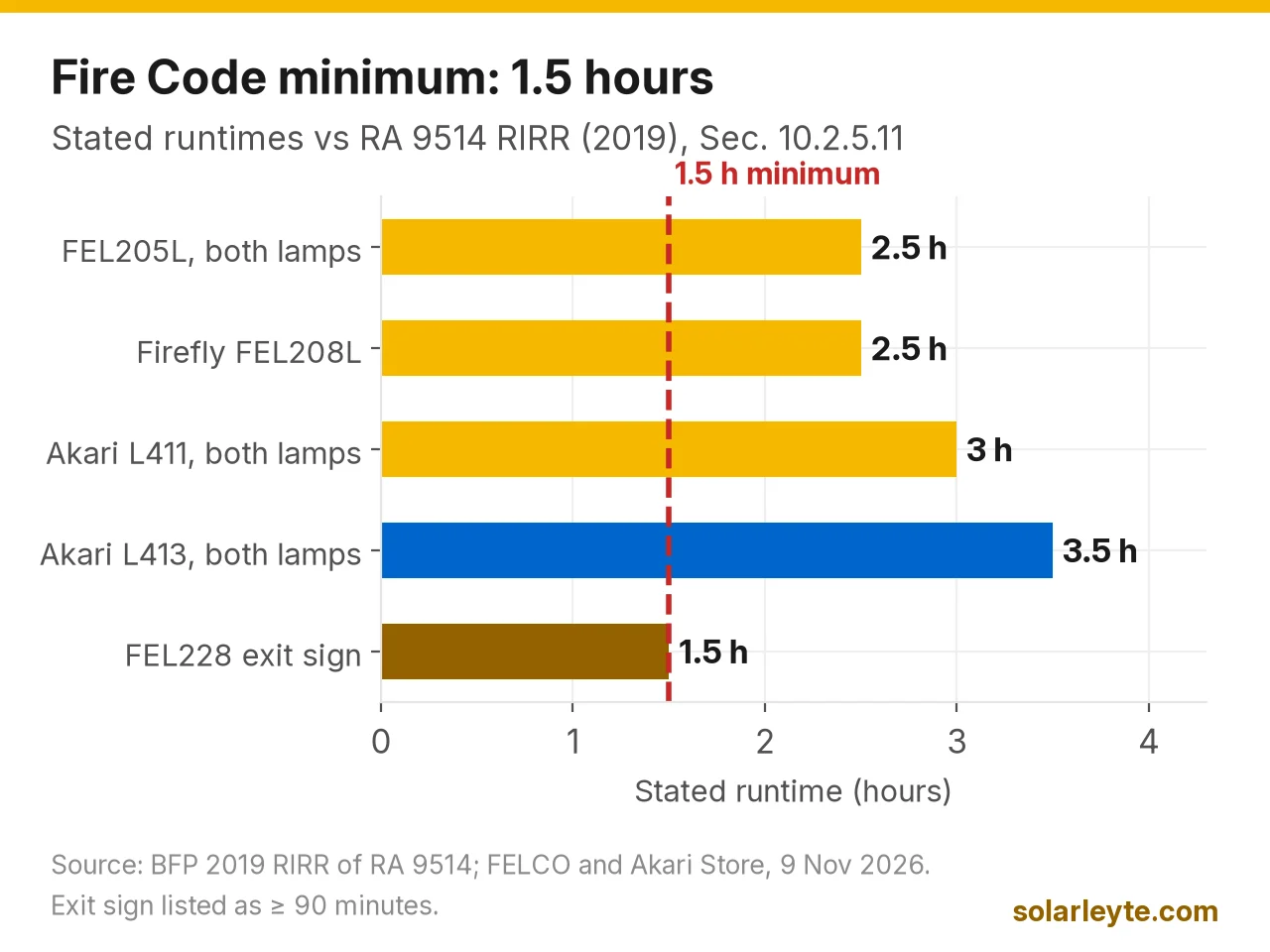
- At least 1.5 hours. Emergency lighting must keep the required light level for at least one and a half hours after normal lighting fails.
- It switches on by itself. The light has to come on automatically on any interruption, whether a co-op outage, a tripped breaker or blown fuse, or someone switching off the lights.
- No dry cells. Battery lamps must use reliable rechargeable storage batteries kept charged. The RIRR says dry batteries can't be used to meet the rule, and a battery lamp or lantern can't be the main lighting of an exit route.
- The fire marshal decides suitability. The City or Municipal Fire Marshal approves whether the equipment suits the premises.
- Keep it maintained, and keep records. The maintenance programme has to be documented in the Fire Safety Maintenance Report (FSMR).
Which buildings need it? From the occupancy sections of the same RIRR:
Occupancy | What the 2019 RIRR says |
|---|---|
Apartment buildings | "All apartment buildings shall have emergency lighting." Every public space, hallway and stairway must be lit. |
Hotels and dormitories | Emergency lighting in guest rooms or suites, hallways, stair landings and other areas the fire marshal sets. |
Business occupancies (offices and similar) | Required where the building is two or more storeys above the exit level, or has 50 or more occupants above or below it, and in all underground and limited-access structures. |
The rules quoted here are for those occupancies. For your own house, there's no BFP inspection of emergency lights, so it's about safety and comfort.
What this means when you buy for a store or paupahan in Naval, Tacloban or Ormoc:
- Pick a wall-mount, auto-on unit with a rechargeable battery and a stated runtime of comfortably more than 1.5 hours on the setting you'll use. Batteries lose capacity as they age, so a lamp rated at exactly 1.5 hours leaves no margin. In our table, the FEL205L and FEL208L list 2.5 hours, the L411 3 hours on both lamps and the L413 3.5 hours on both.
- Exit signs are a separate item (Section 10.2.5.12). For example, FELCO lists Firefly's FEL228 double-face exit light at ₱1,500 with a 3.6 V 600 mAh Ni-Cd battery and a backup of "≥ 90 minutes", and says its lettering meets the BFP standard. Ninety minutes is exactly 1.5 hours, so test it.
- Ask your local BFP fire station how many units and where, before the inspection for your Fire Safety Inspection Certificate (FSIC). The RIRR leaves suitability to the fire marshal.
How to test and look after an emergency light
- Switch off the breaker for that circuit, not just the wall switch, and check the lamp comes on by itself. Do this every month or so, and write the date down if you need FSMR records.
- Run it for the full time once in a while (1.5 hours for a business) to see if the battery still holds up.
- Keep it plugged in. These lamps are designed to sit on charge; lead-acid batteries in particular last longer kept full.
- Replace the battery or lamp when it no longer makes its runtime. A lamp that dies in 20 minutes fails the 1.5-hour rule.
- After a flood or typhoon, dry and check anything that got wet before plugging it back in. Our typhoon checklist has the rest of the list.
FAQ
How much is an emergency light in the Philippines? On 9 November 2026, plug-in rechargeable emergency lights were listed from ₱229.75 (Omni AEL-010 at Office Warehouse) to ₱1,800 (Firefly FEL205L at FELCO Store). Solar-charged models we found started at ₱900 (Firefly FEL559).
What is the emergency light requirement in the Fire Code? Under Section 10.2.5.11 of the 2019 RIRR of RA 9514, emergency lighting must come on automatically when normal lighting fails and keep the required light for at least 1.5 hours, using rechargeable storage batteries, not dry cells. Apartments, hotels, dormitories and many business buildings must have it.
Is a solar emergency light better than a rechargeable one? For short brownouts, no: a plug-in lamp is cheaper per Wh and switches on by itself. Solar helps when the grid is down for days, as after a typhoon, but the small panels and batteries we found give only a few hours of light per charge.
How many hours should an emergency light last? For Fire Code purposes, at least 1.5 hours on the setting you rely on; pick one rated well above that. For a home brownout night, look for 27 Wh or more and use the low setting.
Solar Leyte is run by MACC Systems & Energy Solutions Inc., a solar installer in Naval, Biliran.
Get a free solar quote from MACC
Tired of brownout nights and ready to back up more than a lamp? Send a photo of your latest BILECO or LEYECO bill and tell us what you want running during a brownout, and we'll get back to you with a free, no-obligation written quote.
- Call/Text: 0955 723 5093
- Email: official@macc-inc.com
- Website: www.macc-inc.com
- Or use the site quote form: /quote
Sources (all checked 9 November 2026)
- Bureau of Fire Protection, RA 9514 Fire Code of the Philippines, 2019 Revised IRR (PDF): Section 10.2.5.11 C (emergency lighting at least 1.5 hours, automatic operation, rechargeable storage batteries, no dry batteries, fire marshal approval, maintenance documented in the FSMR), B.3 (battery lamps not primary egress lighting); apartment, hotel and dormitory, and business occupancy lighting provisions. The BFP site blocked our download, so we read the same edition's text in a public flipbook copy (page 114), with apartments on page 173, hotels and dormitories on page 170 and business occupancies on page 184.
- Office Warehouse: Omni AEL-010 (₱229.75; 1.5 W; 700 mAh; 3 h/6 h; 6 h charge) and Omni AEL-200 (₱349.75; 1 W + 2 W; 1,200 mAh; 7 h lamp, 6.5 h torch; 6 h charge).
- DIY Hardware: Omni AEL-T30 (₱399.50; 2.6 W; 1,200 mAh; 4 h/8 h; 10 h charge).
- FELCO Store (Firefly): FEL201L Twinhead (₱1,600; 6 V 4.5 Ah lead-acid; 24 × 0.06 W LEDs; 32 h/17 h; 20–24 h charge), FEL205L Dual Optic (₱1,800; 6 V 4.5 Ah; 2 × 3 W; 2.5 h), FEL207L Dual Optic Mini (₱720; 4 V 1.6 Ah; 2 × 1 W), FEL208L Dual (₱1,000; 4 V 2 Ah; 2.5 h), FEL559 Solar LED Torch Light (₱900; 2 × 4 V 0.9 Ah; 3 W torch, 4 W lamp; 1.5 h/4 h; 15–20 h charge) and FEL228 exit light (₱1,500; 3.6 V 600 mAh Ni-Cd; ≥ 90 minutes).
- Akari Store: AELG-L411 (₱1,099; 200/400 lm; 4 V 2.2 Ah sealed lead-acid; 6 h/3 h; up to 24 h charge) and AELG-L413 (₱1,799; 1,120/2,040 lm; 4 × 3.7 V 2,000 mAh lithium-ion; 4.5 h/3.5 h; up to 12 h charge).
- Kantt, KA-FLPMP100W Portable Solar Emergency Floodlight (₱2,850; "100W"; 3.7 V battery, capacity not stated; 5–6 h; 5–8 h charge).
- Solar Leyte calculations: battery Wh (V × Ah), ₱ per Wh, maximum runtime (Wh ÷ W), the 550 Wh and 149 Ah figures for a true 100 W lamp.
- ENERGY STAR, Learn About Brightness: 60 W incandescent = 800 lm; 100 W = 1,600 lm.