Renewable Portfolio Standards (RPS) is the rule that makes every power distributor in the Philippines, including BILECO and the LEYECO co-ops, get a growing slice of the electricity it sells from newer renewable plants. Under the Department of Energy's current table, that minimum is 16.42% of sales for 2026, rising by 2.52 percentage points every year to 26.50% in 2030. For a household in Leyte or Biliran, the direct cost so far is tiny: on LEYECO IV's October 2026 rates the "REC Recovery" line is ₱0.0127 per kWh, about ₱1.91 on a 150 kWh month.
The bigger story is where your co-op's power comes from in the next ten years, and that rooftop solar under net metering now counts toward the target. Here's how it works, without the jargon.
Last checked 28 October 2026. Rates are LEYECO IV's posted October 2026 figures. The worked example is a Solar Leyte calculation, not a bill or a forecast.
Quick answer: RPS in five lines
Question | Short answer |
|---|---|
What law? | RA 9513, the Renewable Energy Act of 2008, Section 6 |
Who must comply? | Distribution utilities (BILECO, LEYECO II–V, DORELCO and others) for their captive customers, retail suppliers, and generators for directly connected customers |
How much? | 16.42% minimum for 2026, 26.50% for 2030 (DOE table, may be revised yearly) |
What counts? | Newer eligible renewable plants (solar, wind, biomass, hydro, geothermal, ocean) that started commercial operation after the RE Act took effect, plus net-metered and own-use rooftop solar |
What's on your bill? | A separate "REC Recovery" line if your co-op buys certificates; ₱0.0127/kWh on LEYECO IV in October 2026 |
What RPS actually means
The Renewable Energy Act (RA 9513) defines RPS as a "market-based policy that requires electricity suppliers to source an agreed portion of their energy supply from eligible renewable energy resources." The law left the actual percentages to the National Renewable Energy Board and the DOE.
The DOE's RPS rules for on-grid areas (DC2017-12-0015) filled in the details:
- Mandated participants are distribution utilities (for captive customers), retail electricity suppliers (for the contestable market) and generation companies (for directly connected customers).
- Eligible sources are biomass, waste-to-energy, wind, solar, run-of-river and impounding hydro, ocean, geothermal and the RE part of hybrid plants, but only plants that started commercial operation after the RE Act took effect. Net-metered systems and own-use rooftop solar also count.
- One Renewable Energy Certificate (REC) = 1 MWh of eligible renewable power. Each compliance year runs 26 December to 25 December.
- The rules say any added cost from complying "should not result in higher electricity rates" to consumers, and co-ops must buy power through a competitive selection process.
The "newer plants only" part matters for us. Under DOE DC2017-12-0015 Sec. 10, only capacity that began commercial operation after the RE Act took effect is RPS-eligible, so Tongonan's older capacity (Tongonan I has run since 1983) is excluded. Geothermal is still a big reason the Visayas grid was already 47.3% renewable in 2025 (DOE 2025 power statistics). However, DOE's list of RPS-eligible plants includes Tongonan 1 Power Plant (Green Core Geothermal) with 10.50 MW eligible and a commercial operation date of 18 May 2019. More on the plants in our Leyte geothermal post.
The 2.52% step-up: how the target grows
The original 2017 rules raised the requirement by 1% of sales a year. In September 2022 the DOE's DC2022-09-0030 raised that yearly increment to 2.52% starting 2023, and DC2023-05-0015 confirmed the 2.52% applies to mandated participants in Luzon, Visayas and Mindanao. The DOE's stated goal is more than 50% renewables in the generation mix by 2040.
Year | Minimum RPS requirement (% of sales) | DOE target RE share of generation |
|---|---|---|
2022 | 6.34% | 20.49% |
2023 | 8.86% | 21.87% |
2024 | 11.38% | 23.28% |
2025 | 13.90% | 24.73% |
2026 | 16.42% | 26.24% |
2027 | 18.94% | 27.78% |
2028 | 21.46% | 29.37% |
2029 | 23.98% | 30.98% |
2030 | 26.50% | 32.62% |
2040 | 51.70% | 51.48% |
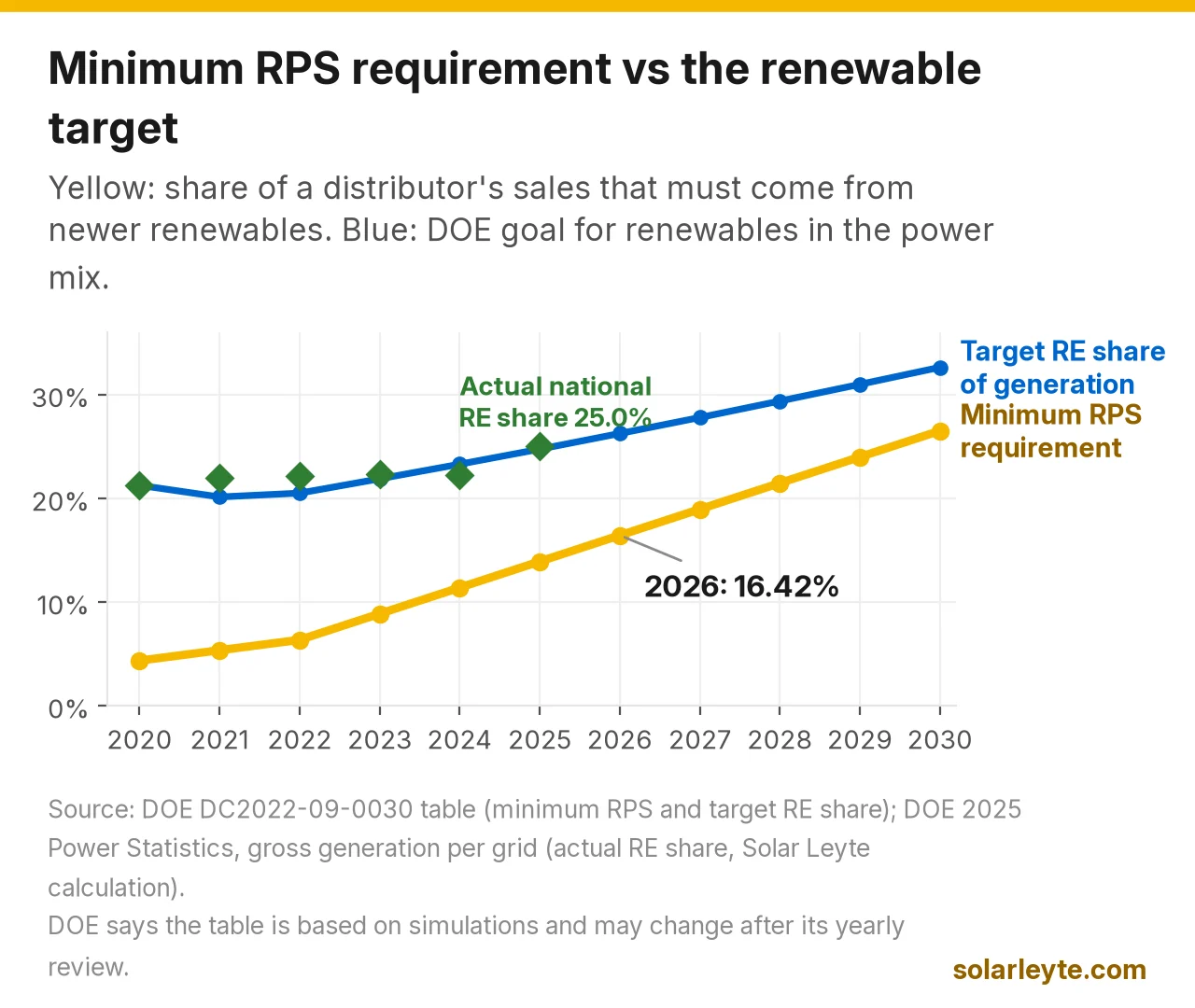
The table in DC2022-09-0030 starts from a 3.34% base for the feed-in tariff (FIT) share, and the DOE says it is "based on current simulations" and may change after its annual review (due by 30 September each year).
How are we doing? Using the DOE's own 2025 power statistics, renewables made up 25.0% of grid generation nationwide in 2025, just above the 24.73% target for that year. (Solar Leyte worked out 2020–2024 shares from the same table: about 21.2%, 22.0%, 22.1%, 22.3% and 22.2%.)
How BILECO and the LEYECO co-ops comply
The rules give co-ops several ways to meet their quota. ERC's Resolution No. 12, Series of 2024 tells distribution utilities to use the energy-based options first:
- RECs allocated from FIT-supported plants (already paid for through the FIT-All charge)
- Power supply agreements with eligible renewable plants
- Net-metered customers' solar and the Green Energy Option Program
- Buying RECs on the Renewable Energy Market (REM), only if the above aren't enough, at the lowest cost, and only for the current year
Region 8's joint RPS tender
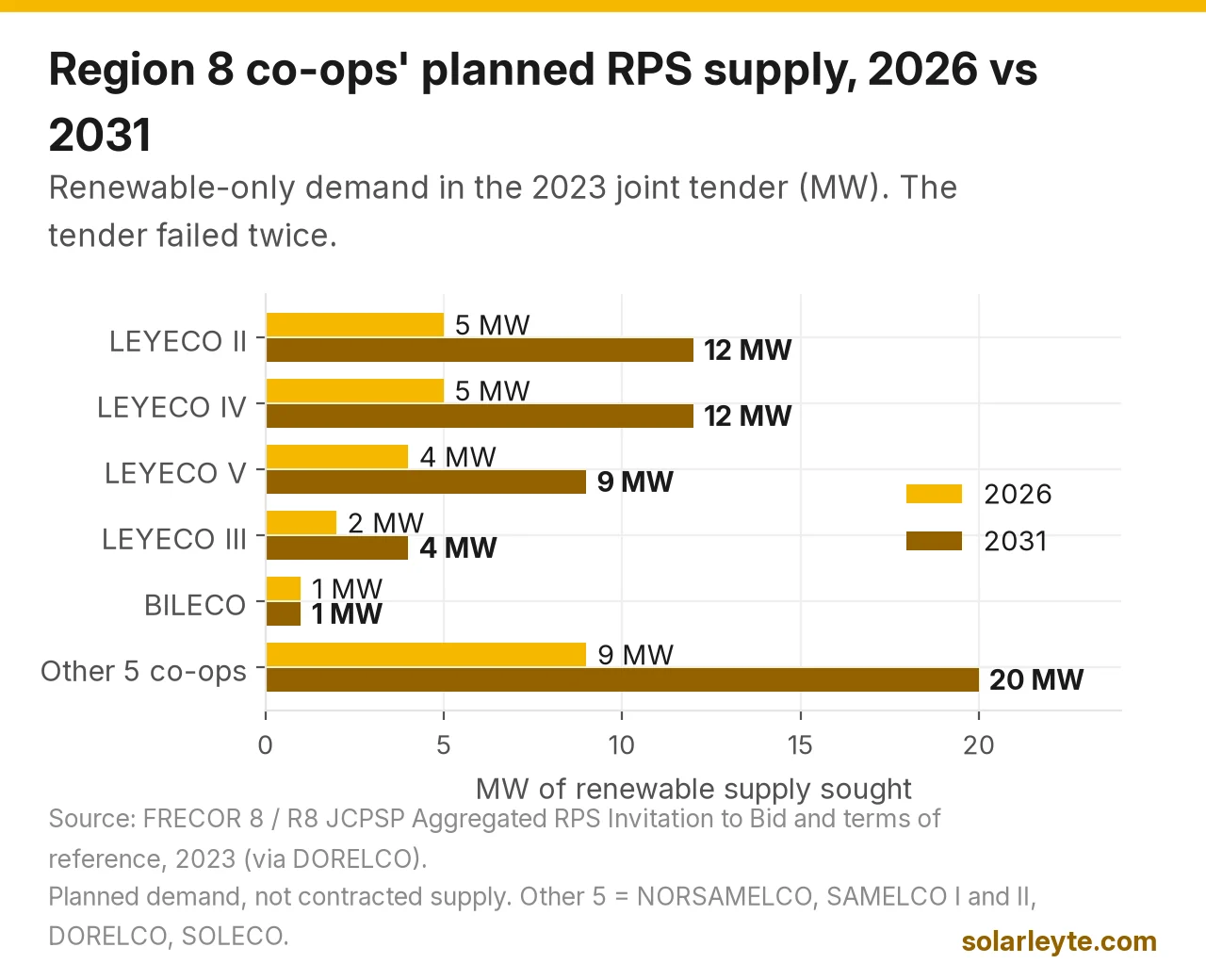
In 2023 the Federation of Rural Electric Cooperatives in Region 8 (FRECOR 8) ran a joint competitive procurement for RPS supply on behalf of 10 co-ops, including BILECO and LEYECO II, III, IV and V. The invitation to bid asked for renewable-only baseload supply from September 2023 to December 2031:
Co-op | 2026 demand (MW) | 2031 demand (MW) |
|---|---|---|
LEYECO II | 5 | 12 |
LEYECO IV | 5 | 12 |
LEYECO V | 4 | 9 |
LEYECO III | 2 | 4 |
BILECO | 1 | 1 |
Other 5 Region 8 co-ops | 9 | 20 |
All 10 co-ops | 26 | 58 |
The bidding failed twice. LEYECO IV posted the second notice of failure on 29 September 2023 (not enough bidders), and FRECOR 8 then moved to direct negotiation. We couldn't find a published result of that negotiation as of 28 October 2026.
LEYECO IV's October 2026 generation breakdown lists Therma Luzon (40.97%), Sual Power (33.80%), KEPCO SPC (17.70%) and WESM purchases (10.76%), with net-metered customers supplying 0.15% (18,173 kWh). No separate renewable supply contract is listed that month.
What RPS adds to your bill
ERC Resolution No. 12 sets how a distribution utility recovers what it spends on RECs:
- REC rate = (annual REC cost − annual REC revenue) ÷ the previous year's kWh sales to captive customers, collected over 12 months in the next compliance year.
- It must appear as a separate line item on your bill, and it is zero-rated for VAT.
- Fines or penalties for missing the RPS "shall in no case be passed on to end-users."
The REC price is also capped. The ERC set a cap of ₱241.56 per MWh (about ₱0.24 per kWh) in April 2024 (ERC Res. 08 s.2024 (reported by IEMOP)), subject to review every two years, and the market started full commercial operations on 26 December 2024 with IEMOP as RE Registrar.
Here are LEYECO IV's renewable-related lines for October 2026 (LEYECO IV rates):
Bill line | ₱ per kWh (residential) |
|---|---|
Feed-in Tariff Allowance (FIT-All) | 0.3359 |
REC Recovery | 0.0127 |
Renewable Energy Dev. Cash Incentive | 0.0101 |
GEA-ALL (Renewable) | 0.0000 |
Total residential rate | 17.0099 |
For BILECO and LEYECO V rates, see our BILECO rate per kWh post and LEYECO IV and V rates post.
Worked example: a 150 kWh LEYECO IV household
Solar Leyte worked example using LEYECO IV's October 2026 residential rates. Not a bill.
Line | Calculation | Amount |
|---|---|---|
REC Recovery | 150 × ₱0.0127 | ₱1.91 |
FIT-All | 150 × ₱0.3359 | ₱50.39 |
RE Dev. Cash Incentive | 150 × ₱0.0101 | ₱1.52 |
GEA-ALL | 150 × ₱0.0000 | ₱0.00 |
All renewable-related lines | ₱53.81 | |
Whole kWh charge | 150 × ₱17.0099 | ₱2,551.49 |
Gamay ra: the RPS-specific REC line is about 0.07% of the kWh charge, and all the renewable-related lines together are about 2.1%. FIT-All, which pays the older feed-in tariff plants, is the big one.
What's the worst case? Purely as an illustration: if a co-op had to cover the whole 16.42% for 2026 by buying RECs at the ₱241.56/MWh cap, that works out to about 0.1642 × ₱0.24156 ≈ ₱0.040 per kWh, or about ₱5.95 on 150 kWh. In practice part of the quota comes from FIT allocations, contracts and net metering, so the REC charge should be lower.
Your rooftop solar now counts
Under RA 9513 Section 10, the distribution utility originally got the RECs from net metering. The DOE changed that with DC2025-10-0020: RECs from the solar power you use yourself go to you (the qualified end-user), while RECs from the power you export go to the co-op, which counts those exports in its net sales. The RECs can be traded on the REM, and the ERC still has to issue implementing rules.
For a home system the amounts are small: 1 REC is 1 MWh, and a 3 kW rooftop setup in Leyte makes only a few MWh a year. The practical upside for households is still the bill savings. For how the export credit works with BILECO, see our BILECO net metering guide and the main net metering guide. If you'd rather pay for green power without a rooftop, that's GEOP, which we explain separately.
FAQ
What is the RPS requirement in the Philippines for 2026?
16.42% of a mandated participant's net electricity sales, under the DOE table in DC2022-09-0030. It goes up by 2.52 percentage points a year and is reviewed annually, so check the DOE for any update.
Does RPS make my electricity more expensive?
Only a little so far. The rules say compliance shouldn't raise rates, and ERC caps REC prices and keeps penalties off consumers. LEYECO IV's REC Recovery line was ₱0.0127/kWh in October 2026.
Does geothermal from Leyte count toward RPS?
Under DOE DC2017-12-0015 Sec. 10, only capacity that began commercial operation after the RE Act took effect is RPS-eligible, so Tongonan's older capacity is excluded. However, DOE's list of RPS-eligible plants includes Tongonan 1 Power Plant (Green Core Geothermal) with 10.50 MW eligible and a commercial operation date of 18 May 2019. Geothermal still keeps the Visayas grid heavily renewable.
Who gets the RECs from my net-metered solar?
Since DC2025-10-0020, you get the RECs for the solar you use yourself and the co-op gets the RECs for what you export. ERC implementing rules are still to come.
What happens if BILECO or LEYECO doesn't meet its RPS?
The 2017 rules set administrative fines of ₱100,000 to ₱500,000 and possible recommendation of franchise action, and the DOE issued separate rules on administrative actions for RPS violations in December 2023 (DC2023-12-0032). ERC says those penalties can't be passed on to consumers. A shortfall can be carried over to the next year only.
Solar Leyte is run by MACC Systems & Energy Solutions Inc., a solar installer in Naval, Biliran.
Get a free solar quote from MACC
Want your own solar to count, and cut your bill too? Send us a recent BILECO or LEYECO bill and we'll size a net-metering-ready system for your roof. Walay obligasyon, no obligation.
- Call/Text: 0955 723 5093
- Email: official@macc-inc.com or benjie@macc-inc.com
- Website: www.macc-inc.com
- Request a quote online: solarleyte.com/quote
- Office: Brgy. Talustusan, Naval, Biliran 6543
Sources (all checked 28 October 2026)
- Republic Act No. 9513, Renewable Energy Act of 2008 (Sec. 2 RPS definition, Sec. 6 RPS, Sec. 8 REM, Sec. 10 net metering RECs)
- DOE, DC2017-12-0015, RPS Rules for On-Grid Areas (mandated participants, eligible technologies, 1 REC = 1 MWh, 26 Dec–25 Dec compliance year, ₱100,000–₱500,000 fines, no higher rates)
- DOE, Eligible RE Power Plants for RPS Compliance for On-Grid and Off-Grid Areas (Tongonan 1 Power Plant / Green Core Geothermal, 10.50 MW eligible, commercial operation 18 May 2019; list updated periodically)
- DOE, DC2022-09-0030 (2.52% annual increment from 2023; minimum RPS and target RE share table 2020–2040; 3.34% FIT base; annual review)
- DOE, DC2023-05-0015 (2.52% for Luzon, Visayas and Mindanao)
- DOE, DC2023-12-0032 (administrative actions for RPS violations)
- DOE, DC2025-10-0020 (REC ownership under net metering)
- DOE, 2025 Power Statistics, gross generation per grid and technology (25.0% national RE share 2025; Visayas 47.3%; 2020–2024 shares calculated by Solar Leyte)
- ERC, Resolution No. 12, Series of 2024 (DU compliance order, REC rate formula, separate bill line, VAT zero-rating, penalties not passed on, one-year carry-over)
- ERC Res. 08 s.2024 (reported by IEMOP), Full commercial operations of the Renewable Energy Market (₱241.56/MWh REC price cap, 23 April 2024; full operations 26 December 2024; IEMOP as RE Registrar)
- FRECOR 8 / R8 JCPSP, Aggregated RPS invitation to bid and terms of reference (10 co-ops; MW demand per co-op 2023–2031)
- LEYECO IV, Notice of Failure of Bidding V2 and Direct Negotiation invitation
- LEYECO IV, October 2026 Rates (FIT-All, REC Recovery, RE Dev. Cash Incentive, GEA-ALL, ₱17.0099 residential) and October 2026 Generation Charges (supplier shares; net metering 0.15%, 18,173 kWh)