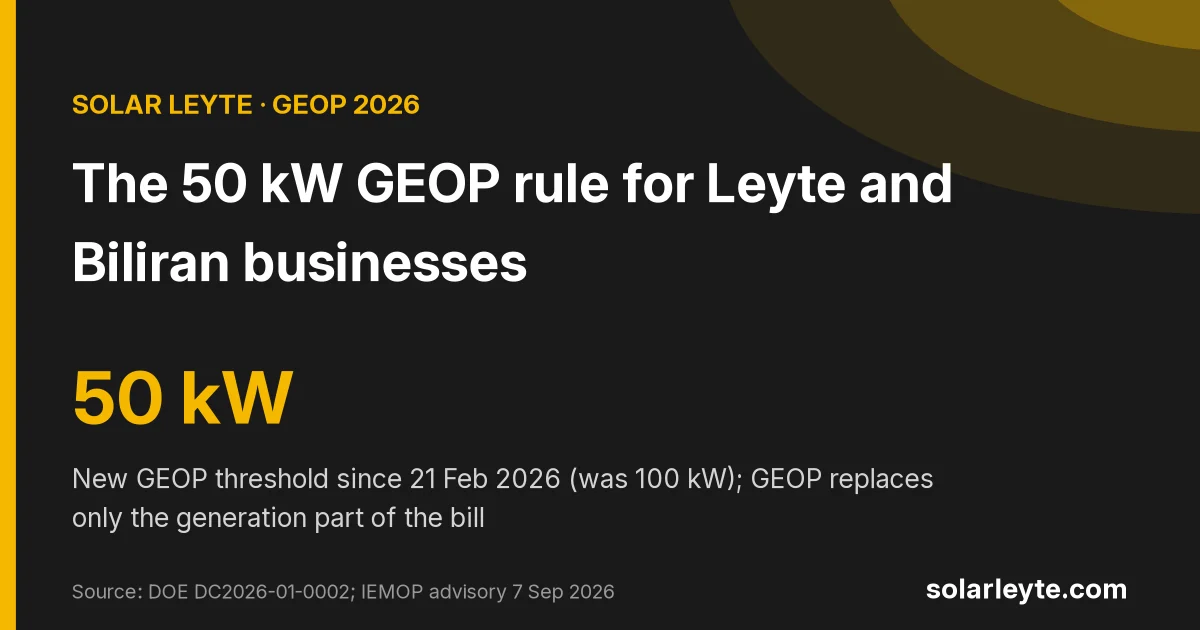
Short answer: yes, on paper. Since 21 February 2026, a business whose average monthly peak demand has been 50 kW or more over the past 12 months can sign a supply contract with a renewable energy (RE) supplier under the Green Energy Option Program (GEOP). Before, the cutoff was 100 kW. The rule is DOE Department Circular DC2026-01-0002, and it covers on-grid areas of Luzon, Visayas and Mindanao (DOE circular, as published; IEMOP advisory, 7 Sep 2026). BILECO and LEYECO areas are on-grid.
Now the catches:
- GEOP replaces only the generation part of your bill. Your co-op still charges for its wires, the meter, system loss, transmission and the universal charges.
- GEOP contract prices are private. The DOE and ERC don't review them, so there's no public "GEOP rate" to compare.
- By the end of June 2026, IEMOP had recorded no participants yet under the new 50 kW threshold. All 963 GEOP end-users nationwide were at 100 kW or above, and 115 of them were in the Visayas (IEMOP Q2 2026 retail market report).
This post is for hotels, resorts, hospitals, schools, cold storage, malls and factories in Leyte and Biliran with big bills. Homeowners can skip it. For your own rooftop system, read the net metering guide or our post on plug-and-play and zero-export solar instead.
Rules and registries checked 16 October 2026. This is general information, not legal advice. Solar Leyte isn't an RE supplier and earns nothing if you join GEOP.
What GEOP is, in one paragraph
The Renewable Energy Act of 2008 (RA 9513, Section 9) told the DOE to set up a program that lets electricity end-users choose renewable energy as their source. GEOP started on a voluntary basis in Luzon and Visayas on 3 December 2021, under rules from 2018 and ERC Resolution No. 08, Series of 2021 (DC2026-01-0002, whereas clauses). Under GEOP you sign a GEOP Supply Contract with an RE supplier, a company that holds a DOE GEOP Operating Permit and an ERC Retail Electricity Supplier licence (Sections 5.18 and 10). Your co-op still delivers the power over its lines ("wheeling"), reads your meter, and steps in as the supplier of last resort if your RE supplier can't deliver (Sections 3.3 and 15.5). The 2026 circular replaced the 2018 rules (DC2018-07-0019) and the 2020 operating-permit rules (DC2020-04-0009) (Section 28).
What changed in 2026
Before 21 Feb 2026 | DC2026-01-0002 (in effect 21 Feb 2026) | |
|---|---|---|
Existing customers | 100 kW monthly average peak demand, past 12 months (ERC Res. 08 s. 2021, Sec. 4.1) | 50 kW monthly average peak demand, past 12 months (Sec. 6.1) |
New customers | Load-profiling rules starting at 100 kW (ERC Res. 08 s. 2021, Sec. 4.2) | 50 kW projected, after choosing an RE supplier and applying for wheeling with the co-op (Sec. 6.2) |
Smaller customers | Not eligible | Can pool demand with others in a "contiguous area" in the same co-op franchise: subdivisions, villages, business districts, economic zones, condominium buildings, commercial establishments, mixed-use complexes. No limit on group size. The RE supplier acts as aggregator (Sec. 5.5 and 6.3) |
Going back to the co-op | — | You can go back to the co-op once your RE supplier obligations are settled, and rejoin GEOP later (Sec. 7) |
Next threshold cut | None scheduled | Annual review. The first is due 12 months after effectivity, with examples of 20 kW, 10 kW and eventually 0 kW (Sec. 8) |
RE certificates | — | RECs from your GEOP supply are voluntary RECs allocated to you (Sec. 17.3) |
IEMOP put the rule into practice on 7 September 2026. Aggregated groups follow the retail competition timeline, and their names carry "GAG", e.g. "GAG_XYZ Condominium". The DOE told IEMOP to use single billing for now, meaning one bill from the RE supplier. REC issuance for GEOP customers is on hold until IEMOP finishes upgrading its registry system and the RE market rules are amended. RECs that accrue in the meantime will be issued later (IEMOP advisory).
Do you hit 50 kW? Rough numbers
"Average monthly peak demand" means the highest kW your meter records each month, averaged over 12 months. It isn't your kWh. If your co-op bills you a kW demand charge (LEYECO IV does this for its high-voltage class), the kW is on your bill. On a low-voltage commercial bill it may not be, so ask the co-op for your 12-month peak demand record. Under the circular, each co-op acting as metering provider must send the DOE a yearly list of customers in its franchise who are eligible, with their peak demand (Sec. 15.4).
To show what 50 kW of peak demand looks like on a bill, we priced it at LEYECO IV's September 2026 low-voltage rate of ₱15.6838/kWh plus ₱68.87 a month in fixed charges (LEYECO IV). "Load factor" is how close your average use runs to your peak. The three load factors are illustrations, not measurements:
If your load factor is… | kWh per month at a 50 kW peak | Monthly bill at LEYECO IV LV, Sep 2026 | Generation part GEOP could replace (₱10.5728/kWh) |
|---|---|---|---|
30% (busy days, quiet nights) | 10,950 | ≈ ₱171,800 | ≈ ₱115,800 |
40% | 14,600 | ≈ ₱229,100 | ≈ ₱154,400 |
50% (long hours, cold rooms) | 18,250 | ≈ ₱286,300 | ≈ ₱193,000 |
Solar Leyte calculation: 50 kW × 730 hours × load factor; bill = kWh × ₱15.6838 + ₱68.87. Your own load factor comes from your meter data.
Rule of thumb from the table: at a 50 kW peak, a low-voltage business at LEYECO IV is probably paying ₱170,000 or more a month. If your bill is a fraction of that, you're likely under 50 kW. Then the only GEOP route is aggregation with neighbours in the same building or business district.
What GEOP changes on your bill (and what it doesn't)
Under the ERC's GEOP rules, the RE supplier's part of your bill is the generation charge and the taxes on it. Everything else stays with the co-op as "distribution wheeling service" charges: transmission, distribution, supply, metering, system loss, franchise tax, the senior citizen and lifeline lines, VAT, universal charges and FIT-All (ERC Resolution No. 08, s. 2021, Annex A, Sec. 34.7; copy hosted by FLECO). Under single billing, the RE supplier collects those co-op charges for the co-op and passes them on.
Here's how that splits LEYECO IV's September 2026 low-voltage rate. Every line is from LEYECO IV's posted unbundled rates, and the lines add up to the posted ₱15.6838:
Part of the ₱15.6838/kWh LV rate | ₱/kWh | Who gets it under GEOP |
|---|---|---|
Generation charge (₱9.5635) + generation VAT (₱1.0093) | 10.5728 (67%) | Your RE supplier's price replaces this |
Transmission + ancillary service charges, with their VAT | 1.8639 | Still billed (pass-through) |
System loss charge | 1.1286 | Still billed |
Distribution charge, distribution VAT, RFSC | 1.4375 | Still billed (co-op) |
Universal charges, FIT-All, lifeline and senior citizen lines | 0.6810 | Still billed |
Fixed charges (₱40.15 + ₱28.72 a month) | — | Still billed |
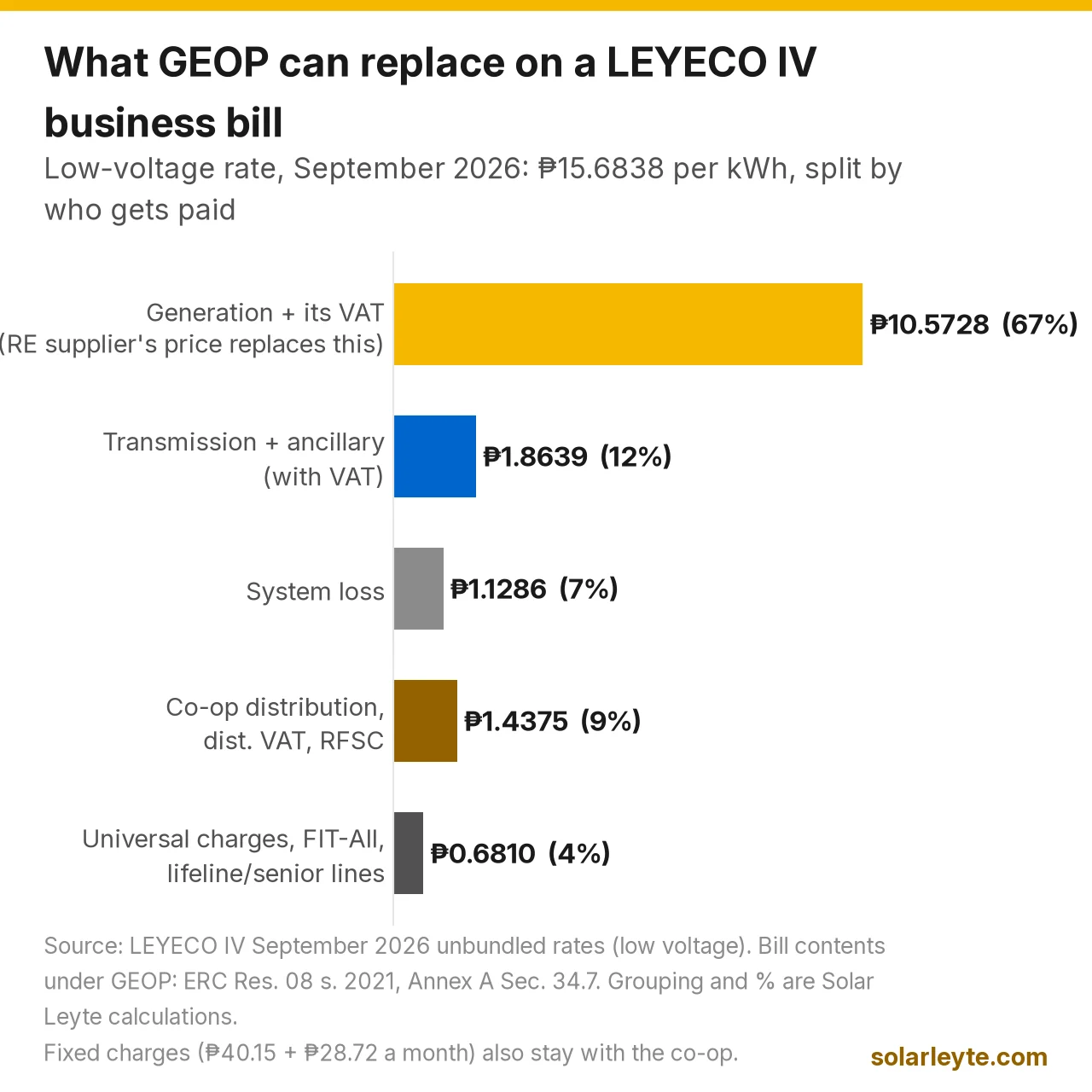
Source: LEYECO IV September 2026 rates. Grouping and percentages are Solar Leyte calculations.
So about two-thirds of a LEYECO IV low-voltage kWh can be shopped around, and about ₱5.11 per kWh can't. What you save depends entirely on the RE supplier's generation price compared with the co-op's generation charge in the same month.
How much could you save? Nobody can tell you from public data
There's no published GEOP price list. The circular says the GEOP Supply Contract doesn't need ERC approval, and the DOE and ERC may not review its terms, including the price, except in a dispute (Sec. 11.1).
The closest public benchmark is from the wider retail market, not GEOP. Customers of retail electricity suppliers paid a weighted average of ₱5.33 to ₱5.41/kWh from January to June 2026. The top five distribution utilities' average generation charges rose from ₱6.12 to ₱7.04/kWh over the same months (IEMOP Q2 2026 report). Those five are big utilities, not Leyte co-ops, and those suppliers don't have to sell renewable power. Treat this as context, not a GEOP quote.
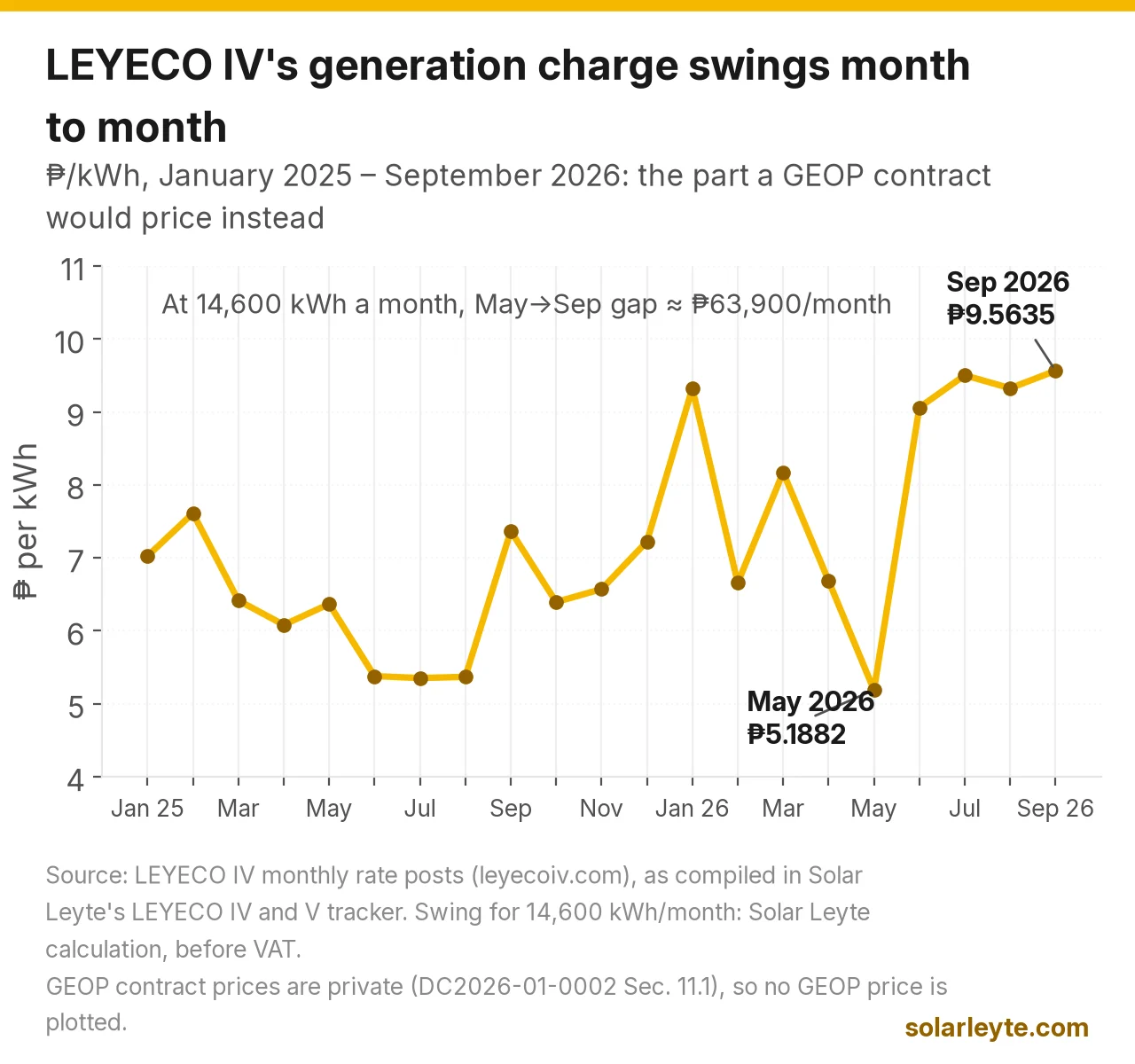
What is clear locally: co-op generation charges swing a lot from month to month. LEYECO IV's generation charge was ₱5.1882 in May 2026 and ₱9.5635 in September 2026 (LEYECO IV rate posts; full history in our LEYECO IV and V tracker). For a business using 14,600 kWh a month, that gap alone is about ₱63,900 a month before VAT (Solar Leyte calculation). A GEOP contract only helps if its price beats the co-op's charge across most months, not just the expensive ones. Read the contract's pricing method carefully: whether the price is fixed or indexed to something.
For a quick sense of scale: every ₱1/kWh difference in the all-in generation price is worth roughly ₱10,950 to ₱18,250 a month for the 50 kW examples above (kWh × ₱1, Solar Leyte calculation).
Can you actually do it in Leyte and Biliran?
The rules cover every on-grid co-op. Here's what we could confirm on 16 October 2026:
- Metering registration. IEMOP's GEOP registry lists LEYECO II (Tacloban area) and LEYECO V (Ormoc area) as registered Retail Metering Services Providers for GEOP. They're marked as previously registered for retail competition, with a supplemental agreement covering GEOP customers. BILECO isn't listed on the registry yet, and neither are LEYECO III or LEYECO IV (IEMOP GEOP participants, last checked 16 Oct 2026). That doesn't mean their customers can't join GEOP. It may mean the co-op still has registration steps ahead, so ask early.
- Suppliers. As of June 2026, 22 RE suppliers were licensed or authorised for GEOP, 21 were registered and 12 were actually serving customers. One supplier group, Ayala, accounted for 60% of GEOP end-users (IEMOP Q2 2026 report). The DOE publishes the list of permit holders (DOE list, September 2025).
- Where GEOP customers are. The MERALCO franchise area accounted for 74.9% of GEOP energy use in Q2 2026, VECO in Cebu 8.4%, and all other utilities together 16.7% (same IEMOP report).
- Co-op websites. Searches of bileco.net, leyeco-2.com and leyecoiv.com returned no GEOP posts on 16 October 2026, and LEYECO V's home page doesn't mention it.
Honest read: GEOP in BILECO or LEYECO territory is possible but untested at the 50 kW level. Expect paperwork and lead time.
The steps to switch
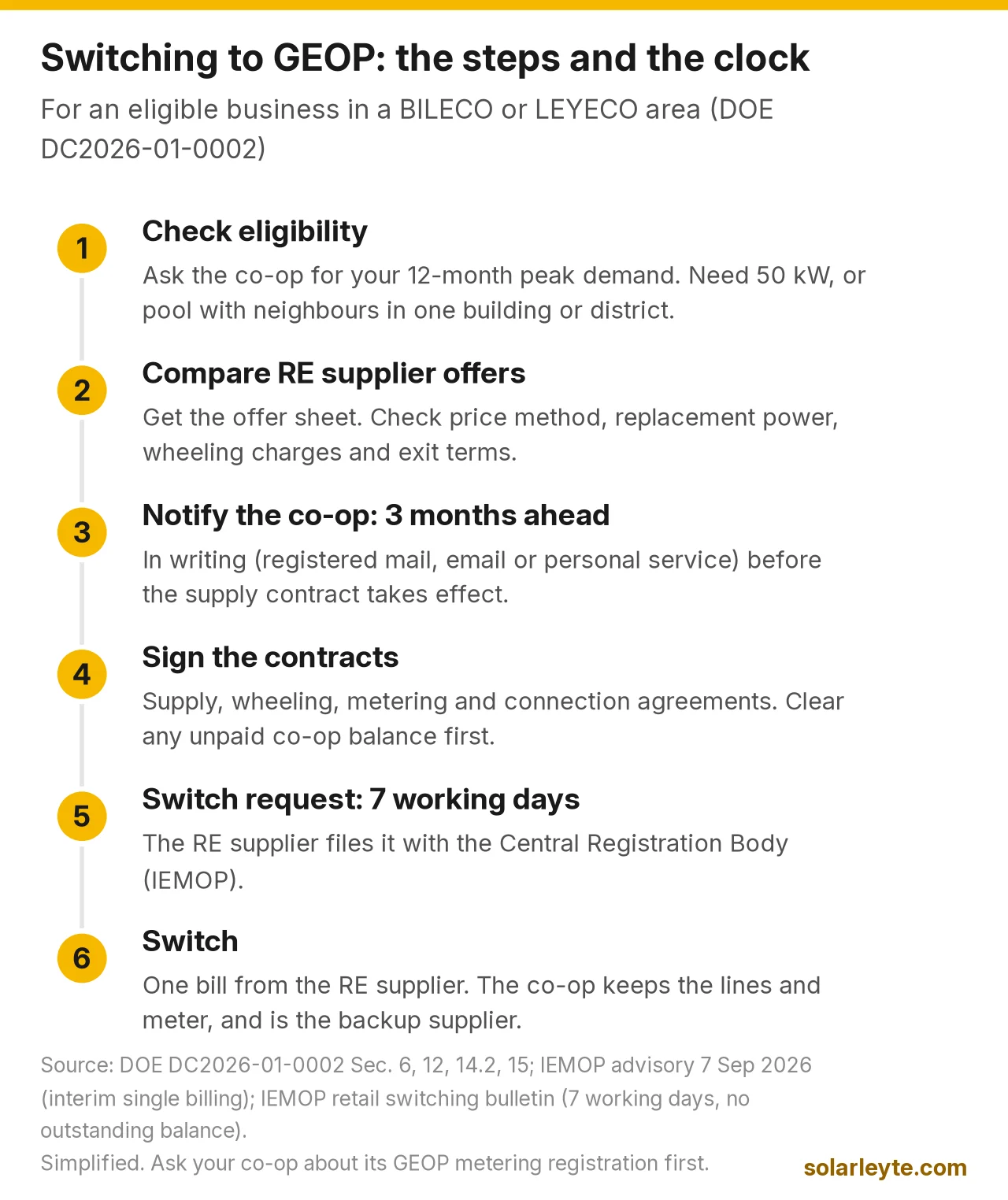
- Check eligibility. Get your 12-month peak demand record from the co-op. If you're under 50 kW, ask whether neighbours in the same building or business district want to aggregate (Sec. 6).
- Get offers from RE suppliers. They must give you a "transparent and simplified offer sheet". The contract must say how they'll cover times when the RE plant isn't producing (replacement power) and who pays the wheeling charges (Sec. 15.1).
- Notify the co-op in writing about 3 months before the GEOP Supply Contract takes effect (the circular says "within three (3) months prior"; ask the co-op how much lead time it wants), by registered mail, email or personal service (Sec. 14.2).
- Sign the contracts. The supply contract with the RE supplier; under single billing, the RE supplier signs the distribution wheeling service agreement with the co-op; plus metering and connection agreements. Settle any unpaid co-op balance first (IEMOP switching bulletin).
- The switch request. The RE supplier submits it to the Central Registration Body (IEMOP) at least 7 working days before the switch date (same bulletin).
- After the switch. You get one bill from the RE supplier. The co-op still owns the lines and the meter, and it's the supplier of last resort if the RE supplier stops serving you (Sec. 12 and 15.5; IEMOP advisory on interim single billing).
One more rule worth knowing: during a transition period (the circular says within three, but no later than five, years after it took effect), an RE supplier may source at least 50% of its replacement power from renewables and the rest from the spot market or other sources. After that, all replacement power must come from renewables (Sec. 17.1). Ask how your supplier handles this today.
GEOP vs retail competition vs your own rooftop solar
GEOP | Retail competition (RCOA) | Rooftop solar, net metered | Rooftop solar, zero export | |
|---|---|---|---|---|
Who qualifies | 50 kW average peak, or aggregated group | 100 kW average peak since 26 June 2026, or a retail aggregated group (IEMOP bulletin) | Your own system, up to 100 kW (net metering guide) | Your own system, no export to the co-op (our zero-export post) |
Power source | Renewable only | Any licensed supplier (not necessarily RE) | Your panels by day, co-op the rest of the time | Your panels by day, co-op the rest of the time |
Upfront equipment cost | None for generation (contracts and metering only) | None for generation | You buy the system | You buy the system |
What it replaces | Generation charge + its VAT | Generation charge + its VAT | Every kWh you use from your panels avoids the full rate; exports are credited at around the generation charge | Every kWh you use from your panels avoids the full rate; no export credit |
Paperwork | Supplier contract, wheeling and metering agreements, 3-month notice | Similar retail switching steps | Co-op net metering application, electrical permit, CFEI | Building permit and co-op notice; a business generally needs an ERC COC |
Two practical notes:
- They aren't either/or in principle, but DC2026-01-0002 doesn't say how GEOP combines with a net-metered rooftop system on the same meter. Ask the co-op and the RE supplier before you sign anything.
- Solar on your own roof also cuts the "still billed" lines. A kWh your own panels supply and you use replaces the whole retail kWh, including distribution and system loss. GEOP only touches the generation part. On the other hand, GEOP needs no roof, no capital and no maintenance, and it can cover nights. LEYECO IV credits net-metering exports at about its generation charge, a month behind: its September 2026 generation-charge breakdown values the 14,492 net-metering kWh it bought at ₱9.3252/kWh. That's LEYECO IV's August 2026 adjusted generation charge, a different figure from the September ₱9.5635 used elsewhere in this post (LEYECO IV September 2026 generation charges; history in our LEYECO IV and V tracker).
For rough rooftop costs and payback at larger sizes, see our 10 kW system price post and is solar worth it. For business examples, see beach resorts and water refilling stations. Every grid-connected route still needs an electrical permit and CFEI.
Questions to ask an RE supplier before you sign
- Is the price fixed or indexed, to what, and for how many years?
- Which RE plants will supply me, and where does replacement power come from when they're down?
- What does the price include? Generation only, or also any line-rental or wheeling costs?
- Single billing: when are payments due, and what are the late-payment terms?
- What happens if I close, relocate, or want to go back to the co-op? What are the exit fees?
- Have you switched a customer in my co-op's franchise before? Is the co-op registered as a GEOP metering provider?
- When will my RECs be issued, given IEMOP's September 2026 hold, and who can claim them?
FAQ
What is the Green Energy Option Program?
A DOE program under the Renewable Energy Act of 2008 that lets eligible electricity users buy their supply from a renewable energy supplier. The local co-op keeps delivering the power over its lines.
What's the GEOP threshold in 2026?
An average monthly peak demand of 50 kW over the past 12 months, or a projected 50 kW for new customers. It took effect on 21 February 2026 under DC2026-01-0002. It was 100 kW before.
Can a small business or household join GEOP?
Only by aggregating with other users in a contiguous area (same building, subdivision, business district or economic zone) within the same co-op franchise, with an RE supplier acting as aggregator. The DOE will review the 50 kW threshold yearly and has floated 20 kW, 10 kW and eventually 0 kW.
Does GEOP make my whole bill cheaper?
No. It replaces only the generation charge and its VAT. On LEYECO IV's September 2026 low-voltage rate that's ₱10.5728 of ₱15.6838 per kWh. Transmission, distribution, system loss, universal charges and FIT-All stay on the bill.
Is GEOP available in BILECO and LEYECO areas?
The rules cover on-grid areas of the Visayas, which includes them. On 16 October 2026, IEMOP's registry listed LEYECO II and LEYECO V as GEOP metering providers. BILECO isn't listed on the registry yet, and neither are LEYECO III or LEYECO IV (last checked 16 Oct 2026). That doesn't mean their customers can't join; ask your co-op about its readiness.
Is GEOP the same as net metering?
No. Net metering is for your own RE system (up to 100 kW) exporting to the grid. GEOP is buying renewable power from a supplier through the co-op's lines.
Is GEOP the same as RCOA or retail competition?
They're related. RCOA lets customers with 100 kW or more (since 26 June 2026) choose any licensed retail supplier. GEOP is for renewable energy only and has the lower 50 kW threshold.
Need a second opinion on your power bill?
If you run a business in Biliran or Leyte and you're weighing GEOP against solar on your own roof, the first step is the same: know your kWh, your peak kW and when you use it.
Solar Leyte is run by MACC Systems & Energy Solutions Inc., a solar installer in Naval, Biliran.
Get a free rooftop solar check for your business from MACC
Send us your last 12 BILECO or LEYECO bills (or your peak demand record) and your operating hours. We'll tell you honestly whether rooftop solar, GEOP, or both make sense to look at. No obligation. MACC isn't an RE supplier and doesn't sell GEOP contracts.
- Call/Text: 0955 723 5093
- Email: official@macc-inc.com or benjie@macc-inc.com
- Website: www.macc-inc.com
- Request a quote online: solarleyte.com/quote
- Office: Brgy. Talustusan, Naval, Biliran 6543
Sources (all checked 16 October 2026)
- DOE, Department Circular No. DC2026-01-0002, Revised GEOP Rules (newspaper publication package): Sections 3, 5, 6, 7, 8, 11, 12, 14, 15, 17, 28, 29
- IEMOP, Advisory on the implementation of DC2026-01-0002 (7 Sep 2026): effective 21 Feb 2026, aggregation, interim single billing, metering registration, REC hold
- IEMOP, Quarterly Retail Market Assessment Report, Q2 2026: 963 GEOP end-users (Visayas 115), none yet under 50 kW, supplier counts, retail market rates
- IEMOP, GEOP market participants registry (metering providers incl. LEYECO II and LEYECO V)
- ERC, Resolution No. 08, Series of 2021, GEOP Rules (copy hosted by FLECO): old 100 kW threshold, bill contents (Sec. 34.7)
- IEMOP, Bulletin on retail customer switching (RCOA, GEOP, RAP) and RCOA threshold bulletin 2026-01 (ERC Res. 22 s. 2025, 100 kW from 26 June 2026)
- DOE, RE suppliers issued with GEOP Operating Permits, September 2025
- Philstar, DOE opens direct green energy contracting to more consumers (25 Feb 2026)
- LEYECO IV, September 2026 rates and 2026 rate posts
- Worked examples (load factors, bill splits, savings per ₱1/kWh): Solar Leyte calculations in this article, labelled where used