Short answers: solar panels don't cause roof leaks, badly sealed holes do. They don't give off ionizing radiation, and the low-frequency magnetic field from a home system drops below 1 µT about a metre from the inverter, while the international public limit is 200 µT. The part of the roof under the panels runs cooler, not hotter. And will solar raise your house value? In the US, yes for owned systems. We found no Philippine study, so don't count on it here.
Kapag nagpa-solar ka, may kapitbahay talagang magsasabi: "Tutulo 'yan," "May radiation 'yan," or "Iinit ang bahay." Fair questions. We checked seven common ones against the WHO, the radiation commission ICNIRP, makers' manuals and peer-reviewed studies.
Last checked 4 November 2026. EMF limits are from ICNIRP's 2010 guidelines and the WHO; roof temperature from studies in San Diego and Bangkok; house value from US studies (no Philippine study found).
The short version
What people say | What the evidence says |
|---|---|
"Solar panels will make the roof leak." | Leaks start at fixings and cable holes that weren't sealed. LONGi's manual tells installers to "seal properly to prevent leakage." |
"Solar panels give off radiation that causes cancer." | Panels and inverters make low-frequency fields, not ionizing radiation. WHO says the evidence of a cancer link is "not strong enough to be considered causal." |
"Don't sleep near the inverter." | Partly true as a habit. Measured fields were up to about 120 µT right at an inverter, but under 1 µT beyond a metre. The public limit is 200 µT. |
"Solar makes the house hotter." | The roof under the panels was up to 9 °C cooler in a Bangkok study. In San Diego, ceilings were up to 2.5 °C cooler. |
"Solar raises your house value." | In US studies, owned systems added about $4 per watt; leased ones added little or nothing. No Philippine study found. |
"Solar panels catch fire easily." | Rare. A German study put the yearly risk at about 30 in a million buildings with solar. |
"Panels die after 10 years." | An NREL review found a median output loss of 0.5% a year. |
Myth 1: "Solar panels will make the roof leak"
The panels sit above the roof and don't let water through. What can leak is every hole made to hold them: screws into longspan ribs, hooks under tiles, and the cable entry.
LONGi's installation manual tells installers to check the roof is suitable and to "seal properly to prevent leakage". It also asks for at least 10 cm between frame and roof. A leak after a solar install is a workmanship problem.
What to do about it:
- Have the installer check and photograph the roof before work starts. If your GI sheets are already rusty or leaking, fix the roof first.
- Ask what fixing they will use for your roof type and how each hole is sealed.
- Get a written workmanship warranty that covers roof leaks, not just the wiring.
We won't repeat the fixings, roof weight and wind loads here. Those are in our roof readiness guide for longspan, concrete deck and tile roofs. The questions to ask an installer are in our installer checklist.
Bonus: in the San Diego study below, the daily temperature swing of the roof under the panels was half that of the bare roof, which the authors say reduces thermal stress.
Myth 2: "Solar panels give off radiation that causes cancer"
"Radiation" covers very different things. X-rays and nuclear radiation are ionizing: they can damage cells directly. Solar panels don't make that. They turn sunlight into DC electricity, and the inverter turns it into 60 Hz AC, the same as the co-op line into your house. Like any wiring or appliance, this makes low-frequency electric and magnetic fields (EMF), which are non-ionizing.
Here's what the WHO says about these fields:
- In 2002 the WHO's cancer agency (IARC) classed extremely low-frequency magnetic fields as "possibly carcinogenic to humans" (Group 2B). That rests on studies showing about twice the childhood leukaemia rate where a home's average magnetic field was above 0.3 to 0.4 µT.
- The WHO adds that those studies have method problems, there's no known way such low fields could cause cancer, and animal studies were "largely negative". Its conclusion: the evidence "is not strong enough to be considered causal."
- Average fields in homes are about 0.07 µT in Europe and 0.11 µT in North America. Under power lines they can be about 20 µT, and close to some appliances a few hundred µT.
ICNIRP's public reference level for 50 to 400 Hz magnetic fields, which covers our 60 Hz power, is 200 µT. For electric fields at 60 Hz it works out to about 4.2 kV/m.
What was actually measured around home solar systems
Where | Magnetic field measured | Study |
|---|---|---|
Rooms closest to the rooftop panels (US home) | 0.02 to 0.14 µT | MassCEC, 2012 |
A few feet from the home's inverters | 0.6 to 1.0 µT | MassCEC, 2012 |
No more than 2.7 m (9 ft) from the inverters | Back to background, 0.02 µT | MassCEC, 2012 |
On the roof, close to the panels (three homes, 4.8 to 9.8 kW) | Under 1.5 µT | Safigianni and Tsimtsios, 2013 |
Right at the inverter | Up to about 120 µT | Safigianni and Tsimtsios, 2013 |
More than 1 m from the inverter | Under 1 µT | Safigianni and Tsimtsios, 2013 |
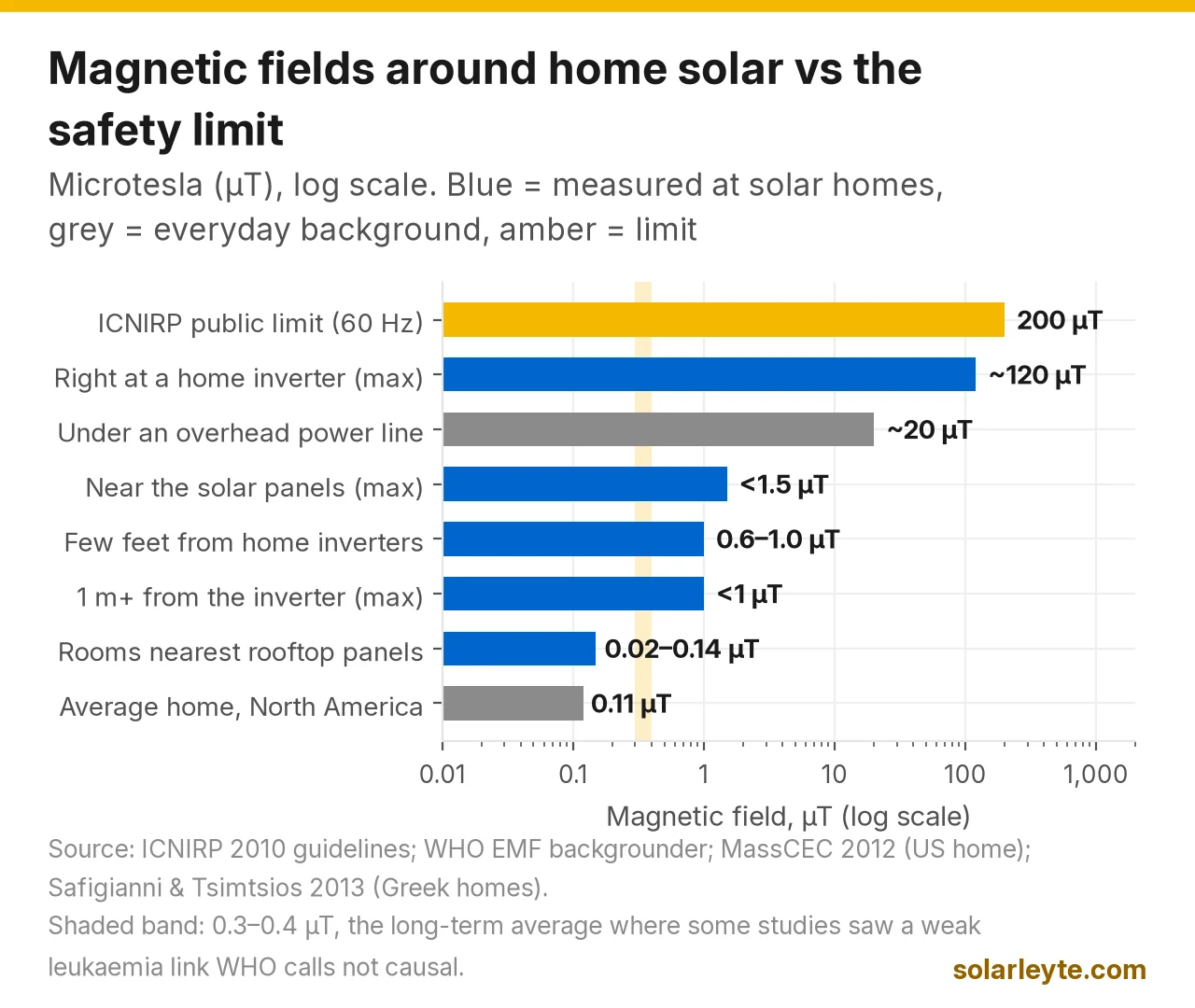
The same studies found electric fields near the panels and inverters at background levels, under about 5 V/m, unless a power line was nearby.
Myth 3: "Don't put the inverter near where people sleep"
Half right. Not because the inverter is dangerous, but because it's an easy, free habit. The field is strongest at the box (still below ICNIRP's limit in the readings above) and under 1 µT a metre away.
The WHO suggests exploring "low-cost ways of reducing exposures" when designing new equipment and buildings. Choosing where the inverter goes is exactly that.
Example (assumptions labelled): say your hybrid inverter goes on the wall of the garage or the dirty kitchen, and the nearest bed is 3 m away through the wall. Going by the MassCEC home measurements, at that distance the field would be back near background, about 0.02 µT. That's under the 0.3 to 0.4 µT level in the WHO-cited studies and about 10,000 times below ICNIRP's 200 µT. Even at 1 m (under 1 µT), you'd be more than 200 times below the limit (Solar Leyte calculation).
So put the inverter in a garage, utility area or covered outside wall, not behind a bedroom wall. That also keeps its fan noise away from where you sleep.
Myth 4: "Solar panels make the house hotter"
Panels do get hot in the sun, but they also shade the roof under them, and air flows through the gap.
- San Diego, USA (Dominguez, Kleissl and Luvall, Solar Energy, 2011): thermal camera readings showed ceilings under the panels up to 2.5 °C cooler than under the bare roof in the late afternoon. Their model gave a 38% lower yearly cooling load for the covered part of the roof (15.6 down to 9.69 kWh per m²). Tilted panels with a gap kept it cooler than panels laid flat on the roof. At night the ceiling under the panels was a little warmer, because the panels hold some heat in.
- Bangkok, Thailand (Khumkrong and others, KMUTT, 2017): in our kind of climate, a thermal camera at noon showed the roof surface under the panels up to 9 °C cooler than the exposed roof.
That doesn't mean a cold house: panels cover only part of the roof, and these are roof and ceiling readings, not room temperatures. But the myth is backwards. If upstairs heat is your real problem, our solar attic fan guide compares fans with insulation and radiant barriers.
Myth 5: "Solar automatically raises your house value"
Careful here: the good numbers online are American.
- Lawrence Berkeley National Laboratory (LBNL), 2015: 22,822 US home sales in eight states (2002 to 2013), 3,951 of them with solar. Buyers paid about $4.18 per watt more for homes with owner-owned solar, roughly $15,000 for an average 3.6 kW system.
- The same study found newer systems earned more: about $5.90 per watt for systems 0.5 to 2.4 years old, down to $2.60 per watt for systems 5.9 to 14 years old.
- Fannie Mae, 2021: owner-owned systems went with higher prices, but leased (non-owned) panels added "no value or slightly lower values". Premiums also fell over time as system prices dropped.
Example (Solar Leyte calculation): in the LBNL data, a system 5.9 to 14 years old earned $2.60 per watt, about 44% of the $5.90 for a nearly new one. So in the US, any premium shrinks as the system ages.
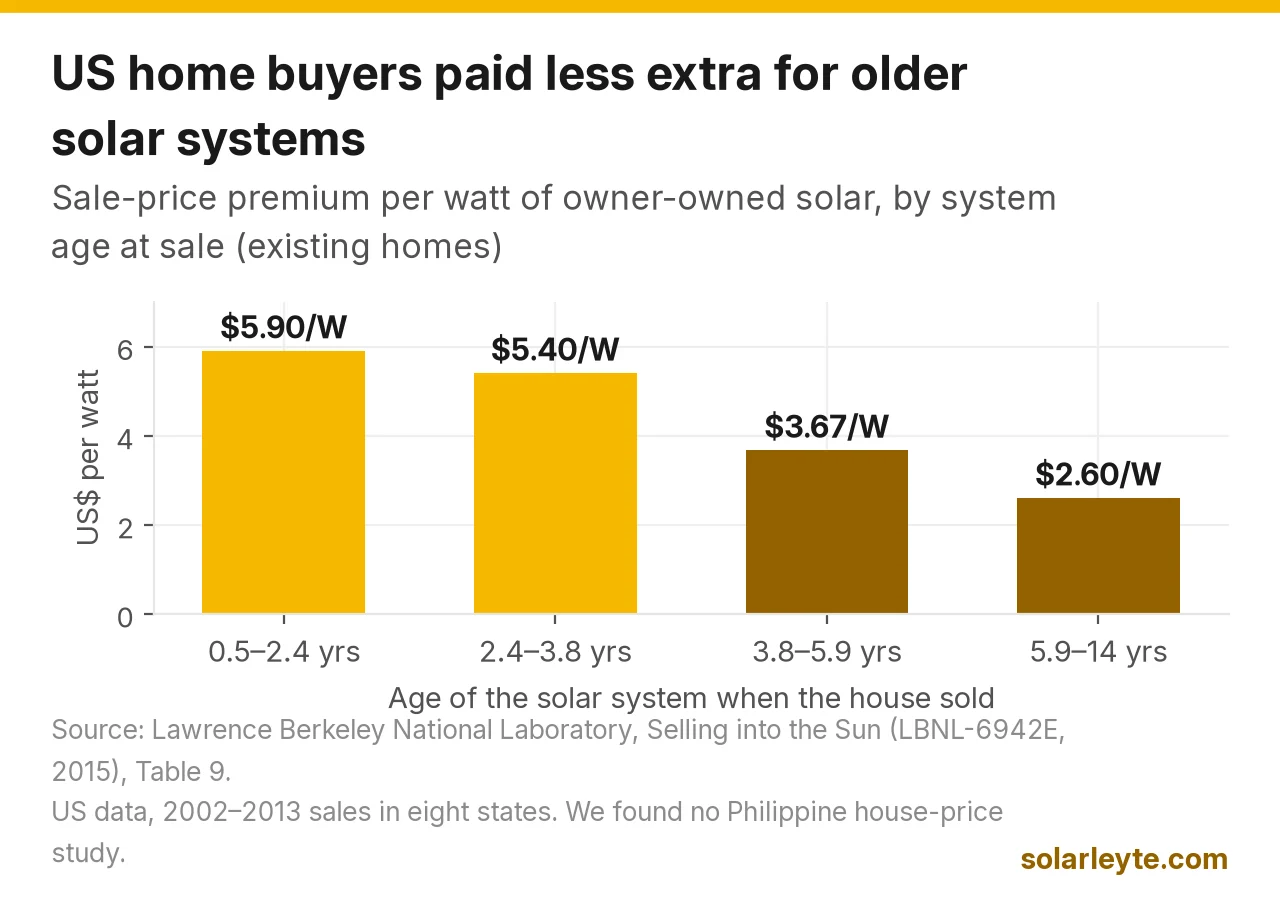
In the Philippines: as of 4 November 2026 we found no published study of house sale prices with and without solar. A 2024 survey of households in Metro Manila and nearby provinces found 67% thought rooftop solar can raise a house's value. That's a belief, not a sale price.
What likely helps a buyer here is paperwork: the electrical permit and CFEI, any net-metering agreement, receipts and warranties. Our permit and CFEI guide lists the papers. If your system is on a lease or rent-to-own plan, settle what happens on sale first. Our rent-to-own guide covers that. Buy solar for the bill savings; treat any resale bonus as extra.
Myth 6: "Solar panels catch fire easily"
Rare, but not zero. Fraunhofer ISE and TÜV Rheinland studied Germany's roughly 1.3 million PV systems and estimated the yearly risk at about 30 in a million that a building gets damaged by a fire from its own solar system. Most start on the DC side: bad connectors, isolators and wiring. More in our solar fire safety guide.
Myth 7: "Solar panels only last 10 years"
An NREL review of nearly 2,000 published degradation rates (Jordan and Kurtz) found a median loss of 0.5% of output per year. Inverters and batteries wear out sooner. Our lifespan and warranty guide explains each warranty.
Before you sign a quote, our solar panel price guide shows how to read one line by line.
FAQ
Do solar panels cause cancer?
There's no established evidence they do. They make no ionizing radiation, and measured fields were under 1.5 µT near the panels and under 1 µT a metre from the inverter, against ICNIRP's 200 µT public limit.
Masama ba matulog malapit sa inverter?
Not dangerous by the numbers, but avoid a bedroom wall. In one US home the field was back to background within about 2.7 m of the inverters.
Do solar panels damage metal roofs?
Not if fixed and sealed properly; leaks start at unsealed screws. See our roof readiness guide for longspan and tile fixings.
Does solar increase house value in the Philippines?
Unknown. We found no Philippine sale-price study. In the US, owned systems added about $4 per watt (LBNL), less for older systems, and leased ones added little or nothing.
Solar Leyte is run by MACC Systems & Energy Solutions Inc., a solar installer in Naval, Biliran.
Get a free solar quote from MACC
Worried about your roof or where the inverter would go? Send us a photo of your latest BILECO or LEYECO bill and your roof, and we'll get back to you with a free, no-obligation written quote.
- Call/Text: 0955 723 5093
- Email: official@macc-inc.com
- Website: www.macc-inc.com
- Or use the site quote form: /quote
Sources (all checked 4 November 2026)
- World Health Organization, Exposure to extremely low frequency fields (backgrounder, June 2007): IARC Group 2B (2002), two-fold childhood leukaemia association above 0.3–0.4 µT average exposure, "not strong enough to be considered causal", average home fields 0.07 µT (Europe) and 0.11 µT (North America), a few hundred µT close to some appliances, about 20 µT under power lines, "low-cost ways of reducing exposures".
- ICNIRP, Guidelines for limiting exposure to time-varying electric and magnetic fields (1 Hz – 100 kHz), Health Physics 2010 (PDF): Table 4, general public reference levels, 50–400 Hz: magnetic field 2 × 10⁻⁴ T (200 µT); electric field 2.5 × 10²/f kV/m (about 4.2 kV/m at 60 Hz).
- Tech Environmental for the Massachusetts Clean Energy Center, Study of Acoustic and EMF Levels from Solar Photovoltaic Projects (2012, PDF) (MassCEC summary page here): residential site, 0.2–1.4 mG in rooms closest to the roof panels, 6–10 mG a few feet from the inverters, background 0.2 mG within 9 feet; electric fields at background (< 5 V/m). (10 mG = 1 µT.)
- Safigianni and Tsimtsios, Electric and Magnetic Fields Due to the Operation of Roof Mounted Photovoltaic Systems (PIERS Proceedings, Stockholm, 2013), as tabulated by photovoltaique.info (Hespul), "Mesures sur des installations de faible puissance (<10 kW)", updated 20 Nov 2024: three rooftop systems (8.05, 4.8 and 9.8 kWp); under 1.5 µT near the modules, up to about 120 µT at the inverter, under 1 µT beyond 1 m; electric field under 5 V/m except near a low-voltage line.
- Dominguez, Kleissl and Luvall, Effects of solar photovoltaic panels on roof heat transfer, Solar Energy 85 (2011) (UC eScholarship PDF): ceilings up to 2.5 K cooler under the arrays; annual cooling load 15.6 → 9.69 kWh/m² (38%); tilted array cooler than flush; warmer at night; daily roof temperature swing halved.
- Khumkrong, Chuangchote, Chenvidhya and Kirtikara, Investigation of indirect benefits of PV rooftop in Thailand, IOP Conf. Ser.: Earth Environ. Sci. 67 012019 (2017, PDF): roof surface under PV arrays up to 9 °C cooler than exposed roof at noon (thermal IR, 30 Sep 2016).
- Hoen and others, Lawrence Berkeley National Laboratory, Selling Into the Sun: Price Premium Analysis of a Multi-State Dataset of Solar Homes (LBNL-6942E, 2015, PDF): 22,822 sales, 3,951 with PV, eight states, 2002–2013, host-owned only; $4.18/W (about $15,000 for 3.6 kW); Table 9 premiums by system age $5.90, $5.40, $3.67, $2.60/W.
- Fannie Mae, Solar at High Noon: Solar Home Premiums in a Rapidly Maturing Market (2 July 2021): owned systems linked to higher prices; non-owned panels "no value or slightly lower values"; premiums fell over the study period.
- Factors Influencing Household Adoption of Rooftop Solar Power in the Philippines (Change and Innovation Systems 12(3), 2024): survey of Metro Manila and nearby provinces; 67% think rooftop solar can raise house value.
- LONGi, Installation Manual for LONGi PV modules, V19 (Hi-MO X10) (distributor-hosted PDF): "seal properly to prevent leakage"; frame-to-roof gap of at least 10 cm.
- Laukamp and others, Fraunhofer ISE and TÜV Rheinland, PV Fire Hazard: Analysis and Assessment of Fire Incidents (28th EU PVSEC, 2013, PDF): about 1.3 million systems; annual risk of about 30 × 10⁻⁶.
- Jordan and Kurtz, NREL, Photovoltaic Degradation Rates: An Analytical Review (OSTI record): nearly 2,000 reported rates, median 0.5% per year.
- Solar Leyte calculations (labelled in the text): mG to µT conversions; 200 µT ÷ 1 µT and ÷ 0.02 µT; $2.60 ÷ $5.90 ≈ 44%.