Your electric bill can only go up for two reasons: the price per kWh went up, or you used more kWh. Usually it's both. Before you blame the meter, take out this month's bill and last month's, and compare two lines: the kWh used and the rate per kWh. That two-minute check tells you which problem you have.
In 2026 the rate alone has done a lot of damage. BILECO's posted residential rate went from ₱12.9458 per kWh in May to ₱19.3628 in October, up 49.6%. LEYECO IV's went from ₱11.6561 to ₱17.0099, up 45.9%. A Biliran home that used exactly 150 kWh both months paid about ₱962 more, without switching on a single extra appliance.
Last checked: 12 November 2026. Rates are from BILECO's and LEYECO IV's own rate pages (links under Sources). BILECO had not posted a November 2026 rate when we checked. The worked examples are Solar Leyte illustrations with stated assumptions, not real bills.
Step 1: Split the increase into "rate" and "kWh"
A bill is roughly kWh used × rate per kWh, plus small fixed charges. So put the two bills side by side:
Line on your bill | Last month | This month | What it tells you |
|---|---|---|---|
kWh used (present − previous reading) | ? | ? | Did you use more electricity? |
Rate per kWh (or total ÷ kWh) | ? | ? | Did the co-op's price change? |
Reading dates | ? | ? | How many days are in this bill? |
- kWh about the same, rate higher: it's the rate. Skip to check 1.
- Rate about the same, kWh much higher: it's your usage, the billing days, or a reading problem. Go to checks 2 to 7.
- Both higher: you've got a mix. The worked example below shows how to split it.
If your bill doesn't print the rate, divide the energy charges by the kWh. Or plug your kWh into our electricity bill calculator at the current rate and see how close it gets.
Check 1: The co-op's rate went up
This is the most common answer to "bakit tumaas ang bill ng kuryente ngayon" in Leyte and Biliran this year. Here are the residential rates the co-ops posted on their own websites:
Month (2026) | BILECO (₱/kWh) | LEYECO IV (₱/kWh) | 150 kWh at BILECO | 150 kWh at LEYECO IV |
|---|---|---|---|---|
January | 17.4415 | 16.7076 | ₱2,616.23 | ₱2,506.14 |
February | 14.1414 | 13.5911 | ₱2,121.21 | ₱2,038.67 |
March | 15.7097 | 15.2342 | ₱2,356.46 | ₱2,285.13 |
April | 15.0929 | 13.7992 | ₱2,263.94 | ₱2,069.88 |
May | 12.9458 | 11.6561 | ₱1,941.87 | ₱1,748.42 |
June | not posted | 15.9958 | – | ₱2,399.37 |
July | 18.3407 | 16.3837 | ₱2,751.11 | ₱2,457.56 |
August | 18.7587 | 16.8741 | ₱2,813.81 | ₱2,531.12 |
September | 18.9275 | 16.9708 | ₱2,839.13 | ₱2,545.62 |
October | 19.3628 | 17.0099 | ₱2,904.42 | ₱2,551.49 |
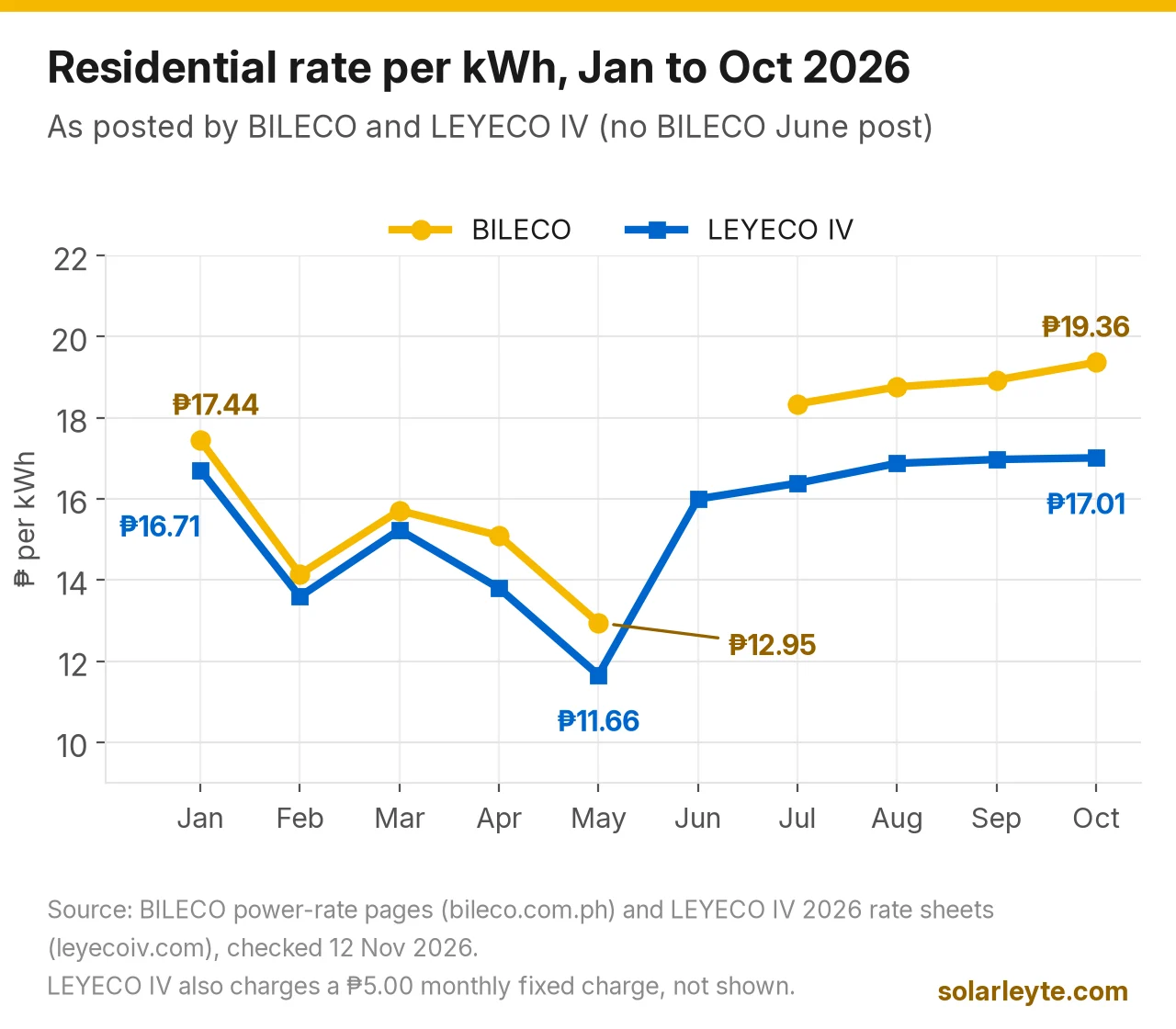
The 150 kWh columns are Solar Leyte calculations (kWh × posted rate). LEYECO IV also charges a fixed ₱5.00 a month on residential accounts, not included above. BILECO's power-rate page had no June 2026 post when we checked. For LEYECO II, LEYECO V and DORELCO, use our monthly trackers: LEYECO II rate per kWh and LEYECO IV and V rates. For BILECO's full history, see the BILECO rate tracker.
Why the rate moves every month
BILECO's billing page puts it plainly: generation and transmission costs are passed on "without any additions or reductions", and they "primarily drove the fluctuating price of power every month". BILECO says generation alone is "roughly 45%" of its rate.
LEYECO IV's own rate sheets show the same thing. Its generation charge rose from ₱5.1882 per kWh in May to ₱9.4113 in October. That's ₱4.2231 of the ₱5.3538 total rise, or about 79% (our calculation from the two sheets).
There's a regional twist too. The Daily Tribune reported that for July 2026, the market operator IEMOP billed Eastern Visayas' 11 co-ops ₱572.9 million in line loss and congestion charges, from ₱0.46 per kWh for LEYECO II up to ₱5.99 per kWh for LEYECO IV. It said that under normal computation, Biliran's July rate "would have reached" ₱24.35 per kWh, and that co-ops "temporarily suspended or staggered" some of those pass-on costs. Staggering spreads a cost over later bills, so a calmer month on the market doesn't always mean a cheaper bill straight away. The bigger picture of why Philippine power is expensive is in bakit mahal ang kuryente.
What you can do: not much about the rate itself. What you control is the kWh, which is where checks 2 to 7 come in.
Check 2: This bill covers more days
A "month" on your bill isn't a calendar month. The Magna Carta for Electricity Consumers (ERC Resolution No. 25, Series of 2026) defines a billing month as 28 to 31 days between readings. A 31-day bill has 10.7% more days than a 28-day bill (31 ÷ 28). At 5 kWh a day, that's 155 kWh instead of 140, or about ₱290 more at BILECO's October rate, for doing nothing different.
Look at the "from" and "to" reading dates. If the meter reader came late this month, part of your next month is in this bill.
Check 3: The aircon ran longer
Meralco says air conditioners "can account for 40% to 50%" of a household's consumption. So a few hot weeks, a new aircon, or kids home on break and sleeping in the aircon room will show up quickly. In Meralco's lab tests, setting a 1 HP aircon to 25°C instead of 18°C saved about 156 kWh a month (our conversion of Meralco's peso figure). We priced those tips at local rates in paano makatipid sa kuryente.
Check 4: Something new is plugged in
A second ref, a freezer for a small business, a water heater, an induction cooker, an electric oven, a gaming PC left on overnight: anything that runs for hours adds up. Our list of how many kWh appliances use helps you find the culprit. A quick way to test it is to read your meter at the same time on two days in a row. The difference is one day's use. Do it once with the new appliance and once without.
Check 5: You lost a discount
Two discounts have hard kWh limits, and going over by even one kWh can remove them for that month:
- Lifeline rate (4Ps and other qualified low-income households): a 100% discount on most charges at 0–50 kWh, under ERC Resolution No. 02, s. 2026. If your co-op has no approved tiers above 50 kWh, a 51 kWh month gets no lifeline discount.
- Senior citizen discount: at least 5% on certain charges when the household uses 100 kWh or less, the meter is in the senior's name, and the senior lives there (RA 9994, Sec. 4(c)). It's one discount per household. At 101 kWh it's zero for that month.
If your bill jumped from about ₱60 to over ₱800, a lost lifeline discount is the likely reason. Our lifeline and senior citizen discount guide has the rules and worked examples.
Check 6: Last month was an estimate, and this month caught up
Check whether the previous reading on this bill matches the present reading on last month's. If last month's bill was low because the meter wasn't actually read (after a typhoon, a locked gate, a dog in the yard), this month's real reading carries all the kWh that weren't billed yet. You haven't been charged twice. The kWh just landed in one bill. Add the two months' kWh together and compare that with two normal months. If it still looks high, ask your co-op to show you the actual readings.
Check 7: Something is leaking, or the meter is wrong
If checks 1 to 6 don't explain it, test the house:
- The "everything off" check: switch off your main breaker and watch the meter for 10–15 minutes. It shouldn't move. If it keeps counting, call your co-op. It could be a wiring fault or someone tapping your line.
- Check the meter number on the meter against the one printed on your bill, especially if several meters share one post.
- Ask for a meter test. Under the 2026 Magna Carta you can get one free test every two years (Art. 12(A)). If the meter's average error is over +2%, Art. 10(B) entitles you to a refund covering at most 6 months before discovery, credited to future bills.
Our step-by-step guide to reading your electric meter covers all three, including dial meters and the pulse-light check.
If this month's kWh is above your 12-month average
The Magna Carta defines high billing this way (Art. 2(o)): "High Billing - occurs when a consumer's one-month kilowatthour consumption exceeds one hundred percent (100%) of the consumer's average 12-month kilowatthour consumption prior to the contested bill." That means a month that uses more kWh than the 12-month average. In that case (Art. 39(C)):
- File a written protest with your co-op within 60 calendar days of paying, with supporting proof of why you shouldn't be liable for the entire bill.
- To avoid disconnection, you may pay an amount equal to your 12-month average while it's investigated.
- The co-op must finish the investigation within 30 calendar days and give you a written report, including the meter test result. The rule says investigation and inspection costs are shouldered by the consumer.
Example (illustration): your 12-month average is 150 kWh and the disputed bill says 330 kWh (220% of average). At BILECO's October rate, you'd pay about 150 × ₱19.3628 = ₱2,904.42 while the protest runs, instead of ₱6,389.72, and settle the difference once it's resolved. If your co-op doesn't settle it, you can go to the ERC by email, written correspondence or the CCTS (Art. 31). The addresses in ERC's August 2026 public release, republished by ISELCO, are consumer@erc.ph and the online system at ccts.erc.ph.
Worked example: a Naval bill that went up ₱857
Solar Leyte illustration. Assumptions: a BILECO residential account; September bill covers 29 days at 5.0 kWh a day; October bill covers 31 days, and the family started using the aircon one more hour each night, adding about 1.0 kWh a day. Rates are BILECO's posted September and October 2026 rates. No discounts, no arrears.
September bill | October bill | |
|---|---|---|
Days in billing period | 29 | 31 |
kWh used | 29 × 5.0 = 145 | 31 × 6.0 = 186 |
Rate per kWh | ₱18.9275 | ₱19.3628 |
Bill | ₱2,744.49 | ₱3,601.48 |
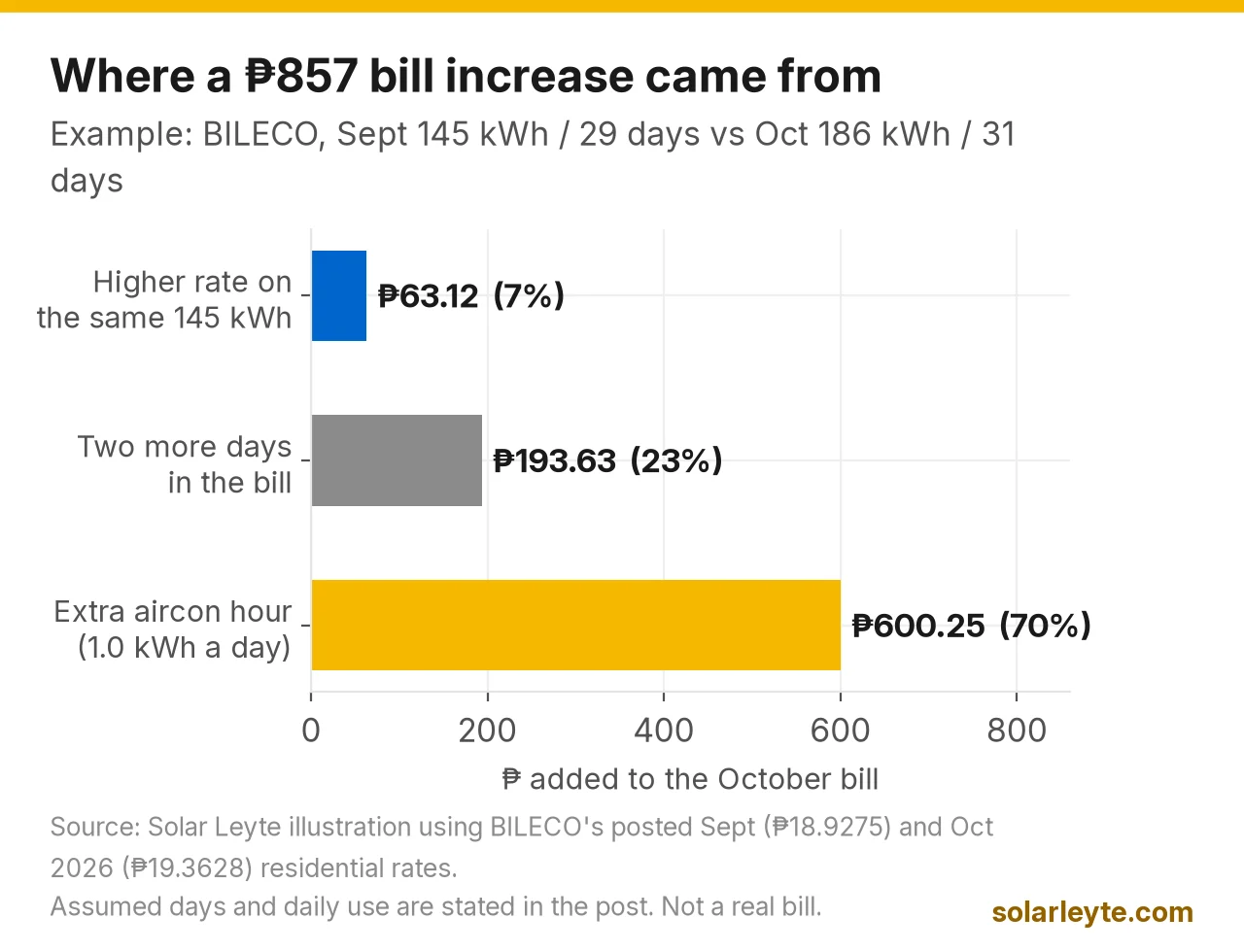
The bill went up ₱856.99. Here's where it came from:
Cause | Calculation | Share of the increase |
|---|---|---|
Higher rate on the same 145 kWh | 145 × (₱19.3628 − ₱18.9275) | ₱63.12 |
Two more days in the bill | 2 days × 5.0 kWh × ₱19.3628 | ₱193.63 |
The extra aircon hour | 31 days × 1.0 kWh × ₱19.3628 | ₱600.25 |
Total | ₱857.00 (₱0.01 off from rounding) |
In this example, the rate change everyone talks about is only about 7% of the jump. The habit change is about 70%. Your own bill could be the other way round, which is why Step 1 matters. Plug your own numbers into the electricity bill calculator to see your split.
What actually brings the bill down
- Watch kWh, not pesos. Pesos follow the rate, which you don't control. kWh is yours. Write down the kWh from every bill so you know your normal. Our average electric bill guide shows what's typical.
- Go after the aircon and ref first. They're usually the biggest loads.
- Keep an eye on the lifeline and senior limits if you're near 50 or 100 kWh.
- Make some of your own power. Solar on the roof cuts the kWh you buy from the co-op during the day. It won't change the rate, but every kWh you don't buy is one you don't pay ₱19 for. Our BILECO and LEYECO rates guide explains your bill line by line. If you want to see what solar would do for your own bill, you can request a quote.
FAQ
Bakit tumaas ang bill ng kuryente ngayon kahit pareho lang ang gamit namin?
Kung pareho ang kWh pero mas mataas ang bill, ang rate per kWh ang tumaas. Ang BILECO, halimbawa, ay ₱12.9458 noong May at ₱19.3628 noong October 2026, ayon sa sariling rate page nila. Tingnan din ang reading dates: baka mas maraming araw ang sakop ng bill na ito.
How do I know if it's the rate or my usage?
Compare the kWh used and the rate per kWh on this month's and last month's bills. If kWh is about the same, it's the rate. If kWh jumped, look at billing days, aircon hours, new appliances, lost discounts and catch-up readings.
My bill doubled but nothing changed at home. What do I do?
Do the "everything off" meter check and confirm the meter number. If your kWh is above your 12-month average, file a written protest with your co-op within 60 calendar days of paying. You can pay your 12-month average while the co-op investigates, and it has 30 calendar days to finish.
Will BILECO's November rate be lower?
We can't say yet. BILECO had not posted a November 2026 rate on its website when we checked on 12 November 2026. We update the BILECO rate tracker when it does.
Solar Leyte is run by MACC Systems & Energy Solutions Inc., a solar installer in Naval, Biliran.
Get a free solar quote from MACC
Tired of guessing what next month's bill will be? Send us your latest BILECO or LEYECO bill and we'll show you what solar could cut from it, with a free, no-obligation written quote.
- Call/Text: 0955 723 5093
- Email: official@macc-inc.com
- Website: www.macc-inc.com
- Or use the site quote form: /quote
Related guides
- BILECO and LEYECO electricity rates: how to read your bill
- How to read your electric meter and check your bill
- Bakit mahal ang kuryente? 7 reasons
- Paano makatipid sa kuryente: 12 tips with peso savings
Sources (all checked 12 November 2026)
- BILECO, power rate list (newest post: October 2026; no November or June 2026 post) and monthly residential rates: January ₱17.4415, February ₱14.1414, March ₱15.7097, April ₱15.0929 (VAT inclusive), May ₱12.9458 (VAT inclusive), July ₱18.3407, August ₱18.7587, September ₱18.9275, October ₱19.3628.
- BILECO, Billing Information: pass-through costs "without any additions or reductions"; generation "roughly 45%" of the monthly rate.
- LEYECO IV, 2026 rate sheets (residential rate per kWh, generation charge, ₱5.00 fixed charge): January ₱16.7076, February ₱13.5911, March ₱15.2342, April ₱13.7992, May ₱11.6561 (generation ₱5.1882), June ₱15.9958, July ₱16.3837, August ₱16.8741, September ₱16.9708, October ₱17.0099 (generation ₱9.4113).
- Daily Tribune, EV power consumers seek rate relief (July 2026): ₱572.9 million LLCC for July; ₱0.46 (LEYECO II) to ₱5.99 per kWh (LEYECO IV); Biliran "would have reached" ₱24.35/kWh; co-ops "temporarily suspended or staggered" pass-on costs.
- ERC Resolution No. 25, Series of 2026, Magna Carta for Electricity Consumers (full text, PDF copy published by Visayan Electric): billing month of 28–31 days (Art. 2(s)); Art. 2(o) high billing; Art. 10(B) (refund when average error is over +2%, covering at most 6 months before discovery, credited to future bills); Art. 12(A) (free meter test once every 2 years); Art. 31 (email, written correspondence or the CCTS); Art. 39(C) (60-calendar-day protest with supporting proof, pay the 12-month average, 30-calendar-day investigation; investigation and inspection costs shouldered by the consumer).
- Power Philippines, ERC strengthens consumer protection on high power bills, disconnections (30 August 2026): pay the 12-month average during a high-billing complaint; 30-day investigation.
- ERC's August 2026 public release, republished by ISELCO, ERC pinaigting ang karapatan ng mga konsyumer sa bagong Magna Carta for Electricity Consumers (30 August 2026): consumer@erc.ph and ccts.erc.ph. Art. 31 names email, written correspondence and the CCTS, but does not print these addresses.
- ERC Resolution No. 02, s. 2026 (full text as hosted by CELCOR, PDF) and the DOE media release of 30 January 2026: uniform 0–50 kWh lifeline threshold, 100% discount.
- Republic Act No. 9994 (Lawphil), Sec. 4(c): senior citizen discount of at least 5% up to 100 kWh; one discount per household; the senior must live there; meter in the senior's name.
- Meralco, Bedroom energy-efficiency tips: air conditioners "can account for 40% to 50%" of household consumption; 25°C vs 18°C test result (see our tips post for the kWh conversion).
- Worked examples: Solar Leyte calculations from the rates above (kWh × posted rate, rounded to the centavo), with the assumed days, daily use and readings stated in each example. Percentages (49.6%, 45.9%, about 79%, 10.7%, 7% and 70%) are our calculations.