There is no published official “average electric bill” just for Leyte or Biliran. The newest primary figure we can cite is national, and it is in kilowatt-hours, not pesos: in the Department of Energy and Philippine Statistics Authority's 2023 Household Energy Consumption Survey, households that get electricity from a distribution utility used an average of 266.88 kWh a month, up from 108.17 kWh in the 2011 survey. At October 2026 posted rates, that same 266.88 kWh would cost about ₱5,168 on BILECO and about ₱4,545 on LEYECO IV (including LEYECO IV's ₱5 monthly metering charge). Those peso amounts are Solar Leyte illustrations using the national average, not a local survey of Naval or Tacloban homes. The number that matters for your household is the average kWh on your last 12 bills.
Last checked: 8 November 2026. The 266.88 kWh figure is from DOE's preliminary 2023 HECS results, presented in June 2025. BILECO and LEYECO IV rates below are the October 2026 posted residential rates; no November 2026 schedule was found for either co-op as of 8 November 2026. Peso examples are labelled Solar Leyte calculations and do not include lifeline or senior-citizen discounts.
What the official survey actually measured
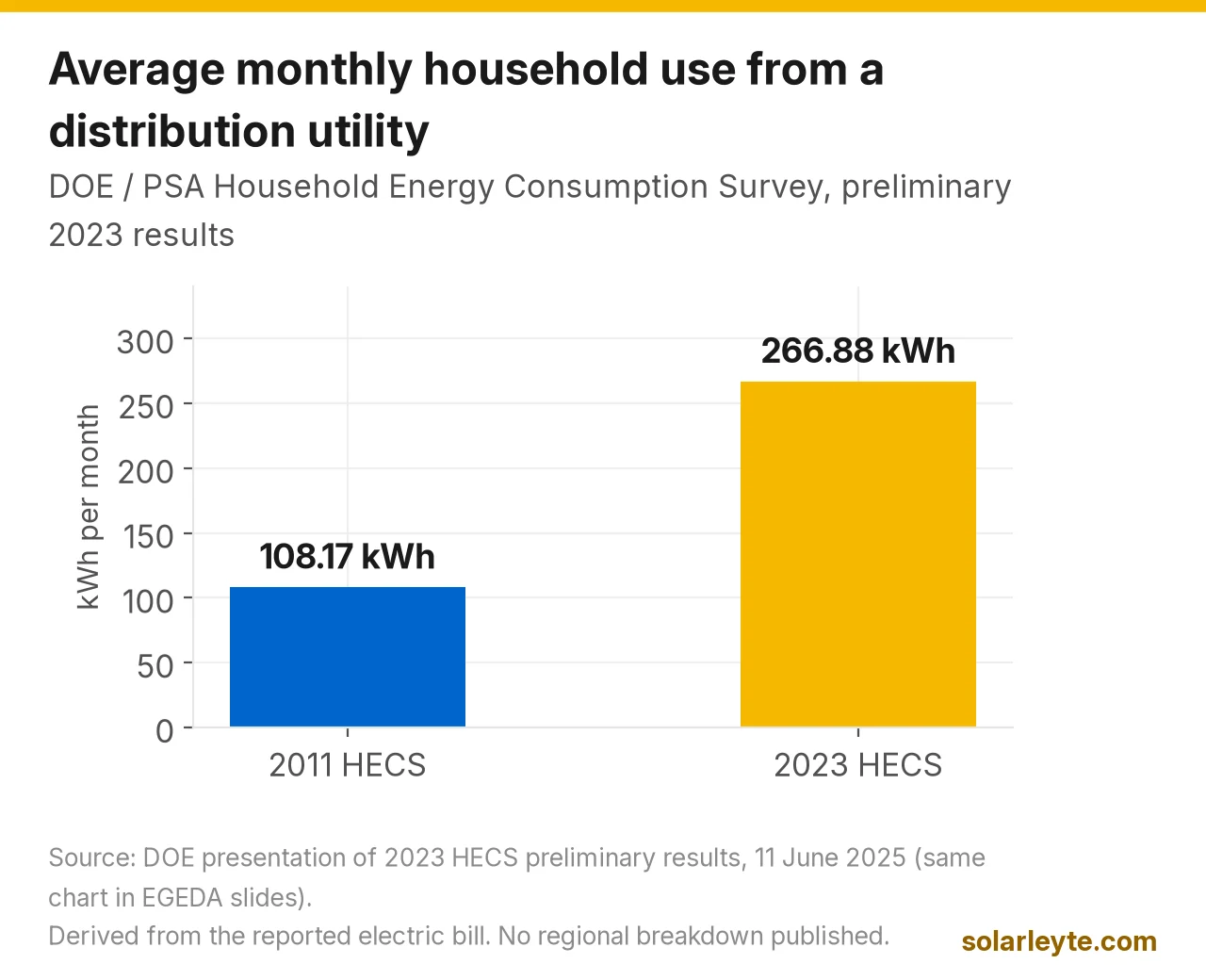
The 2023 Household Energy Consumption Survey is a joint DOE and PSA survey of about 45,000 households, designed to support national and regional estimates. DOE's Danilo V. Vivar, Chief Science Research Specialist at the Energy Policy and Planning Bureau, presented the preliminary results at an IEA workshop on 11 June 2025. The same chart appears in DOE's slides for APEC's EGEDA workshop.
The electricity slide is specific:
- It covers households using electricity from distribution utilities
- The average is monthly, in kilowatt-hours
- The note on the chart says: “Average electric consumption was derived from the reported electric bill.”
- 2011: 108.17 kWh
- 2023: 266.88 kWh
- The slide labels the change as 7.8% per year
We have not found a published 2023 HECS table that breaks that kWh average down by region, so we will not invent an Eastern Visayas or Biliran figure. The survey was built to support regional estimates, and a final report with statistical tables was being prepared, but as of 8 November 2026 the figure we can cite is the national preliminary average.
Dividing by 30 days, the 266.88 kWh national average is about 8.9 kWh a day, and the 2011 figure was about 3.6 kWh a day. That daily split is a Solar Leyte calculation, useful if you have been searching “how many kWh per day is normal.”
The survey also asked about problems with the distributor. In 2023, 71.0% of those households cited the high rates or cost of electricity, down a little from 77.0% in 2011, while power interruptions were cited by 81.9%. High bills are not only about how much you use; the rate itself is a separate story, which we unpack in Bakit mahal ang kuryente.
What that national average would cost here
BILECO's October 2026 page lists the residential effective rate as ₱19.3628 per kWh. The same site's bill FAQ says the current rate includes the generation charge, transmission charge and VAT. The headline figures themselves are not labelled “exclusive” or “inclusive” of VAT; we treat ₱19.3628 as the posted all-in rate the page tells you to multiply by your kWh.
LEYECO IV's October 2026 rates, posted 28 October 2026, show a residential Rate per kWh of ₱17.0099. That total already includes the EVAT lines (generation VAT ₱1.0013, transmission VAT ₱0.0614, ancillary service VAT ₱0.1439 and distribution VAT ₱0.2491), plus a separate ₱5.00 per meter per month metering charge. No November 2026 schedule was found on that page as of 8 November 2026.
Monthly use | What it is | BILECO bill (kWh × ₱19.3628) | LEYECO IV bill (kWh × ₱17.0099 + ₱5) |
|---|---|---|---|
100 kWh | A modest household month | ₱1,936.28 | ₱1,705.99 |
150 kWh | A common working figure in our other rate examples | ₱2,904.42 | ₱2,556.49 |
200 kWh | The consumption level Meralco uses as “typical” | ₱3,872.56 | ₱3,406.98 |
266.88 kWh | 2023 HECS national average | ₱5,167.54 | ₱4,544.60 |
300 kWh | A heavier household month | ₱5,808.84 | ₱5,107.97 |
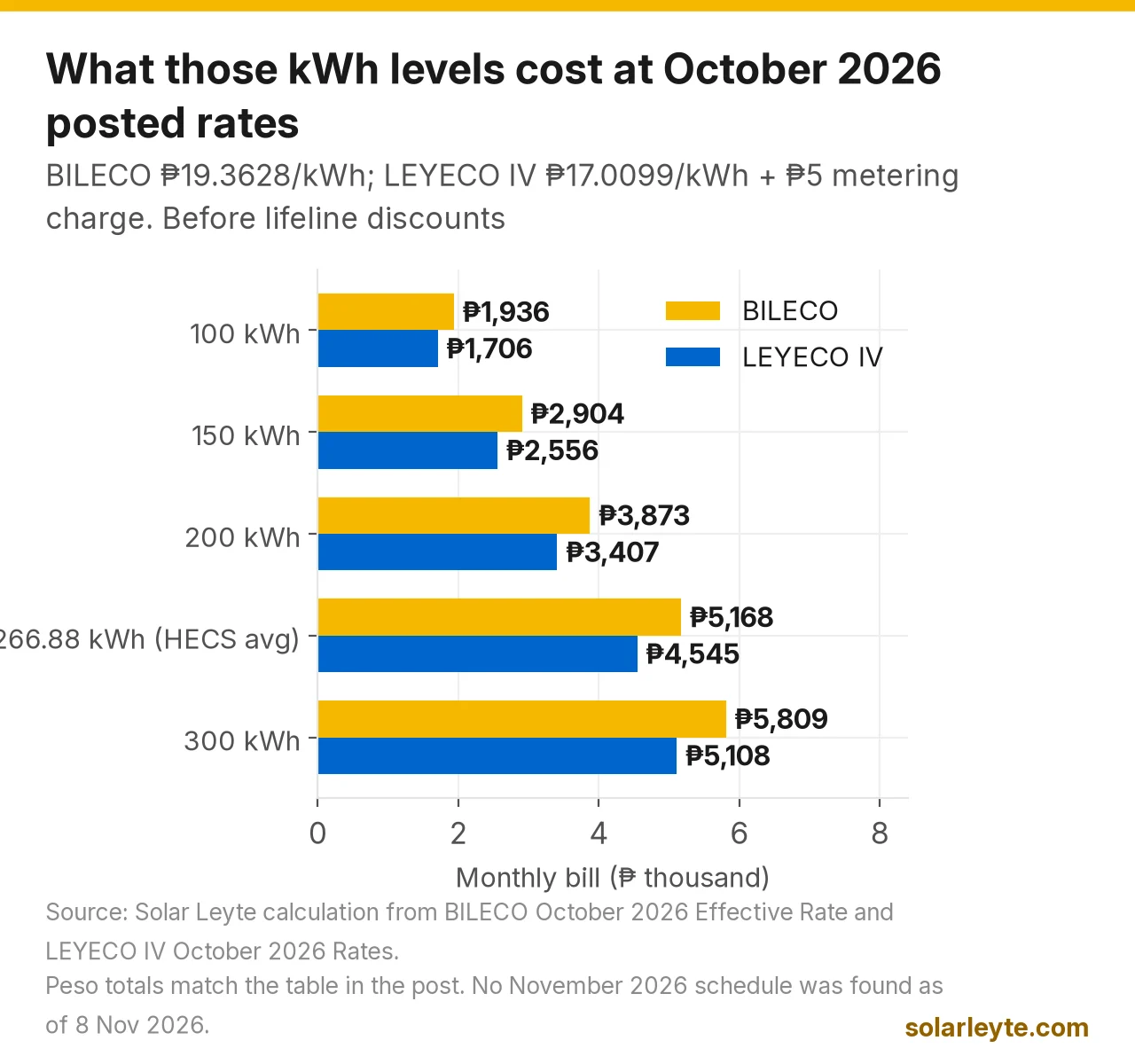
These are Solar Leyte calculations using the posted residential rates, before any lifeline or senior-citizen discount. A qualified lifeline household pays much less than the simple kWh × rate sum; see our lifeline rate and senior-citizen discount guide. Other Leyte co-ops post their own rates, which we track separately for LEYECO II, LEYECO IV and LEYECO V and DORELCO and LEYECO III. For how the charges on a bill fit together, start with the BILECO and LEYECO rates guide and the BILECO monthly tracker.
If ₱5,168 feels high compared with the bills you see in Naval, Caibiran or a Leyte town without much aircon, that does not mean the survey is “wrong.” It means the national average includes many higher-use homes, and no official Eastern Visayas kWh average has been published yet. Treat 266.88 kWh as a national benchmark, not as “normal for Biliran.”
Meralco's “typical” 200 kWh is not the national average
Most articles about the “average electric bill in the Philippines” quietly switch to Meralco and to 200 kWh, because Meralco publishes a monthly table called “Residential Bills at Typical Consumption Levels.” That table is a rate illustration at set kWh points, not a survey of how much households actually use.
In Meralco's October 2026 typical-consumption table, a non-lifeline household using 200 kWh is billed ₱3,012.30, or ₱15.0615 per kWh. At 300 kWh the same table shows ₱4,611.23.
Put the same 200 kWh on a local posted rate and the gap is the rate, not your lifestyle:
- BILECO: ₱3,872.56, about ₱860 more than Meralco's ₱3,012.30
- LEYECO IV: ₱3,406.98, about ₱395 more than Meralco's figure
So if a Metro Manila article says a “typical” bill is around ₱3,000, that is a 200 kWh Meralco example from that month, not proof that a Leyte or Biliran household should expect the same peso amount for the same kWh.
How to find your own normal
A national survey cannot tell you whether your bill is high. Your last 12 statements can.
- Open 12 months of bills, on paper or through your co-op's online payment page.
- Write down the kWh used each month, not only the peso total. The peso total moves when the rate moves.
- Add the 12 kWh figures and divide by 12. That is your household's average monthly use.
- For a rough peso estimate at today's rate, multiply that average by BILECO's ₱19.3628 or by LEYECO IV's ₱17.0099 and then add LEYECO IV's ₱5 metering charge.
If one month jumps because a visitor ran the aircon, or a month drops because you were away, the 12-month average smooths that out better than staring at a single SOA.
Once you know your kWh, you can see what is using it. Our appliance kWh guide works through a refrigerator, electric fan, TV and rice cooker at BILECO and LEYECO rates, and the aircon guide covers the usual big swing in household use. For habits that cut kWh without changing the rate, see Paano makatipid sa kuryente.
If the kWh looks normal but the pesos still sting
There are two different problems that get called a “high bill”:
- High kWh. The house is using a lot of energy. The fix is in how you run appliances, and, if you want to offset daytime use, in system size. Our how many solar panels do I need post starts from your bill's kWh, not from a national average.
- High rate. The kWh is ordinary, but each unit costs more here than the Meralco examples people see online. That is a rate story, not a usage story, and it is why the same 200 kWh is about ₱860 more on BILECO than on Meralco in October 2026.
If you share a meter with another household, the peso total on the SOA is not “your” bill until you split the kWh. Use the submeter computation guide rather than guessing.
FAQ
What is the average electric bill in the Philippines?
There is no single official peso average for 2026. The newest official consumption figure is the 2023 HECS preliminary result: 266.88 kWh a month (national average) for households using electricity from a distribution utility, derived from the reported electric bill. The peso bill depends on your distribution utility's rate that month. At October 2026 posted rates, 266.88 kWh works out to about ₱5,168 on BILECO and ₱4,545 on LEYECO IV, before lifeline or senior-citizen discounts.
What is a normal electric bill in Leyte or Biliran?
We could not find a published BILECO or LEYECO average residential kWh for a recent year, and the 2023 HECS has not released a Region VIII breakdown of that 266.88 kWh figure. A “normal” local bill is the one you get by averaging your own 12 months of kWh and applying the current posted rate. Many homes without aircon will land well below the national average; some with several aircon units will land above it.
How many kWh per day is normal?
Using the HECS monthly average and dividing by 30, about 8.9 kWh a day nationwide in 2023, compared with about 3.6 kWh a day in 2011. That is a national survey average, not a recommended daily budget for a Leyte or Biliran home.
Why is my bill higher than the ₱3,012 I see in Meralco articles?
Meralco's October 2026 table bills a non-lifeline 200 kWh month at ₱3,012.30. The same 200 kWh at BILECO's October residential rate is ₱3,872.56, and at LEYECO IV it is ₱3,406.98. Part of the difference is the higher posted rate here. The other part is whether you actually used 200 kWh, or more.
Does the 266.88 kWh average include lifeline households?
The HECS chart is the average monthly consumption, derived from reported bills, of households using electricity from distribution utilities. It does not say whether lifeline customers are included or excluded, and it does not publish a median. Lifeline discounts change what you pay, not necessarily how many kWh you used. Check the lifeline rules separately if your use is around 50 kWh or below.
Solar Leyte is run by MACC Systems & Energy Solutions Inc., a solar installer in Naval, Biliran.
Get a free solar quote from MACC
Planning rooftop solar for a Biliran or Leyte home or business? Send a photo of your latest BILECO or LEYECO bill and we'll get back to you with a free, no-obligation written quote.
- Call/Text: 0955 723 5093
- Email: official@macc-inc.com
- Website: www.macc-inc.com
- Or use the site quote form: /quote
Sources (all checked 8 November 2026)
- Department of Energy, Survey Implementation of the 2023 Household Energy Consumption Survey, presented by Danilo V. Vivar, EPPB-PFRD, IEA Demand Side Data and Energy Efficiency Indicators Workshop for Southeast Asia, 11 June 2025 (file dated 10 June 2025): preliminary results; 45,000-household sample; 266.88 kWh (2023) and 108.17 kWh (2011) average monthly electric consumption of households using electricity from distribution utilities, derived from the reported electric bill; 7.8% per year; 71.0% cited high rates or cost of electricity in 2023 (77.0% in 2011); 81.9% cited power interruptions in 2023.
- Department of Energy, An Overview of the Energy Accounting Process / 2023 HECS, EGEDA workshop slides: same 266.88 / 108.17 kWh chart and note.
- PSA, regional notes on the 2023 HECS (joint DOE–PSA survey; fifth in the series after 1989, 1995, 2004 and 2011).
- BILECO, October 2026 Effective Rate: residential ₱19.3628/kWh; commercial ₱17.8574/kWh. The site's bill FAQ describes the current rate as including generation charge, transmission charge and VAT. A live fetch of this URL on 8 November 2026 returned a Cloudflare challenge (HTTP 530); figures are from a saved copy of the official page retrieved on 7 November 2026, matching copies saved on 3, 5 and 6 November 2026. No November 2026 BILECO rate page was found.
- LEYECO IV, October 2026 Rates, posted 28 October 2026: residential Rate per kWh ₱17.0099 (EVAT lines included in that total); ₱5.00/meter/month metering charge. No November 2026 rates post was listed as of 8 November 2026.
- Meralco, Residential Bills at Typical Consumption Levels, October 2026: non-lifeline 200 kWh total bill ₱3,012.30 (₱15.0615/kWh); 300 kWh ₱4,611.23.