On 13 November 2026, a Philippine IT and solar store listed the Huawei SUN2000-5KTL-L1 (5 kW hybrid inverter) at ₱36,625, the LUNA2000 power module at ₱31,385 and each 5 kWh LUNA2000 battery module at ₱90,787. That puts a 5 kW inverter with a 5 kWh battery at about ₱158,800 in parts, before panels, wiring and installation. The battery is the expensive bit. At roughly ₱20,000 to ₱24,000 per kWh, LUNA2000 costs roughly 1.5 to 4 times as much per kWh as the 48 V lithium batteries sold widely in the Philippines.
The bigger catch for brownout areas: Huawei's own spec sheet says the SUN2000-L1 only gives backup power through a Backup Box-B0 (or Huawei's SmartGuard). Without one, the inverter and battery shut down with the grid, like a plain grid-tie system. Ask if it's in your quote.
Last checked: 13 November 2026. Prices change often, so treat them as a snapshot.
What a Huawei home system is made of
Huawei's residential line in the Philippines is built around three parts:
- SUN2000-L1 inverter (2 to 6 kW, single-phase). Huawei calls it a "smart energy controller". It works as a grid-tie inverter and becomes a hybrid when you add a LUNA2000 battery.
- LUNA2000-S0 battery. A 12 kg power module (LUNA2000-5KW-C0) sits on top of one to three 50 kg, 5 kWh battery modules (LUNA2000-5-E0). That gives you 5, 10 or 15 kWh, and two stacks reach 30 kWh.
- Backup Box-B0. A separate switch box that lets the inverter run your house when the grid drops.
The battery runs at 350 to 560 V on a single-phase system, so it is a high-voltage battery. That matters for prices and choices. A LUNA2000 only works with Huawei inverters, and a Huawei L1 only takes Huawei batteries. Its spec sheet lists only LUNA2000-S0 and -S1 as compatible. You can't later swap in a cheaper 48 V battery the way you can with a Deye, SRNE or Growatt hybrid.
Huawei prices in the Philippines (November 2026)
Public Philippine peso prices for Huawei's home range are hard to find. Most sellers ask you to message them. These are the listings we could check:
Item | What it is | Seller | Listed price |
|---|---|---|---|
SUN2000-5KTL-L1 | 5 kW single-phase hybrid inverter | We Sell IT (seller: DCI International) | ₱36,625 |
SUN2000-6KTL-L1 | 6 kW single-phase hybrid inverter | We Sell IT (DCI International) | ₱37,758 |
SUN2000-10K-LC0 | 10 kW single-phase hybrid inverter | We Sell IT (DCI International) | ₱45,250.51 |
LUNA2000-5KW-C0 | Battery power module (one per stack) | We Sell IT (DCI International) | ₱31,385 |
LUNA2000-5-E0 | 5 kWh battery module | We Sell IT (DCI International) | ₱90,787 |
SUN2000-5KTL (suffix not shown) | 5 kW inverter | Sungrid Energy (15 Oct check) | ₱52,000 |
We Sell IT's Huawei pages were live on its staging site, so treat these as indicative prices, not a final quote. No Philippine seller we checked showed a public price for the Backup Box-B0 or Huawei's power meter. Ask for both by name.
The same 5 kW inverter showed up at ₱36,625 in one store and ₱52,000 in another. A gap that size is normal, so get the inverter priced on its own line in any quote. Our grid-tie inverter price comparison has more on-grid prices for Huawei, Solis and Deye.
Worked example A: parts cost for a 5 kW Huawei hybrid
Solar Leyte calculation from the listings above (parts only, no panels, Backup Box, meter, wiring or labour):
Build | Inverter | Battery stack | Parts total | Battery ₱ per kWh |
|---|---|---|---|---|
5 kW + 5 kWh | ₱36,625 | ₱31,385 + ₱90,787 = ₱122,172 | ₱158,797 | ₱24,434 |
5 kW + 10 kWh | ₱36,625 | ₱31,385 + 2 × ₱90,787 = ₱212,959 | ₱249,584 | ₱21,296 |
5 kW + 15 kWh | ₱36,625 | ₱31,385 + 3 × ₱90,787 = ₱303,746 | ₱340,371 | ₱20,250 |
The power module is a one-time cost per stack, so each extra 5 kWh brings the cost per kWh down a little. It never gets near low-voltage prices, though. One homeowner on r/SolarPH said they were quoted ₱250,000 installed for 5 kWh of LUNA2000 storage alone. That's one anecdote, not a market price, but it shows how quickly the battery becomes most of the bill.
Huawei vs a typical 48 V hybrid: the cost per kWh
Here's how the LUNA2000 cost per kWh compares with the battery listings in our solar battery price guide. Those were Philippine listings checked in October and November 2026:
Battery type (as listed) | ₱ per kWh |
|---|---|
48 V LiFePO4 racks and wall units (Solarhome, ONE SOLAR, Hopetrek, Humsienk) | ₱5,859 to ₱13,242 |
BYD 10 kWh storage battery | ₱28,000 |
Huawei LUNA2000, 5 kWh stack | ₱24,434 |
Huawei LUNA2000, 15 kWh stack | ₱20,250 |
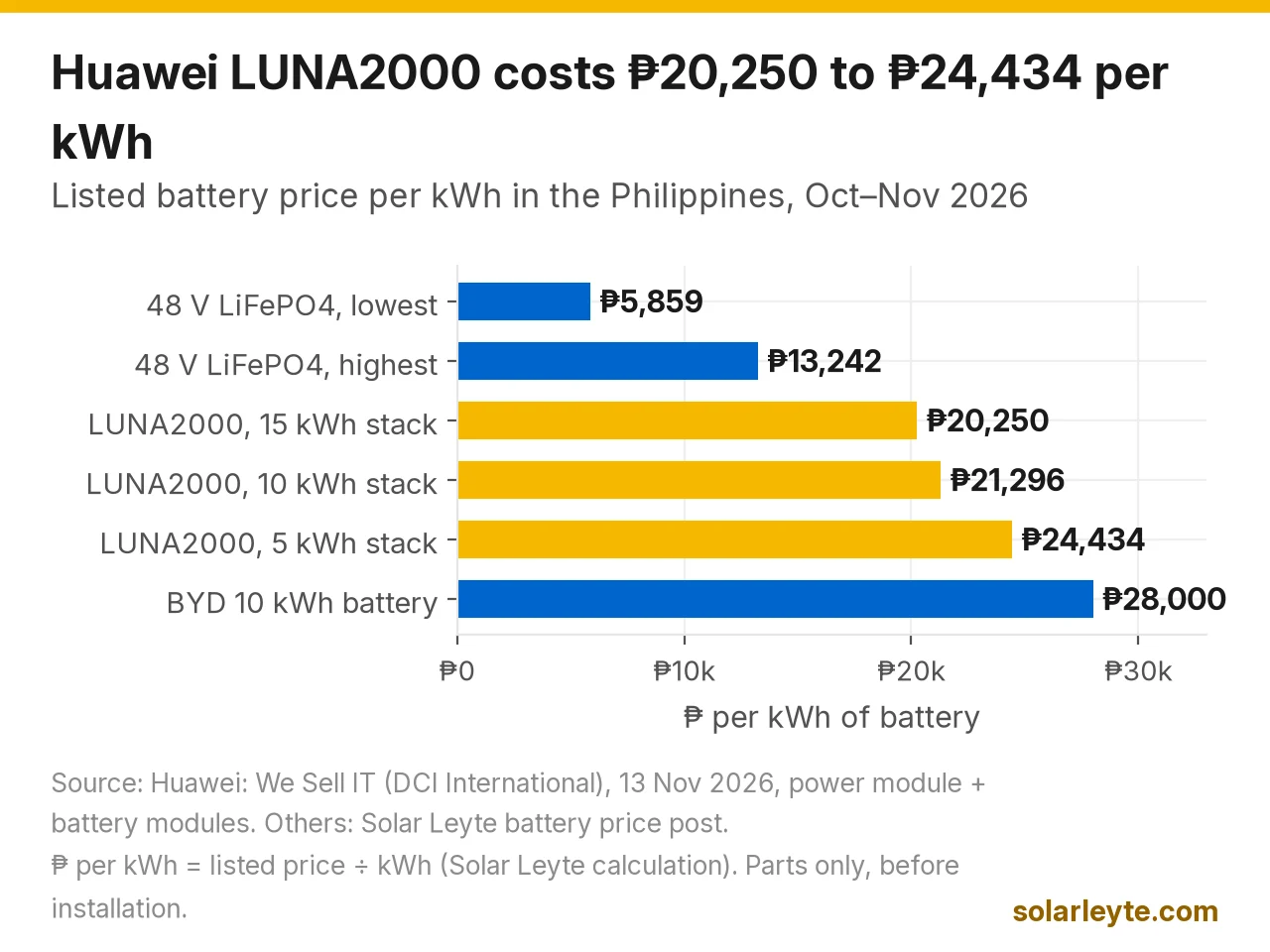
So a premium high-voltage battery from a big brand costs about what BYD costs, and far more than a 48 V rack. Here's what the extra money buys, going by Huawei's datasheet:
- An IP66 enclosure rated for outdoor or indoor use, −20 °C to +55 °C
- Modules you add 5 kWh at a time
- Monitoring in the same FusionSolar app as the inverter
- A long written warranty (see below)
Whether that's worth 1.5 to 4 times the price per kWh depends on how much you value one-brand support. Can your installer actually service Huawei in Leyte or Biliran? Our hybrid inverter price post shows the 48 V route. A 5 kW Deye or SRNE hybrid was listed at about ₱50,000 to ₱53,000, and 48 V batteries cost far less per kWh.
The brownout catch: Backup Box, battery limits and the 3-second gap
This is what Leyte and Biliran buyers most need to check.
1. No Backup Box, no brownout power. The SUN2000-L1 spec sheet on Huawei's Philippine site lists backup power output as "Yes (via Backup Box-B0, HUAWEI SmartGuard-63A-S0)". Like every grid-tied inverter, the L1 has anti-islanding protection and stops when the grid fails. So a Huawei system with a LUNA2000 but no Backup Box saves on your bill, but the lights still go out in a brownout. Kung brownout ang problema mo, siguraduhin na kasama ang Backup Box sa quote.
2. The battery size limits your load. Huawei's LUNA2000 datasheet gives these outputs:
LUNA2000 stack | Usable energy | Max output | Short peak |
|---|---|---|---|
5-S0 (1 module) | 5 kWh | 2.5 kW | 3.5 kW for 10 s |
10-S0 (2 modules) | 10 kWh | 5 kW | 7 kW for 10 s |
15-S0 (3 modules) | 15 kWh | 5 kW | 7 kW for 10 s |
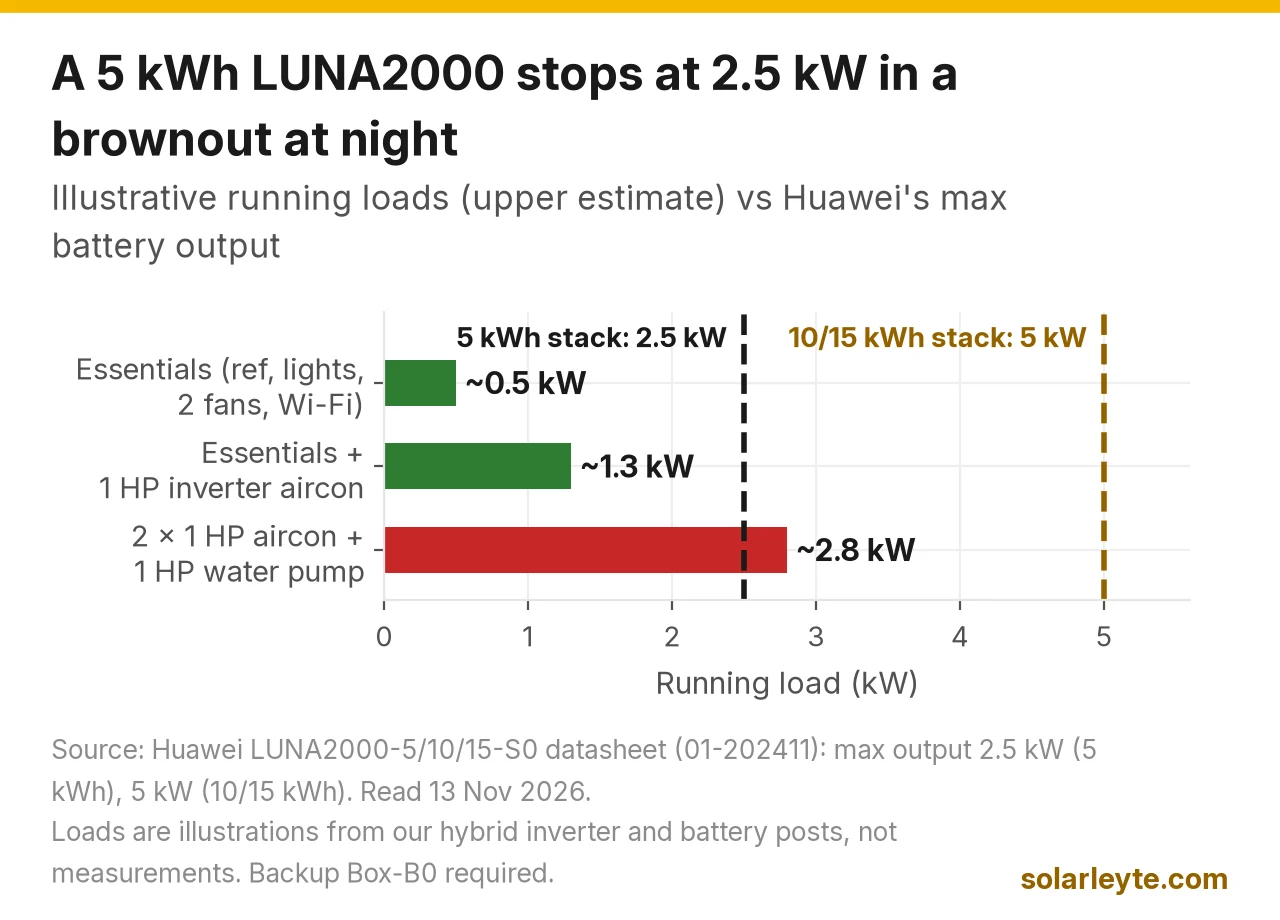
The Backup Box-B0 itself can handle up to 5,000 VA (22.7 A). At night, with no solar, the battery is the only source, so a 5 kWh stack caps you at about 2.5 kW no matter what the inverter is rated for.
3. There's a short gap. The Backup Box datasheet gives a switchover time of under 3 seconds. That's fine for a ref, fans and lights. But a desktop PC, a Wi-Fi router or a Starlink dish will reboot. If staying online matters, add a small UPS for those. Our Wi-Fi and Starlink brownout guide sizes one.
Worked example B: will a 5 kWh LUNA2000 run my house in a brownout?
These are illustrative loads from our earlier posts, not measurements of your home:
- Essentials (ref, 4 LED bulbs, 2 stand fans, Wi-Fi): under 0.5 kW running. Our battery post works out about 0.76 kWh for a 4-hour evening brownout. A 5 kWh stack covers this easily.
- Essentials plus one 1 HP inverter aircon (870 W rated): about 1.1 to 1.3 kW running. That's still under the 2.5 kW limit of a 5 kWh stack.
- Two 1 HP aircons plus a 1 HP water pump (746 W): about 2.6 to 2.8 kW running. That's above 2.5 kW, so the 5 kWh stack would trip on overload. You'd need the 10 kWh stack (5 kW), or you'd have to keep the pump off the backup circuit.
Worked example C: keeping some battery for brownouts
Huawei's Backup Box quick guide describes a "backup power SOC" setting from 20% to 100%. In normal grid-tied mode, the battery stops discharging when it reaches that level, and the rest is saved for a brownout. On a 5 kWh stack:
- A 30% setting keeps 5 × 0.30 = 1.5 kWh in reserve. That's about twice the 0.76 kWh evening-essentials figure.
- A 50% setting keeps 2.5 kWh in reserve, but you get less bill-saving use from the battery each night.
Solar Leyte calculation. Real hours depend on your loads and inverter losses.
Warranty: what Huawei publishes, and what to get in writing
Huawei's published limited warranty letter (the July 2024 European edition we could download) lists:
- Residential inverters: 10 years, starting 180 days after shipment, with paid extensions of +5 or +10 years
- LUNA2000-S0 battery: 10 years, or 60% of nominal energy, or 16.45 MWh of discharge per 5 kWh module, whichever comes first
- Backup Box and power meter: 2 years each
Here's what 16.45 MWh means. One full 5 kWh cycle a day for 16,450 ÷ 5 = 3,290 days is about 9 years (Solar Leyte calculation). A household that cycles the battery hard every day could reach the energy limit before the 10-year date.
The Philippine store listing for the same SUN2000-5KTL-L1 says "5 Year warranty". That's not the 10 years in the European letter. Warranty terms are set by country and by who sold the unit. Before you pay, get in writing which warranty applies in the Philippines, who registers the products with Huawei, and who handles a claim from Leyte or Biliran. Our installer checklist covers the rest of the paperwork.
When Huawei makes sense, and when it doesn't
Huawei fits if:
- You want a tidy, one-brand system with one app, and you value the long written warranty
- Your roof has shade or odd angles. Huawei's spec sheet lists add-on panel optimizers for the L1
- Your installer stocks Huawei and has done the Backup Box set-up before
Look elsewhere if:
- Your main goal is the most brownout hours per peso. A 48 V hybrid with a cheaper lithium rack gives far more kWh for the money
- You may want to add a different battery brand later
- No installer near you services Huawei
If you just want to cut the bill with no battery, a Huawei L1 can run as a plain grid-tie inverter now and take a LUNA2000 later. Check your monthly kWh first with our electricity calculator. Then compare written quotes. You can request one through our quote form.
Frequently asked questions
How much is a Huawei solar system in the Philippines?
In November 2026, parts alone for a 5 kW SUN2000-L1 with a 5 kWh LUNA2000 came to about ₱158,800 from one Philippine listing. With 10 kWh, it's about ₱249,600. Panels, Backup Box, wiring and installation come on top.
Magkano ang Huawei LUNA2000 battery sa Pilipinas?
Sa listing na nakita namin noong 13 Nobyembre 2026, ₱90,787 ang bawat 5 kWh battery module at ₱31,385 ang power module. Mga ₱122,000 ang pinakamaliit na 5 kWh stack, bago ang installation.
Does a Huawei hybrid work during a brownout?
Only if it has a Backup Box-B0 (or Huawei SmartGuard) and a LUNA2000 battery. Without the Backup Box, it shuts down with the grid. With one, it switches over in under 3 seconds and powers the backup circuits, up to the battery's output limit.
Can I use a cheaper battery with a Huawei inverter?
No. The SUN2000-L1 spec sheet lists only Huawei LUNA2000-S0 and -S1 batteries as compatible.
Solar Leyte is run by MACC Systems & Energy Solutions Inc., a solar installer in Naval, Biliran.
Get a free solar quote from MACC
Comparing Huawei with other hybrid setups? Send us a recent BILECO or LEYECO bill and tell us what you want running in a brownout. We'll send a free, no-obligation written quote.
- Call/Text: 0955 723 5093
- Email: official@macc-inc.com
- Website: www.macc-inc.com
- Or use the site quote form: /quote
Related guides
- Solar panel price in the Philippines: how to read a quote
- Hybrid inverter prices: Deye, SRNE, Sungrow and more
- Solar battery prices and brownout sizing
- Pylontech vs Dyness vs Deye batteries
- 5 kW solar system price, itemised
Sources (all checked 13 November 2026)
- Huawei Smart PV Philippines: SUN2000-2/3/3.68/4/4.6/5/6KTL-L1 specs: compatible batteries LUNA2000-5/10/15-S0 and -7/14/21-S1; battery 350–560 V; max discharge 5,000 W (5 and 6 kW models); backup power output "Yes (via Backup Box-B0, HUAWEI SmartGuard-63A-S0)"; anti-islanding; optimizer compatibility; IP65.
- Huawei LUNA2000-5/10/15-S0 datasheet (PDF, version 01-202411): 5/10/15 kWh usable; 2.5/5/5 kW max output; 3.5/7/7 kW peak for 10 s; 12 kg power module, 50 kg battery modules; IP66; −20 °C to +55 °C; scalable 5–30 kWh; modules ordered separately.
- Huawei Backup Box-B0/B1 datasheet (PDF, version 02-202311): B0 for SUN2000-L1, 5,000 VA, 22.7 A, switchover under 3 s.
- Huawei LUNA2000 Backup Box quick guide (PDF, distributor copy): "Backup power SOC" setting from 20% to 100%; automatic or manual off-grid switching.
- Huawei limited product warranty, July 2024 European edition (PDF, distributor copy): residential inverters 10 years (extendable); LUNA2000-S0 10 years / 60% / 16.45 MWh per LUNA2000-5-E0; Backup Box and meter 2 years.
- We Sell IT: Huawei SUN2000-5KTL-L1 and LUNA2000-5-E0 (sold by DCI International, Makati): ₱36,625, ₱37,758 (6KTL-L1), ₱45,250.51 (10K-LC0), ₱31,385 (LUNA2000-5KW-C0), ₱90,787 (LUNA2000-5-E0); "5 Year warranty" on the inverter listing.
- Sungrid Energy: Huawei SUN2000-5KTL: ₱52,000.
- r/SolarPH: "LUNA2000 Huawei Batteries": a homeowner's ₱250,000 installation quote for 5 kWh (one anecdote).
- Low-voltage battery, BYD and 48 V hybrid prices: our solar battery price and hybrid inverter price posts, with their own dated sources. Load figures (0.76 kWh essentials; 870 W aircon; 746 W pump): the same posts.
- Worked examples A–C, the cost per kWh and the 3,290-day figure are Solar Leyte calculations from the figures above.