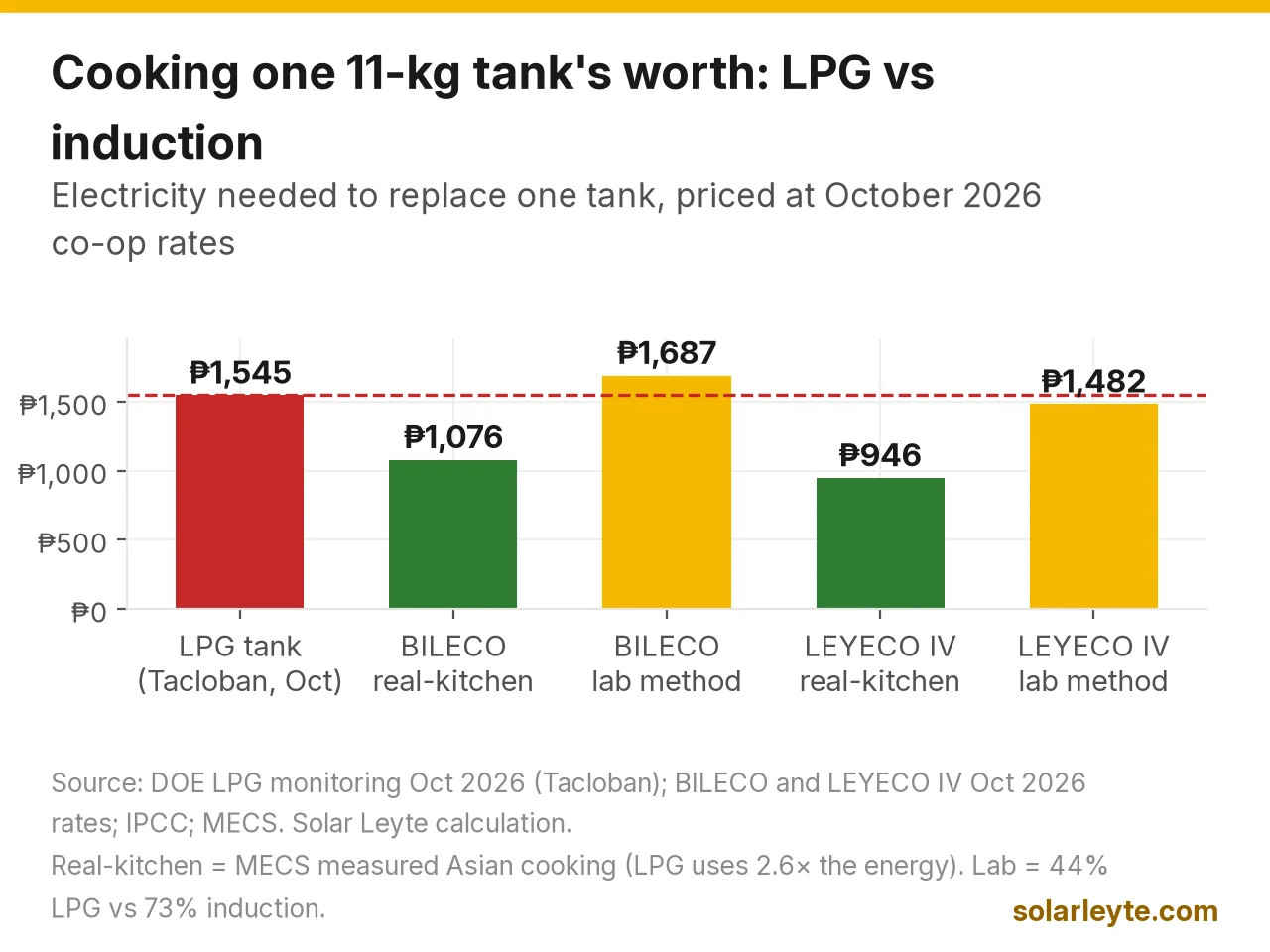
Short answer: in most Leyte homes, cooking on induction costs less than LPG, but in Biliran it's closer than people think. Using measured data from real kitchens in Asia, the electricity that replaces one 11-kg tank costs about ₱1,076 at BILECO's October 2026 rate and about ₱946 at LEYECO IV's, against ₱1,545 for a tank in Tacloban. Using lab efficiency figures instead, induction costs about ₱1,687 at BILECO (more than the tank) and ₱1,482 at LEYECO IV (slightly less). How you cook decides which side you land on. And LPG still works in a brownout.
Last checked: 2 November 2026. LPG prices change every month and co-op rates change every billing month, so check your own numbers with the method below.
The numbers we used
Input | Value | Source |
|---|---|---|
11-kg LPG, Tacloban City (October 2026) | ₱1,446 to ₱1,545; common price ₱1,545 | DOE price monitoring, Regions 6 to 8 |
11-kg LPG, Ormoc City (October 2026) | ₱1,344 to ₱1,570 | DOE price monitoring, Regions 6 to 8 |
BILECO residential rate, October 2026 | ₱19.3628/kWh | BILECO |
LEYECO IV residential rate, October 2026 | ₱17.0099/kWh, plus ₱5.00 a month fixed | LEYECO IV |
Heat in 11 kg of LPG | 47.3 MJ/kg, so about 144.5 kWh per tank | IPCC 2006 Guidelines |
Stove efficiency (lab test values) | LPG 44%, induction 73% | MECS, citing US DOE test procedures |
Energy used in measured Asian cooking | LPG uses about 2.6 times the energy of induction for the same dishes | MECS, from 700+ measured dishes |
Two notes on these. The DOE sheet was taken in early October, before the later October increases and Petron's ₱50-per-cylinder rollback on 27 October, and an industry group expects another ₱1 to ₱3 per kg in November. The BILECO rates used here are BILECO's posted effective rates, VAT included. The simplest fix for the tank-price note: use your own tank price and your own bill (total ÷ kWh).
Why "per tank" is the fair way to compare
An LPG tank and a kWh aren't the same thing, so we compare the electricity needed to do the same cooking as one 11-kg tank.
- One 11-kg tank holds about 144.5 kWh of heat (11 kg × 47.3 MJ/kg ÷ 3.6).
- Lab method: if your LPG burner puts 44% of that heat into the pot and induction puts in 73%, one tank's cooking needs about 87 kWh on induction.
- Real-kitchen method: MECS, a UK-funded clean-cooking research programme, looked at measured data from more than 700 dishes cooked on different fuels. For Asian cooking, LPG used about 2.6 times as much energy as induction for the same dishes. That means one tank's cooking needs about 56 kWh on induction.
Why the gap? Lab tests use a fixed procedure, while real cooking depends on habits like using a lid, turning the heat down and switching off on time. MECS notes that real results depend a lot on cooking style. Our guess at part of the reason: induction's exact power steps and timers make it easier to avoid wasted heat than a gas knob does. ENERGY STAR's figures (about 85% for induction, 32% for gas) give a result close to the real-kitchen number: about 54 kWh per tank.
Cost per tank: BILECO vs LEYECO IV
This is a Solar Leyte calculation using the inputs above, against a ₱1,545 tank (Tacloban common price):
kWh to replace one tank | At BILECO ₱19.3628 | At LEYECO IV ₱17.0099 | |
|---|---|---|---|
Real-kitchen method (MECS, Asia) | 55.6 kWh | ₱1,076 (₱469 less than LPG) | ₱946 (₱599 less) |
Lab method (44% vs 73%) | 87.1 kWh | ₱1,687 (₱142 more than LPG) | ₱1,482 (₱63 less) |
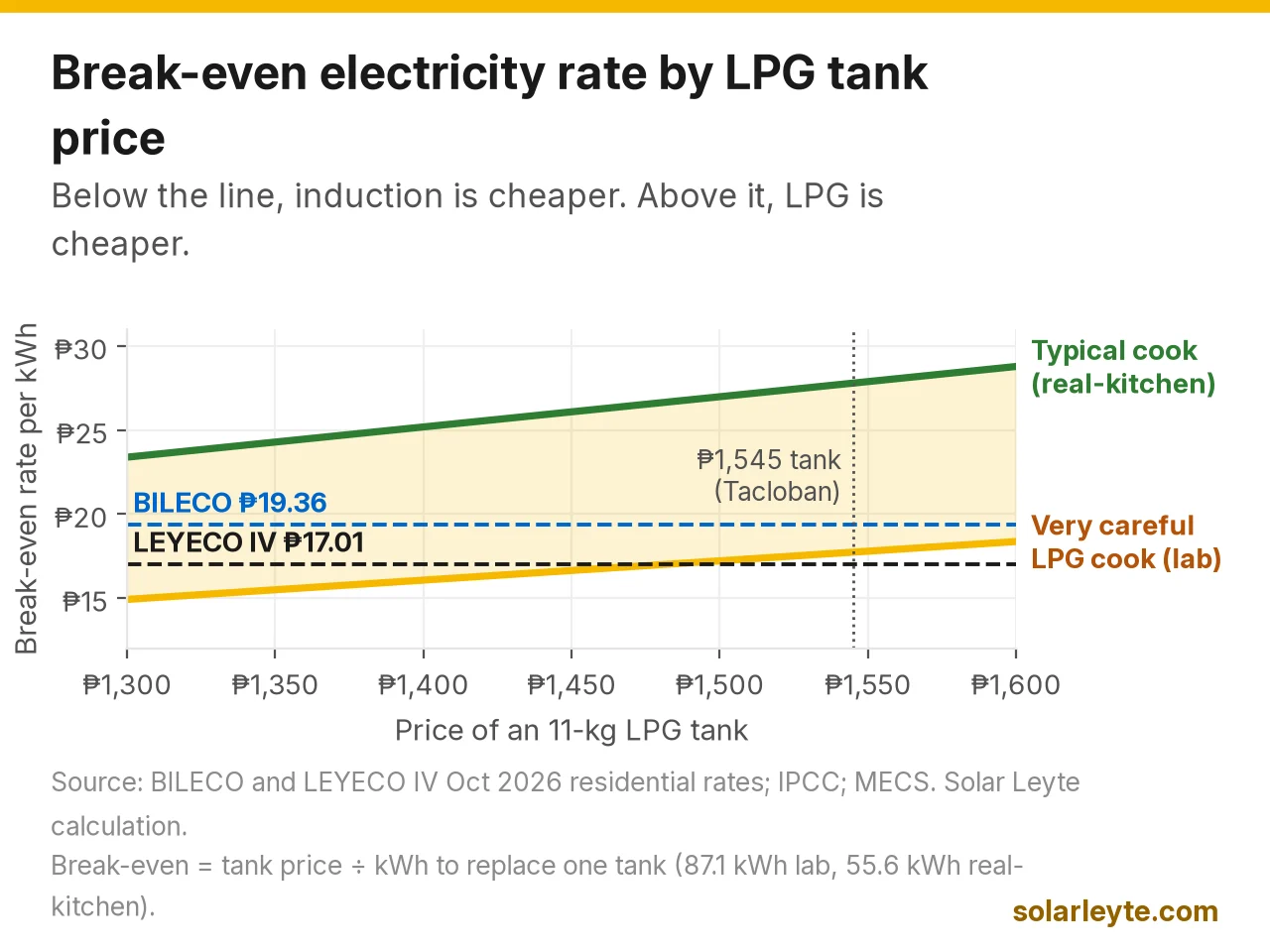
The break-even electricity rate tells you the most. With a ₱1,545 tank, induction stops being cheaper above ₱17.74/kWh if you cook like a lab test, or above ₱27.79/kWh if you cook like a typical household. BILECO's October rate sits between the two. LEYECO IV's is just under the lower one.
So, in plain terms:
- Leyte (LEYECO IV, and other co-ops at similar or lower rates): induction wins under both methods, by a little or by a lot.
- Biliran (BILECO): induction wins if your cooking resembles the real-kitchen data. If you're already a careful LPG cook (small flame, lid on, low heat once it boils), the gap narrows or flips.
- Cheap tank? In Ormoc, the lowest price DOE recorded was ₱1,344. At that price the lab-method break-even falls to ₱15.43/kWh, so a very careful LPG cook would spend less on gas.
If BILECO's rate climbs back up or LPG drops, the answer moves. The chart below shows how much.
How much electricity does an induction cooker use per hour?
The answer to "induction cooker electricity consumption per hour Philippines" is simple: watts ÷ 1,000 = kWh per hour at that power setting. Induction cookers cycle and you rarely cook on max, so real use is usually lower than the label.
Power setting | kWh in 1 hour | At BILECO (Oct 2026) | At LEYECO IV (Oct 2026) |
|---|---|---|---|
1,000 W (medium) | 1.0 | ₱19.36 | ₱17.01 |
1,400 W | 1.4 | ₱27.11 | ₱23.81 |
2,000 W (max on most single cookers) | 2.0 | ₱38.73 | ₱34.02 |
Example (assumptions, not a measurement): 1 hour of cooking a day at an average of 1,000 W is 30 kWh a month, about ₱581 on a BILECO bill or ₱510 on LEYECO IV. Check your own cooker's label and run it through our appliance kWh guide.
What the cookers on sale draw (prices checked 2 November 2026):
Model (seller) | Rated power | Listed price |
|---|---|---|
Tough Mama NTM-IC1 (SM Home) | 1,500 W | ₱1,679.20 (sale) |
Kyowa KW-3631 (SM Home) | 1,400 W | ₱2,599 |
Imarflex IDX-2000S (Imarflex official store) | 2,000 W | ₱3,998 |
Imarflex IDX-3210C twin (SM Home) | 2,800 W total (1,300 W + 1,500 W) | ₱6,749.10 (sale) |
Induction only works with pots a magnet sticks to (flat-bottomed cast iron or magnetic stainless steel). Aluminium kaldero and most clay pots won't work, so budget for at least one compatible pot.
Worked example: a Naval family that uses one tank a month
Assumptions (ours): a household on BILECO's October 2026 residential rate uses one 11-kg tank a month at ₱1,545 and switches all cooking to induction.
- Real-kitchen method: 55.6 kWh × ₱19.3628 = about ₱1,076 a month, so roughly ₱469 saved.
- Lab method: 87.1 kWh × ₱19.3628 = about ₱1,687 a month, so roughly ₱142 more.
- Payback on a ₱1,679 to ₱3,998 cooker (if you save ₱469 a month): about 4 to 9 months. If your cooking is closer to the lab method, there's no payback on cost alone.
Same family on LEYECO IV: about ₱946 (real-kitchen) or ₱1,482 (lab). That's ₱599 or ₱63 less than the tank.
Carinderia note: BILECO's October 2026 commercial rate is ₱17.8574/kWh. At that rate, one tank's worth of cooking costs about ₱993 (real-kitchen) or ₱1,556 (lab). Busy kitchens that cook big pots non-stop are closer to the lab case, so test one burner for a month before switching the whole stall.
Many families do both: induction for daily cooking, with the LPG burner kept as a backup. Mas tipid, and you still have a stove when the power goes out.
Brownouts: the big catch
LPG doesn't care if the line is down. Induction does. In typhoon season, or during a Visayas grid alert, that matters more than a few hundred pesos.
- A 2,000 W induction cooker needs an inverter or power station rated at least 2,000 W continuous. Many small power stations can't run it at full power.
- Example: 30 minutes at an average of 1,000 W uses about 0.5 kWh of battery, before inverter losses.
- A gasoline generator works too, but compare fuel cost first in our generator vs solar guide.
Practical answer for Leyte and Biliran: keep a tank (even a small one) for brownouts. See inverter and battery backup if you want a backup for the fridge, fans and Wi-Fi as well.
What changes if you have solar panels
With rooftop solar, cooking at midday (tanghalian) runs the cooker on your own power while the panels are producing, so you buy fewer kWh from the co-op. That matters because power you export under net metering is credited at the co-op's blended generation cost (excluding other generation adjustments), which is lower than the retail rate you pay. Using your own solar for cooking is usually worth more than exporting it. Dinner after sunset still comes from the grid unless you have a battery.
If you're thinking about panels anyway, our net metering guide explains how credits work, and is solar worth it in Leyte and Biliran has the payback math.
How to check your own break-even in 2 minutes
- Take your last tank price (e.g. ₱1,545) and divide by 87 for the lab case and by 56 for the real-kitchen case. That gives you two break-even rates (₱17.76 and ₱27.59 for ₱1,545; the small difference from the table above is rounding).
- Take your latest bill: total amount ÷ kWh used = your real rate per kWh. Our BILECO and LEYECO rates guide shows where each charge comes from.
- If your rate is below the first number, induction is cheaper even for a careful cook. If it's between the two, it depends on how you cook. If it's above both, stay with LPG.
Want to cut the bill further? See paano makatipid sa kuryente and the monthly BILECO rate tracker.
FAQ
Is induction cheaper than LPG in the Philippines?
Usually yes, but it depends on your electricity rate and how you cook. With a ₱1,545 tank, induction is cheaper below about ₱17.74/kWh even if you cook very carefully on LPG, and below about ₱27.79/kWh for typical home cooking (based on measured Asian kitchen data).
How many kWh does an induction cooker use per month?
It depends on hours and power setting. One hour a day at an average of 1,000 W is 30 kWh a month (our example), about ₱581 at BILECO's October 2026 residential rate. Replacing a whole 11-kg tank's worth of cooking takes roughly 56 to 87 kWh.
Can I run an induction cooker on solar or a power station?
On a grid-tie or hybrid system during the day, yes, as long as the inverter can supply the cooker's wattage. On a power station, check that the continuous rating is at least the cooker's rated watts (often 2,000 W). Battery runtime is short at full power, so keep LPG as your brownout backup.
Do I need special pots for induction?
Yes. The pot base must be magnetic (test with a ref magnet) and flat. Cast iron and magnetic stainless steel work. Aluminium and glass don't.
Solar Leyte is run by MACC Systems & Energy Solutions Inc., a solar installer in Naval, Biliran.
Get a free solar quote from MACC
Thinking of cooking on sunshine at lunchtime? Send us a photo of your latest BILECO or LEYECO bill and we'll reply with options sized to your daytime load, including the cooker. No obligation.
- Call/Text: 0955 723 5093
- Email: official@macc-inc.com
- Website: www.macc-inc.com
Sources (all checked 2 November 2026)
- DOE Oil Industry Management Bureau, Price Monitoring of 11 kg Household LPG, Regions 6 to 8 and NIR, October 2026 (PDF), via the DOE LPG price monitor: Tacloban City ₱1,446 to ₱1,545 (Gasul ₱1,537, Solane ₱1,510, Prycegas ₱1,545, Phoenix ₱1,446, Fiesta Gas ₱1,507); Ormoc City ₱1,344 to ₱1,570.
- DOE, Liquid Fuels and LPG Price Adjustments for 6 to 13 October 2026: October 2026 maximum LPG adjustment of ₱17.33/kg (₱190.60 per 11-kg cylinder).
- radar.ph, 27 October 2026: Petron Gasul and Fiesta Gas ₱50 per 11-kg rollback from 27 October. Daily Tribune, 22 October 2026: LPG Marketers Association expects ₱1 to ₱3/kg more in November.
- BILECO, October 2026 Effective Rate: residential ₱19.3628/kWh, commercial ₱17.8574/kWh. These are BILECO's posted effective rates, VAT included.
- LEYECO IV, October 2026 Rates: residential rate per kWh ₱17.0099; fixed charge ₱5.00 a month.
- IPCC 2006 Guidelines, Vol. 2, Ch. 1, Table 1.2 (PDF): LPG net calorific value 47.3 TJ/Gg (47.3 MJ/kg).
- MECS, "Stove efficiency is only half the story", 14 January 2025: reference efficiencies (LPG 44%, induction 73%, from US DOE test procedures) and an LPG-to-induction energy ratio of about 2.6 from measured Asian cooking data.
- ENERGY STAR, Residential Induction Cooking Tops: induction about 85% efficient, gas cooktops about 32%.
- Imarflex IDX-2000S: 2,000 W, PHP 3,998. SM Home, Electric Stoves and Induction Cookers: Tough Mama NTM-IC1 1,500 W ₱1,679.20; Kyowa KW-3631 1,400 W ₱2,599; Imarflex IDX-3210C 2,800 W ₱6,749.10.
- Ocampo & Suralvo on ERC Resolution No. 15, s. 2025: net-metering exports credited at the utility's blended generation cost.
- Kilowatt-hours per tank, costs per tank, break-even rates and worked examples: Solar Leyte calculations from the figures above.