On 16 October 2026, Philippine shops listed the Tapo C410 KIT (a 2K camera plus a 2.5 W solar panel) at ₱3,500 at Complink and ₱3,990 at Game One. The Tapo C402 KIT was ₱3,990 at Tancom, and the bigger-battery Tapo C425 KIT was ₱5,490 at Bermor Techzone (down from ₱6,490). For farms with no Wi-Fi, the EZVIZ EB8 4G was ₱9,999 to ₱11,900. A Reolink Argus 4 Pro was ₱11,990 on Lazada for the camera alone.
So do they actually work through Leyte's rainy December and January? We checked 25 years of NASA sun data for Naval. For a camera at a quiet gate with its panel in open sun, yes. Even December's average sun is about five times what Tapo says the camera needs. They fail in three situations: the panel sits in shade, the camera faces a busy road and fires hundreds of clips a day, or someone expects a battery camera to record 24/7. The numbers are below.
This post is about battery cameras that come with their own small panel. If you want to power a wired CCTV system or an NVR from solar, that's a different job. You'd need a 12 V panel, a controller and a battery (see our small solar panel price guide) or a portable power station. The pillar overview is the solar generators and portable power guide.
Prices were checked on 16 October 2026 (Philippine time) on each seller's own page, and they change often. Confirm what's in the box before you pay. Listing a product isn't an endorsement, and Solar Leyte earns nothing from these links. No MACC prices appear below.
Solar CCTV prices in the Philippines (16 October 2026)
Camera (as listed) | What you get | Network | Seller | Listed price |
|---|---|---|---|---|
Tapo C410 KIT | 2K 3MP camera + Tapo A201 solar panel | 2.4 GHz Wi-Fi | Complink | ₱3,500 |
Tapo C410 KIT | Same kit | 2.4 GHz Wi-Fi | Game One | ₱3,990 |
Tapo C402 KIT | 1080p camera + Tapo A201 solar panel | 2.4 GHz Wi-Fi | Tancom | ₱3,990 |
Tapo C402 KIT | Same kit (camera-only C402 ₱3,898.50) | 2.4 GHz Wi-Fi | PCWorx | ₱4,588.50 |
Tapo C425 KIT | 2K 4MP camera, 10,000 mAh battery + solar panel | Wi-Fi | Bermor Techzone | ₱5,490 (was ₱6,490) |
EZVIZ EB8 4G "with Solar Panel" | 2K pan-tilt camera, 10,400 mAh battery; "inquire first" stock | 4G SIM | Bermor Techzone | ₱9,999 |
EZVIZ EB8 4G | Camera listing | 4G SIM | CCTVPinoy | ₱11,900 |
EZVIZ Solar Charging Panel E | 6.18 W panel for EZVIZ battery cameras | — | CCTVPinoy | ₱2,100 |
Reolink Argus 4 Pro | 4K camera only; the listing says the solar panel is sold separately | Dual-band Wi-Fi 6 | Lazada (seller "Reolinkphilippine") | ₱11,990 (was ₱24,798) |
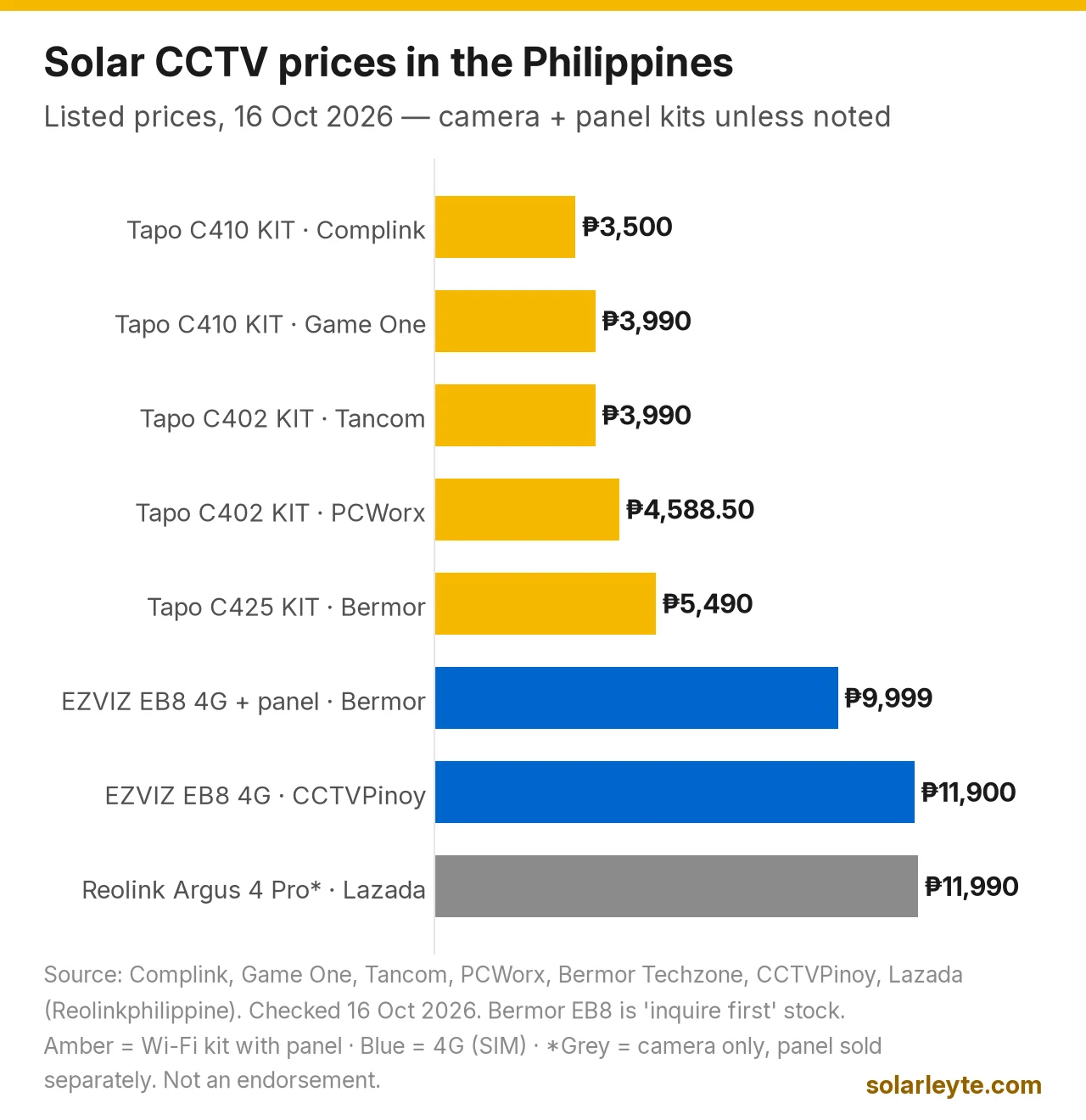
Sources: Complink, Game One, Tancom, PCWorx, Bermor C425 KIT, Bermor EB8 4G, CCTVPinoy EZVIZ cameras, CCTVPinoy EZVIZ panels, Lazada Reolink Argus 4 Pro. All checked 16 Oct 2026. Reolink's own Philippine store showed "Contact Sales" instead of peso prices that day.
What the table says:
- Wi-Fi solar kits start around ₱3,500. The Tapo kits are the cheapest way to get a camera with a panel already in the box.
- 4G costs about three times as much. You pay that for a camera that needs no router, which matters on a farm or at a beach lot with no internet line. You also need a SIM with a data load.
- Read the listing. The ₱11,990 Reolink price leaves the panel out, and the Bermor EB8 page sits behind "inquire first before checkout". Ask whether the panel is in the box before you compare prices.
What's in the box: panel watts, battery and "days" claims
Model | Solar panel (maker spec) | Battery (maker spec) | Battery-life claim | Sun claim | Weather rating |
|---|---|---|---|---|---|
Tapo C402 / C410 KIT | Tapo A201: 2.5 W max charging power, 5.2 V | Built-in Li-ion (mAh not published) | Up to 180 days, at 250 seconds of use a day | 45 min of direct sun a day, for up to 100 events | IP65 |
Tapo C425 KIT | Tapo solar panel (IP65) | 10,000 mAh | Up to 300 days at 230 s a day; 180 days at 360 s a day | 45 min of direct sun a day | Camera IP66, panel IP65 |
EZVIZ EB8 4G | Works with EZVIZ Type-C panels; Panel E is 6.18 W max | 10,400 mAh; max power use 10 W | EZVIZ gives no days figure (it varies with 4G signal); one PH retailer says about 210 days | — | IP65 |
Reolink Argus PT Ultra | 3 W Reolink panel | 21.6 Wh | "Varies based on settings, usage and temperature" | 20 min of sunlight a day | IP65 |
Reolink Argus 4 Pro | Reolink Solar Panel 2 (6 W) | 5,000 mAh | Varies | — | IP66 |
Sources: TP-Link Philippines C402 KIT and C410 KIT pages and the C402 KIT datasheet; Tapo Philippines C425 KIT; EZVIZ EB8 4G and Solar Charging Panel E; the Bermor EB8 listing for the 210-day retailer claim; Reolink Philippines Argus PT Ultra and Argus 4 Pro. Checked 16 Oct 2026.
Read the fine print on "180 days" and "45 minutes"
- "180 days" is a lab figure for a very quiet camera. Tapo's footnote bases it on 250 seconds of recording and live view a day, about 4 minutes. On the C425, Tapo itself says 360 seconds a day cuts its 300 days to 180. Watch live view often and the battery goes faster.
- "45 minutes of sun" means full lab sun. Tapo's footnote says 1,000 W/m² at 25°C, with up to 100 motion events a day. That works out to 0.75 kWh/m² of sun a day (45 minutes at 1 kW/m²). We use that figure in the rainy-month test below.
- They record clips, not 24/7. The C410 KIT page says plainly that a battery camera "is not designed for continuous recording. It only records motion clips when activity is detected." If you need every minute on record (a store till, a gate log), use a wired camera on a recorder with backup power.
- Heat matters more than cold here. The Tapo datasheet lists a 0–45°C battery-charging range and −20 to 45°C for the panel. A panel lying flat on a hot GI roof can run hotter than that on a sunny afternoon. Mount it on a bracket in moving air rather than flat on the sheet. Reolink lists −10 to 55°C for the Argus 4 Pro and PT Ultra.
Do solar CCTV cameras work in Leyte's rainy months?
The weakest months for sun in Eastern Visayas are December and January, the same months that decide off-grid sizing. Here is NASA's daily satellite record for Naval, Biliran, from 2001 to 2025:
Month | Average sun (kWh/m² a day) | Times Tapo's 45-minute lab need (0.75 kWh/m²) |
|---|---|---|
October | 4.77 | 6.4× |
November | 4.37 | 5.8× |
December | 3.86 | 5.1× |
January | 3.92 | 5.2× |
April (sunniest) | 6.09 | 8.1× |
Source: NASA POWER daily all-sky surface irradiance (ALLSKY_SFC_SW_DWN) for 11.56° N, 124.40° E, 1 Jan 2001 to 31 Dec 2025, the same dataset used in our off-grid post. The "times" column is a Solar Leyte calculation.
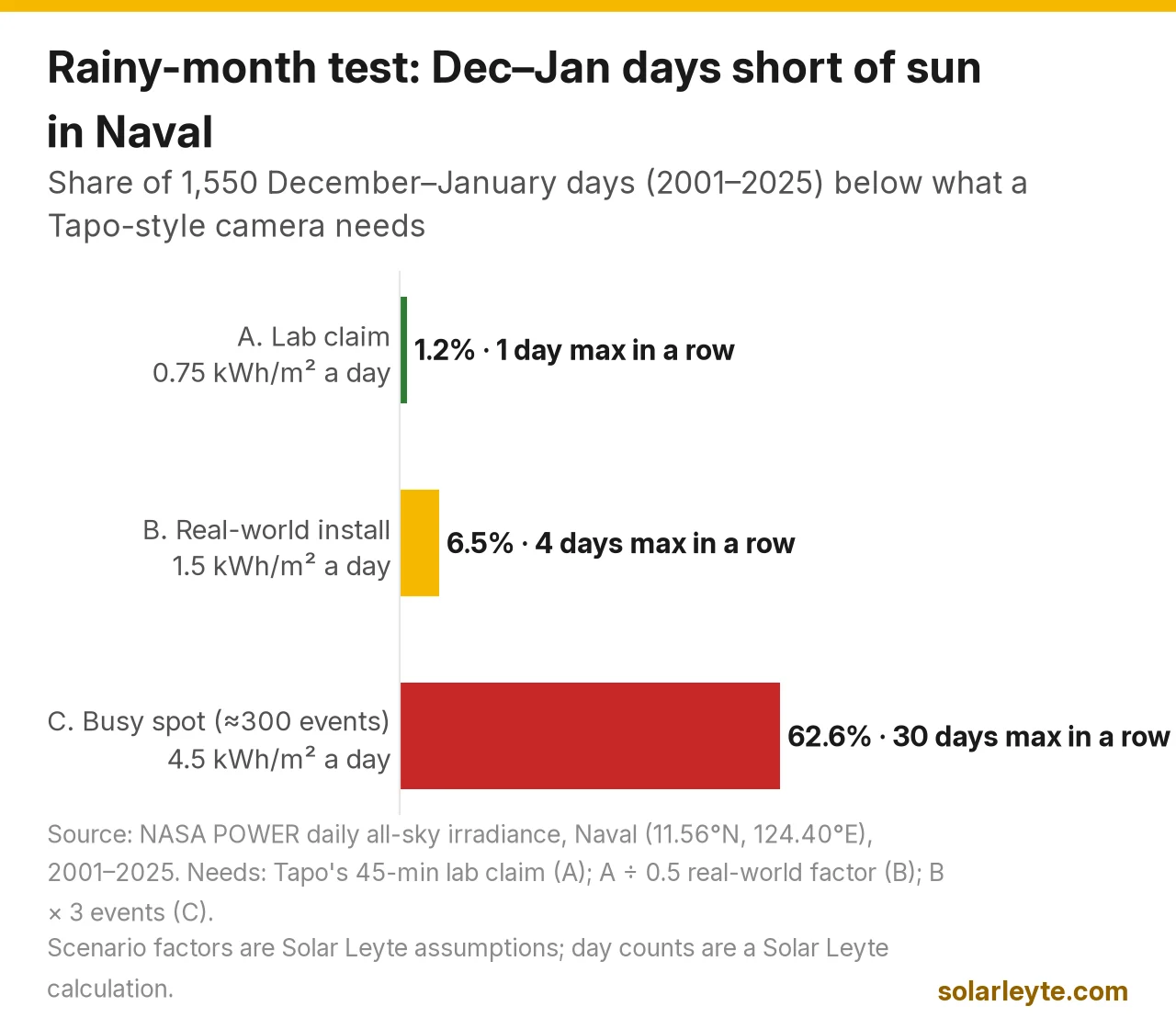
An average day isn't the test, though. A battery runs down on the grey days. So we counted every December and January day in those 25 years (1,550 days) against three levels of need, all for a Tapo-style camera with a 2.5 W panel:
Scenario (Solar Leyte assumptions) | Sun the camera needs per day | December–January days below that | Longest run of such days |
|---|---|---|---|
A. Lab claim: quiet spot, panel in full sun, aimed well | 0.75 kWh/m² | 19 days (1.2%) | 1 day |
B. Real-world install: same camera, but the panel gets only half the benefit (wall-mounted, not ideally aimed, heat, dust, charging losses) | 1.5 kWh/m² | 101 days (6.5%) | 4 days (ending 16 Dec 2017, Tropical Storm Urduja) |
C. Busy spot: scenario B, but about 300 events a day (a road-facing gate) | 4.5 kWh/m² | 970 days (62.6%) | 30 days |
Scenario B's 50% factor and scenario C's "three times the events means three times the energy" are our planning assumptions, not maker figures. The day counts are a Solar Leyte calculation on the NASA POWER daily data above.
What this means:
- In a quiet spot with a sunny panel, the rainy months aren't the problem. Even in scenario B, a short-sun day comes about one day in 15, and never more than four in a row in 25 years. A battery rated for months of standby rides that out easily.
- A busy camera is the problem, in any month. In scenario C, most December and January days fall short. The battery slowly drains and you end up taking the camera down to charge it. The same thing happens if a coconut tree shades the panel from noon.
- Fix it with placement and settings, not a bigger battery. Put the panel where it gets open sun from mid-morning to mid-afternoon. Shrink the motion zone so it ignores the road. Cut live-view time.
Worked example: a Reolink Argus PT Ultra through a Naval December
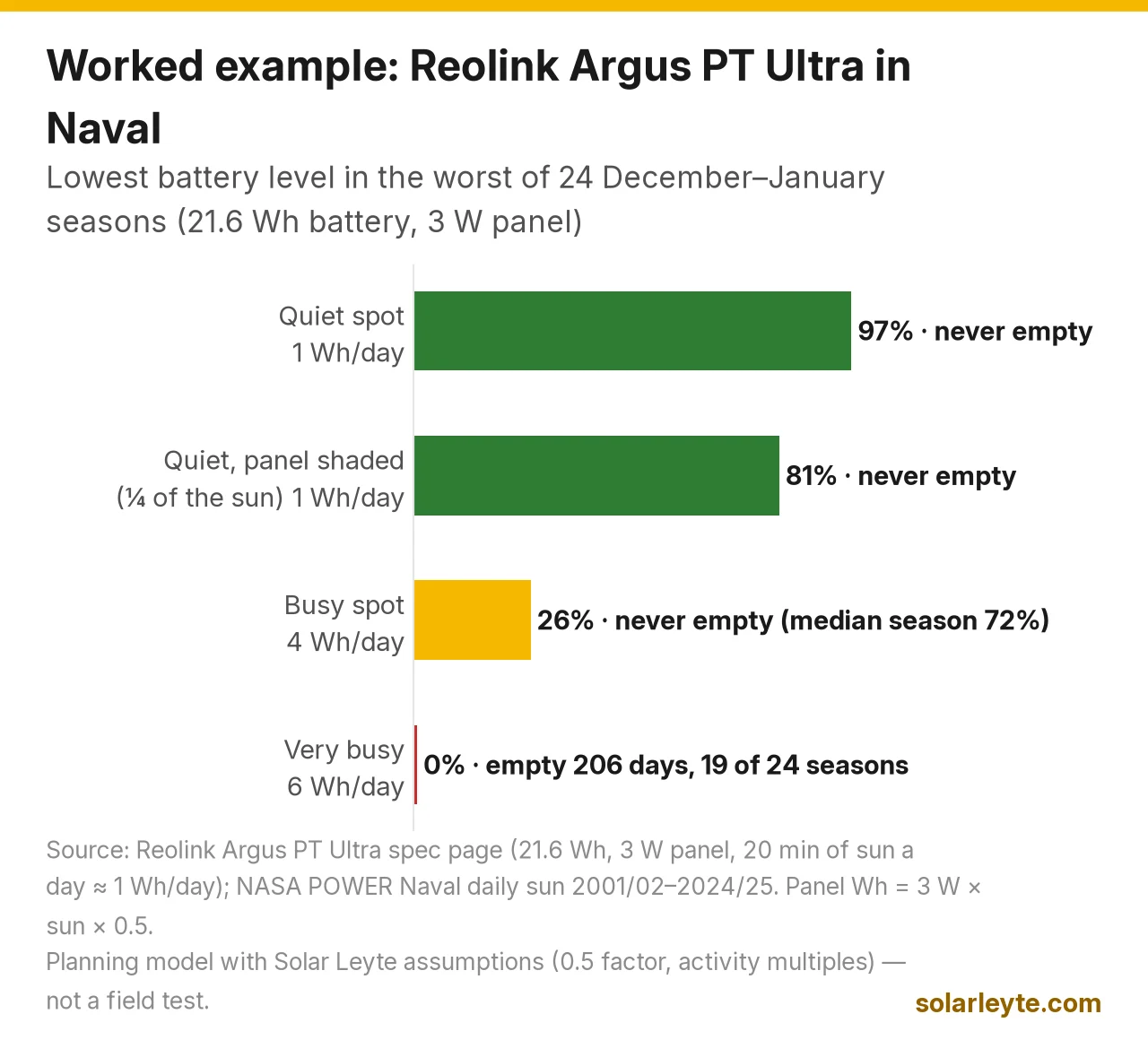
Reolink publishes the two numbers we need for this camera: a 21.6 Wh battery and a claim that 20 minutes of sun a day on its 3 W panel keeps it running. That claim works out to about 1 Wh a day (3 W × ⅓ hour, a Solar Leyte calculation). We ran a day-by-day battery balance for every December and January from 2001/02 to 2024/25 (24 seasons). The battery starts full on 1 December. Each day the panel adds 3 W × that day's NASA sun × 0.5 (the same real-world factor as scenario B), and the camera takes its daily need.
Scenario (labelled example) | Daily need | Lowest battery in the worst season | Days the battery hit empty (24 seasons) |
|---|---|---|---|
Quiet spot (Reolink's claim) | 1 Wh | 97% | 0 |
Quiet spot, panel shaded so it gets only a quarter of the sun | 1 Wh | 81% | 0 |
Busy spot: 4 × the activity | 4 Wh | 26% (median season: 72%) | 0 |
Very busy: 6 × the activity | 6 Wh | 0% | 206 days, in 19 of 24 seasons |
Inputs: Reolink Argus PT Ultra spec page (21.6 Wh, 3 W, 20 minutes); NASA POWER Naval daily sun 2001–2025. The 0.5 factor and the activity multiples are our assumptions. This is a planning model, not a field test.
Takeaway: at a normal house gate, a solar battery camera in Naval should get through the worst December–January in 24 seasons of NASA data. Point the same camera at a busy junction, or let the family watch live view all evening, and no December sun will keep up. Plan to charge it by USB now and then, or pick a wired camera.
Wi-Fi or 4G for a farm, resort or store?
- Wi-Fi models (Tapo C402/C410, Reolink Argus 4 Pro) need a strong router signal where the camera hangs. The Tapo C402 and C410 use 2.4 GHz only, which reaches further through walls than 5 GHz. Test the signal on your phone at the exact spot before you drill.
- During a brownout, your router goes off and the camera can't send alerts. Tapo says the C410 KIT keeps recording to its microSD card "during a storm, power outage, or Wi-Fi disruption". So put a microSD card in (every camera above takes up to 512 GB). If you want phone alerts through brownouts too, the router needs backup power. A small power station handles that (see our EcoFlow and solar generator price comparison), and the Visayas grid alert explainer covers why outages cluster.
- 4G models (EZVIZ EB8 4G) suit a fishpond, a farm lot or a beach property with no internet line, as long as there's mobile signal. EZVIZ warns that battery life "may vary due to the stability and/or signal strength of network carriers". A weak-signal spot means more battery drain, so pair it with the bigger 6.18 W panel and check signal bars before you buy.
Placement checklist for typhoon country
- Sun first, camera second. Use the panel's extension cable so the panel can sit in open sun while the camera sits where it can see. Tapo quotes 13 ft (about 4 m) of cable on the C402 KIT, and EZVIZ quotes a 4-metre cable on Panel E. Facing roughly south and tilted up is the usual aim this far north of the equator.
- Check the weather rating. IP65 means dust-tight and protected against water jets from a 6.3 mm nozzle. IP66 handles "powerful jets" from a 12.5 mm nozzle (IP code summary). Neither rating promises the bracket survives a typhoon. Before a signal warning, take the camera and panel down, or check the screws, the same way you'd prepare the house using our typhoon checklist.
- Mount it high and out of reach. A camera that can be lifted off its bracket in five seconds will be. Put it high enough that you need a ladder.
- Keep the panel off hot roofing. Remember the 45°C charging limit on the Tapo datasheet. A bracket with an air gap helps.
- Wipe the panel. These panels are small (the Tapo A201 is about 17 × 12 cm), so a film of dust or bird droppings takes a big share of their output. A cloth wipe each month in the dry season helps.
- Set a tight motion zone. This is the single biggest battery saver, as the busy-spot rows above show.
When a solar battery camera is the wrong tool
- You need 24/7 recording (a store counter, a cash area, a parking lot): use wired cameras and a recorder, and give the recorder backup power. Our solar battery price guide and off-grid sizing post show how to size that.
- You want four or more cameras at one site: one small 12 V solar setup feeding a wired system can beat four separate panels. Start with the small solar panel guide for the 12 V basics.
- You want lights along the same path: an all-in-one solar street light has its own panel and battery. See our solar street light price guide for the Wh checks.
FAQ
How much is a solar CCTV camera in the Philippines? On 16 October 2026 we saw Tapo solar kits (camera plus panel) from ₱3,500 (C410 KIT at Complink) to ₱5,490 (C425 KIT at Bermor). The EZVIZ EB8 4G was ₱9,999 to ₱11,900, and a Reolink Argus 4 Pro was ₱11,990 without the panel.
Do solar CCTV cameras work during the rainy season in Leyte and Biliran? At a quiet spot with the panel in open sun, yes. On NASA's 2001–2025 data for Naval, December's average sun (3.86 kWh/m² a day) is about five times Tapo's 45-minute lab need. Shade, a busy road and heavy live viewing are what drain them.
How long does a Tapo solar camera battery last without sun? Tapo quotes up to 180 days for the C402 and C410 at 250 seconds of use a day, and up to 300 days for the C425 at 230 seconds a day (180 days at 360 seconds). Those are lab figures, and real use is usually heavier.
Can a solar CCTV record 24/7? Not the battery models in this post. They record motion clips. For continuous recording, use wired cameras with a recorder and backup power.
Do I need Wi-Fi for a solar CCTV? The Tapo and Reolink models here use Wi-Fi. The EZVIZ EB8 4G uses a SIM instead, which suits farms and lots with mobile signal but no internet line.
Solar Leyte is run by MACC Systems & Energy Solutions Inc., a solar installer in Naval, Biliran.
Get a free brownout-power check from MACC
Planning cameras for a house, farm, resort or store where Wi-Fi and power drop out? Tell us how many cameras you need, where they'll go, and whether the router or lights should also stay on during brownouts. We'll tell you whether battery cameras with their own panels are enough or whether a small solar-and-battery setup makes more sense. There's no obligation, and this article has no made-up MACC price list.
- Call/Text: 0955 723 5093
- Email: official@macc-inc.com or benjie@macc-inc.com
- Website: www.macc-inc.com
- Office: Brgy. Talustusan, Naval, Biliran 6543
- Or use the site quote form: /quote
Sources (all checked 16 October 2026)
- TP-Link Philippines: Tapo C402 KIT, Tapo C410 KIT, Tapo C402 KIT datasheet (PDF); Tapo Philippines: Tapo C425 KIT
- EZVIZ: EB8 4G, Solar Charging Panel E
- Reolink Philippines: Argus PT Ultra, Argus 4 Pro, solar camera store page
- PH sellers: Complink, Game One, Tancom, PCWorx, Bermor Techzone (C425 KIT, EZVIZ EB8 4G), CCTVPinoy (EZVIZ cameras, EZVIZ panels), Lazada Reolink Argus 4 Pro listing
- NASA Langley Research Center, POWER Data Access: daily all-sky surface irradiance for Naval, 2001–2025
- IP code (IEC 60529) summary
- Day counts, scenario thresholds and the Reolink battery model: Solar Leyte calculations in this article (labelled), with assumptions stated
- Related on Solar Leyte: small solar panels, off-grid sizing, solar street lights, EcoFlow / generators, battery prices, Visayas grid alerts, typhoon checklist, portable power guide