Yes — you can charge an e-trike, e-bike or car EV from rooftop solar in Leyte and Biliran. The catch is scale. A common 48 V / 20 Ah e-trike pack is about 1 kWh from the wall per full charge (maker charger 48 V × 3 A for 6–8 hours). At BILECO's October 2026 residential rate that is about ₱19 a charge; at LEYECO IV it is about ₱17. One mid-size panel already covers that on a typical Naval day (PVGIS). A passenger EV with a 44.9 kWh pack is roughly forty times that energy — you need a real rooftop array, not a portable kit. And under the Electric Vehicle Industry Development Act (RA 11697, EVIDA), a home charger used only by your household is an own-use station: you must not collect charging fees from other people.
Last checked 5 Nov 2026 against RA 11697 on Lawphil, the EVIDA IRR on the Supreme Court E-Library, the DOE's EVCS unbundling advisory, BILECO and LEYECO IV October 2026 rate pages, NWOW's ERV2 maker sheet, BYD Philippines' Dolphin page, and PVGIS 5.3 for Naval. Rates and circulars change — confirm with your co-op and a licensed electrician before you buy.
For homeowners and e-trike / e-bike operators in Biliran and Leyte. Related: how many solar panels, hybrid inverter prices, BILECO rates, LEYECO IV / V rates, and the grid-tie vs hybrid guide.
How many kWh does one charge use?
Use the battery label first: kWh ≈ volts × amp-hours ÷ 1,000. That is the energy stored in the pack. What the wall (or your inverter) actually draws is a bit higher because of charger and battery losses. For the e-trike we can also use the maker's charger rating × hours.
Vehicle (example) | Pack (maker / brand page) | Stored energy | Wall energy we use below | Charge time (maker) |
|---|---|---|---|---|
NWOW ERV2 e-trike | 48 V / 20 Ah lead-acid (Jiangsu NWOW sheet) | 0.96 kWh | ~1.01 kWh (48 V × 3 A × 7 h) | 6–8 hours |
NWOW-class e-bike (GC10-type) | 48 V / 12 Ah lead-acid (Zigwheels / seller summaries citing 48 V 350 W + 12 Ah) | 0.58 kWh | ~0.70 kWh (pack × 1.2 loss factor, labelled assumption) | 6–8 hours |
BYD Dolphin (passenger EV) | Blade Battery 44.9 kWh (BYD Cars Philippines) | 44.9 kWh | ~44.9 kWh (0→100% pack energy; wall draw is higher — we use pack kWh as a lower-bound example) | Overnight on a home AC wallbox; BYD's PH charging guide lists up to 7 kW AC Type 2 for several of its models |
Assumptions labelled: 7-hour mid-point for the 3 A e-trike charger; 1.2× wall factor on the e-bike (no published GC10 charger-amp figure on the sheet we used); passenger-EV wall energy = pack kWh as a lower-bound bill example. Chargers waste heat, so your meter reads a little more. NWOW's ERV2 sheet lists 47.6 km with one 75 kg rider (3rd gear) and 39.3 km at 150 kg — not the 60–70 km some sellers quote. Zigwheels lists the ERV2 pack as 1 kWh, matching 48 × 20 / 1,000.
What does one charge cost at BILECO and LEYECO IV?
October 2026 residential rates we verified on the co-op pages:
- BILECO: ₱19.3628 / kWh (residential); commercial ₱17.8574 / kWh (BILECO power rate details, October 2026).
- LEYECO IV: ₱17.0099 / kWh residential + ₱5.00 / meter / month fixed (LEYECO IV October 2026 rates).
Example charge | kWh used | BILECO ₱ | LEYECO IV ₱ (energy only) |
|---|---|---|---|
E-trike ~1.01 kWh | 1.01 | ₱19.56 | ₱17.18 |
E-bike ~0.70 kWh | 0.70 | ₱13.55 | ₱11.91 |
Dolphin 44.9 kWh (lower bound) | 44.9 | ₱869.39 | ₱763.74 |
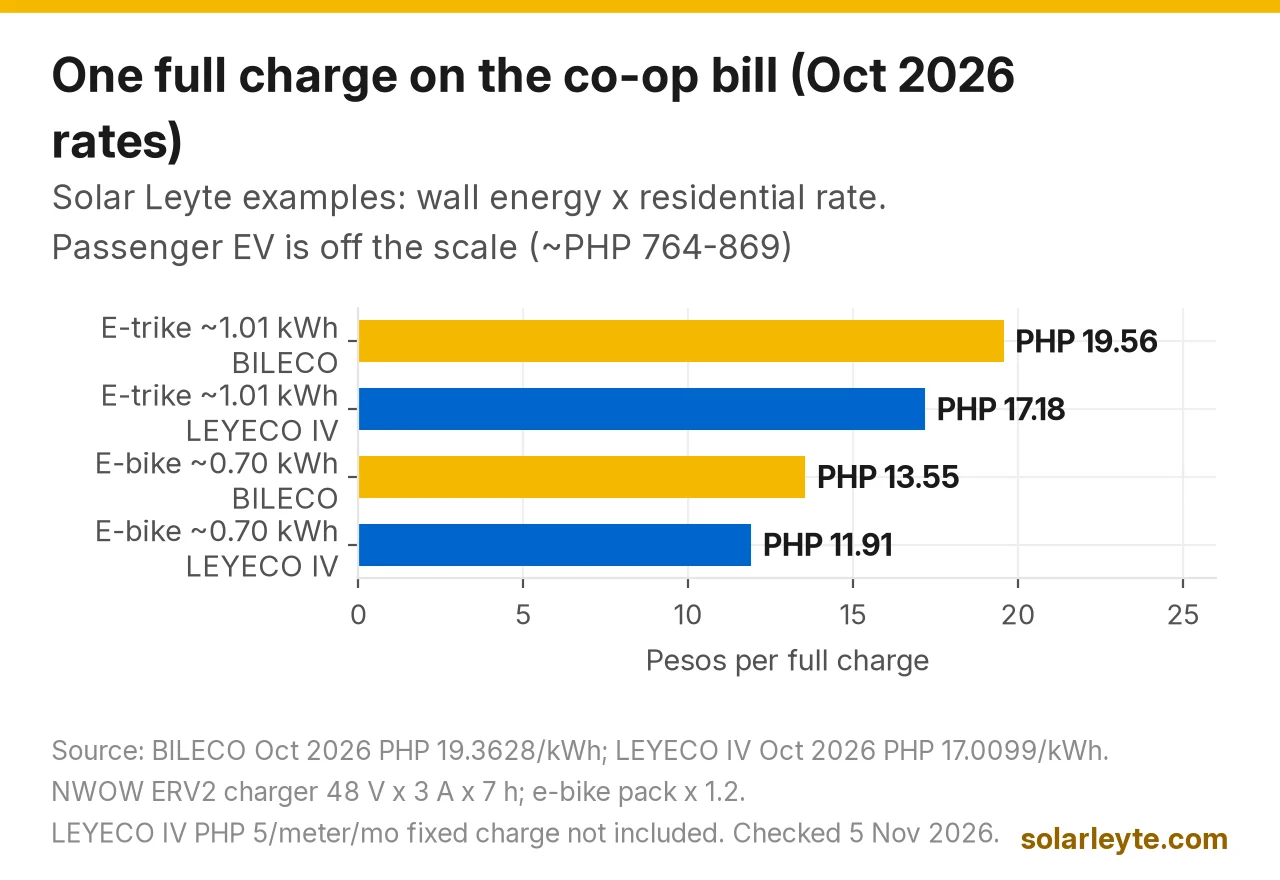
Solar Leyte calculations (rate × wall energy). LEYECO IV's ₱5 fixed charge is monthly, so it is not in the per-charge column. One e-trike charge a day ≈ ₱587 / month at BILECO (1.01 × 19.3628 × 30) before solar.
Cost per kilometre (labelled example)
Maker 47.6 km single-rider figure ÷ ~₱19.56 BILECO charge ≈ ₱0.41 / km (about ₱0.33 / km at a 60 km seller claim). Compare with your own petrol litres × pump price — we are not inventing a petrol figure. A sari-sari with daytime solar surplus can top up an e-trike the same way; see solar for sari-sari store.
How many solar panels do you need?
PVGIS 5.3 for Naval, Biliran (≈11.56°N, 124.40°E), 1 kWp crystalline, 10° tilt, south, 14% system loss, PVGIS-ERA5:
Average day | December day | Year | |
|---|---|---|---|
1 kWp in Naval | 4.06 kWh | ~3.63 kWh | 1,483 kWh |
One 550 W panel (0.55 kWp) | ~2.23 kWh | ~2.00 kWh | ~815 kWh |
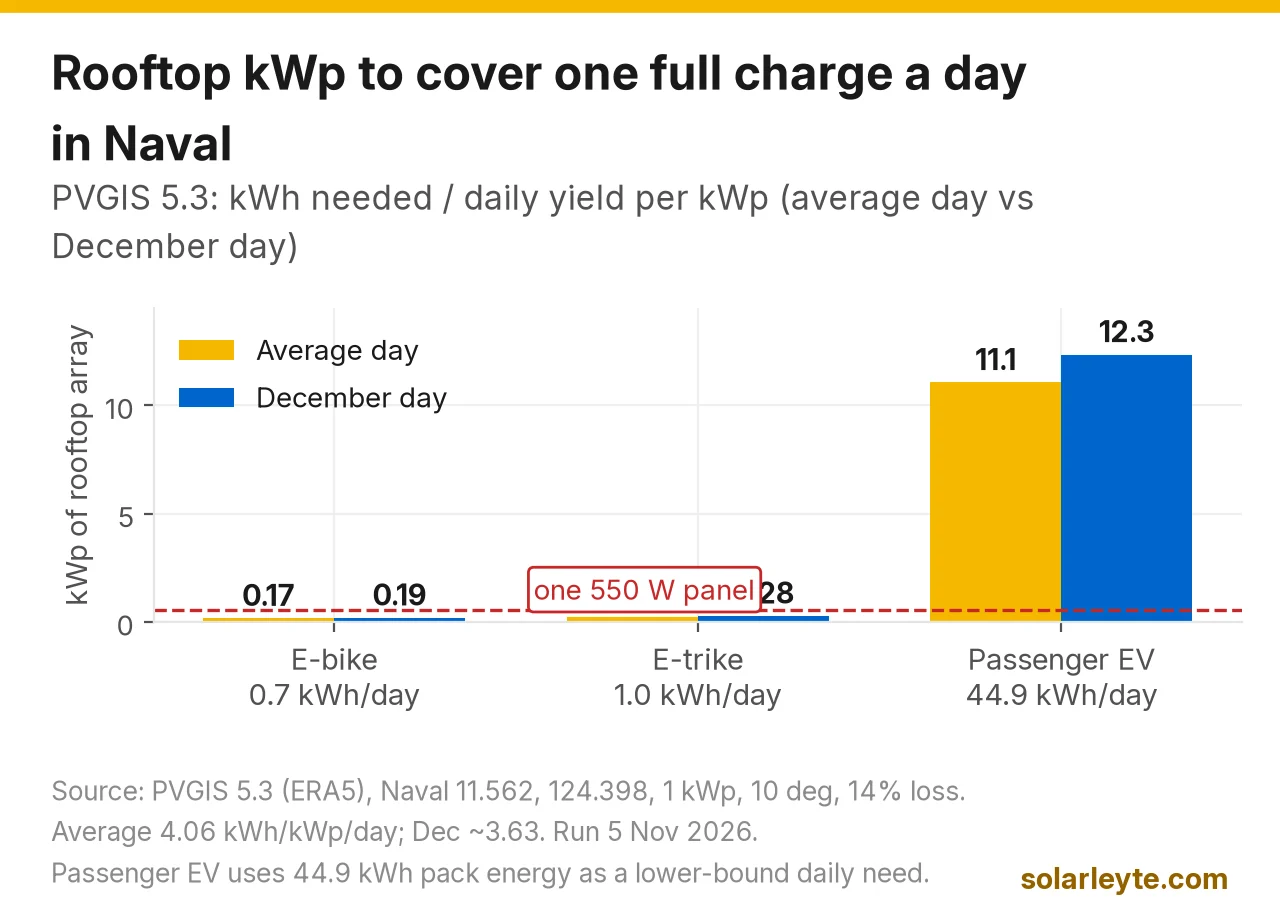
Solar Leyte reading of PVGIS totals (run 5 Nov 2026). December is usually the duller month in Eastern Visayas, so size against it if you want a full charge every day year-round.
Daily charge you want from solar | Rough array at Naval average | Rough array for a Naval December day |
|---|---|---|
E-trike ~1.0 kWh | ~0.25 kWp (one 550 W panel is already ~2×) | ~0.28 kWp |
E-bike ~0.7 kWh | ~0.17 kWp | ~0.19 kWp |
Dolphin 44.9 kWh (one full charge / day) | ~11.1 kWp | ~12.4 kWp |
A 3–5 kWp house array usually covers a daily e-trike / e-bike charge from midday surplus if you plug in while the sun is up. A passenger EV refilled empty-to-full from solar every day needs ~10 kWp+; most Leyte homes mix daytime solar top-ups with overnight grid charging. A hybrid inverter with battery can shift midday solar to an evening plug-in only if the battery still has spare kWh after brownout loads.
- Charge in the sun. Net-metering export credits are usually at the co-op's blended generation charge, below the retail rate you avoid by self-using (net metering guide).
- Match the plug. E-trikes / e-bikes use a 220 V brick on a normal outlet. Passenger EVs need a wallbox on a dedicated circuit by a licensed electrician (RA 7920 / PEC).
- Brownouts. Grid-tie-only solar shuts down with the co-op. Charging through a brownout needs hybrid or off-grid with battery.
What EVIDA (RA 11697) means for a home charger
Republic Act No. 11697, the Electric Vehicle Industry Development Act, took effect in 2022. The pieces that matter for a homeowner or trike operator are definitions and fees, not the factory incentives.
Own-use vs commercial (RA 11697 Sec. 4; IRR Sec. 6; DOE unbundling advisory):
- Own-use charging stations (OUCS): used exclusively by an individual (the IRR also covers exclusive use by a group entity). You may not impose or collect charging fees (RA 11697 Sec. 20; DOE advisory restates this).
- Commercial use charging stations (CUCS): open to the public or a defined group, and may collect fees — those fees must be unbundled, and the provider is in DOE accreditation territory (DC2023-05-0011 family; applications via evindustry.ph).
So: plugging your own e-trike into your house is own-use. Putting a "charge here ₱50" sign for neighbours turns it commercial. Kung gusto mong magnegosyo ng charging, that is a different compliance path (DOE accreditation, unbundled fees, often LGU permits).
Self-generating charging stations (RA 11697 Sec. 4; IRR Sec. 7): stations that take power from the grid and from on-site generation (your rooftop solar counts). The IRR says these shall comply with rules to be issued — treat a solar-backed charger as this category and keep an eye on DOE/ERC follow-on rules. ERC also sets rates DUs charge to charging stations (RA 11697 Sec. 8).
Incentives are not a homeowner rebate. Sec. 24 targets manufacturing/assembly and charging-station infrastructure; completely built charging stations get an eight-year import-duty exemption. That helps builders, not a household wallbox. Sec. 25 non-fiscal incentives also run eight years from effectivity.
New buildings (Sec. 17–18): dedicated EV parking (and, on the CREVI timeline, charging) for buildings built after the law — a Building Official / CREVI question, not for plugging an e-trike into an existing house.
DOE's DC2023-05-0011 PDF did not download cleanly from doe.gov.ph here (CDN challenge). OUCS / CUCS above follow the IRR and the DOE EVCS unbundling advisory. Commercial stations: evindustry.ph.
Three realistic setups (Solar Leyte examples)
- E-trike / e-bike, already have rooftop solar. Weatherproof outlet on a GFCI breaker; charge 9 AM–3 PM so the hybrid rides solar first. One daily e-trike charge (~1 kWh) is small against a 5 kWp array (~20 kWh on a good Naval day).
- Solar mainly for the house, e-trike in the driveway. Size for the house bill first (how many panels); tell the designer the charger load (~150 W for a 3 A / 48 V brick, or the wallbox nameplate).
- Passenger EV. Dedicated circuit and a proper wallbox. A full Dolphin-class charge is ~45 kWh; a 5 kWp roof (~20 kWh average day) is a top-up, not empty-to-full every day. Hybrid batteries only help evening charging if they still have spare kWh after brownout loads.
FAQ
Can I charge an e-trike with a portable solar generator?
Only as a trickle top-up. A ~1 kWh power station can hold one e-trike charge on paper, but daily use is simpler from a wall outlet on rooftop solar. See portable power station prices for station sizing — not as a house-array substitute.
Do I need DOE accreditation to charge at home?
For an own-use charger used only by your household, you are not operating a commercial station and you must not collect fees (RA 11697 Sec. 20; IRR Sec. 6.3). You still need safe electrical work under RA 7920 and the Philippine Electrical Code, and any LGU electrical / building inspection your municipality requires. Selling charging to the public is the commercial path (DOE-accredited EVCS provider).
Magkano ang tipid kung naka-solar?
E-trike at ~₱19.56 per BILECO grid charge: thirty solar-covered charges a month ≈ ₱587. A passenger EV at ~₱869 per full charge saves more — but only for the kWh your panels make while the car is plugged in.
Will net metering pay me to charge my neighbour's EV?
No. Own-use stations cannot collect charging fees. If you export surplus under net metering, the credit is on your co-op bill at the rules that apply to your DU — it is not a public charging business. Commercial charging needs CUCS compliance.
Solar Leyte is run by MACC Systems & Energy Solutions Inc., a solar installer in Naval, Biliran.
Get a free solar quote from MACC
Planning rooftop solar for a Biliran or Leyte home that also charges an e-trike or EV? Send a photo of your latest BILECO or LEYECO bill and a short note about the vehicle (e-trike, e-bike or car), and we'll get back to you with a free, no-obligation written quote.
- Call/Text: 0955 723 5093
- Email: official@macc-inc.com
- Website: www.macc-inc.com
- Or use the site quote form: /quote
Sources (all checked 5 November 2026)
- Republic Act No. 11697 (EVIDA), Lawphil full text: Sec. 4 definitions (charging fee, charging station, commercial use, own-use, self-generating); Sec. 8 ERC role; Sec. 17–20 parking and use of charging stations (own-use may not collect fees); Sec. 24–25 incentives.
- EVIDA Implementing Rules and Regulations, Supreme Court E-Library: Sec. 6.2 CUCS / 6.3 OUCS; Sec. 7 self-generating charging stations (grid + on-site generation).
- Department of Energy, EVCS Unbundling Advisory: restates CUCS vs OUCS; CUCS fees unbundled (as of 30 Sep 2026 listing referenced on the page).
- DOE EVCS provider portal: evindustry.ph accreditation process (commercial providers; DC2023-05-0011 family).
- BILECO, October 2026 effective rates: residential ₱19.3628 / kWh; commercial ₱17.8574 / kWh.
- LEYECO IV, October 2026 rates: residential ₱17.0099 / kWh; metering retail customer charge ₱5.00 / meter / month.
- Jiangsu NWOW Technology, ERV2 electric tricycle product sheet: battery 48 V 20 Ah lead-acid; charger 48 V 3 A, 6–8 hours; mileage 47.6 km (75 kg) / 39.3 km (150 kg).
- BYD Cars Philippines, BYD Dolphin: Blade Battery 44.9 kWh; 405 km NEDC range (brand page).
- BYD Cars Philippines, BYD charging guide: several PH BYD models listed at up to 7 kW AC Type 2 home charging.
- European Commission JRC, PVGIS 5.3: Naval ~11.562, 124.398; 1 kWp; 10°; aspect 0; 14% loss; PVGIS-ERA5; run 5 Nov 2026 (E_d 4.06 kWh; Dec E_m 112.66 kWh ≈ 3.63 kWh/day).
- Zigwheels PH, NWOW ERV2 specifications: battery capacity listed as 1 kWh; 48 V lead-acid; ~6 h charge time on that page.
- Zigwheels PH, NWOW GC10: 48 V 350 W motor, 12 Ah lead-acid, 6–8 h charge, 40–50 km range range (used as the e-bike example class).