Yes, solar can run a fishpond aerator, but only with a battery, because aerators are needed at night and before dawn, when panels produce little or nothing. A 1 HP (750 W) paddlewheel running from 10 pm to past sunrise uses about 6 kWh a night. To cover that from solar you need roughly 8 to 9 kWh of LiFePO4 battery and about 2.5 to 3 kW of panels in Biliran. Our example parts list for that comes to about ₱137,000 before the aerator, mounting and labour. BFAR Region 5 budgeted ₱200,000 per complete, installed off-grid solar paddlewheel set when it bought 20 of them in 2025.
If your pond already has BILECO or LEYECO power, the honest answer is often different: keep the aerator on the grid, use a timer and a DO meter so it only runs when needed, and add a battery or generator for brownout nights. Mao gyud na ang pinakadako nga risgo: a brownout at 3 am with the aerator off.
This post is the aerator-specific companion to our solar water pump guide, which covers pumping water into and out of ponds. We don't repeat pump sizing here.
Last checked 28 October 2026. Prices are online list prices on that date and change often. Brands are named only because their specs or prices are public. This isn't an endorsement, and none of this is a MACC price or a quote.
Quick answer
Question | Short answer | Source |
|---|---|---|
When do fish need aeration most? | At night and near dawn, when dissolved oxygen (DO) is lowest | Global Seafood Alliance; UF/IFAS |
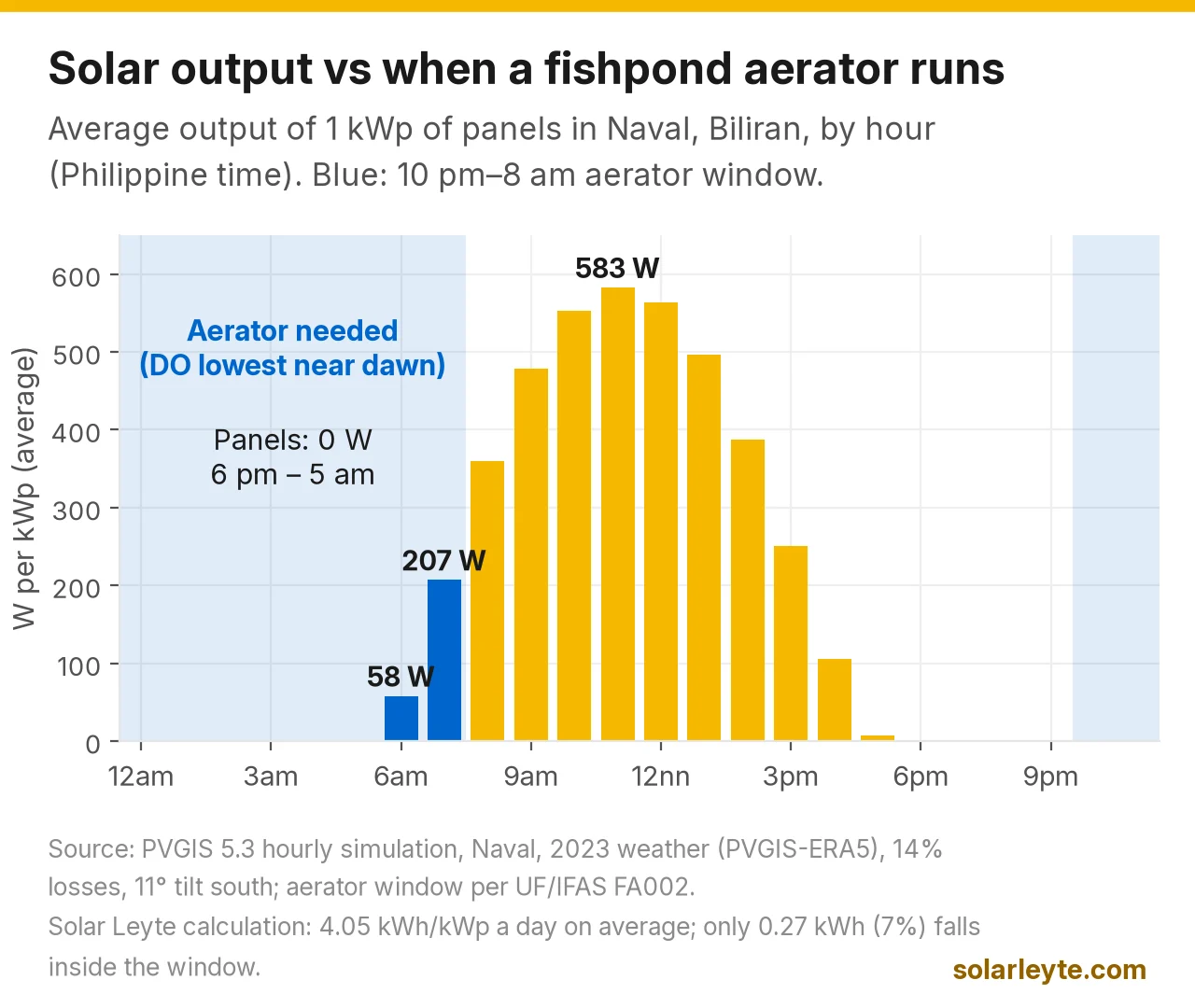
How much do panels produce then? | Nothing from 6 pm to 5 am in Naval; only about 7% of a day's output falls in a 10 pm–8 am aerator window | PVGIS hourly data, Solar Leyte calculation |
Energy for one 1 HP (750 W) aerator, 8 hours | 6 kWh a night, about 180 kWh a month | Solar Leyte calculation |
Same energy from the grid | About ₱3,300 a month at BILECO's July 2026 residential rate | BILECO; Solar Leyte calculation |
Government budget for a full solar set | ₱200,000 per installed off-grid solar paddlewheel set (BFAR Region 5, 2025) | PhilGEPS |
Why aerators run at night, not at noon
Pond algae make oxygen in daylight and use it up at night, together with your fish and the bacteria breaking down feed and waste. In an article for the Global Seafood Alliance, aquaculture scientist Claude Boyd puts it simply: DO is usually lowest near dawn, peaks in mid-afternoon, then falls through the night. Many researchers now say DO in warm-water ponds shouldn't drop below 4 mg/L.
That's why the University of Florida's IFAS extension suggests putting an aerator on a timer that switches on in the late evening (10 pm to midnight) and off after daylight (7 to 8 am). It says running an aerator in the afternoon isn't generally recommended, because a pond is often supersaturated with oxygen then and the aerator just pushes oxygen back into the air.
BFAR's fisheries technology centre in Dagupan has told bangus growers that 5 ppm is the normal DO for milkfish and below 3 ppm is stressful, and advised early harvest, less feed and lower stocking when DO drops (Philstar, 2014). SEAFDEC's Fish Farming Handbook (1980) notes that bangus farming normally doesn't need aerators "except when oxygen level is low". Intensive tilapia and shrimp ponds are different: they usually need aeration every night once feeding gets heavy.
So for a solar aerator, the key fact is timing. The power is needed exactly when panels are dark.
How much aeration does your pond need?
A widely used rule of thumb from Boyd, published by the Global Seafood Alliance:
- About 1 hp of aeration for every 10 kg of feed per hectare per day keeps night-time DO above 4 mg/L.
- Most ponds can carry about 1,000 kg of fish per hectare without aeration, which is roughly 30 kg/ha/day of feed. Aeration is for the feed above that.
- Tilapia tolerate lower DO, so at a 3 mg/L floor you need only 0.75 hp per 10 kg/ha of feed (0.5 hp at 2 mg/L).
- In fish ponds, it's usually fine to switch aerators off from mid-morning until early evening.
A study on a Thai red-tilapia farm (Kasetsart Journal) found the ponds needed about 5 hp/ha at night and none by day, yet the farmer ran 14.07 hp/ha for 22.5 hours a day. The cheapest kWh is the one you don't use, solar or not.
Example pond (rule-of-thumb estimate) | Feed per day | Feed per ha per day | Aeration at 4 mg/L | Aeration at 3 mg/L (tilapia) |
|---|---|---|---|---|
Backyard tilapia pond, 1,000 m² (0.1 ha) | 10 kg | 100 kg/ha | 0.7 hp | about 0.5 hp |
Commercial tilapia pond, 0.5 ha | 60 kg | 120 kg/ha | 4.5 hp | about 3.4 hp |
Solar Leyte calculation using the Boyd rule: hp per ha = (feed per ha per day − 30) ÷ 10, times 0.75 for a 3 mg/L floor, times pond area. Pond sizes and feed are examples, not recommendations. Check your own DO readings.
So a backyard pond needs about one 1 HP paddlewheel; a half-hectare commercial pond needs three to five.
What a paddlewheel aerator draws
Most small paddlewheels sold for Philippine ponds are 1 HP (750 W) or 2 HP (1.5 kW). We couldn't find a Philippine seller that publishes aerator prices online. Rigid Machineries in Caloocan, for example, lists specs but no price, so ask for a quote.
Model (seller or maker) | Power supply | Motor | Oxygen transfer | Panels the maker recommends |
|---|---|---|---|---|
Rigid YC-1.5-K (Rigid, PH) | 220 V AC, 1- or 3-phase, 60 Hz | 1.5 kW (2 HP) | ≥ 1.9 kg/h | Not a solar model |
Baile SSC2-48/750 paddlewheel (ETW) | 48 V DC solar | 750 W | ≥ 1.1 kg/h | 1,000–1,200 W |
Baile SSC4-96/1500 paddlewheel (ETW) | 96 V DC solar | 1,500 W | ≥ 1.9 kg/h | 2,000–2,400 W |
The DC "solar aerator" models are built to run straight off panels in daylight. The panel figure in the last column is for daytime direct drive only. Run one at night and you need a battery and charge controller on top.
Energy per night
Aerator | 6 hours | 8 hours | 10 hours |
|---|---|---|---|
1 HP (0.75 kW) | 4.5 kWh | 6 kWh | 7.5 kWh |
2 HP (1.5 kW) | 9 kWh | 12 kWh | 15 kWh |
kW × hours. Solar Leyte calculation.
What solar actually produces in Naval, hour by hour
We pulled PVGIS's hourly simulation for a 1 kWp array in Naval, Biliran (2023 weather, 14% system losses, panels tilted 11° facing south). It averaged 4.05 kWh per kWp per day over the year, but only 2.62 kWh in January, the cloudiest month. One day in ten made less than 2.64 kWh.
By hour, output is zero from 6 pm to 5 am, about 58 W per kWp in the 6–7 am hour, 207 W at 7–8 am, and peaks at about 583 W per kWp in the 11 am–noon hour. Add up the hours inside a 10 pm–8 am aerator window and you get about 0.27 kWh, roughly 7% of the day's output. Everything else has to be stored in a battery first.
Three ways to use solar with an aerator
1. Direct-drive DC solar aerator (no battery)
Cheapest and simplest: panels, controller, aerator. But it runs mostly from about 7 am to 4 pm, when fish ponds need it least. It can help with daytime mixing (shrimp ponds benefit more), but it won't protect fish at dawn.
2. Battery-backed off-grid aerator
This is the only fully solar option for night aeration. It makes sense for ponds far from the co-op line, where the alternative is a diesel engine. It's also what BFAR has been buying. BFAR Region 5's 2025 tender (BFAR5BAC-2025-272) budgeted ₱4 million for 20 "complete set of full off-grid solar-powered paddle wheel aerators", or ₱200,000 per set installed. It asked for at least a 1-year parts warranty, 5 years on batteries and 10 years on panels. The sets went to BFAR technology outreach stations in Masbate, Catanduanes, Sorsogon and Camarines Sur, and the contract shows as awarded.
Closer to home, Southern Leyte State University has run a procurement for field testing and market validation of a "cost-efficient solar-powered self-navigating paddle wheel aerator system" for grow-out farming under DOST-TAPI's TECHNiCOM program (awarded July 2025). So the idea is being tested in Region 8.
3. Grid aerator plus brownout backup (the usual best fit)
If BILECO or LEYECO power already reaches your pond, keep the aerator on the grid and plan for the night the power goes off. Visayas grid alerts and typhoon outages often hit at the worst time (see our yellow and red alert explainer). Two options:
- A battery and inverter for a few hours. On our assumptions below, a 6.144 kWh, 51.2 V LiFePO4 battery listed at ₱42,000 would run a 1 HP aerator for about 5.9 hours.
- A small generator with a transfer switch. It's cheaper to buy, but someone has to wake up and start it, and it needs fuel. Our generator vs solar comparison and transfer switch guide cover the trade-offs.
Rooftop or ground-mount solar on a farm with grid power then pays back on the daytime loads (pumps, freezers, the house), not the aerator. Our grid-tie vs hybrid guide explains which system type does what.
Worked example: a 1 HP aerator on solar and battery in Biliran
This is an example with stated assumptions, not a design or a quote.
Assumptions: one 1 HP (750 W) paddlewheel running 8 hours a night (6 kWh at the motor). The inverter is 90% efficient, so the battery supplies about 6.67 kWh. We only use 80% of the battery's rated capacity to protect its life, and charging is 95% efficient, so the panels must deliver about 7 kWh a day. Panel output is the Naval PVGIS figure above.
Item | Sizing | Listed price (28 Oct 2026) |
|---|---|---|
Battery | Needs about 8.3 kWh rated. Solarhome 51.2 V 230Ah, 11.78 kWh (LakaSolar) | ₱70,000 |
Panels | 7 kWh ÷ 2.62 kWh/kWp (January) ≈ 2.7 kWp. Five 550 W panels = 2.75 kWp (₱6,700 each, ABC Solar Electronics / Phsolar) | ₱33,500 |
Inverter-charger | SRNE HFP4850S80-H, 5 kW off-grid, 48 V (Reflections Solar Solutions) | ₱33,600 |
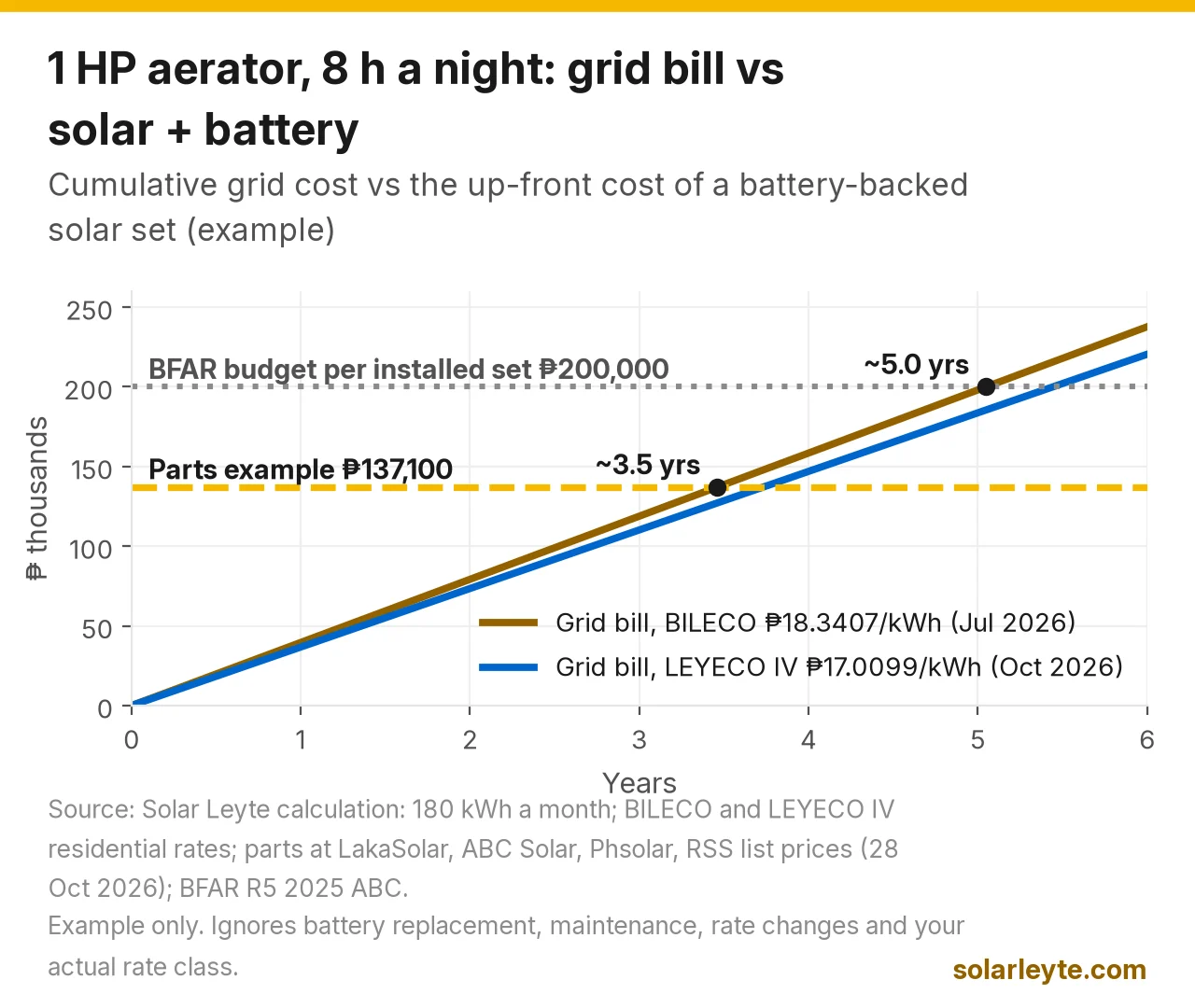
Parts subtotal | Excludes aerator, mounting, cables, breakers, labour | ₱137,100 |
With 2.75 kWp, the panels average about 11 kWh a day over the year and about 7.2 kWh in a typical January day. That just covers the night load in the cloudiest month, but not a run of very dark days. The 11.78 kWh battery gives about 11 hours of 1 HP running at our 80% limit, so one bad day is covered, not three.
Against the grid. The same 6 kWh a night is about 180 kWh a month. That's about ₱3,301 a month at BILECO's July 2026 residential rate of ₱18.3407/kWh (our BILECO tracker), or about ₱3,062 at LEYECO IV's October 2026 residential rate of ₱17.0099/kWh (LEYECO IV and V rates). On parts alone, that's about 3.5 years to break even on BILECO power. At BFAR's ₱200,000 installed budget per set, it's about 5 years. Your account may be billed at a commercial or other rate, so use your own bill.
Two catches. The battery cycles every single night, so check its rated cycle life before you count on that payback. And a motor needs a burst of extra current to start, so ask the aerator seller for the starting current and make sure the inverter's surge rating covers it. For battery prices across brands, see our solar battery price guide. For whole off-grid farm systems, see our off-grid solar post.
Before you buy: a checklist
- Measure DO first. A DO meter or test kit tells you which nights you really need the aerator. Running less saves more than any panel.
- Put the aerator on a timer (late evening on, after sunrise off) and stretch the hours only when DO readings say so.
- Size for the worst month, not the yearly average. In Naval, January makes about two-thirds of the average day's solar.
- Check the inverter surge rating against the motor's starting current.
- Keep electronics off the dike. Batteries and inverters belong in a dry, shaded, ventilated shed above flood level, away from salt spray.
- Have a plan B for a long brownout, such as a generator, a spare charged battery or an emergency harvest plan.
- Ask BFAR Region 8 or your municipal agriculture office whether a fisherfolk association can join a government aerator or solar program before buying on your own.
Our poultry and piggery solar post applies the same night-load logic to fans and brooders.
FAQ
Can a solar panel run a fishpond aerator without a battery?
Yes, but only in daylight. DC solar aerators like the 750 W Baile SSC2-48/750 run straight from about 1,000–1,200 W of panels, but stop at dusk. Fish need aeration most at night and near dawn, so without a battery it won't prevent a fish kill.
How many solar panels do I need for a 1 HP aerator at night?
In our Biliran example, about 2.75 kWp (five 550 W panels) plus roughly 8–9 kWh of LiFePO4 battery for 8 hours a night, sized for January. More hours or a bigger aerator scale that up proportionally.
How much does a 1 HP aerator cost to run on BILECO or LEYECO power?
At 8 hours a night, about 180 kWh a month: about ₱3,301 at BILECO's July 2026 residential rate or ₱3,062 at LEYECO IV's October 2026 residential rate. Your own rate class may differ.
How much is a complete solar paddlewheel aerator set?
BFAR Region 5 budgeted ₱200,000 per installed off-grid solar paddlewheel set in its 2025 tender for 20 sets. That's a government budget ceiling, not a retail price. Our parts-only example comes to about ₱137,100 before the aerator, mounting and labour.
Do bangus ponds need aerators?
Traditional bangus ponds usually don't, except when oxygen gets low (SEAFDEC). Watch for fish gasping at the surface at dawn, especially in hot, calm weather or after heavy feeding, and follow BFAR advisories on low-DO periods.
Solar Leyte is run by MACC Systems & Energy Solutions Inc., a solar installer in Naval, Biliran.
Get a free solar quote from MACC
Running a fishpond or farm in Leyte or Biliran? Tell us what you run at night, how long your brownouts last and send a recent BILECO or LEYECO bill. We'll suggest whether solar, a battery or a backup plan fits, with no obligation.
- Call/Text: 0955 723 5093
- Email: official@macc-inc.com or benjie@macc-inc.com
- Website: www.macc-inc.com
- Request a quote online: solarleyte.com/quote
- Office: Brgy. Talustusan, Naval, Biliran 6543
Sources (all checked 28 October 2026)
- Global Seafood Alliance, Species, pond size define aeration approaches (C. Boyd): DO lowest near dawn; 4 mg/L minimum; about 1 hp per 10 kg/ha/day of feed; about 1,000 kg/ha or 30 kg/ha/day feed without aeration; 0.5–0.75 hp for tilapia at 2–3 mg/L; aerators off mid-morning to early evening in fish ponds
- University of Florida IFAS, Dissolved Oxygen for Fish Production (FA002): timer on 10 pm–midnight, off 7–8 am; daytime aeration not generally recommended; emergency aeration if DO is projected below 4 mg/L before 7 am
- Kasetsart Journal of Natural Sciences, Oxygen budget and aeration requirements of red tilapia cage culture in earthen ponds: 5.00 hp/ha needed at night, none in the day; farmer used 14.07 hp/ha for 22.5 h/day
- Philstar, Low dissolved oxygen threatens bangus in 2 P'sinan towns (17 May 2014): BFAR NIFTDC, 5 ppm normal for bangus, below 3 ppm stressful; harvest early, reduce feed and stocking
- SEAFDEC Aquaculture Department, Fish Farming Handbook (1980): bangus farming needs aerators only when oxygen is low
- PhilGEPS, BFAR Region 5 bid notice 12273985 (BFAR5BAC-2025-272): 20 complete off-grid solar-powered paddlewheel aerator sets, ₱4,000,000 ABC, ₱200,000 per set; warranties 1 yr parts, 5 yr batteries, 10 yr panels; status awarded
- Southern Leyte State University, solar-powered self-navigating paddle wheel aerator field-testing procurement (DOST-TAPI TECHNiCOM, awarded, posted 17 July 2025)
- Rigid Machineries and Mill Supply, Paddle Wheel Aerator YC-1.5-K: 1.5 kW/2 HP, 220 V 60 Hz, ≥1.9 kg/h (no price listed)
- ETW International / Baile Pump, Solar aerators: SSC2-48/750 (750 W, 48 V DC, 1,000–1,200 W panels, ≥1.1 kg/h) and SSC4-96/1500 (1,500 W, 96 V DC, 2,000–2,400 W panels, ≥1.9 kg/h)
- European Commission JRC, PVGIS 5.3 hourly series for Naval, Biliran (11.563° N, 124.398° E), 2023, PVGIS-ERA5, 1 kWp, 14% loss, 11° tilt facing south: 4.05 kWh/kWp/day average, 2.62 in January, 10th-percentile day 2.64; hourly profile (Solar Leyte calculation, Philippine time)
- BILECO, power rates: July 2026 residential ₱18.3407/kWh
- LEYECO IV, October 2026 rates: residential ₱17.0099/kWh
- LakaSolar, Solarhome 51.2 V 230Ah, 11.776 kWh (₱70,000) and ONE SOLAR HIGEE120 51.2 V 120Ah, 6.144 kWh (₱42,000)
- ABC Solar Electronics, AE Solar 550 W (₱6,700); Phsolar, Sunova 550 W (₱6,700)
- Reflections Solar Solutions, SRNE HFP4850S80-H 5 kW off-grid inverter (₱33,600, tax included)
- Solar Leyte, solar water pump guide, BILECO rate tracker, LEYECO IV and V rates, solar battery prices, off-grid solar