For most bangkas, "solar powered" means a small 12 V kit, not a solar motor. One 100 W panel lying flat on the canopy, a 10–20 A charge controller in a dry box and a 12 V battery is enough to run an LED navigation light, a fish finder, a bilge pump and phone charging on a night trip. In our Solar Leyte example the whole night uses about 80 Wh. A flat 100 W panel in Naval makes about 400 Wh a day on average and about 330 Wh in December (PVGIS model). What you can't do is power a superlight with it in municipal waters: those are banned no matter what feeds them. Fully solar-electric bangkas exist in the Philippines, but so far as funded pilot boats, not something you can buy off the shelf.
Last checked 5 Nov 2026 against the COLREG 1972 rules text, MARINA's fishing vessel safety rules, RA 10654, BFAR FAO 262, the EO 305 registration guide, PVGIS 5.3, maker datasheets and Philippine shop listings. Rules and prices change, so confirm with your Municipal Agriculture Office (MAO) or PCG station before you buy.
This post is for fisherfolk and boat owners around Leyte and Biliran who want lights and power on the water. For small panels on land, see our small solar panels guide. For salt air on a house roof, see solar panels near the sea. The pillar overview is the solar generators and portable power guide.
What lights does a small bangka need at night?
The Philippines joined COLREG 1972, the international "rules of the road" at sea, on 10 June 2013, according to MARINA's list of IMO conventions. COLREG applies "upon the high seas and in all waters connected therewith navigable by seagoing vessels", which takes in most coastal water where bangkas meet ferries and cargo boats. Here is what it says for small boats:
Your boat at night | What COLREG asks for | Rule |
|---|---|---|
Power boat under 7 m, top speed 7 knots or less | One all-round white light. Sidelights (red/green) if practicable | 23(d)(ii) |
Power boat under 12 m | All-round white light plus sidelights | 23(d)(i) |
Under oars (paddled), or a sailboat under 7 m | At least a white torch or lantern ready to show in time | 25(d) |
Fishing (not trawling) | Red over white all-round lights; add sidelights and sternlight when moving | 26(c) |
At anchor, under 50 m | One all-round white light | 30(b) |
At anchor, under 7 m, away from channels and anchorages | No light required | 30(e) |
For boats under 12 m, COLREG wants an all-round light visible 2 nautical miles away and sidelights visible 1 mile away (Rule 22(c)).
Ano naman ang sinasabi ng local rules? MARINA's 2018 fishing vessel safety rules say they "shall not apply to fishing vessels of 3 GT and below". Under Executive Order 305, registration of municipal fishing boats 3 GT and below is with your municipal or city LGU, not the PCG (since August 2005), while the PCG and MARINA keep "visitorial functions". We didn't find a separate national light list for 3 GT and below, so treat COLREG as the baseline and ask your MAO if your town's fisheries ordinance adds anything.
A solar battery doesn't make a superlight legal
RA 10654 defines a superlight as a halogen or metal halide light whose energy "comes from a generator, battery or dynamo". It says "the use of superlight is banned within municipal waters and bays", and that LGUs regulate other fishing light attractors there. The fine is ₱20,000 per superlight, plus confiscation. On conviction it's 6 months to 2 years in jail plus a ₱40,000 fine. A municipal fisherfolk may do community service instead. BFAR's FAO 262 (2018) repeats that superlights in municipal waters are illegal "regardless of the amount of visible light". So the solar kit in this post is for navigation and work lights, not attracting fish. For a light attractor, check your LGU ordinance first.
How much does a flat panel make on a bangka?
On a boat the panel usually lies flat on the canopy (bubong ng bangka), because it turns with the boat anyway. We ran PVGIS 5.3 for a 100 W panel (ERA5 weather data, 14% system loss):
100 W panel | Average per day | December | April | Per year |
|---|---|---|---|---|
Naval, flat (0°) | ~400 Wh | ~330 Wh | ~480 Wh | 146 kWh |
Naval, tilted 10° | ~410 Wh | ~360 Wh | ~470 Wh | 148 kWh |
Naval, flat, glued down (runs hotter) | ~390 Wh | ~320 Wh | ~460 Wh | 141 kWh |
Tacloban, flat (0°) | ~380 Wh | ~300 Wh | ~450 Wh | 140 kWh |
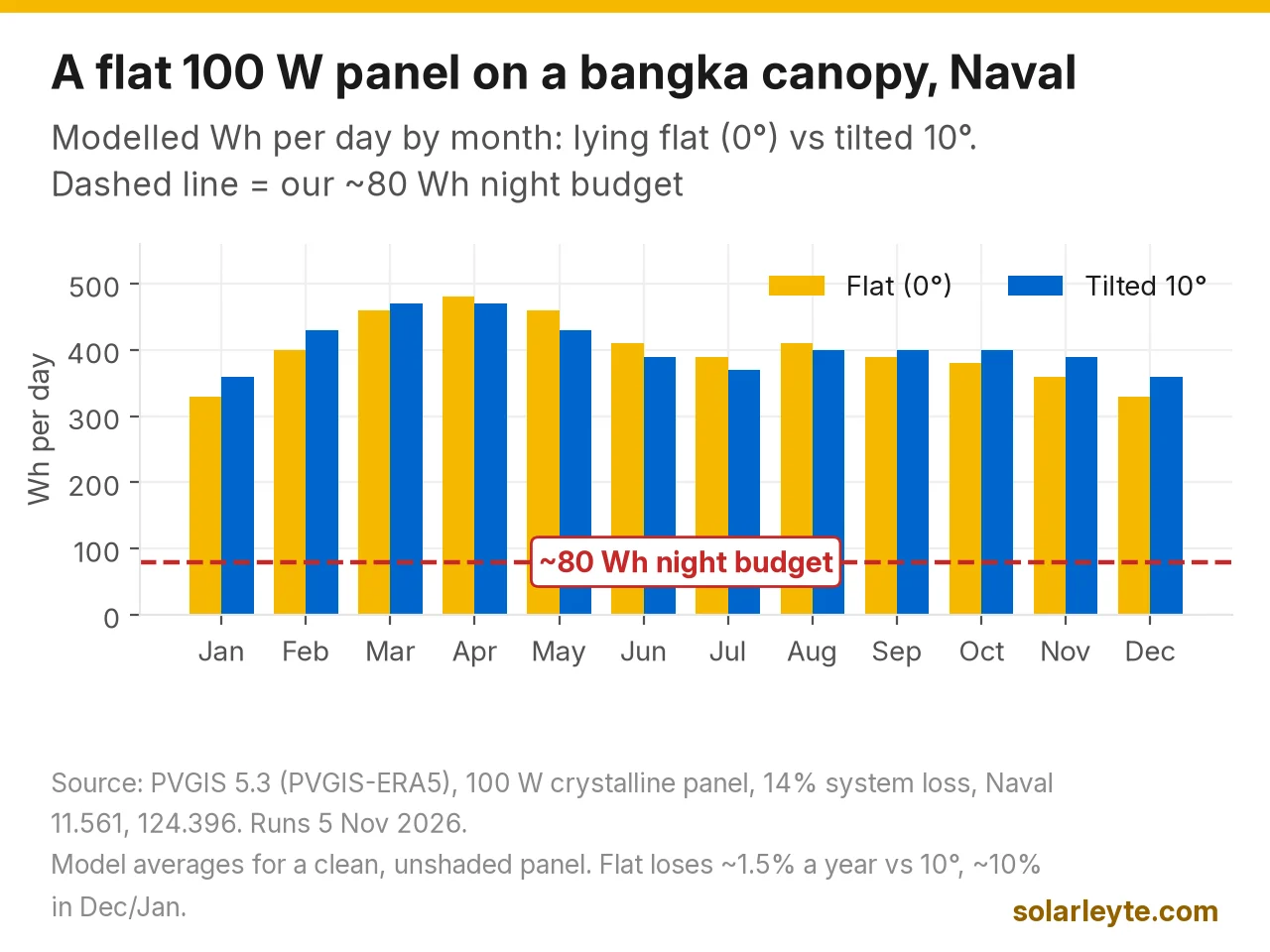
Lying flat costs only about 1.5% a year against a 10° tilt in Naval, but about 10% in December and January, when the sun sits lower. A panel glued straight to the canopy can't cool from behind; PVGIS's "building-integrated" setting (our stand-in for that) drops the year by about 3.5%. These are model figures with clean panels. Salt film, the mast's shadow and the boat's heading cut real output, so rinse the panel with fresh water.
Sample night budget (Solar Leyte example)
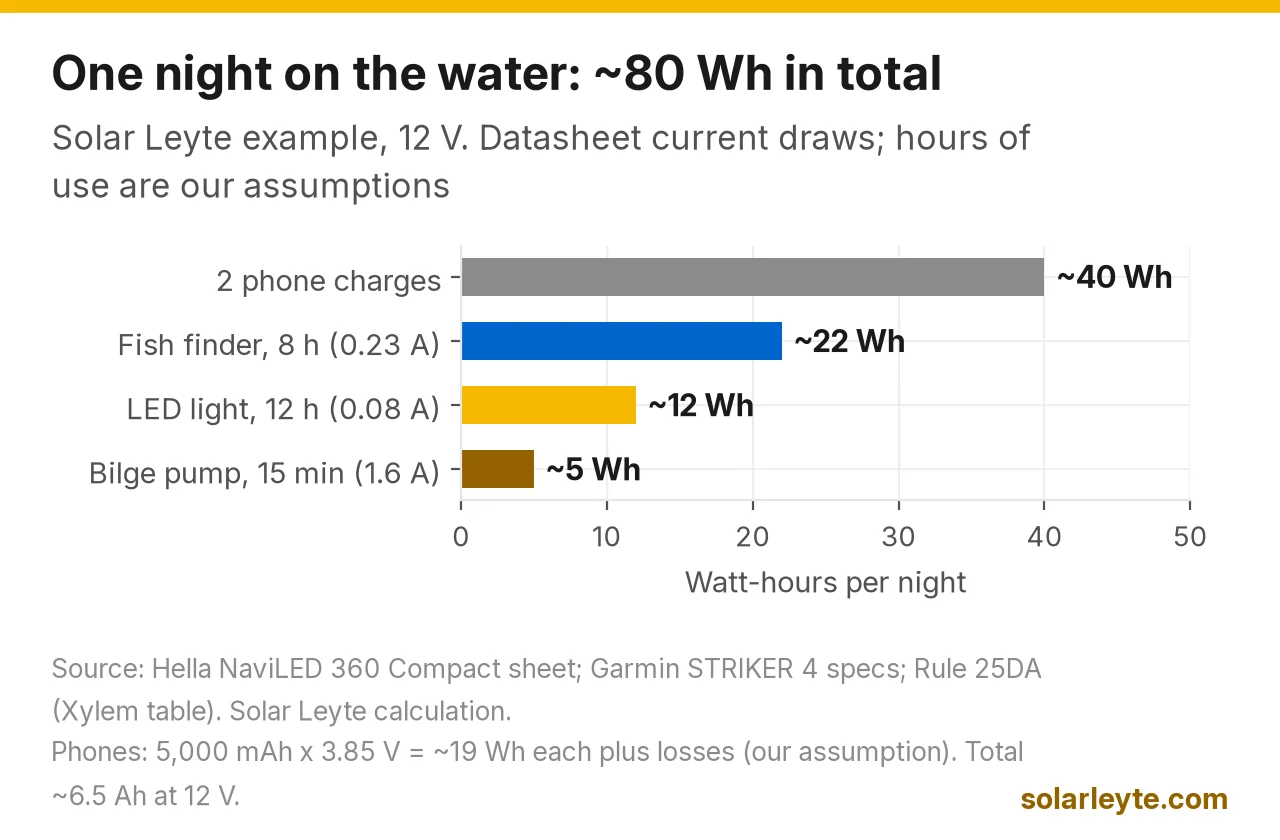
Assumptions: a 12 V system, one 12-hour night trip, LED lights. The fish finder, pump and light are real datasheet figures; hours of use and phone charges are our assumptions.
Load | Datasheet draw | Our hours | Energy |
|---|---|---|---|
LED all-round white light (Hella NaviLED 360 Compact) | 0.08 A at 12 V (<1 W) | 12 h | ~12 Wh |
Fish finder (Garmin STRIKER 4) | 0.23 A typical (2.8 W) | 8 h | ~22 Wh |
Bilge pump (Rule 25DA, 500 GPH) | 1.6 A at 12 V (19 W) | 15 min | ~5 Wh |
2 phone charges (5,000 mAh × 3.85 V ≈ 19 Wh each, plus losses) | n/a | n/a | ~40 Wh |
Total | ~80 Wh (about 6.5 Ah at 12 V) |
Worked example (Solar Leyte calculation): 80 Wh a night is a quarter of what a flat 100 W panel makes on a December day in Naval (~330 Wh). With a cheap PWM controller, the panel is held near battery voltage (~13.5 V) instead of its 18.6 V sweet spot, so expect roughly a quarter less. That's still around 240 Wh, three times the night's use. A 50 W panel would cover it on paper, but 100 W gives you room for cloudy days and a small LED work light.
For the battery, Wattcycle lists its 12 V 50 Ah LiFePO4 at 640 Wh usable. That's about 8 nights of this budget, or plenty of buffer for a rainy week. A car or motorcycle battery also works for small loads, but only about half its capacity is safe to use; see our car battery for solar post.
What a small bangka kit costs (prices checked 5 Nov 2026)
Part | Example listing | Price |
|---|---|---|
Rigid 100 W panel | Sunworth 100Wp mono (ABC Solar Electronics) | ₱3,200 |
Flexible 100 W panel | ALLPOWERS SE100, IP68, 3 mm thick | ₱6,471 |
Flexible 100 W panel | Renogy 100 W 12 V flexible, IP67 (MotoTesto) | ₱15,500 |
PWM controller, 10 A | KTD1210 (ABC) | ₱700 |
MPPT controller, 20 A | SRNE ML2420, IP32 (ABC) | ₱3,500 |
12 V 50 Ah LiFePO4 | Wattcycle (shown sold out on 5 Nov) | ₱7,999 |
Example (Solar Leyte calculation): rigid panel + 10 A PWM + 50 Ah LiFePO4 = ₱11,899. Flexible ALLPOWERS + SRNE MPPT + the same battery = ₱17,970. Neither total includes marine wire, fuses, MC4 connectors, the mount or a dry box. These are listed shop prices, not MACC prices.
Rigid or flexible? A rigid glass panel is cheaper and lasts, but it's heavy and needs a frame you can bolt to the canopy. Flexible panels are light (Renogy lists 1.9 kg) and bend to a curved roof, but they cost more and run hotter when glued down. The 100 W panels above are around 18–19 V at max power, which is the right range for a 12 V controller.
For choosing between the two controller types, see MPPT vs PWM charge controllers. For battery voltage settings, see our charge controller settings guide.
Salt, spray and typhoons: keeping it alive
- Keep the controller dry. The SRNE ML2420 is rated IP32, which only means protection from dripping water. Put it in a closed, ventilated box under the canopy, never where waves hit.
- Check the IP rating on everything outside. The Hella light is IP67 and the Garmin STRIKER 4 is IPX7. The ALLPOWERS panel is IP68 and the Renogy IP67. An IP rating keeps water out, but it isn't a salt-corrosion test; for IEC 61701 salt-mist ratings, see solar panels near the sea.
- Fuse the battery. Put a fuse close to the battery positive. Rule lists a 4 A fuse for the 25DA pump.
- Unplug before a storm. If a typhoon or thunderstorm is coming, take the panel down or disconnect it. See our lightning and surge protection post.
- Rinse with fresh water after trips and check connectors for green or white crust.
What about a fully solar-powered bangka?
They exist, but as pilot projects. The Adlao Azul, launched in Coron, Palawan on 8 November 2023, was built by Oceantera through a ₱25-million grant under USAID's Energy Secure Philippines. The US Embassy says it can cruise "for over six hours" on bifacial panels and a US-made battery. Renewable Energy Magazine describes it as a fiberglass, MARINA-registered banca carrying 6 passengers and 2 crew at up to 11 knots. In July 2025 Iloilo announced a similar solar bangka from RTI International for fishing, tourism and Bantay Dagat, able to run "up to six hours at sea" (Power Philippines).
Note: electric outboards are sold, but we didn't find a Philippine source with prices or range for a complete solar electric outboard setup on a bangka, so we aren't quoting one. BFAR is also using solar for hatcheries and hybrid solar ice plants. Its Tanay station cut electricity use by 60–70% (Context.ph, July 2026). For ice and cold storage, see our solar freezer and ice maker post.
FAQ
What size solar panel do I need for a 12 V boat battery?
For lights, a fish finder and phones, 50–100 W is enough for most bangkas. In our example the night uses ~80 Wh, while a flat 100 W panel makes ~330–480 Wh a day in Naval depending on the month (PVGIS). Pick the panel after you add up your own loads.
Can I run a superlight on solar?
Not in municipal waters. RA 10654 bans superlights there whatever powers them, with a ₱20,000 fine per light. LGUs regulate other light attractors, so check your town's ordinance.
Pwede ba ang flexible panel sa bubong ng bangka?
Yes, and it's the lighter option. Use one rated IP67 or IP68, glue or strap it to a smooth surface, and expect a bit less output because it runs hotter (about 3.5% a year in our PVGIS model).
Do I need to register my bangka?
Municipal fishing boats 3 GT and below are registered with your municipal or city LGU under EO 305. Ask your MAO about BFAR's boat registration.
Solar Leyte is run by MACC Systems & Energy Solutions Inc., a solar installer in Naval, Biliran.
Get a free solar quote from MACC
Thinking about solar for your home or a small business on the coast? Send us a photo of your latest BILECO or LEYECO bill, and we'll get back to you with a free, no-obligation written quote.
- Call/Text: 0955 723 5093
- Email: official@macc-inc.com
- Website: www.macc-inc.com
- Or use the site quote form: /quote
Sources (all checked 5 November 2026)
- MARINA, IMO conventions ratified by the Philippines (Sept 2024, PDF): COLREG 1972 acceded 10 June 2013.
- IMO, COLREG 1972, consolidated edition (PDF, navlib copy): Rules 1(a), 22(c), 23(d), 25(d), 26(b)–(c), 30(b) and 30(e).
- MARINA, Philippine Fishing Vessels Safety Rules and Regulations 2018 (PDF): not applicable to fishing vessels of 3 GT and below.
- League of Municipalities / League of Cities, Local government guide to registration of municipal fishing boats 3 GT and below (EO 305, PDF): LGU registration, PCG stopped from August 2005, PCG/MARINA visitorial functions.
- Republic Act No. 10654, Supreme Court E-Library: superlight definition; Sec. 14 (amended Sec. 44) ban in municipal waters; Sec. 98 penalties (₱20,000 per superlight; 6 months–2 years and ₱40,000; community service).
- BFAR, Fisheries Administrative Order No. 262, s. 2018 (PDF, FAOLEX): superlights in municipal waters illegal regardless of intensity.
- European Commission JRC, PVGIS 5.3: 100 W, PVGIS-ERA5, 14% loss, Naval (11.561, 124.396) and Tacloban (11.244, 125.004), 0° and 10°, free-standing and building-integrated; runs 5 Nov 2026.
- HELLA marine, NaviLED 360 Compact all-round white instruction sheet (PDF): <1 W, 0.08 A at 12 V, 2 NM, IP67.
- Garmin, STRIKER 4 specs: typical current draw 0.23 A, power consumption 2.8 W, IPX7.
- Rule (Xylem), standard bilge pumps model table (PDF): 25DA 500 GPH, 1.6 A at 12 V, 4 A fuse.
- ABC Solar Electronics: Sunworth 100Wp mono (₱3,200; Vmp 18.6 V, Imp 5.38 A); KTD1210 10 A PWM (₱700); SRNE ML2420 MPPT (₱3,500, IP32).
- ALLPOWERS PH, SE100 100 W flexible panel (₱6,471.07, IP68, 3 mm).
- MotoTesto, Renogy 100 W 12 V flexible panel (₱15,500; Vmp 18.9 V, IP67, 1.9 kg).
- Wattcycle PH, 12 V 50 Ah LiFePO4 (₱7,999; 640 Wh; shown sold out 5 Nov 2026).
- U.S. Embassy in the Philippines, U.S.-funded solar-powered boat to serve vulnerable communities in Palawan (22 Nov 2023): Adlao Azul, ₱25-million grant, over six hours.
- Renewable Energy Magazine, Oceantera introduces first solar electric "outrigger" boat in Philippines (24 Nov 2023): 6 passengers + 2 crew, 11 knots, MARINA-registered.
- Power Philippines, Iloilo unveils first solar-powered bangka (25 Jul 2025): RTI International prototype, up to six hours at sea.
- Context.ph, BFAR scales up climate-smart, energy-efficient projects (2 Jul 2026): Tanay station 60–70% less electricity; hybrid solar ice plants.