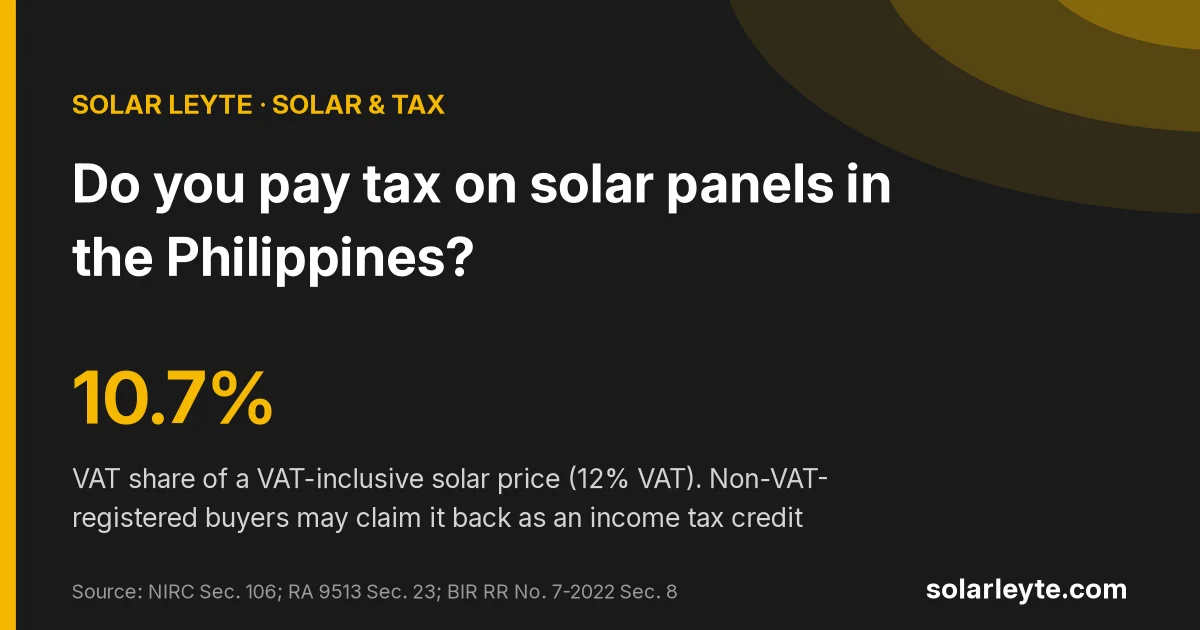
Short answer: yes, you usually pay tax on solar panels in the Philippines, but less than people fear, and there's one refund most homeowners have never heard of. You pay 12% VAT when you buy from a VAT-registered seller. That's about ₱10.70 of every ₱100 on a VAT-inclusive price. Your province or city may also assess the system for real property tax once it's on your roof. On the plus side, a BIR regulation from 2022 (RR No. 7-2022, Section 8) says a buyer of renewable energy equipment for home use who isn't VAT-registered can get a rebate equal to the VAT passed on to them. It comes as a credit against your income tax for the year you bought the system.
What you don't get as a homeowner: the famous RA 9513 package of income tax holidays, 0% VAT on purchases and a special 1.5% realty tax cap. Those are for RE developers registered with the DOE, the companies that build and run power projects. They weren't written for a 5 kW roof in Naval.
Below are the laws, two worked examples with the math shown, and who to ask in Biliran and Leyte. For loans and payment options, see our solar financing guide and the Pag-IBIG solar loan explainer.
This is a plain-English summary of the laws and BIR regulations listed under Sources, last checked 16 October 2026. It isn't tax or legal advice. Your municipal or provincial assessor, your BIR Revenue District Office or a tax professional has the final word on your case.
Solar panel taxes at a glance
Tax | Who charges it | Does a homeowner pay it? | What the law says |
|---|---|---|---|
VAT on the panels, inverter and installation | National (BIR), collected by the seller | Yes, if the seller is VAT-registered: 12% | NIRC Sec. 106, as amended by RA 9337. RE developers get 0% on purchases for their plants (RA 9513 Sec. 15(g)), homeowners don't |
VAT rebate on RE equipment for residential use | National (BIR) | Can be claimed back if you're not VAT-registered, as a credit against that year's income tax | RA 9513 Sec. 23; RR No. 7-2022 Sec. 8. Unused credit is forfeited |
Real property tax (RPT) on the system | Province (for towns like Naval) or city (like Tacloban or Ormoc) | Possibly. It depends on how your assessor classifies and declares it | LGC (RA 7160) Secs. 218, 224, 225, 233, 235. "Machinery" is now defined in RA 12001 Sec. 3(k) |
Special 1.5% realty tax cap | Province or city | No. It's for registered RE developers | RA 9513 Sec. 15(c) |
Income tax holiday, 10% corporate rate, duty-free imports | National | No. These are for DOE-certified RE developers | RA 9513 Sec. 15(a), (b), (e); Secs. 25–26 |
VAT on the electricity you make and use yourself | None | No. Power you never buy carries no bill, so no VAT on it | Plain bill math; see the net-metering section below |
Sources: RA 9513, RA 7160, RA 12001 and RA 9337 on Lawphil; BIR RR No. 7-2022. Links under Sources. Last checked 16 Oct 2026.
VAT: what you pay when you buy
When a VAT-registered installer or shop sells you panels, an inverter, batteries or an installation service, 12% VAT is built into the price or added on top. Section 106 of the Tax Code, as amended by RA 9337, is the rule for sales of goods. RA 9337 also provided for the rise from 10% to 12% from 2006, and BIR regulations still cite 12% today (for example RR No. 10-2025).
Quotes come in two styles, so check which one you have:
- VAT-inclusive: the VAT is already inside. The VAT share is 12 ÷ 112, or about 10.7% of the total.
- VAT-exclusive ("plus VAT", "VAT ex"): add 12% on top. Some package flyers we've tracked show prices this way. Our 5 kW solar price guide flags the ones that do.
If your installer isn't VAT-registered, the invoice won't show VAT at all, and there's nothing to rebate later. That doesn't make it cheaper by itself. Compare totals.
The 0% VAT you've read about isn't for households
RA 9513 Section 15(g) does say "zero percent (0%) value-added tax". Read the whole provision, though. The 0% applies to the sale of power generated from renewable sources, and to an RE developer's purchases "needed for the development, construction and installation of its plant facilities". BIR RR No. 7-2022 Section 4(E) adds that sellers shouldn't pass on the 12% VAT to "duly-registered RE developers", and that the seller must ask for the developer's BOI and DOE registration. A homeowner buying a rooftop system for the house doesn't have those papers, so the seller charges the normal 12%.
The newer laws you may hear about, CREATE (RA 11534, 2021) and CREATE MORE (RA 12066, November 2024), rewrote incentives for registered business enterprises. CREATE MORE even repeats that their local sales are subject to 12% VAT unless exempt or zero-rated. Neither law gives households a solar VAT break.
The VAT rebate most homeowners miss (RA 9513 Sec. 23)
Section 23 of the Renewable Energy Act told the Department of Finance to "provide rebates for all or part of the tax paid for the purchase of RE equipment for residential, industrial, or community use". The BIR's rules for it are in Revenue Regulations No. 7-2022. Section 8 says:
- Purchasers of RE equipment for residential, industrial or community use get "a rebate equivalent to the VAT passed on" to them.
- It's only for purchasers who are not VAT-registered. If you're an employee, or a homeowner without a VAT-registered business, that's probably you.
- It comes "in the form of a tax credit from the income tax liability of the purchasers during the year of purchase".
- "Any unutilized rebate or tax credit shall be forfeited."
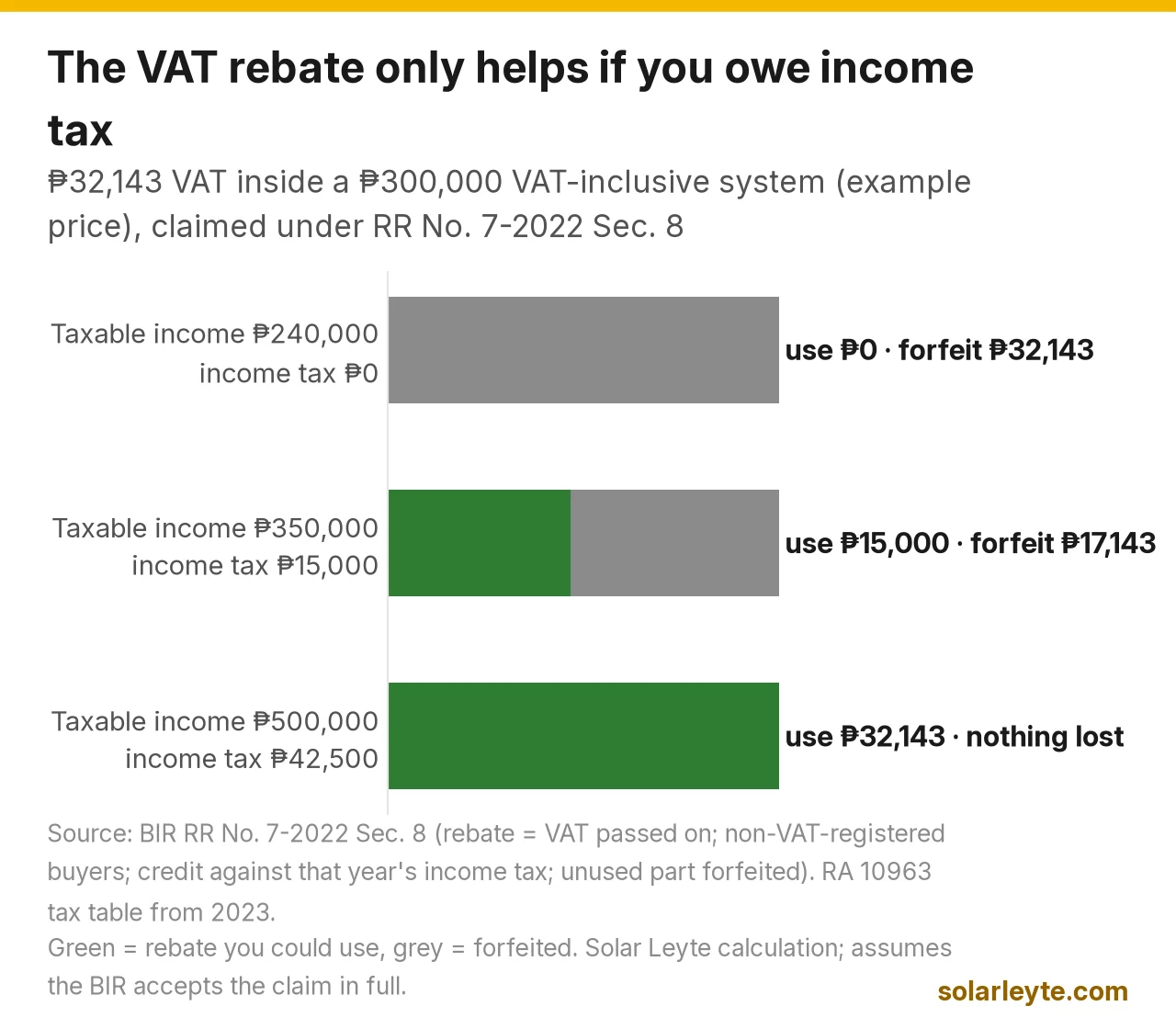
That last line matters. A credit against income tax only helps if you actually owe income tax that year. Under the TRAIN law (RA 10963), the first ₱250,000 of an individual's annual taxable income is taxed at 0% from 2023 onward. A household earning below that has no income tax to offset, so the rebate is worth nothing to them. We haven't found a BIR form or step-by-step procedure for claiming this rebate. Keep the official receipt or invoice showing the VAT, in your own name, and ask your BIR Revenue District Office how they want it claimed.
Worked example 1: the VAT on a ₱300,000 system
Example only. The ₱300,000 is a round number for the math, not a MACC price or a quote. Real prices are in our price guides.
Assumptions: a home solar system bought for ₱300,000, VAT-inclusive, from a VAT-registered seller. The buyer isn't VAT-registered and has only one income. The tax figures use the 2023-onward TRAIN schedule (RA 10963) on the buyer's taxable income for the year.
- VAT inside the price: ₱300,000 × 12 ÷ 112 = ₱32,143 (price before VAT ₱267,857).
- Under RR 7-2022 Sec. 8, that ₱32,143 is the most the rebate can be.
Buyer's taxable income that year | Income tax due (TRAIN, 2023 onward) | Rebate the buyer could use | Rebate forfeited |
|---|---|---|---|
₱240,000 | ₱0 | ₱0 | ₱32,143 |
₱350,000 | ₱15,000 (15% of the excess over ₱250,000) | ₱15,000 | ₱17,143 |
₱500,000 | ₱42,500 (₱22,500 + 20% of the excess over ₱400,000) | ₱32,143 | ₱0 |
Solar Leyte calculation from RR No. 7-2022 Sec. 8 and the RA 10963 tax table. It assumes the BIR accepts the claim in full. Whether and how a purely salaried employee files for it is something to confirm with your RDO.
Real property tax on solar panels
This is the part behind most "solar panel tax declaration" searches.
Who charges it. For a house in a municipality like Naval, Caibiran or Palo, the province levies the basic real property tax at up to 1% of assessed value. In a city like Tacloban, Ormoc or Baybay, the city levies it at up to 2% (LGC Sec. 233). Both can add 1% for the Special Education Fund (Sec. 235). These are ceilings. Each province or city sets its own rate by ordinance.
Is a solar system "machinery"? RA 12001 (the Real Property Valuation and Assessment Reform Act, approved 13 June 2024) now holds the definition. It repealed LGC Sec. 199(o) and kept nearly the same wording. Machinery "refers to machines, equipment, mechanical contrivances, instruments, appliances, or apparatus which may or may not be attached, permanently or temporarily, to the real property". Neither law names solar panels. The LGC does list a residential class for machinery, with a maximum assessment level of 50% (Sec. 218(c)). So the law clearly lets assessors tax household machinery. Whether yours gets a separate tax declaration, gets added to the house's value or isn't assessed at all is up to your local assessor.
How the value is set. For brand-new machinery, the fair market value is the acquisition cost (Sec. 224(a)). Each year of use can reduce it by up to 5% of the original cost, down to a floor of 20% while it's still working (Sec. 225).
Ordinance check. Some LGUs have cut this tax for solar. Makati exempted accessory solar energy systems from real property tax in December 2024 (Inquirer). Iloilo City gives qualifying solar homes a 20% RPT discount under Regulation Ordinance No. 2009-358, put into effect through a 2023 IRR (Rappler). We found no Biliran or Leyte provincial, city or municipal ordinance online that mentions solar panels and real property tax, as of 16 October 2026. That doesn't mean there isn't one, or that solar is exempt. Ask.
Worked example 2: the most RPT a ₱300,000 system could carry
Example only. It uses the legal maximums, so it shows the most the law allows, not what your assessor will charge. The ₱300,000 is the same round number as above.
Assumptions: the assessor treats the system as separate machinery. Year-one value is the ₱300,000 acquisition cost (Sec. 224(a)). Assessment levels are at the LGC maximums for machinery (Sec. 218(c)). The basic rate is at the maximum (1% province, 2% city, Sec. 233), plus the 1% SEF (Sec. 235).
Use of the system | Max assessment level | Assessed value | Max yearly RPT in a municipality (1% + 1% SEF) | Max yearly RPT in a city (2% + 1% SEF) |
|---|---|---|---|---|
Residential (your house) | 50% | ₱150,000 | ₱3,000 | ₱4,500 |
Agricultural (farm, pump) | 40% | ₱120,000 | ₱2,400 | ₱3,600 |
Commercial (store, resort) | 80% | ₱240,000 | ₱4,800 | ₱7,200 |
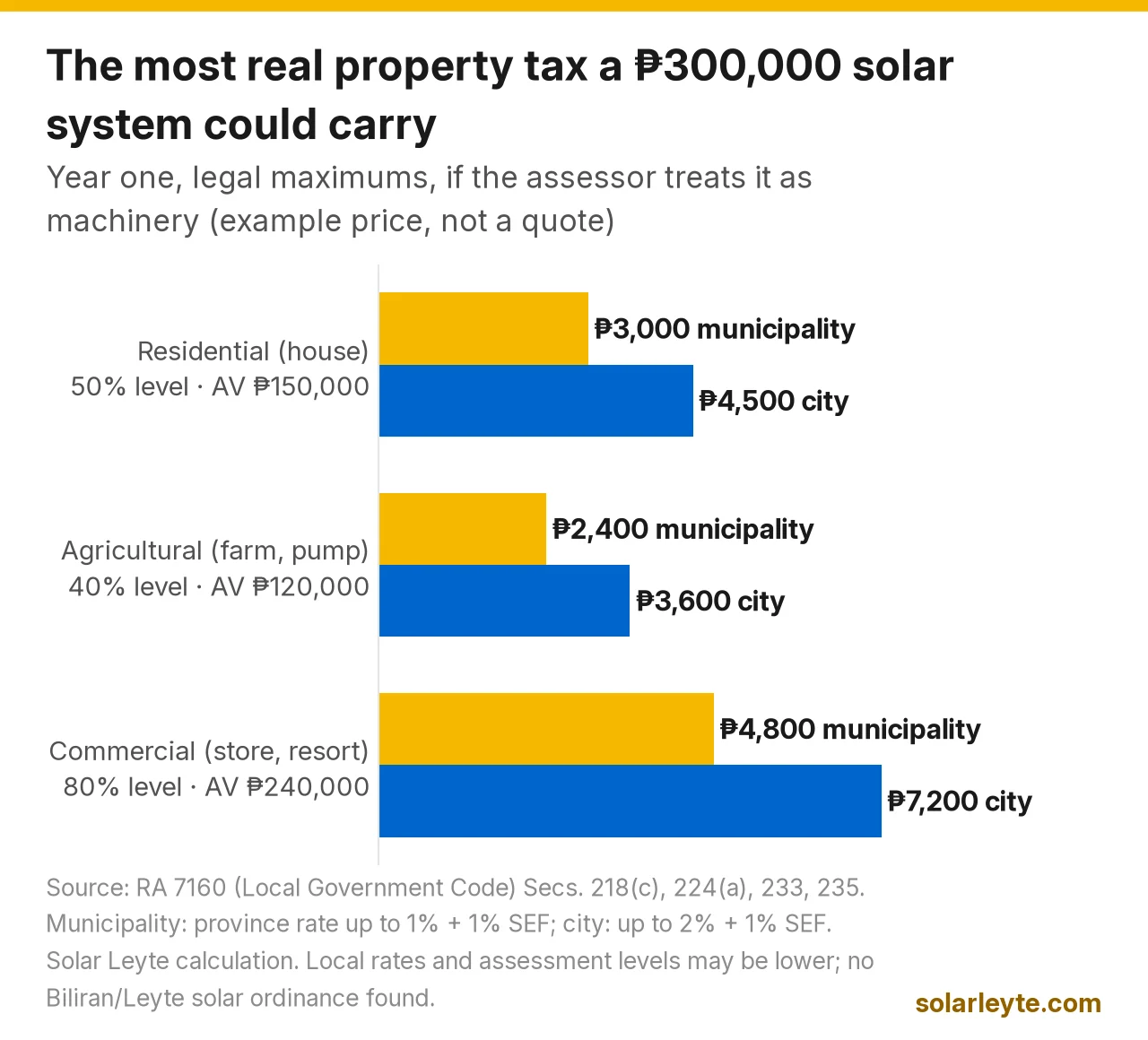
Solar Leyte calculation from RA 7160 Secs. 218(c), 224, 233 and 235. Actual local rates and assessment levels may be lower.
Over time, if the assessor applies the full 5% yearly depreciation from Sec. 225, the residential ceiling in a municipality drops to about ₱2,250 after 5 years and ₱1,500 after 10. From year 16 it stays at about ₱600 (the 20% floor). A smaller depreciation rate would keep it higher. Two other rules help with the bill. You can pay in four quarterly instalments without interest (Sec. 250), and the sanggunian may grant up to a 20% discount for paying in advance (Sec. 251).
For comparison: a DOE-registered RE developer's special cap under RA 9513 Sec. 15(c) is 1.5% of original cost less depreciation. That's up to ₱4,500 a year on the same ₱300,000, which isn't lower than the residential ceilings above. It was designed for power plants that would otherwise sit in the 80% commercial or industrial classes.
Should you declare it?
The Local Government Code puts the duty on owners to declare their real property, "including the improvements therein", to the assessor (Sec. 202). If the assessor later finds an undeclared item, Sec. 222 lets them collect back taxes for up to 10 years. Those back taxes carry no interest if paid by the end of the quarter after you get the notice, and 2% a month after that. So the safe move is to ask now:
- Call or visit your municipal assessor, or the Biliran Provincial Assessor's Office at the Capitol Compound, Brgy. Calumpang, Naval, (053) 500-9062 (biliran.gov.ph). In Leyte, ask the municipal assessor or the city assessor in Tacloban, Ormoc or Baybay.
- Ask: "Do you assess rooftop solar for homes? As machinery or as part of the house? What assessment level and tax rate apply, and is there any discount or exemption ordinance?"
- Bring the invoice. It shows the acquisition cost the assessor will start from.
Your house's existing tax declaration may also come up for other reasons. Permit offices may ask for it (see our electrical permit and CFEI guide), and The Pag-IBIG document list in our Pag-IBIG solar loan post includes an updated real estate tax receipt.
What RA 9513 really gives homeowners
RA 9513 provision | What it gives | Who gets it |
|---|---|---|
Sec. 10, net metering | Distribution utilities must enter into net-metering agreements with qualified end-users who request them, subject to technical considerations | Homeowners and businesses (system limits set by ERC rules) |
Sec. 23, tax rebate | DOF to rebate tax paid on RE equipment for residential, industrial or community use (BIR: VAT rebate for non-VAT-registered buyers, RR 7-2022) | Homeowners, if they owe income tax that year |
Sec. 17, universal charge | Power generated "for the generator's own consumption" is exempt from the universal charge | Anyone using their own solar power |
Sec. 15(a)–(j), fiscal incentives | Income tax holiday, duty-free imports, 1.5% realty cap, 0% VAT, 10% corporate tax and more | RE developers "duly certified by the DOE" (Sec. 15), registered through the DOE's Renewable Energy Management Bureau (Secs. 25–26) |
Sec. 21, RE commercialization | Tax and duty breaks, income tax holiday | DOE-accredited local manufacturers, fabricators and suppliers of RE equipment |
Source: RA 9513 (Lawphil); BIR RR No. 7-2022. Checked 16 Oct 2026.
The definition of an "RE developer" in RA 9513 (Sec. 4(pp)) can technically include individuals. But the Section 15 incentives only start after DOE registration and certification, BOI registration and the BIR paperwork in RR 7-2022. In our reading, that process is built for power projects, not a family roof.
Net metering and taxes
Under net metering (RA 9513 Sec. 10), BILECO or your LEYECO co-op credits the power you export against your bill. Our net metering guide and BILECO net metering steps cover how. On tax:
- The kWh you make and use at home never pass through your bill, so you pay none of the charges on them, VAT included. That's where most of the saving comes from.
- We didn't find a BIR regulation that addresses whether a household's net-metering credits count as income, either taxable or exempt, as of 16 October 2026. If you run a business, ask your accountant how to book the credits.
FAQ
Do I pay VAT on solar panels in the Philippines? Yes, if the seller is VAT-registered: 12%, about 10.7% of a VAT-inclusive price. The 0% VAT in RA 9513 is for the sale of renewable power and for registered RE developers' purchases, not for households.
Can I get the VAT back? Possibly. BIR RR No. 7-2022 Sec. 8 gives buyers of RE equipment for residential use who aren't VAT-registered a rebate equal to the VAT passed on. It's a credit against that year's income tax, and any unused part is forfeited. Ask your BIR Revenue District Office how to claim it.
Do I have to pay real property tax on solar panels? It depends on your assessor. The LGC lets provinces and cities tax residential machinery (maximum assessment level 50%, plus up to 1% basic tax in provinces or 2% in cities, plus 1% SEF). On a ₱300,000 system that's at most ₱3,000 a year in a municipality or ₱4,500 in a city. We found no Biliran or Leyte ordinance on solar specifically.
Do I need a tax declaration for my solar panels? The LGC requires owners to declare real property and improvements (Sec. 202). Whether your system needs its own tax declaration or is folded into the house is the assessor's call, so ask your municipal or provincial assessor.
Are homeowners entitled to RA 9513 tax incentives? Mostly no. The Section 15 incentives go to DOE-certified RE developers. Homeowners get net metering (Sec. 10), the VAT rebate (Sec. 23 and RR 7-2022) and the universal charge exemption on their own use (Sec. 17).
Solar Leyte is run by MACC Systems & Energy Solutions Inc., a solar installer in Naval, Biliran.
Get an itemised solar quote from MACC
Planning to claim the VAT rebate, apply for a loan or talk to your assessor? Ask us for an itemised written quote that shows the price before VAT, the VAT and the total, with every model number listed. You'll have the numbers your BIR office, your assessor or Pag-IBIG may ask for. No obligation, and this article has no made-up MACC price list.
- Call/Text: 0955 723 5093
- Email: official@macc-inc.com or benjie@macc-inc.com
- Website: www.macc-inc.com
- Office: Brgy. Talustusan, Naval, Biliran 6543
- Or use the site quote form: /quote
Sources (all checked 16 October 2026)
- Republic Act No. 9513, Renewable Energy Act of 2008 (Lawphil): Secs. 4(oo)–(pp), 10, 15, 17, 21, 23, 25, 26
- BIR Revenue Regulations No. 7-2022, tax incentives under the Renewable Energy Act (June 2022): Secs. 4(E) and 8
- BIR Revenue Regulations No. 10-2025 (VAT; zero-rating of renewable power sales, 12% rate references)
- Republic Act No. 7160, Local Government Code of 1991 (Lawphil): Secs. 202, 218, 222, 224, 225, 232, 233, 235, 250, 251
- Republic Act No. 12001, Real Property Valuation and Assessment Reform Act (approved 13 June 2024; Lawphil): Sec. 3(k), Sec. 38
- Republic Act No. 9337 (VAT reform; NIRC Secs. 106 and 110 as amended)
- Republic Act No. 10963, TRAIN law: individual income tax schedule from 1 January 2023
- Republic Act No. 11534, CREATE and Republic Act No. 12066, CREATE MORE
- Inquirer, Makati City exempts solar energy systems from property taxes (18 Dec 2024)
- Rappler, Iloilo City offers incentives to households shifting to solar power (11 Mar 2024)
- Province of Biliran, Provincial Assessor's Office
- Worked examples: Solar Leyte calculations in this article (labelled), with assumptions stated
- Related on Solar Leyte: solar financing guide, Pag-IBIG solar loan, 5 kW system prices, electrical permit and CFEI, net metering guide, BILECO net metering steps