The quickest way to check if a solar panel is original is to type its serial number into the maker's own checker: Jinko, LONGi and Trina all have one, and it takes about a minute per panel. Do it before you pay, or at the latest before the panels go on your roof. Then match the nameplate on the back to the official datasheet, and make sure the price and size make sense.
One thing surprises most buyers. A panel can be 100% genuine and still have no maker's warranty in the Philippines, because it is B-grade or came in through an unofficial channel. The serial check is the only easy way to find that out.
Last checked 10 November 2026. Checker pages, datasheets and seller prices were opened on that date. The DTI's mandatory certification rule for solar products was still a draft as far as we could find. The worked examples are Solar Leyte calculations, not a MACC quote.
Four ways a panel can be "not original"
"Fake" covers more than one problem. They need different checks.
What you got | What it is | Does the maker's serial check catch it? | Maker's warranty? |
|---|---|---|---|
Counterfeit | Another factory's panel with a famous brand's label | Usually: the serial isn't found, or doesn't match the label | No |
Relabelled | A real panel with a new sticker showing a higher wattage or newer model | Yes, if you compare the model and watts the checker returns with the label | No, for the claimed model |
B-grade or C-grade | A real panel the maker graded below A because of defects | Trina's checker shows the grade; Jinko classes its panels A, B or C | Ask for it in writing; often limited or none |
Grey import | A real panel sold into another country, then shipped here | Jinko's checker can flag it as sold outside the region | Often none outside the original sales region |
Sources: Jinko EU serial-number tool page, Jinko EU SN Verification Tool Guidance, Trina module query. Used and refurbished panels are a fifth group. A serial check may pass, so ask for the age and test results.
It does happen here. On 30 June 2026 the CIDG seized about ₱1.54 million worth of allegedly substandard solar lights and panels from a warehouse in Bulakan, Bulacan, under the Consumer Act, RA 7394 (Daily Tribune, 8 July 2026). In October 2026 LONGi warned buyers again about counterfeit modules sold under its name, after a case abroad ended with a fine for the company and a prison sentence for its controller (Green Building Africa, 4 Oct 2026).
Where to check: Jinko, LONGi and Trina
Brand | Official checker | What you type | What you get back |
|---|---|---|---|
Jinko | Country where the panel is, the 24-digit serial number, and a verification code | Whether it's genuine and in which sales region the warranty applies | |
LONGi | The product barcode (a string of numbers on the front or back), or scan the QR code on the nameplate | Module type and level, certification, electrical data and warranty, per LONGi | |
Trina | The serial number only | A table with Serial No., PV-MODULE Type, Grade and Query Time ("No Data" if not found) |
Sources: the three checker pages, opened 10 November 2026; LONGi, "One Module One Code", 16 March 2022.
Jinko: watch the country list
Jinko's serial number is 24 digits. You'll find it in one corner on the front of the panel and in the middle of the back (Jinko EU). Jinko describes three outcomes:
- Genuine, sold to the country you picked: eligible for warranty "within the [country] and the sales region this country located."
- Genuine, sold to another country in the same region: still covered in that region.
- Not genuine, or "sold and entered into the market through unofficial sales channel": "not eligible for Jinko Limited Warranty and supporting service."
That third message treats a grey import the same way as a fake when it comes to warranty. Jinko's EU guidance also lists the class it found: Class A "high quality", Class B "mid quality product with minor defects" and Class C "low quality" (SN Verification Tool Guidance).
A catch for Philippine buyers: when we opened Jinko's global checker on 10 November 2026, its country list had 12 entries (including Pakistan, India, Australia, the UAE and China), and the Philippines wasn't one of them. If you can't pick the Philippines, ask the seller for Jinko's written confirmation that the serials were sold for the Philippine market, or ask Jinko through its online consulting page.
LONGi: barcode or QR code
LONGi has put an anti-counterfeiting QR code on each module's nameplate since 2022. Scanning it shows the module type and level, certification, electrical parameters, specification and warranty (LONGi). LONGi's October 2026 warning says the serial number and barcode are on the rear sticker or under the front glass, and the QR code is also on the shipping pallet (Green Building Africa).
Our tip: type longi.com yourself instead of trusting the QR code. A fake sticker can carry a QR code that opens a copycat page. If the scan opens anything other than LONGi's own website, stop.
Trina: the one that shows the grade
Trina's checker asks for nothing but the serial number, and its result table has a Grade column (Trina). If you paid for an A-grade Vertex N and the table shows something else, raise it with the seller before installation. The query form opened for us without signing in.
Match the nameplate to the datasheet
The checker tells you the serial is real. The nameplate check tells you the sticker belongs to that panel. DTI's draft technical regulation would require every panel sold here to show these markings (DTI-BPS draft, 25 May 2026, Rule 7.1):
- trade name or trademark
- model number
- batch or serial number
- date of manufacture
- polarity of terminals
- maximum system voltage
- nominal and minimum maximum power at STC
- PS mark with licence number, or an ICC sticker
The rule isn't in force yet, but the list works as a checklist. Then compare the label with the maker's datasheet for that exact model code:
What to compare | Jinko Tiger Neo JKM600N-72HL4-BDV | LONGi Hi-MO 7 LR5-72HGD-580M |
|---|---|---|
Model code starts with | JKM | LR5-72HGD |
Size | 2,278 × 1,134 × 30 mm | 2,278 × 1,134 × 30 mm |
Weight | 31.0 kg | 31.8 kg |
Power tolerance | 0 to +3% | 0 to 3% |
Efficiency at STC | 23.23% | 22.5% |
Voc / Imp | 53.30 V / 13.50 A | 51.41 V / 13.42 A |
Sources: Jinko JKM575-600N-72HL4-BDV datasheet; LONGi Hi-MO 7 LR5-72HGD 560–590M datasheet (distributor-hosted copy).
Red flags on the label itself: a minus tolerance (such as ±3% or ±5%) on a brand whose datasheet says 0 to +3%; a wattage the datasheet for that model code doesn't list; a serial on the back that differs from the one under the front glass; two panels in your delivery with the same serial.
Worked example A: does the size fit the watts?
Example only. Assumptions: a panel sold as a "Jinko 600 W" measures 1,722 × 1,134 mm with a tape measure.
- Its area is 1.722 × 1.134 = 1.95 m².
- 600 W ÷ 1.95 m² = about 307 W per m², which works out to roughly 30.7% efficiency.
- Jinko's real 600 W model is 2,278 × 1,134 mm (2.58 m², about 232 W per m²) and lists 23.23% efficiency.
A panel that small can't make 600 W at STC. It's either another model with a 600 W label or a fake. Our Lazada and Shopee buying guide has more of these quick physics checks, including Vmp × Imp.
Does the price make sense?
Big-brand panels aren't sold far below everyone else. Here is what brand-name panels of 585 W and up were listed at on 10 November 2026:
Panel (as listed) | Seller | Listed price | ₱ per watt (our calculation) |
|---|---|---|---|
Seraphim 620 W TOPCon bifacial | ₱5,000 | ₱8.06 | |
Trina 600 W Vertex N bifacial | ₱5,000 | ₱8.33 | |
AE Solar 585 W N-type | ₱4,980 | ₱8.51 | |
JA Solar 600 W N-type bifacial | ₱5,125 | ₱8.54 | |
Sunova 615 W N-type bifacial | ₱5,250 | ₱8.54 | |
Dahai 585 W N-type | ₱6,437.50 | ₱11.00 | |
Seraphim 630 W bifacial | ₱7,250 | ₱11.51 | |
Trina 615 W N-type | ₱7,125 | ₱11.59 | |
JA Solar 625 W N-type bifacial | ₱7,437.50 | ₱11.90 | |
Aiko 665 W ABC bifacial | ₱8,250 | ₱12.41 |
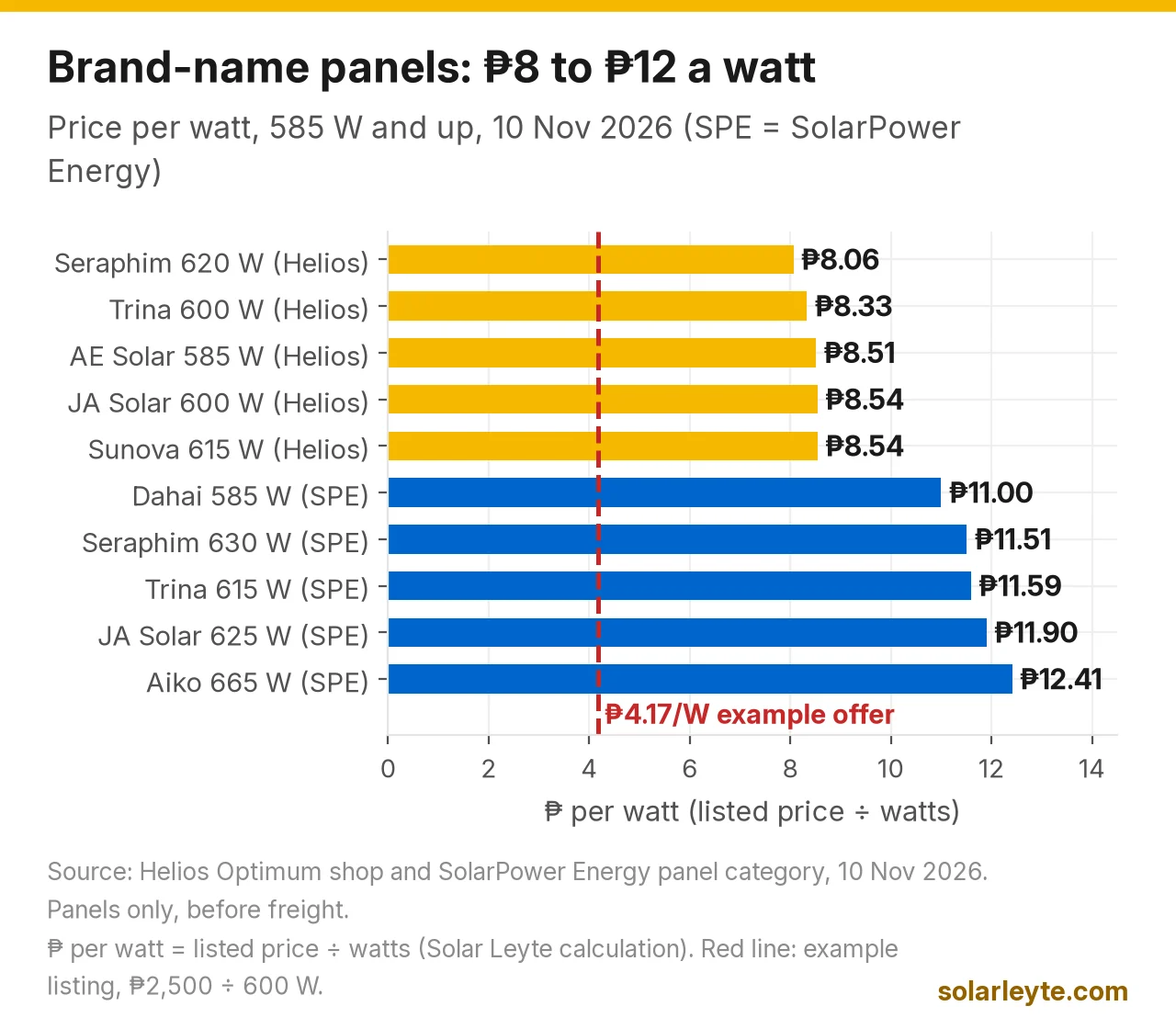
Panels only, before freight to Leyte or Biliran. SolarPower Energy lists a 5-piece minimum order. Sources: seller websites, 10 November 2026; ₱ per watt is a Solar Leyte calculation.
Worked example B: the "too good" listing
Example only. Assumption: a listing offers a "Jinko 600 W" panel for ₱2,500.
- ₱2,500 ÷ 600 W = ₱4.17 per watt.
- The cheapest brand-name listing above is ₱8.06 per watt, so this offer is about 48% lower.
A gap that big usually means B-grade stock, a relabelled panel, a used panel or a fake. Ask for the serial numbers before you pay and run them through the maker's checker. A seller with genuine A-grade stock has no reason to say no.
What to ask the seller, in writing
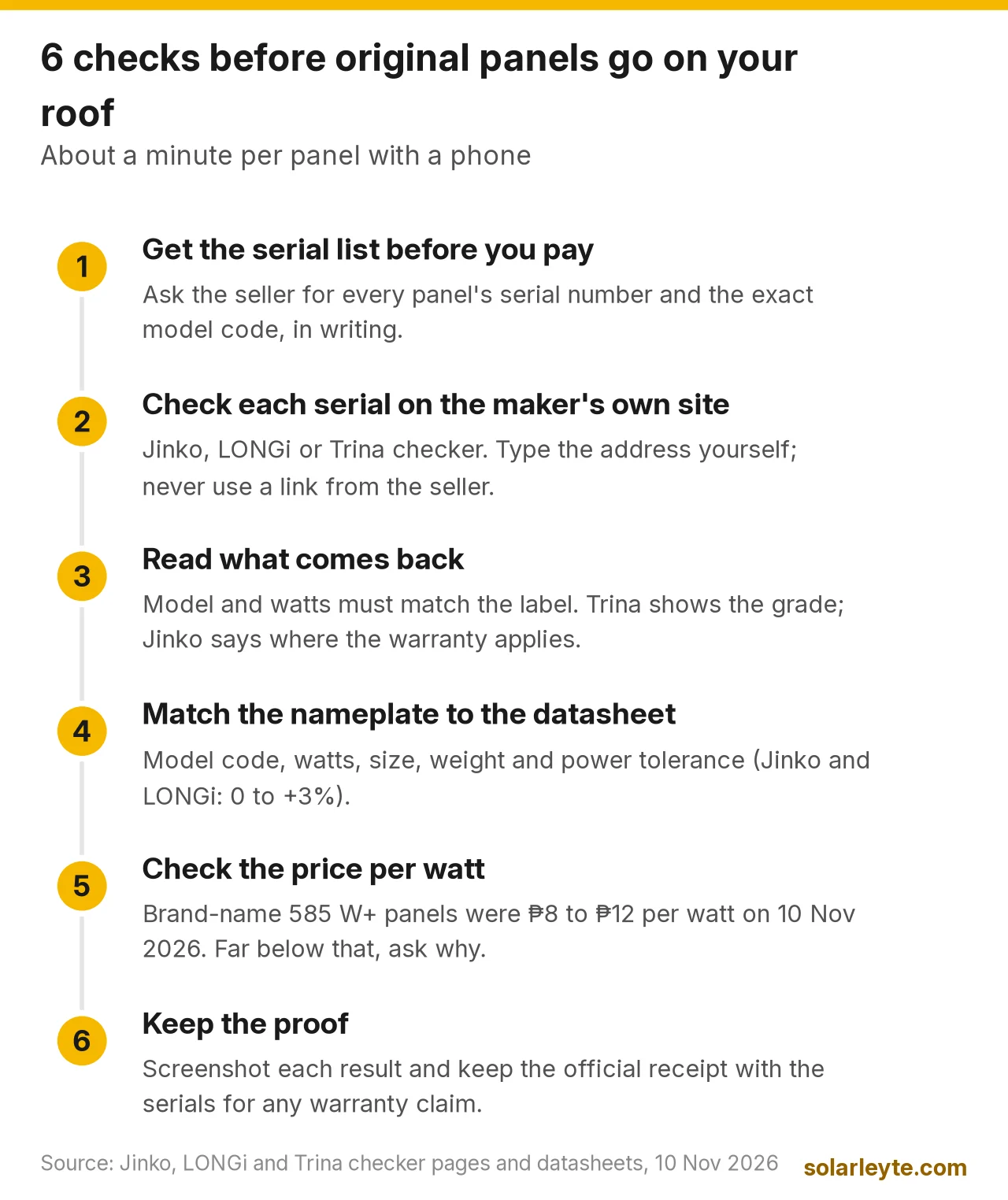
- The full serial list for your panels, before payment, so you can run the checks yourself.
- The exact model code and the datasheet for that code. Brand names like "Tiger Neo" cover many models with different warranties (see our Jinko vs Trina vs LONGi comparison).
- Grade A in writing on the invoice.
- Who handles warranty claims in the Philippines, and whether the maker covers these serials here. Our lifespan and warranty guide shows what the maker documents usually require.
- An official receipt with the serials on it. LONGi asks buyers to keep their contract and invoice (Green Building Africa).
- The IEC 61215 and IEC 61730 certificates for that model. Our Tier 1 explainer shows how to look them up.
If an installer supplies the panels, all of this belongs in your handover folder. Our installer guide and solar contract checklist cover the rest.
What if you already bought them?
- Run the checks now and screenshot each result next to the serial.
- If the serial isn't found or the model doesn't match, write to the seller first, with the screenshots. For a product that isn't as described, you can file a complaint with the DTI under the Consumer Act. The Lazada and Shopee guide explains return windows and RA 11967 for online buys.
- If it's genuine but B-grade or out-of-region, it may still work fine. Test it (multimeter guide) and watch for hot spots and cracks (cracked panel guide). But plan as if there's no maker's warranty.
Will the government make this easier? The DTI's draft order would require PS or ICC certification for panels, inverters, batteries and other solar parts, with a 12-month transition after it takes effect (DTI-BPS draft, 25 May 2026; GMA News). As of 10 November 2026 we found no signed order, so for now the checking is up to you.
FAQ
How do I check if a Jinko solar panel is original?
Open cs-jinkosolar.com/authenticity, pick the country, type the 24-digit serial from the front corner or the middle of the back, enter the code shown and press Verify. A "not genuine … or unofficial sales channel" reply means no Jinko warranty. If the Philippines isn't in the list, ask the seller for Jinko's written confirmation for these serials.
Is a B-grade solar panel fake?
No. B-grade panels are real panels from the maker, with real serial numbers, graded below A because of defects. Jinko calls Class B "mid quality product with minor defects." They can pass an authenticity check, so look at the grade (Trina shows it) and ask for Grade A on the invoice.
Pwede bang i-check bago magbayad?
Oo, at dapat. Hingin ang listahan ng serial numbers bago magbayad, at i-type mo mismo sa website ng Jinko, LONGi o Trina. Huwag gamitin ang link na galing sa seller.
What does a real LONGi panel weigh?
The LONGi Hi-MO 7 LR5-72HGD (560–590 W) weighs 31.8 kg at 2,278 × 1,134 × 30 mm, per its datasheet. A "LONGi 580 W" that is much smaller or lighter than its model's datasheet is a red flag.
Related guides
- Solar panel price guide: how to read a quote
- 550 W to 620 W solar panel prices
- Buying solar panels on Lazada and Shopee
- What "Tier 1" really means
- Jinko vs Trina vs LONGi
Solar Leyte is run by MACC Systems & Energy Solutions Inc., a solar installer in Naval, Biliran.
Get a free solar quote from MACC
Already have a quote with panel brands on it? Send it to us with your latest BILECO or LEYECO bill, and we'll go through it with you, with no obligation.
- Call/Text: 0955 723 5093
- Email: official@macc-inc.com or benjie@macc-inc.com
- Website: www.macc-inc.com
- Request a quote online: solarleyte.com/quote
- Office: Brgy. Talustusan, Naval, Biliran 6543
Sources (all checked 10 November 2026)
- Jinko Solar: global serial-number verification page (country, SN and verification code; country list seen 10 Nov 2026 had 12 entries, no Philippines); Jinko EU, Serial Number Verification Tool (24-digit SN, location on the panel, three outcomes and quoted messages, A-grade via authorised distributors); Jinko EU SN Verification Tool Guidance, 2025 (Class A/B/C definitions; the PDF returned an error to our fetch, so the text was read from a search-index copy); online consulting page
- LONGi: PV Module Authenticity page (product barcode on the front or back); "One Module One Code", 16 March 2022 (QR code on nameplates; module type and level, certification, electrical data, specification, warranty)
- Trina Solar: customer service portal, Verify Module Authenticity (serial-number field; result columns Serial No., PV-MODULE Type, Grade, Query Time, Tips; "No Data"; read in a browser)
- Green Building Africa, "LONGi warns African solar market over counterfeit module risks", 4 October 2026 (fine and prison sentence abroad; barcode/QR; rear sticker or under the front glass; keep contracts and invoices)
- Daily Tribune, "P1.5M substandard solar panels seized in Bulacan", 8 July 2026 (30 June 2026, Brgy. Matungao, Bulakan; ₱1,540,000; RA 7394)
- DTI-BPS, draft technical regulation on mandatory certification of solar energy systems, 25 May 2026 (Rule 7.1 module markings; PS/ICC; 12-month transitory provision); GMA News, "DTI eyes mandatory certification for solar power products" (comments until 25 July 2026)
- Datasheets: Jinko JKM575-600N-72HL4-BDV (2,278 × 1,134 × 30 mm; 31.0 kg; 0~+3%; 600 W: 23.23%, Voc 53.30 V, Imp 13.50 A); LONGi Hi-MO 7 LR5-72HGD 560–590M (distributor-hosted copy; 2,278 × 1,134 × 30 mm; 31.8 kg; 0~3%; 580M: 22.5%, Voc 51.41 V, Imp 13.42 A)
- Prices (10 November 2026): Helios Optimum shop (Seraphim 620 W ₱5,000; Trina 600 W ₱5,000; AE Solar 585 W ₱4,980; JA Solar 600 W ₱5,125; Sunova 615 W ₱5,250); SolarPower Energy panel category (Dahai 585 W ₱6,437.50; Seraphim 630 W ₱7,250; Trina 615 W ₱7,125; JA Solar 625 W ₱7,437.50; Aiko 665 W ₱8,250; 5-piece minimum)
- Price per watt, areas, efficiency and the two worked examples: Solar Leyte calculations from the figures above