Short answer: Leyte is becoming a solar farm province. The San Isidro Solar Power Project (two phases of 120 MWp each) is already energized. Two more farms, San Miguel (150 MW) and Isabel (76.65 MW), won the DOE's fourth Green Energy Auction (GEA-4) and are due to start delivering in December 2027 and June 2029. Tabango has a 20 MW grid battery in testing. Will these lower your BILECO or LEYECO bill? Maybe a little, over time, but not directly and not soon. Most of their power is sold to businesses or into the spot market, and solar doesn't produce at 6 PM when the Visayas grid is tightest. Here's what's actually being built and how it can reach your bill.
Last checked: 3 November 2026. Project dates are the developers' targets as reported to the DOE, and they often slip.
Leyte's solar farms and batteries at a glance
These are the Leyte projects on the DOE's Visayas lists as of August 2026, plus the two older farms that are already running.
Project (town) | Type | Size | Status / target | Who buys the power |
|---|---|---|---|---|
Ormoc Solar Power Project (Ormoc) | Solar | 24.48 MW installed | In commercial operation | Not stated on DOE list |
Sepalco Castilla Solar (Palo) | Solar | 42 MW installed (opened in 2016 as a 50 MW plant) | In commercial operation | Not stated on DOE list |
San Isidro Solar, Phases 1 and 2 (San Isidro) | Solar | 2 × 120 MWp (DOE lists Phase 2 at 112 MW) | Phase 1 energized Oct 2025, Phase 2 on 30 July 2026 | Shell Energy, two 15-year contracts |
San Miguel Solar (San Miguel) | Solar | 150 MW | GEA-4 winner, delivery from 30 Dec 2027 | Green Energy Auction |
Isabel Solar (Isabel) | Solar | 76.65 MW | GEA-4 winner, delivery from 30 Jun 2029 | Green Energy Auction |
Leyte Wind (Leyte and Capoocan) | Wind | 200 MW on DOE list; 110 MW won in GEA-4 | Delivery from 26 Dec 2028 (GEA-4); DOE list says COD Nov 2033 | Green Energy Auction |
Tabango BESS (Tabango) | Battery | 20 MW | "Ongoing T&C", target COD Oct 2026 | Grid reserves (ancillary services) |
Tabango BESS Phase 2 | Battery | 20 MW | On hold | Grid reserves |
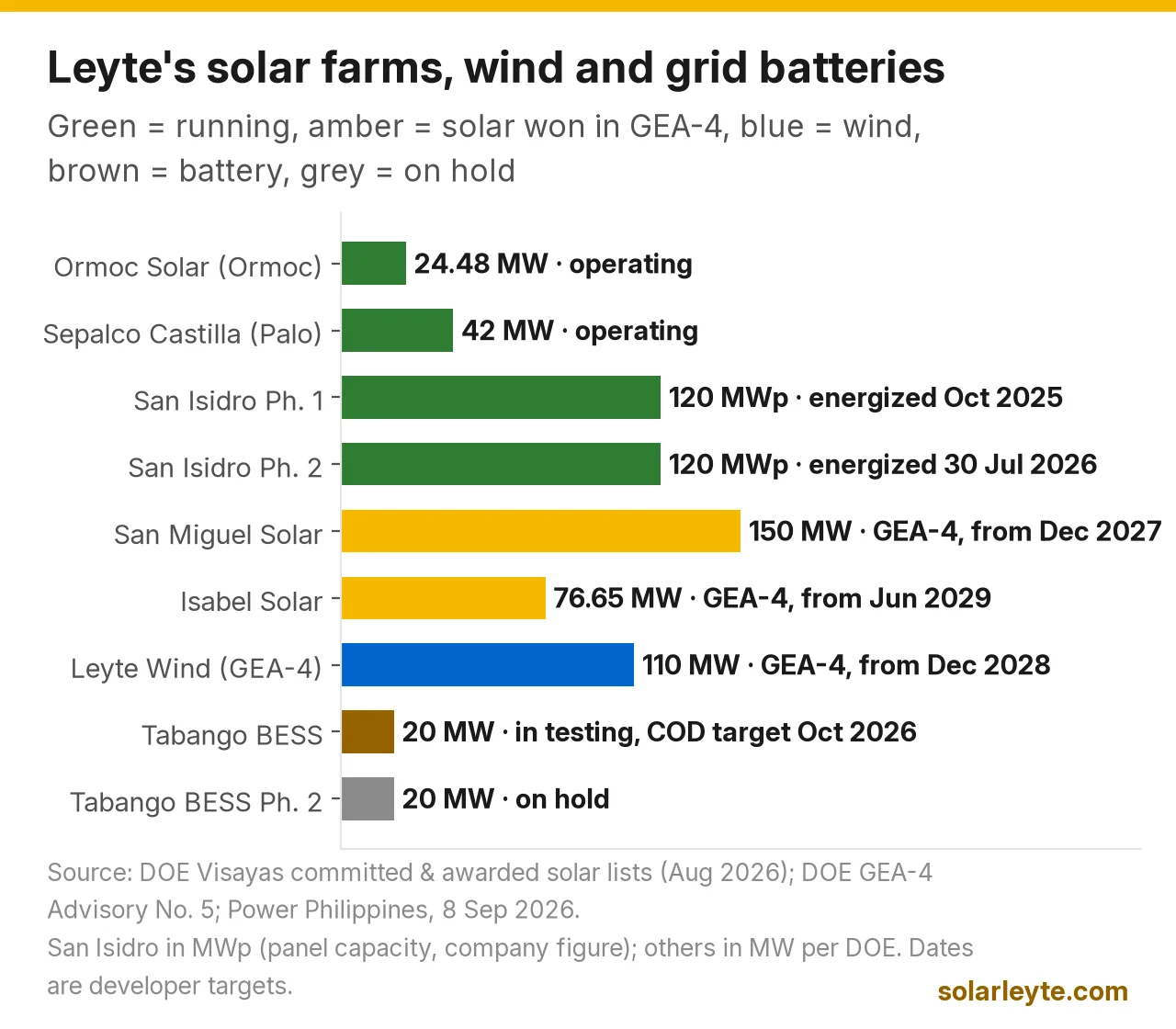
Two things to notice. First, the DOE's August list still shows San Isidro Phase 2 at 83.46% construction, while the companies said it was energized on 30 July 2026. Government lists lag behind press releases, so treat dates as approximate. Second, the 120 MWp figure is panel (DC) capacity; the DOE's 112 MW figure is what the plant can deliver to the grid, which is normally a bit lower.
Add up the three new solar farms still on the DOE's committed list (San Isidro Phase 2, San Miguel and Isabel) and you get 338.65 MW. That's almost all of the 341 MW of committed solar the DOE counts for the whole of Eastern Visayas.
What about Biliran?
No Biliran project is on the DOE's committed list. Biliran's projects are all at earlier stages. On the DOE's August 2026 "indicative" list (projects without firm financing or permits yet), there's a 20 MW Biliran Solar Power Project by E&P Green Energy. Its testing target was June 2025, its commercial operation date is "TBD" and financial closing is at 85%. For Biliran's geothermal plans, see our Leyte and Biliran geothermal explainer.
Further down the pipeline
The same indicative list has more Leyte solar: Kidlat Solar in Tabango (245 MW), a 31.25 MW farm in Babatngon, and extra capacity in San Miguel and Isabel. It also lists about 325 MW of standalone batteries planned in Babatngon, Ormoc and Tabango, most targeting 2027 to 2030. Indicative projects often never get built, so don't count on them yet.
How a solar farm's power reaches your bill
This is the part most news stories skip. A farm in San Isidro doesn't plug into your barangay. It feeds the Visayas grid, and its power is sold in one of three ways:
- Private contracts with suppliers. San Isidro's output is contracted to Shell Energy Philippines under two 15-year power supply agreements. Shell says the supply is for its commercial and industrial customers. So San Isidro adds supply to the grid, but it isn't a BILECO or LEYECO supply contract.
- The Green Energy Auction. San Miguel, Isabel and Leyte Wind won GEA-4 at fixed prices. Their power is sold into the spot market (WESM). If WESM pays less than the auction price, a small charge on everyone's bill, the GEA-All, tops them up. ERC Chairperson Francis Juan described it this way: "Kung kulang iyon kumpara sa guaranteed rate ng DOE, doon pumapasok ang GEA Allowance."
- The spot market directly. Any power sold into WESM adds supply, and more supply in daytime hours tends to push daytime spot prices down. Co-ops buy part of their power from WESM, so this can help them a little.
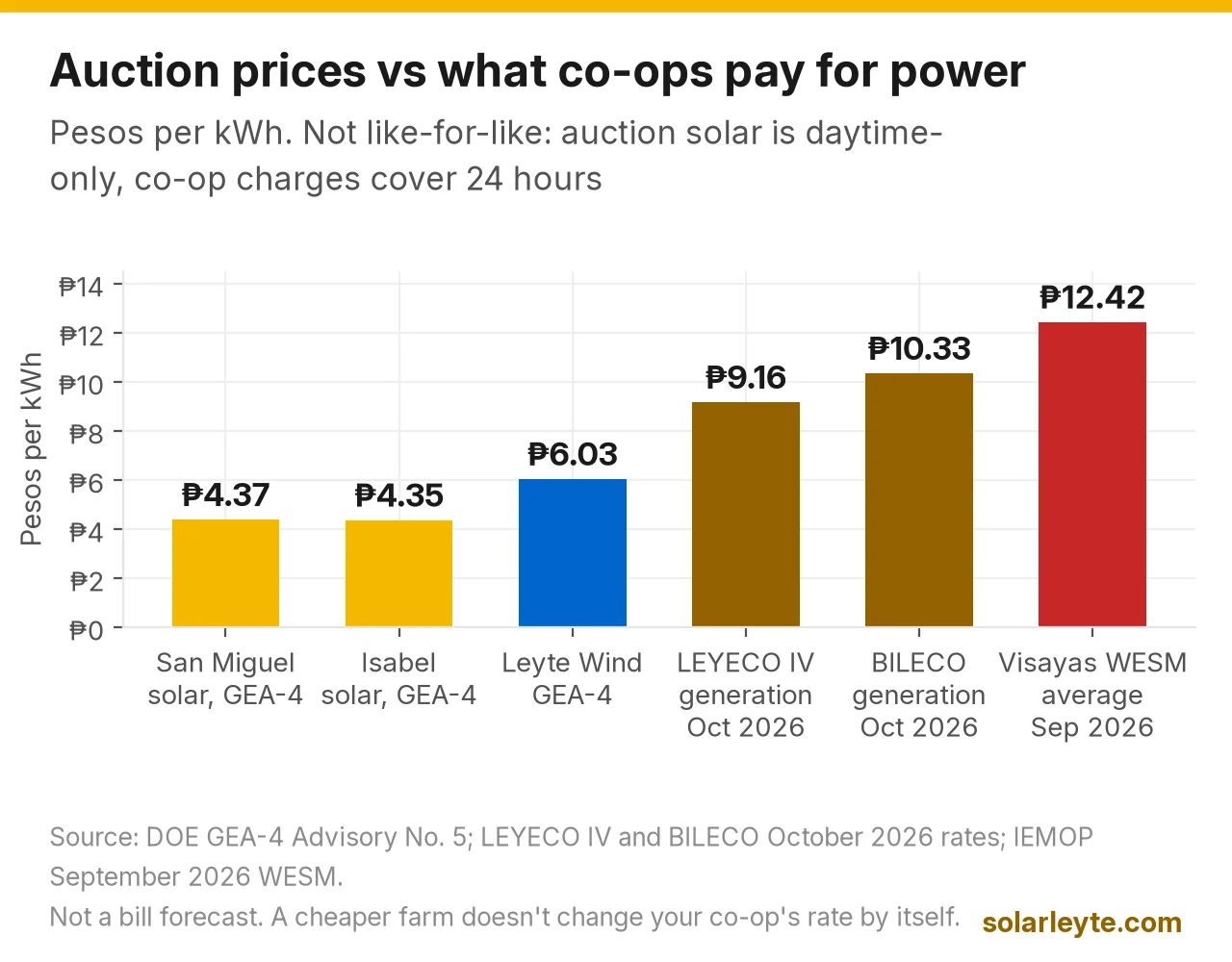
Auction prices vs what co-ops pay
Here are the GEA-4 prices for the Leyte winners next to what BILECO and LEYECO IV charged for generation in October 2026:
Price per kWh | ₱/kWh |
|---|---|
San Miguel Solar, GEA-4 winning price | 4.3700 |
Isabel Solar, GEA-4 winning price | 4.3488 |
Leyte Wind, GEA-4 winning price | 6.0259 |
ERC price cap for ground-mounted solar in GEA-4 | 4.4832 |
LEYECO IV generation charge, October 2026 | 9.1550 |
BILECO generation system charge, October 2026 | 10.3315 |
Visayas WESM average, September 2026 | 12.42 |
That looks like a huge gap, but it's not apples to apples. The auction price is for daytime-only solar energy delivered at the plant. A co-op's generation charge is a blend of round-the-clock power, including the evening hours that solar can't cover. So cheaper solar farms can pull the average down over the years, but they can't replace night power. For more on why co-op rates are what they are, see bakit mahal ang kuryente and our LEYECO IV and V rate tracker.
Example: how much a cheaper generation charge would save
Example only. Assumptions: LEYECO IV residential, October 2026 rates, 200 kWh a month, and a made-up drop of ₱1.00/kWh in the generation charge to show the scale. This is not a forecast.
- Your 200 kWh bill: 200 × ₱17.0099 + ₱5 fixed charge = ₱3,406.98
- Generation part: 200 × ₱9.4113 = ₱1,882.26, about 55% of the bill
- If generation fell by ₱1.00/kWh: you'd save about ₱200 a month
The rest of the bill (distribution, transmission, system loss, taxes and universal charges) wouldn't change because of a solar farm.
Example: what the GEA-All costs you
Example only. Assumption: the ₱0.0371/kWh GEA-All that Meralco began billing in January 2026 under ERC Resolution No. 06, s. 2025, applied to 200 kWh.
- 200 × ₱0.0371 = ₱7.42 a month
LEYECO IV's October 2026 rate sheet shows GEA-All at ₱0.0000, so check the line on your own bill. Our RA 9513 explainer covers the other renewable-energy lines on a bill.
Why the batteries matter more than the panels (for now)
The Visayas grid's worst hours are in the evening. On 24 August 2026, for example, GMA reported a yellow alert from 2 to 5 PM and a red alert from 5 to 8 PM, with 2,318 MW available against 2,431 MW of peak demand. That's after sunset, when solar farms produce almost nothing. Our Visayas yellow and red alert explainer covers what those alerts mean.
That's why the DOE is pushing grid batteries (BESS):
- On 22 May 2026, the DOE directed NGCP to contract at least 250 MW of reserves for the Visayas. On 13 August it issued a Show Cause Order over the delay.
- The DOE says a simulation by IEMOP (the market operator) showed that further delays could mean at least 10 red alerts and 30 yellow alerts, with spot prices averaging above ₱12/kWh.
- On 12 October 2026, the DOE said 253 MW of battery capacity is targeted to be online by the end of 2026, including the 20 MW / 20 MWh Tabango BESS in Leyte.
- Energy Secretary Sharon Garin told GMA that once those batteries are connected, "at the minimum, there will be 50% less yellow and red alerts in the Visayas."
The DOE has also pointed to transmission limits between Luzon and Leyte and between Leyte and Cebu. Leyte can generate a lot of power (geothermal plus solar), but the lines can only move so much of it to Cebu and the rest of the grid. New farms in Leyte don't fix that.
What this means for your own rooftop
Solar farms help the grid in the daytime. Your own panels do the same job at home, and you capture the full value of every kWh you use. A kWh from your roof saves you the full ₱17 to ₱19 retail rate. A big farm, at best, shaves something off the generation charge. The farms won't help you during a 6 PM brownout either, but a home battery will.
If you're deciding between waiting for rates to fall and installing now, our BILECO rate tracker shows how much rates move month to month. The rooftop solar boom explainer shows where rooftop fits in the national picture.
FAQ
What is the biggest solar farm in Leyte?
The San Isidro Solar Power Project in San Isidro, with two 120 MWp phases (240 MWp in total), both energized by 30 July 2026. Of the committed projects still to be built, San Miguel Solar (150 MW) is the biggest.
Will the San Isidro solar farm lower my LEYECO V bill?
Not directly. Its output is contracted to Shell Energy Philippines for commercial and industrial customers, and LEYECO V buys its power under its own supply arrangements. Extra daytime supply on the grid can ease spot prices a little, but there's no guaranteed bill cut.
When will San Miguel and Isabel solar start?
Their GEA-4 delivery start dates are 30 December 2027 (San Miguel) and 30 June 2029 (Isabel). As of August 2026, the DOE lists Isabel at 0% construction.
Is there a solar farm planned in Biliran?
There's a 20 MW Biliran Solar Power Project on the DOE's indicative list, with its commercial operation date marked "TBD". It isn't a committed project yet.
Why are there still red alerts if Leyte has so much power?
Red alerts hit in the evening, when solar isn't producing, and transmission limits restrict how much Leyte power can flow to Cebu. Batteries like the 20 MW Tabango BESS are meant to cover those evening gaps.
Solar Leyte is run by MACC Systems & Energy Solutions Inc., a solar installer in Naval, Biliran.
Get a free solar quote from MACC
Want your own daytime power instead of waiting for the grid? Send us a photo of your latest BILECO or LEYECO bill and we'll reply with options sized to your daytime use, with or without a battery for evening brownouts. No obligation.
- Call/Text: 0955 723 5093
- Email: official@macc-inc.com
- Website: www.macc-inc.com
Sources (all checked 3 November 2026)
- DOE, Visayas Committed Power Projects as of August 2026 (PDF): San Isidro Phase 2 112 MW, construction 83.46%, target COD Oct 2026; San Miguel 150 MW, COD Dec 2027; Isabel 76.65 MW, construction 0%, COD Jun 2029; Leyte Wind 200 MW, COD Nov 2033; Tabango BESS 20 MW "Ongoing T&C", COD Oct 2026; Tabango BESS Phase 2 20 MW on hold.
- DOE, Summary per Region, Committed Power Projects as of August 2026 (PDF): Region VIII committed solar 341 MW.
- DOE, Visayas Indicative Power Projects as of August 2026 (PDF): Biliran Solar 20 MW (T&C Jun 2025, COD TBD, financial closing 85%); Kidlat Solar 245 MW; Babatngon solar 31.25 MW; Leyte standalone BESS projects totalling 325 MW.
- DOE, Awarded Solar Projects as of 31 August 2026 (PDF): Ormoc Solar 24.48 MW and Sepalco Castilla (Palo) 42 MW installed, in commercial operation.
- DOE, Private Sector Initiated Power Projects: index page for the lists above.
- DOE, GEA-4 Advisory No. 5, List of Winning Bidders and PDF: San Miguel ₱4.3700/kWh, 150 MW, delivery from 30 Dec 2027; Isabel ₱4.3488, 76.65 MW, 30 Jun 2029; Leyte Wind ₱6.0259, 110 MW, 26 Dec 2028.
- Philstar, "ERC sets ceiling rates for fourth green auction", 16 June 2025: ground-mounted solar GEAR price ₱4.4832/kWh.
- Power Philippines, "Shell Energy signs second 15-year PSA deal for 120-MWp Leyte solar", 8 September 2026 and Daily Tribune, 8 September 2026: two 120 MWp phases, 240 MWp total, 15-year contracts, energized Oct 2025 and 30 July 2026, commercial and industrial customers.
- The Freeman (Philstar), "Leyte's 2nd solar power farm opened", 11 March 2016: 50 MW plant in Brgy. Castilla, Palo, after the Ormoc farm.
- Daily Guardian, "ERC defends GEA-All charge on electricity bills", 7 January 2026: GEA-All as a top-up between auction rates and WESM earnings; Chair Juan quote.
- Meralco, GEA-All FAQs: ₱0.0371/kWh from January 2026 billing, ERC Resolution No. 06, s. 2025.
- LEYECO IV, October 2026 Rates and October 2026 Generation Charges: residential ₱17.0099/kWh; ₱5.00 fixed charge; generation ₱9.1550 before adjustment, ₱9.4113 after; GEA-All ₱0.0000.
- BILECO, October 2026 Effective Rate: generation system charge ₱10.3315/kWh.
- IEMOP, September WESM prices: Visayas average ₱12.42/kWh.
- GMA News, "NGCP ordered to install over 250 MW of batteries", 24 August 2026: alert hours, 2,318 MW available vs 2,431 MW peak, Sec. Garin's "50% less" quote.
- DOE, "DOE: NGCP reserves failure exposed Visayas to red and yellow alerts", 5 October 2026: 22 May directive for at least 250 MW, 13 August Show Cause Order, IEMOP simulation, transmission limits.
- DOE, "Normal power supply outlook, 51 projects completed under Task Force 200", 12 October 2026: 253 MW of BESS targeted by end-2026.
- Daily Guardian, "NGCP denies delaying Visayas ancillary services contracts": 20 MW / 20 MWh SBPI Tabango BESS among the battery projects.
- 338.65 MW total, 325 MW BESS total, the 200 kWh bill examples and the 55% share: Solar Leyte calculations from the figures above.