Short answer: RA 9513, the Renewable Energy Act of 2008, is the law that makes net metering possible. Section 10 says your electric cooperative "shall enter into net-metering agreements" with customers who install solar or other renewable systems. Most of the rest of the law is about power plants: tax holidays and 0% VAT for registered RE developers, the feed-in tariff, and the rule that utilities must buy a growing share of renewable power. For a household in Biliran or Leyte, the useful parts are net metering, a VAT rebate on equipment, and knowing why a few small charges appear on your bill. Section 10 itself doesn't state the 100 kW cap; that comes from the law's definitions (Sec. 4(j) distributed generation up to 100 kW, with Sec. 4(gg) tying net metering to distributed generation) and is applied by the ERC and DOE rules. The law also doesn't set what an export is worth—those pricing details come from ERC and DOE rules that changed in 2025 and 2026.
Last checked: 3 November 2026. This is a plain-language summary, not legal advice. ERC and DOE rules change, so confirm current requirements with your cooperative.
RA 9513 at a glance
The law was signed on 16 December 2008 and has 40 sections. The DOE wrote its implementing rules (the IRR) as Department Circular DC2009-05-0008 in May 2009. These are the sections a homeowner actually runs into:
Section | What it says (short version) | What it means for a Leyte or Biliran home |
|---|---|---|
Sec. 6, Renewable Portfolio Standard | Utilities must source a minimum share of power from renewables | BILECO and LEYECO buy more RE over time; small REC cost on bills |
Sec. 7, Feed-in tariff | Fixed long-term tariffs for wind, solar, ocean, run-of-river hydro and biomass plants | For power plants, not homes. You pay for it through the FIT-All line |
Sec. 8, Renewable Energy Market | A market for trading RE certificates under WESM | Mostly utilities; full operations began 26 Dec 2024 |
Sec. 9, Green Energy Option | End-users can choose RE as their source | Larger businesses only, under DOE rules |
Sec. 10, Net metering | Utilities must sign net-metering agreements with qualified end-users | The main benefit for homes with rooftop solar |
Sec. 15, Incentives | Income tax holiday, duty-free imports, 0% VAT and more for DOE-certified RE developers | Not for ordinary homeowners |
Sec. 17, Universal charge | Power you generate for your own use is exempt from the universal charge | Solar you use at home has no universal charge on it |
Sec. 23, Tax rebate | Rebates for tax paid on RE equipment for residential use | A possible VAT rebate on your system |
Sec. 31, Host communities | 80% of the government share from RE projects subsidises users at 100 kWh a month or less | Relevant near Leyte's geothermal plants |
Secs. 35 and 36, Penalties | "Willful refusal" to do net metering is prohibited; fines of ₱100,000 to ₱100 million and/or 1 to 5 years in prison | A co-op can't just refuse a qualified applicant |
Sources: RA 9513 on Lawphil; IEMOP for the market start date. Links under Sources.
Net metering: what the law says and what it leaves to the rules
Section 10 is short, and a lot of what people say about net metering isn't in it:
- It says distribution utilities "shall enter into net-metering agreements with qualified end-users", "subject to technical considerations and without discrimination and upon request".
- It tells the ERC to set the interconnection standards, the pricing method and the other commercial arrangements.
- It gives the utility the Renewable Energy Certificates (RECs) from net metering, so the utility can count them toward its RPS target.
Section 10 itself doesn't state the 100 kW cap. The cap comes from the law's definitions—Sec. 4(j) defines distributed generation as up to 100 kW, and Sec. 4(gg) ties net metering to distributed generation—and is applied by the ERC's net-metering rules and DOE circulars. The law also doesn't say what your exported power is worth. The DOE describes net metering as a program under RA 9513 for systems "of up to 100 kilowatts (kW)".
The rules that apply now (late 2026)
Rule | What it changed | Source |
|---|---|---|
ERC Resolution No. 15, s. 2025 | Exported energy is credited at the utility's monthly generation charge (its blended generation cost, excluding other adjustments). Credits are banked and rolled over to later bills. The REC meter is optional. 20 working days to interconnect once permits are in. | Ocampo & Suralvo summary of the resolution |
DOE DC2025-10-0020 (Oct 2025) | RECs from power you use yourself go to you. RECs from exported power go to the utility. Credits can be shared between your accounts in the same co-op area. The ERC still has to issue rules for parts of this. | DOE circular |
EO 110 (24 Mar 2026) and the DOE's 1 Apr 2026 directive | National energy emergency. The DOE told DUs and co-ops to process net-metering applications in 10 working days (non-extendible) and LGUs to act on permits in 3 working days. Before this, co-ops had 20. | EO 110 on Lawphil; DOE press release |
EO 110's emergency lasts one year from 24 March 2026, so until 24 March 2027, "unless otherwise extended or lifted by the President." We found no order lifting or extending it as of 3 November 2026. If it lapses, the ERC's 20-working-day rule is the fallback.
For the actual steps, see our net metering guide, the BILECO net metering steps and the LEYECO II application guide.
Worked example: what an exported kWh is worth at LEYECO IV
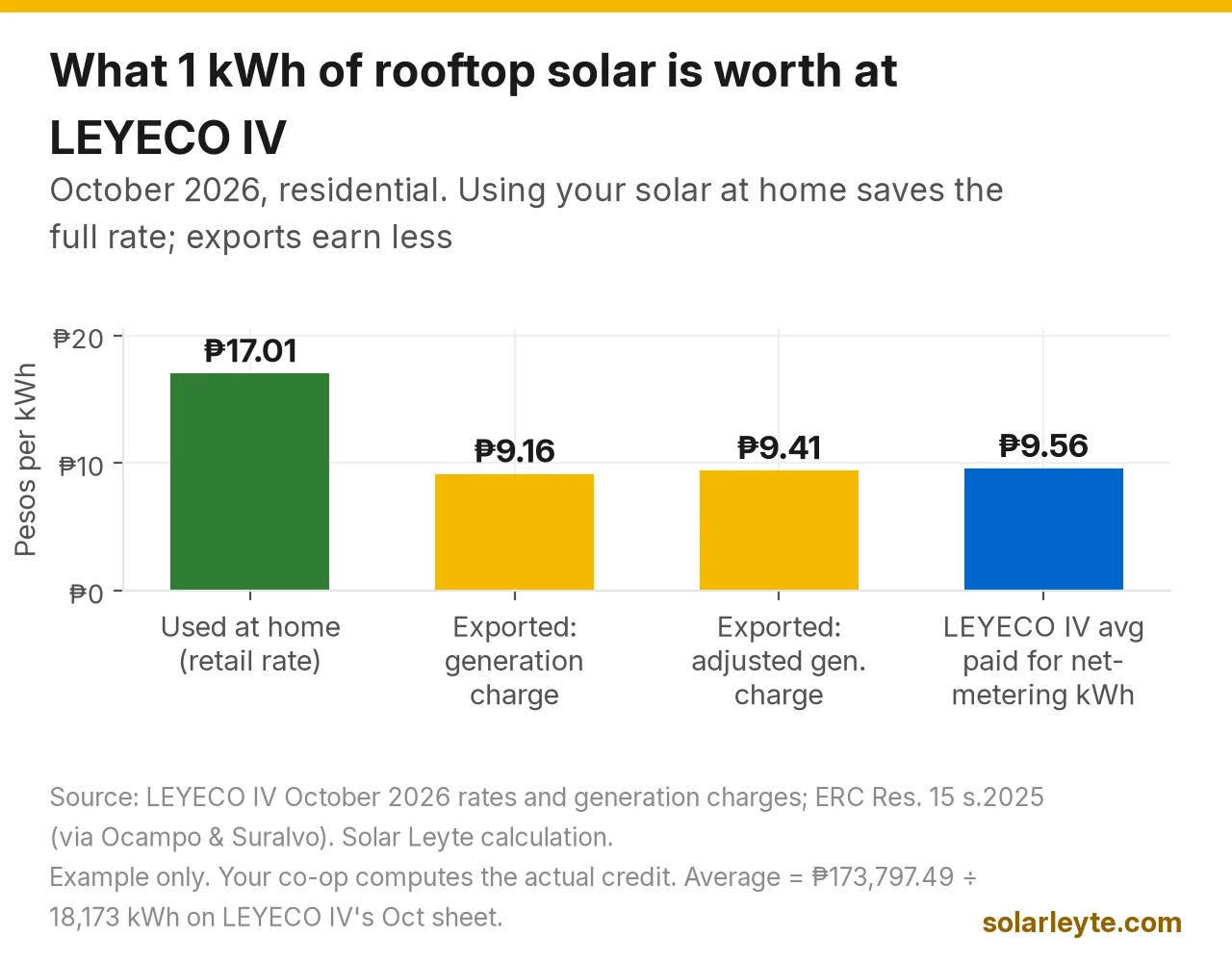
Example only. Assumptions: a LEYECO IV residential customer, October 2026 rates, and our reading that the export credit is the generation charge before the "other generation rate adjustment". Your co-op computes the actual credit.
LEYECO IV's October 2026 sheet shows a residential rate of ₱17.0099/kWh. Its generation charge is ₱9.1550/kWh, or ₱9.4113 after a ₱0.2563 adjustment. The same sheet lists 18,173 kWh bought from net-metering customers at an average of ₱9.5635/kWh, about 0.15% of what the co-op bought that month.
100 kWh of solar… | Value at LEYECO IV, Oct 2026 |
|---|---|
Used in your house (saves the full retail rate) | about ₱1,701 |
Exported, credited at ₱9.1550 | about ₱916 |
Exported, credited at ₱9.4113 | about ₱941 |
So an exported kWh is worth roughly 54% to 55% of a kWh you use yourself. At BILECO's October 2026 residential rate of ₱19.3628/kWh, 100 kWh used at home saves about ₱1,936. Estimate (BILECO export credit): exports are credited at roughly BILECO's blended generation cost excluding other adjustments, about ₱9.50/kWh in September 2026 per PRESYO-PH; the posted October generation charge is ₱10.3315 before VAT; the credit rate changes monthly, so check with BILECO.
The practical lesson hasn't changed: size solar mostly for your own daytime use, and treat exports as a bonus. If you don't want to export at all, a zero-export system follows different DOE rules (see plug-and-play and zero-export solar).
Where RA 9513 shows up on your bill
You pay for some of the law even without solar. LEYECO IV's October 2026 residential rate breakdown has four lines that trace back to RA 9513:
Bill line (LEYECO IV, Oct 2026) | Per kWh | Linked to | On a 200 kWh month |
|---|---|---|---|
Feed-in Tariff Allowance (FIT-All) | ₱0.3359 | Sec. 7, feed-in tariff | ₱67.18 |
REC Recovery | ₱0.0127 | Sec. 6, RPS | ₱2.54 |
Renewable Energy Dev. Cash Incentive | ₱0.0101 | Sec. 15(h), missionary electrification | ₱2.02 |
GEA-All (Renewable) | ₱0.0000 | Green Energy Auction allowance | ₱0.00 |
Total | ₱0.3587 | ₱71.74 |
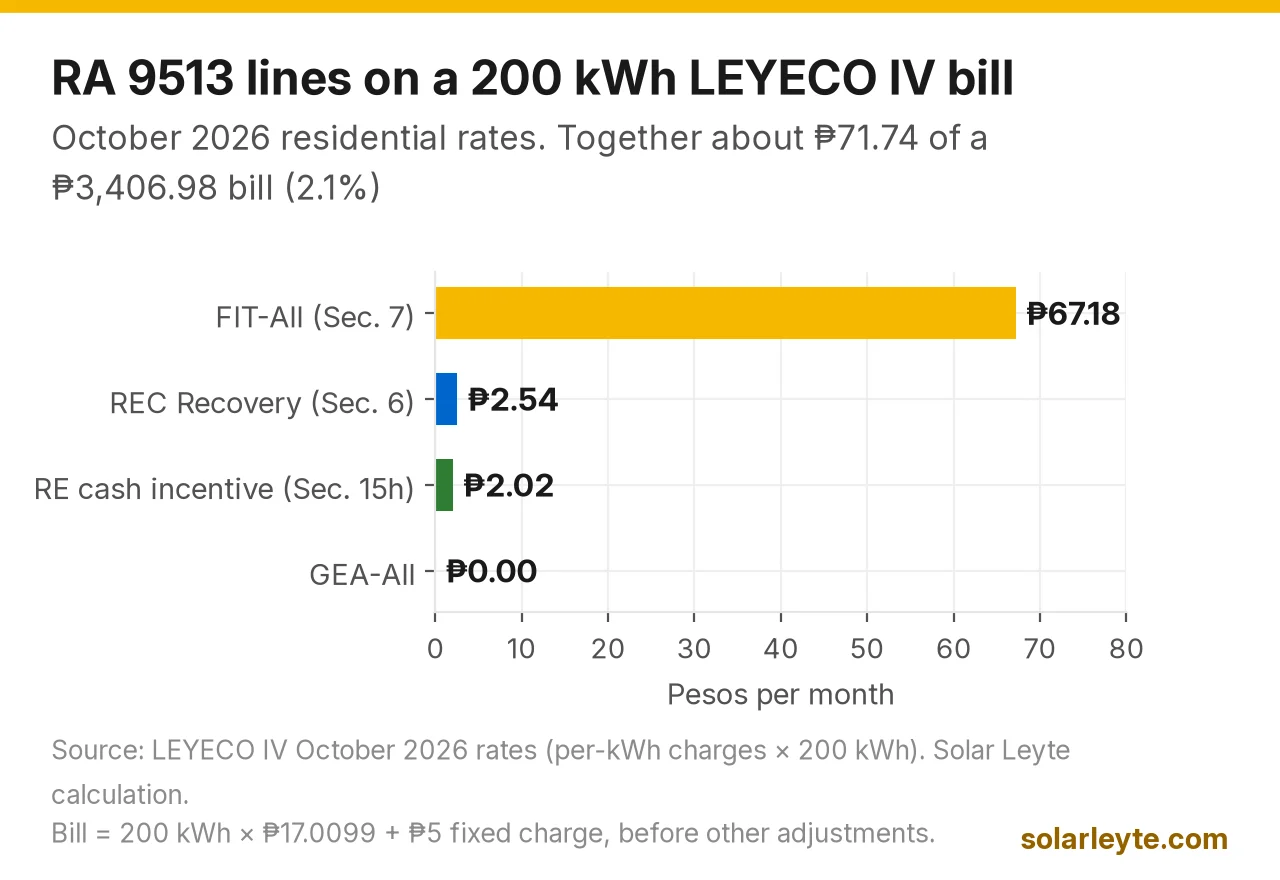
Example: 200 kWh at LEYECO IV's ₱17.0099 plus the ₱5 fixed charge is a ₱3,406.98 bill before any other adjustments. The RA 9513 lines are about ₱71.74 of that, roughly 2.1%. Solar Leyte calculation.
The biggest part of the bill is generation (₱9.4113 plus ₱1.0013 VAT on LEYECO IV's sheet). Our bakit mahal ang kuryente post explains why.
What homeowners get, and what they don't
The big incentive list in Section 15 (seven-year income tax holiday, duty-free imports, 0% VAT, a 1.5% realty tax cap, 10% corporate tax after the holiday) goes to RE developers "duly certified by the DOE". That means companies that build and run power projects, not a family roof in Naval. A homeowner gets:
- Net metering (Sec. 10), as above.
- No universal charge on solar you use yourself (Sec. 17). The law exempts power "for the generator's own consumption" from the universal charge.
- A possible rebate of the VAT you paid on RE equipment (Sec. 23). How to claim it, plus real property tax on panels, is in our solar panel tax guide.
RA 9513 doesn't give households free panels or a cash subsidy. For what NEA, DOE and LGUs actually offer, see is there a government solar subsidy.
The other parts, in one line each
- RPS (Sec. 6): co-ops must raise their renewable share every year. Our RPS explainer shows what that means for BILECO and LEYECO.
- Green Energy Option (Sec. 9): lets bigger users buy renewable power directly. See our GEOP guide for who qualifies.
- Host communities (Sec. 31): 80% of the host LGU's share from RE projects goes to subsidising the bills of users at 100 kWh a month or less. Leyte hosts big geothermal plants; our Leyte geothermal post covers them.
Common mix-ups
- "RA 12017 is the new net-metering law." It isn't. RA 12017 (9 August 2024) is the franchise of LEYECO II for Tacloban, Babatngon and Palo. Net metering is still under RA 9513.
- "Exports are credited at the same rate I pay." Not under the current ERC rules. Credits use the generation charge, which is about half the retail rate at LEYECO IV in October 2026.
- "The law caps net metering at 100 kW." Sec. 10 itself doesn't state the cap. It comes from the definitions in Sec. 4(j) (distributed generation up to 100 kW) and Sec. 4(gg) (net metering is for distributed generation), and is applied by the ERC rules and DOE policy.
Tagalog summary (buod)
Ang RA 9513 o Renewable Energy Act of 2008 ang batas na nagbibigay ng net metering: kapag may solar ka, obligado ang BILECO o LEYECO na pumirma ng net-metering agreement kung qualified ka. Ang kuryenteng ma-export mo ay may credit sa bill, pero mas mababa ito kaysa sa rate na binabayaran mo, mga ₱9 lang kada kWh sa LEYECO IV ngayong Oktubre 2026 kumpara sa ₱17. Kaya mas sulit kung gamitin mo mismo ang solar sa araw. Ang malalaking tax incentive sa batas ay para sa mga registered RE developer, hindi para sa ordinaryong bahay. Puwede kang mag-claim ng VAT rebate sa equipment. Ang maliit na "FIT-All" sa bill mo ay galing din sa batas na ito.
FAQ
What is RA 9513 in simple terms?
It's the Philippine law, signed 16 December 2008, that promotes renewable energy. For homes, its main effect is net metering: your co-op must let you connect solar and credit the power you export. Most of the other sections set up incentives and markets for power plants and utilities.
Does RA 9513 require BILECO and LEYECO to accept net metering?
Yes, "subject to technical considerations". Section 10 requires distribution utilities to enter into net-metering agreements with qualified end-users on request, and Section 35 prohibits willful refusal. You still need the permits, a CFEI and a bidirectional meter. See how long solar installation takes for the deadlines.
Is there a 100 kW limit for net metering?
Yes. Sec. 10 itself doesn't state the 100 kW cap; it comes from Sec. 4(j) (distributed generation up to 100 kW) and Sec. 4(gg) (net metering is for distributed generation), and is applied by the ERC rules and DOE policy. The DOE describes net metering as being for RE systems of up to 100 kW. Most homes in Leyte and Biliran are far below that.
Solar Leyte is run by MACC Systems & Energy Solutions Inc., a solar installer in Naval, Biliran.
Get a free solar quote from MACC
Planning solar with net metering in Biliran or Leyte? Send us a photo of your latest BILECO or LEYECO bill and we'll reply with options sized to your daytime use, plus what the net-metering paperwork involves. No obligation.
- Call/Text: 0955 723 5093
- Email: official@macc-inc.com
- Website: www.macc-inc.com
Sources (all checked 3 November 2026)
- Republic Act No. 9513, Renewable Energy Act of 2008 (Lawphil): approved 16 December 2008; Secs. 4(j), 4(gg), 6, 7, 8, 9, 10, 15, 17, 23, 31, 33, 35 and 36 as quoted and summarised above.
- DOE Department Circular DC2009-05-0008, IRR of RA 9513 (ESCAP policy database): the implementing rules issued under Sec. 33.
- Ocampo & Suralvo, "The Energy Regulatory Commission Amends the Net-Metering Rules for Renewable Energy": ERC Resolution No. 15, s. 2025; credit at the DU's monthly generation charge from its blended generation cost excluding other adjustments; banking and rollover; optional REC meter; 20 working days; NMA to the ERC within 5 days.
- DOE Department Circular DC2025-10-0020 (PDF): REC ownership (own use to the end-user, exports to the DU), multi-site sharing of credits, ERC enjoined to issue rules.
- DOE, "DOE Fast-Tracks Net Metering Under EO 110", 1 April 2026: 10 working days for DUs and ECs, 3 for LGUs, previously 20; net metering under RA 9513 for systems up to 100 kW.
- Executive Order No. 110, s. 2026 (Lawphil): national energy emergency declared 24 March 2026; Sec. 12, in force for one year unless extended or lifted.
- LEYECO IV, October 2026 Rates: residential ₱17.0099/kWh; ₱5.00 fixed charge; FIT-All ₱0.3359; REC Recovery ₱0.0127; RE Dev. Cash Incentive ₱0.0101; GEA-All ₱0.0000; generation charge ₱9.4113; generation VAT ₱1.0013.
- LEYECO IV, October 2026 Generation Charges: generation charge ₱9.1550 before the ₱0.2563 other generation rate adjustment; net metering 18,173 kWh (0.15%) at an average of ₱9.5635/kWh.
- BILECO, October 2026 Effective Rate: residential ₱19.3628/kWh; October 2026 unbundled schedule generation system charge ₱10.3315/kWh plus ₱0.9693 generation VAT (image /uploads/power-rate/20261028021015.jpg).
- PRESYO-PH (ICSC), BILECO local rates: September 2026 blended generation cost about ₱9.50/kWh (latest available period Sep 2026; aligned blended rate 9.50).
- IEMOP, Full Commercial Operations of the Renewable Energy Market: REM full commercial operations from 26 December 2024.
- Republic Act No. 12017 (Lawphil): franchise of LEYECO II for Tacloban City, Babatngon and Palo, 9 August 2024.
- Export-credit values, the 200 kWh bill example and percentages: Solar Leyte calculations from the figures above.