Yes, a small vulcanizing or fabrication shop in Leyte or Biliran can run an inverter welding machine on solar — but you size the hybrid inverter to the welder's input kVA while the arc is on, not to the "200 A" sticker on the box, and not to the inverter's 10-second peak rating. Stick (MMA) and TIG inverters sold in Philippine hardware shops pull several kilowatts from the wall for minutes at a time. That is a continuous load. Motor-start surge headroom helps a pump; it does not carry a weld.
This post is for shop owners and fabricators who already have, or are pricing, rooftop solar with a hybrid inverter and battery. It uses maker datasheets for input power, dated PH listings for welder prices, BILECO's October 2026 commercial rate for a bill example, and the same hybrid inverter price band we published earlier. No MACC package prices, warranties or testimonials appear here.
Related: hybrid inverter prices, generator vs solar, inverter + battery backup, sari-sari solar and grid-tie vs hybrid.
Figures and listings checked 7 November 2026. Prices and stock change — re-check the seller page before you buy.
How much power an inverter welder really draws
The amps on the front panel are welding output, not wall input. For solar sizing you need the rated and maximum power consumption from the welder datasheet (often in kVA).
PATON's PRO series datasheet (single-phase 220 V MMA/TIG/MIG inverters, EN IEC 60974-1) is clear on input:
Model (datasheet) | Nominal weld current | Rated power consumption | Max power consumption | Rated mains current |
|---|---|---|---|---|
PRO-160 | 160 A | 4.0–4.6 kVA | 5.8 kVA | 18–21 A |
PRO-200 | 200 A | 5.0–6.0 kVA | 7.4 kVA | 23–27 A |
PRO-250 | 250 A | 6.9–7.9 kVA | 9.4 kVA | 29.5–35 A |
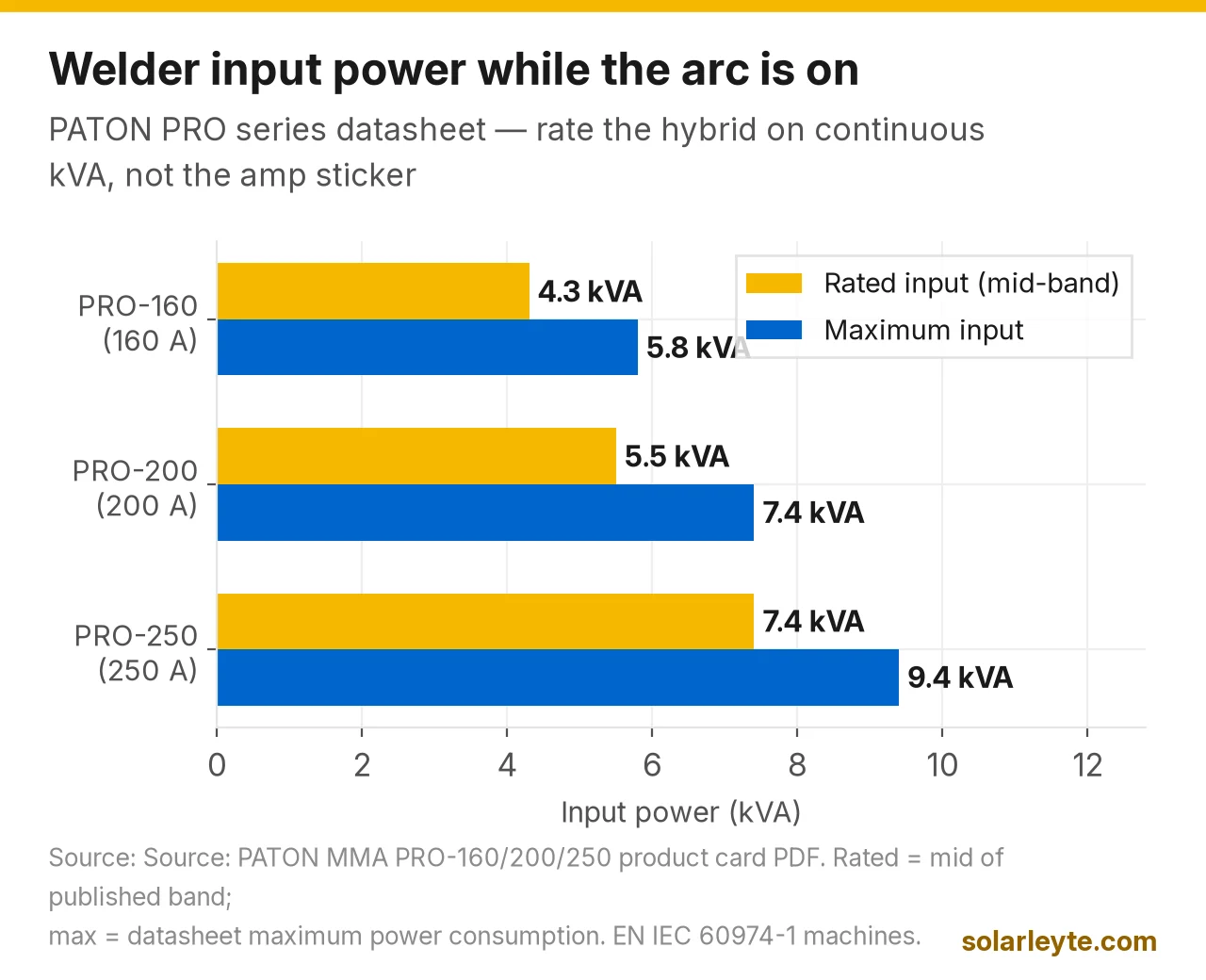
Source: PATON MMA PRO product card PDF (PRO-160 / 200 / 250). Efficiency is listed at 92%.
A common PH model, INGCO ING-MMA2006 (200 A @ 60% duty, 220–240 V), shows rated input capacity 8.7 kVA on Tikweld's sheet (INGCO's own page confirms amps and duty but not kVA). Treat 8.7 kVA as an upper-bound example for that model, not every 200 A listing.
Rule of thumb for planning (labelled Solar Leyte):
- 160 A stick class: plan about 4.5–6 kVA continuous while welding (PATON rated/max band).
- 200 A stick class: plan about 5–9 kVA continuous (PATON rated/max, or INGCO MMA2006's 8.7 kVA if that is your machine).
- Add lights, a small grinder and a fan on the same backup circuit — another few hundred watts to ~1 kW.
If your welder's manual only shows output amps, ask the seller for the input current or kVA before you order panels. Guessing from the amp sticker alone under-sizes the inverter.
Duty cycle: why "200 A" is not 200 A all day
Duty cycle is the share of a 10-minute window you may weld at the rated current before the machine must rest and cool (EN IEC 60974-1 test conditions). Examples from the sheets above:
- PATON PRO-160: 70% at 160 A (about 7 minutes on, 3 off) and 100% at 134 A.
- INGCO MMA2006: 200 A @ 60%.
- INGCO ING-MMA16015 (common PH listing): 160 A @ 40% (KHM Megatools).
Your hybrid inverter still has to deliver the full input kVA during the "on" minutes. Duty cycle lowers the average kWh over an hour; it does not let you buy a 2 kW inverter for a 5 kVA welder.
The surge trap: 10-second peak is not a welding rating
Many hybrid datasheets advertise peak / off-grid power = 2× rated for 10 seconds. Deye's SUN-(3.6–6)K-SG06LP1 series states exactly that: "Peak Power (off-grid) (W): 2 times of rated power, 10s" (Deye 3.6–6 kW hybrid product page). Our hybrid inverter price post uses the same figure for the Deye 5 kW class (~10 kW for 10 s).
That peak is for short motor starts (pump, compressor, fridge). A weld bead runs for tens of seconds to minutes. If the continuous AC rating is 5 kW and the welder wants ~6 kVA while the arc is on, the inverter will overload, cut out or derate — even though "10 kW peak" looked fine on the brochure.
What you are sizing | Use this number |
|---|---|
Welder while arcing | Continuous input kVA / kW from the welder datasheet |
Hybrid inverter | Rated (continuous) AC output ≥ welder input + other backup loads |
Hybrid "peak 2× / 10 s" | Only for motor start on the same circuit — not for the weld itself |
Battery | Discharge current and usable kWh for the minutes you weld off-grid |
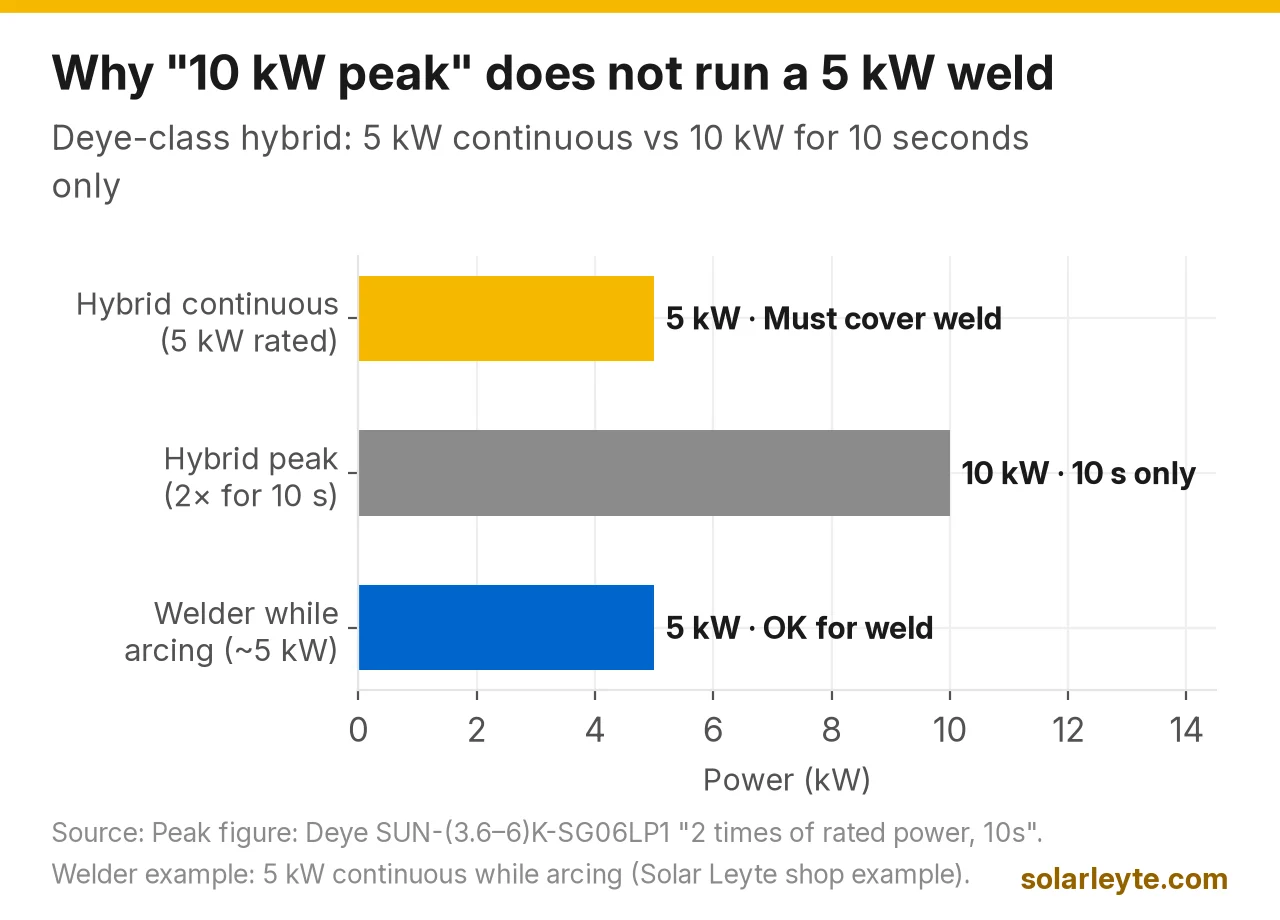
On-grid with a healthy BILECO or LEYECO feed, many hybrids can pass grid power through to the welder (Deye lists up to 50 A continuous AC passthrough on the SG06LP1 series). The hard case is brownout welding, when everything comes from battery + PV.
Worked shop example (Solar Leyte assumptions)
Assume a barangay vulcanizing / light fab shop:
- Welder: 160 A class, using 4.5 kVA while welding (mid PATON PRO-160 rated band). We treat 4.5 kVA as about 4.5 kW, assuming a power factor near 1 (kW = kVA × power factor); if your welder's datasheet lists rated input watts, use that figure instead.
- Arc-on time: 2 hours a day (duty-cycle rests already folded into "arc-on" as meterable energy — if you only arc 90 minutes, scale down).
- Other backup loads while welding: 0.5 kW (lights, fan, small grinder idle).
- Total while welding: ≈ 5.0 kW.
Item | Figure | Note |
|---|---|---|
Hybrid inverter continuous | ≥ 5–6 kW | 5 kW is tight; 6 kW leaves headroom |
Do not rely on | 10 kW "peak for 10 s" | Wrong timescale for welding |
Energy per day (arc-on) | 4.5 kW × 2 h = 9 kWh | Welder only |
+ other loads 2 h | 0.5 × 2 = 1 kWh | |
Day total attributed to welding window | ≈ 10 kWh | Solar Leyte calculation |
Bill without solar at BILECO October 2026 commercial ₱17.8574/kWh, assuming the shop is billed on a commercial account (effective rate; BILECO's billing page lists VAT within the effective rate). A home welding shop still billed as residential would pay ₱19.3628/kWh (October 2026):
- 10 kWh × ₱17.8574 ≈ ₱179 per day
- 26 shop days ≈ about ₱4,643 a month (10 kWh × ₱17.8574 × 26 days = ₱4,642.92; Solar Leyte calculation; fixed charges extra)
Panels for daytime welding: at roughly ~4 kWh/kWp/day on a typical Naval day (same basis as our how many panels post), ~10 kWh needs about 2.5–3.5 kWp if you weld in good sun — more in December or if the roof is shaded. Planning band only, not a quote.
Battery for brownout welding: 5 kW from a 48 V bank needs at least ~104 A continuous (5,000 ÷ 48), an ideal minimum that ignores inverter losses, so real battery current will be higher. Check max discharge current, not only kWh. A 1-hour session at 5 kW draws ~5 kWh — one 5 kWh wall pack is nearly empty after that (Solar Leyte calculation; respect the pack's DoD). Heavy brownout welding usually needs more kWh or a generator (generator vs solar).
5–6 kW hybrid list prices were ₱45,000–₱58,000 on 7 October 2026 (hybrid inverter guide); batteries in the battery price guide. Parts lists only — not installed shop packages.
Philippine welder prices (hardware listings)
These are the welding machines themselves — not solar kits. Checked 7 November 2026 on the sellers' pages:
Welder (as listed) | Output / duty (seller) | Seller | Listed price |
|---|---|---|---|
INGCO ING-MMA16015 | 10–160 A; 160 A @ 40% | ₱3,900 (was ₱7,800) | |
INGCO ING-MMA2006 | 10–200 A; 200 A @ 60% | ₱9,290 | |
INGCO ING-MMA4006P | 15–400 A; 400 A @ 60% | ₱15,000 list; KHM also showed ₱7,500 sale |
Promo prices move — confirm before you pay (INGCO FAQ). These are welders only; you still need hybrid, battery, panels and a licensed install. A 400 A stick unit usually needs an 8 kW+ hybrid (Deye 8 kW listed ₱72,000–₱99,000 on 7 Oct) or a generator.
Grid-tie only vs hybrid for a welding shop
Setup | Daytime welding | Brownout welding | Notes |
|---|---|---|---|
Grid-tie, no battery | Offsets bill while the sun is up | Stops when the co-op feed drops | Cheapest inverter; see grid-tie vs hybrid |
Hybrid + battery | Self-use + optional export credit | Continues if continuous kW and battery allow | Size continuous rating to the welder |
Generator | Anytime (fuel) | Anytime (fuel) | Often still cheapest for rare heavy beads; compare |
Net metering helps when daytime export earns credit, but welding shops often self-consume most daytime kWh. Process: net metering guide.
Safety and who should wire it
Welding machines are 220–240 V tools with high open-circuit voltage (often 70–85 V). Follow the maker's earthing and PPE. Tying solar, a hybrid and a welder into the shop service is electrical installation work under RA 7920 — licensed practitioners, not DIY; Secs. 31 and 34 require the electrical plans to be signed and sealed by a Professional Electrical Engineer (PEE) (Lawphil RA 7920). LGU electrical permit / CFEI still apply (permit guide). Use a dedicated circuit sized for the welder; see solar fire safety.
FAQ
Can a 3 kW hybrid run a 200 A welder?
Usually no for full-output stick welding. A 200 A class inverter often wants 5–9 kVA while arcing. A 3 kW hybrid's continuous output is below that even before lights and grinders. Step up to 5–8 kW continuous, or weld at a much lower output setting and verify with a clamp meter.
Will the hybrid's "10 kW surge" cover my welder?
Not for the weld itself. Ten seconds of peak covers a motor start. Arc time is longer. Size on rated output.
Do I need lithium batteries just to weld during the day?
If the co-op feed is up and the hybrid can passthrough grid power, daytime welding can run with little or no battery draw. Batteries matter when you need brownout continuity or you are off-grid. Daytime self-consumption from panels still cuts the bill.
Magkano ang tipid sa bill?
Using the labelled example: about ₱179 per welding day at BILECO commercial ₱17.8574/kWh (assuming a commercial account) for ~10 kWh, or about ₱4,643 per 26-day month, before fixed charges. Real tipid depends on how many arc-on hours you actually log and how much the array covers at noon. Clamp-meter your welder for a week before you buy hardware.
Disclosure
Solar Leyte is run by MACC Systems & Energy Solutions Inc., a solar installer in Naval, Biliran.
Get a free solar quote from MACC
Planning solar for a welding, vulcanizing or fab shop in Biliran or Leyte? Send a photo of the panel, your welder's nameplate (input kVA or amps if shown) and your latest BILECO or LEYECO bill and we will get back to you with a free, no-obligation written quote.
- Call/Text: 0955 723 5093
- Email: official@macc-inc.com
- Website: www.macc-inc.com
- Or use the site quote form: /quote
Sources (all checked 7 November 2026)
- PATON, MMA PRO-160/200/250 product card PDF: rated/max kVA, mains current, duty cycle.
- INGCO, ING-MMA2006 product page: 10–200 A, 200 A @ 60% duty, 220–240 V.
- Tikweld, INGCO-MMA2006 listing: rated input capacity 8.7 kVA.
- KHM Megatools, ING-MMA16015 (₱3,900 / was ₱7,800; 160 A @ 40%); ING-MMA4006P.
- IT Avenue Eshop, ING-MMA2006 (₱9,290).
- INGCO Philippines, ING-MMA4006P (₱15,000); FAQ on Lazada/Shopee Mall.
- Deye, SUN-(3.6–6)K-SG06LP1-EU-BM2: peak 2× rated for 10 s; 50 A AC passthrough.
- BILECO, October 2026 effective rate: commercial ₱17.8574/kWh, residential ₱19.3628/kWh (effective rates).
- Solar Leyte, hybrid inverter prices (7 Oct 2026 listings); generator vs solar.
- RA 7920, Lawphil.