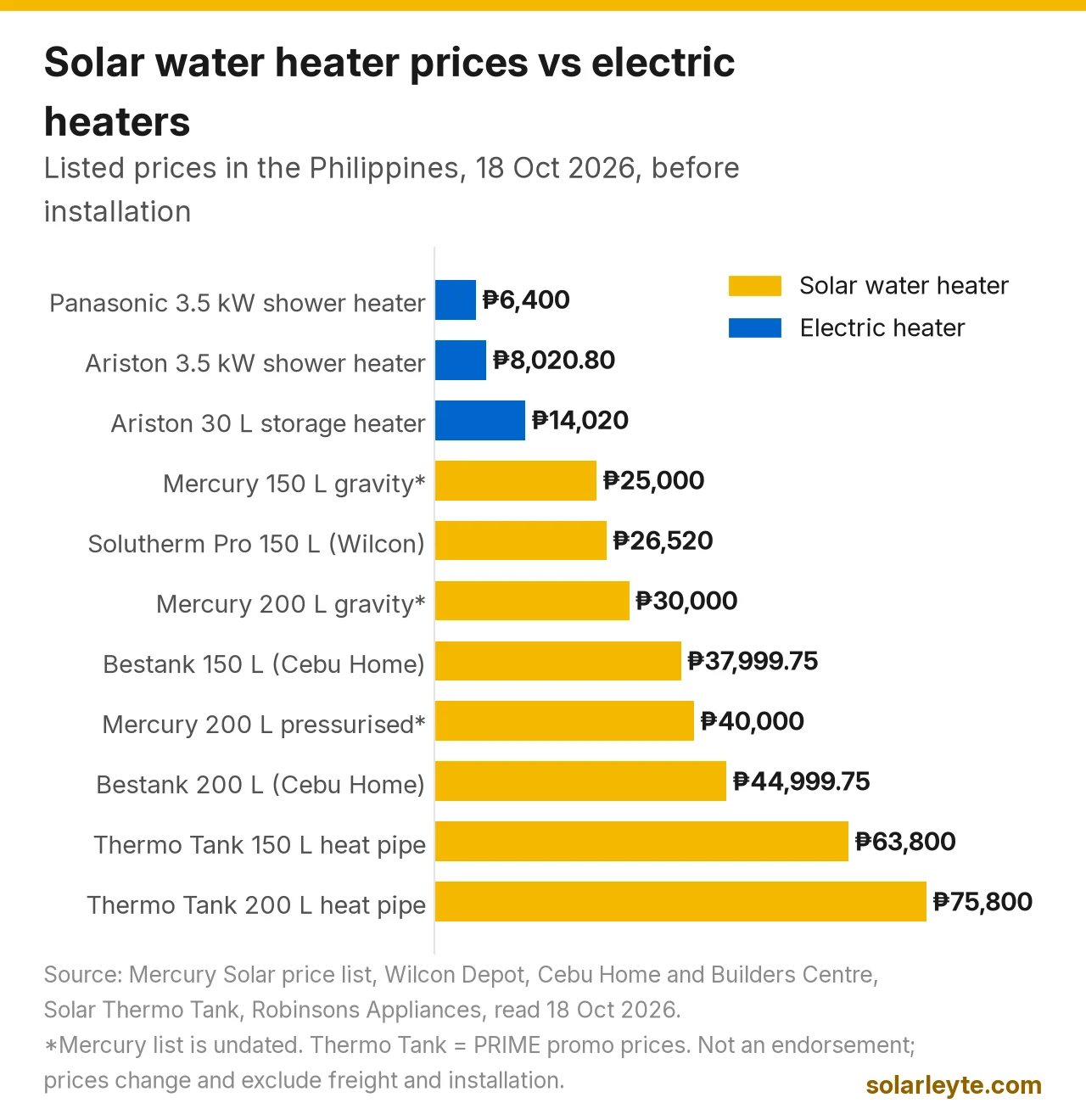
On 18 October 2026, Philippine sellers listed 150- and 200-litre solar water heaters from ₱25,000 to ₱75,800, before installation. A regular electric shower heater costs ₱6,400 to ₱8,021, and a 30-litre electric storage heater about ₱14,020. At BILECO's September 2026 rate of ₱18.93/kWh, a family of four that takes a warm shower every day spends about ₱15,400 a year heating that water with electricity (our example below). At that level of use, a ₱26,520 solar unit pays for itself in about 2 to 3.5 years. For a couple, it takes about twice as long. If your household bathes with cold water and a tabo now, a solar heater adds comfort but won't cut your bill.
The short version: a solar water heater is worth it when you already pay for hot water every day. Size the tank to your showers, not to the seller's biggest model, and keep the electric backup for rainy weeks.
Last checked: 18 October 2026.
This post is about solar thermal heaters: glass tubes or a flat collector on the roof that heat water directly, with no solar panels involved. If you want to run appliances on rooftop solar instead, start with our grid-tie vs hybrid guide. For what every other appliance in the house costs to run, see our appliance kWh post. Resorts with many rooms should read our solar for Biliran beach resorts post as well.
Solar water heater prices in the Philippines (checked 18 October 2026)
Prices are copied from each seller's own page on 18 October 2026. None of them include installation, plumbing or a roof stand unless the seller says so, so ask for an installed quote.
Model | Tank | Type | Listed price | Seller |
|---|---|---|---|---|
Mercury, gravity type | 150 L | Non-pressurised (gravity) | ₱25,000 | Mercury Solar price list (undated) |
Solutherm Pro SP-460-58/1800-15 | 150 L | Evacuated tube, 15 tubes | ₱26,520 | Wilcon Depot online |
Mercury, gravity type | 200 L | Non-pressurised (gravity) | ₱30,000 | Mercury Solar price list (undated) |
Bestank Solar Water Heater | 150 L | Not stated | ₱37,999.75 | Cebu Home and Builders Centre |
Mercury, pressurised type | 200 L | Pressurised | ₱40,000 | Mercury Solar price list (undated) |
Bestank Solar Water Heater | 200 L | Not stated | ₱44,999.75 | Cebu Home and Builders Centre |
Solar Thermo Tank PRIME (heat pipe, copper tip) | 150 L | Pressurised, 15 tubes | ₱63,800 promo (SRP ₱75,000) | Solar Thermo Tank |
Solar Thermo Tank PRIME (heat pipe, copper tip) | 200 L | Pressurised, 20 tubes | ₱75,800 promo (SRP ₱93,500) | Solar Thermo Tank |
A few things to know before you compare:
- Gravity vs pressurised is the big price split. A gravity (non-pressurised) unit sits on the roof with its own feed of cold water and sends hot water down by gravity. It's the cheaper option. A pressurised unit connects to your water line or pressure pump, so the shower feels like city water. Mercury's own list shows the gap: ₱30,000 gravity vs ₱40,000 pressurised for 200 L.
- Read the model code. Wilcon's page title says 150 L, but one field shows a "-10 (100l)" model while the description gives "SP-460-58/1800-15 (150L)". The last number is the tube count, so 15 tubes matches 150 L. Check which one you're actually getting before you pay.
- Ignore too-good-to-be-true pre-orders. Solar Hub PH listed a 150 L non-pressurised unit at ₱8,400, "was ₱60,000", as a "Coming Soon" pre-order. We left it out of the table.
- Not an endorsement. These are the listings we could read on 18 October. Stock and promo prices change often, and Leyte and Biliran buyers will pay freight on top.
Electric water heaters, for comparison
Model | Type | Listed price | Seller |
|---|---|---|---|
Panasonic DH-3VL1PW | 3.5 kW single-point shower heater | ₱6,400 (regular ₱7,500) | Robinsons Appliances |
Ariston Aures single-point 3.5 kW | 3.5 kW single-point shower heater | ₱8,020.80 | Wilcon Depot online |
Ariston Aures multipoint 6.0 kW | 6 kW multipoint (several taps) | ₱11,940 | Wilcon Depot online |
Ariston Andris 30 L 2.5 kW | 30 L electric storage tank | ₱14,020 | Wilcon Depot online |
So the solar heater costs about ₱17,000 to ₱70,000 more up front than the electric heater it replaces. The rest of this post is about whether the electricity you save covers that gap.
How a solar water heater works (and why it isn't solar panels)
The cheaper units in the table are thermosiphon ("gravity") systems: a row of glass tubes or a flat collector under an insulated tank, all on one roof stand. The US Department of Energy (DOE) explains the idea simply: warm water rises and cooler water sinks, so water circulates through the collector and into the tank with no pump. That only works if the collector sits below the tank (US DOE consumer guide).
The main collector types you'll see:
- Evacuated tubes (the common 58 mm × 1,800 mm glass tubes). Each tube has a vacuum between two glass layers, which cuts heat loss. Solar Hub PH's 150 L listing uses 15 of these tubes and states 1.2 m² of absorber area (Solar Hub PH).
- Heat-pipe tubes ("copper tip"). Water doesn't flow through the glass. A sealed copper pipe in each tube carries heat up into the tank. Solar Thermo Tank sells these as its pressurised PRIME series (Solar Thermo Tank).
- Flat-plate collectors. A dark metal absorber in a glass-covered box. Solar Thermo Tank, for one, also sells flat-plate systems (Solar Thermo Tank).
Brownouts: the US DOE notes that passive systems like these "work during power outages" (US DOE consumer guide). That's a real plus in Biliran. An electric shower heater stops the moment the power goes off. The catch: if your house water comes from an electric pressure pump, a pressurised unit loses pressure in a brownout too. A gravity unit with its own roof feed tank keeps giving hot water until the tank runs dry.
Rainy days: solar water heaters "almost always require a backup system for cloudy days and times of increased demand", usually an electric element in the tank (US DOE consumer guide). Solar Thermo Tank lists a built-in electric backup for rain or low sun (Solar Thermo Tank). That backup is what you pay for during a week of habagat or amihan rain.
What tank size do you need?
Seller sizing tables are generous. Solar Thermo Tank rates its pressurised units at 1–2 people for 150 L, 2–3 for 200 L, up to 4 for 250 L and up to 5 for 300 L (Solar Thermo Tank). Its FAQ suggests 50 to 75 litres of storage per person (Solar Thermo Tank FAQ).
Here's how much tank water a warm shower actually uses, as a worked example with our assumptions: each shower uses 40 litres of water at 38°C (about 8 minutes at 5 litres a minute), cold water comes in at 26°C (Naval's average air temperature in PVGIS, used as a stand-in for tap water), and the tank holds water at 55°C. Mixing 55°C tank water with 26°C cold water to get 38°C takes about 41% tank water. That's roughly 17 litres of tank water per shower, or about 66 litres a day for four people.
Household (example) | Warm showers a day | Tank water used a day (55°C) | Seller rule of thumb (50–75 L each) |
|---|---|---|---|
Couple | 2 | about 33 L | 100–150 L |
Family of 4 | 4 | about 66 L | 200–300 L |
Family of 6 | 6 | about 99 L | 300–450 L |
On a sunny day, a 150 L tank covers a family of four with room to spare. The bigger tank the sellers recommend mostly buys you hot water left over for the next cloudy day, plus margin for longer showers, laundry or a bathtub. If your budget is tight, a 150 L gravity unit is a sensible size for up to four people who shower once a day. Go bigger if you have a bathtub, run a guesthouse, or want hot water at the kitchen sink too.
What hot water costs you on BILECO electricity today
Heating water takes a fixed amount of energy. Water needs 4,184 joules to warm one kilogram by 1°C (USGS). In everyday units, that's about 1.16 watt-hours per litre per °C, whether the heat comes from a 3.5 kW shower heater, a storage tank or the sun.
Worked example 1 (assumptions as above): one 40-litre warm shower, 26°C to 38°C, takes 40 × 12 × 1.16 Wh ≈ 0.56 kWh. A 3.5 kW shower heater delivers that in about 9.6 minutes, so the assumption matches a normal shower. At BILECO's September 2026 residential rate of ₱18.93/kWh (PRESYO-PH), one shower costs about ₱10.56.
Household (example) | kWh a day | Per month (30 days) at BILECO ₱18.93 | Per year at BILECO ₱18.93 | Per year at LEYECO II ₱14.05 |
|---|---|---|---|---|
Couple, 2 warm showers a day | 1.12 | ₱634 | ₱7,709 | ₱5,722 |
Family of 4, 4 warm showers a day | 2.23 | ₱1,267 | ₱15,418 | ₱11,444 |
Family of 6, 6 warm showers a day | 3.35 | ₱1,901 | ₱23,127 | ₱17,165 |
Rates are PRESYO-PH's September 2026 residential figures (BILECO ₱18.93, LEYECO II ₱14.05). BILECO's own website still showed July 2026 (₱18.3407) as its latest posted rate when we checked; see our BILECO rate tracker and LEYECO II rate post. Electric storage tanks also lose some heat standing by, so a storage heater costs a bit more than these figures. A shower heater that's set lower, or shorter showers, cost less.
For scale: the Florida Solar Energy Center puts a typical US family of four at 70 gallons of hot water a day and 3,990 kWh a year (FSEC). That's far more than our example, mainly because US tap water is much colder, so every litre needs more heating. Our example household needs much less, which is exactly why you should run your own numbers before you believe a "6-month payback".
How much heat can a solar collector make in Biliran?
None of the Philippine listings above publish independent test data, so we used a European test certificate for the same tube format. Under the Solar Keymark scheme, a 15-tube, 58 × 1,800 mm evacuated-tube collector (Sunpower SPA-58/1800-15, 2.57 m² gross) was rated at 1,497 kWh of heat a year in Athens at a 50°C average water temperature. Athens gets 1,765 kWh/m² a year on the collector (Solar Keymark certificate SC1075-12).
PVGIS gives Naval, Biliran 1,944 kWh/m² a year on a 15° south-facing surface (PVGIS 5.3). Scaling the Athens figure by Naval's extra sun gives about 1,650 kWh a year, or roughly 4.5 kWh of heat a day. That's a Solar Leyte estimate, before tank and pipe losses, and it isn't a rating for any brand sold here. Naval's warmer air helps a little. Dust, shade and tank losses pull it down.
Month (Naval, 15° south) | Sun on collector (kWh/m²/day) | Estimated heat from a 15-tube collector (kWh/day) |
|---|---|---|
January | 4.84 | 4.1 |
March | 6.17 | 5.2 |
July | 4.69 | 4.0 |
October | 5.29 | 4.5 |
Year average | 5.33 | 4.5 |
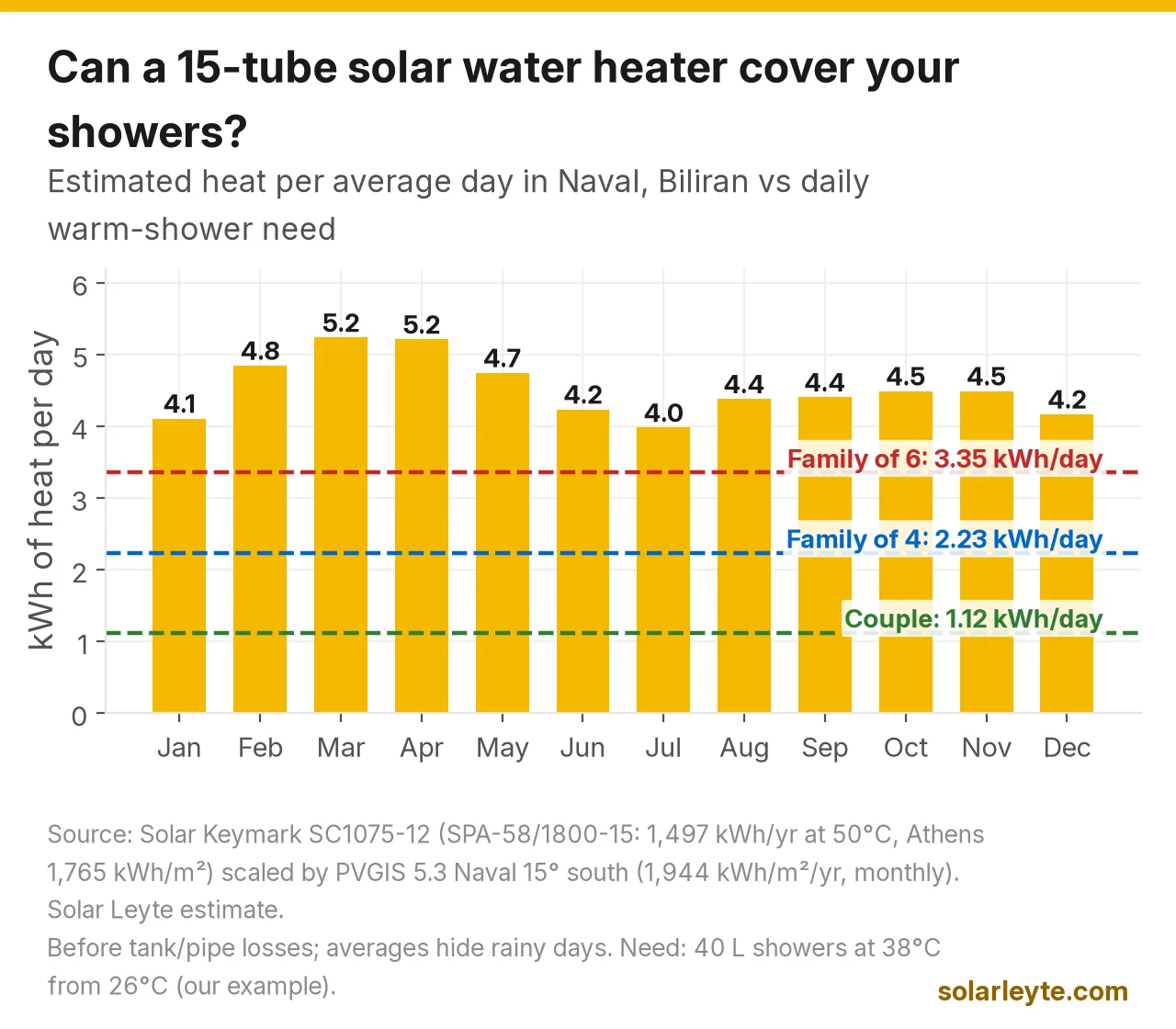
That's about twice the 2.23 kWh/day our family of four needs. In most months, a 15-tube unit can heat everything that family uses on an average day. The averages hide the bad days, though. A three-day low-pressure system or a typhoon week can drop collection to a fraction of this, and that's when the electric backup works. Point the collector roughly south at a gentle tilt, as with solar panels; see our solar panel tilt and direction guide.
Payback: when a solar water heater is worth it
How much you save depends on how much of your hot water the sun covers. The Florida Solar Energy Center says a solar water heater "should save between 50% and 85% of the hot water portion" of the electric bill (FSEC). The US DOE's building science page says "at least a 50% reduction", and more in sunny places (US DOE). Biliran's year-round sun probably puts a well-sized unit toward the top of that range, but we use the full 50–85% range below to stay honest.
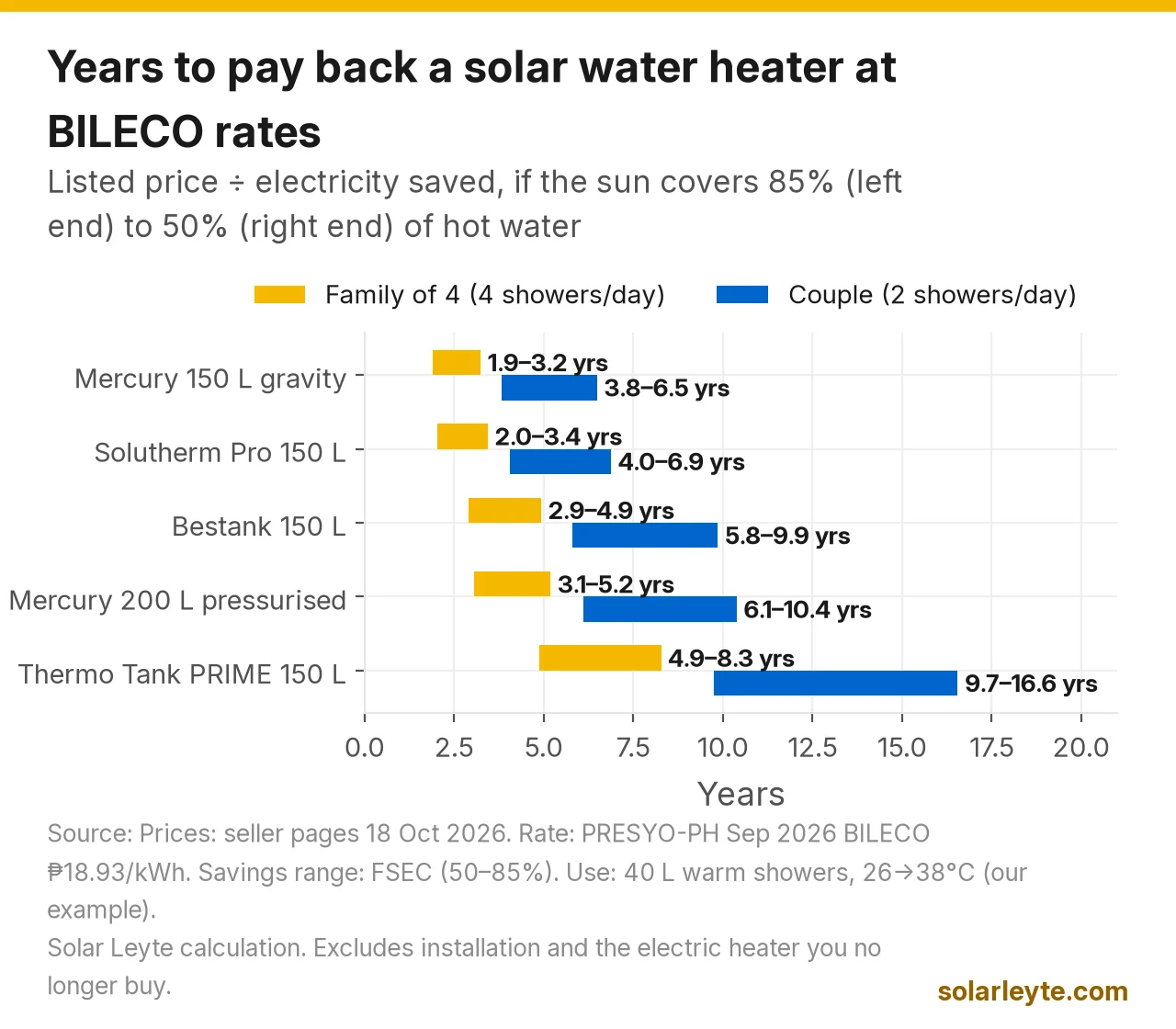
Worked example 2: years to recover the listed price from electricity savings at BILECO ₱18.93/kWh, using the household examples above. The first figure assumes the sun covers 85% of your hot water, the second 50%. These figures leave out installation, which lengthens payback, and the electric heater you no longer have to buy, which shortens it.
Solar unit (listed price) | Couple (save ₱3,855–₱6,553/yr) | Family of 4 (save ₱7,709–₱13,105/yr) | Family of 6 (save ₱11,564–₱19,658/yr) |
|---|---|---|---|
Mercury 150 L gravity (₱25,000) | 3.8–6.5 years | 1.9–3.2 years | 1.3–2.2 years |
Solutherm Pro 150 L (₱26,520) | 4.0–6.9 years | 2.0–3.4 years | 1.3–2.3 years |
Bestank 150 L (₱37,999.75) | 5.8–9.9 years | 2.9–4.9 years | 1.9–3.3 years |
Mercury 200 L pressurised (₱40,000) | 6.1–10.4 years | 3.1–5.2 years | 2.0–3.5 years |
Solar Thermo Tank PRIME 150 L (₱63,800) | 9.7–16.6 years | 4.9–8.3 years | 3.2–5.5 years |
What this tells you:
- Daily hot-water users get a quick payback. A family of four or more that takes warm showers every day recovers a basic 150 L unit in roughly two to three and a half years at BILECO rates.
- Light users wait much longer. For a couple, even the cheapest unit takes about four to six and a half years, and a premium pressurised system can take 10 to 17 years.
- No electric heater now = no savings. If you bathe with cold water today, a solar heater is a comfort upgrade, not a money saver. That's a fine reason to buy one; just don't expect a lower bill.
- LEYECO II customers save about a quarter less, because ₱14.05/kWh is about 26% below BILECO's ₱18.93. Paybacks stretch by about a third.
Solar water heater vs an electric heater on rooftop solar panels
If you already have solar panels, or plan to, you might wonder why not just run an electric heater from them. For hot water alone, the solar water heater usually wins:
Solar water heater (15 tubes) | Electric heater running on rooftop solar panels | |
|---|---|---|
Energy per m² of roof per day, Naval average | about 1.76 kWh of heat (our estimate) | about 0.91 kWh of electricity |
Roof area to cover our family of four (2.23 kWh/day) | about 1.3 m² of collector on an average day (most units have 2–3 m²) | about 0.55 kW of panels, roughly 2.4 m² |
Hot water at 6 am | Yes, from yesterday's sun stored in the tank | Only with a battery, or with a storage heater on a timer |
During a brownout | Gravity units keep working | Only with a hybrid inverter and battery |
What else it can power | Nothing | Anything in the house |
The panel figures use PVGIS's 4.07 kWh per kW of panels per day for Naval at 15° south (PVGIS 5.3) and a LONGi 580 W panel's 2,278 × 1,134 mm size (about 4.45 m² per kW; see our 550–620 W panel post). The collector figure is our estimate from the Solar Keymark data above.
Rooftop solar does make sense for water heating in one case: you already have a zero-export system that's throttling unused midday power. A storage water heater on a timer can soak up that surplus. Our plug-and-play and zero-export solar post explains why that midday power goes unused. For everything else, panels earn more running your aircon, fridge and fans, and a solar water heater handles the showers.
Before you buy: roof, typhoon and water checks
- Weight. A litre of water weighs about a kilogram, so a full 150 L tank is roughly 150 kg of water on top of the tank and stand. A 200 L tank is 200 kg. The US DOE warns that installers "must pay careful attention to roof design because the water in the storage tank is heavy" (US DOE consumer guide). Ask the seller for the filled weight and have someone check your purlins and trusses, especially on an older GI roof.
- Typhoon anchoring. A tank on a stand catches wind. It must be bolted through to the roof structure, not just to the roofing sheet. Ask how the stand is anchored and whether it has been installed in typhoon areas. Our typhoon checklist covers what to inspect before and after a storm.
- Very hot water. The Solar Keymark test lists the collector's stagnation temperature as 230°C and its maximum operating temperature as 95°C (Solar Keymark). On a sunny day with no one using water, the tank can get hot enough to scald. Ask for a pressure/temperature relief valve and a mixing (tempering) valve at the shower.
- Electrical safety of the backup element. The backup heater in the tank is a normal electrical load. Have it wired on its own breaker with earth-leakage protection (ELCB or RCD) by a licensed electrician.
- Hard water and scale. If your water leaves white scale on kettles and showerheads, it will scale the tubes and tank too. Ask the seller whether your unit needs descaling, how often, and what it costs.
- Warranty in writing. Get the tank, tube and backup-heater warranties in writing, and ask whether single tubes can be replaced and what a spare costs. Solar Thermo Tank, for example, states a 3-year heater warranty (Solar Thermo Tank); terms differ a lot between brands.
FAQ
How much is a solar water heater in the Philippines in 2026? On 18 October 2026, 150 L units were listed from ₱25,000 to ₱63,800 and 200 L units from ₱30,000 to ₱75,800, before installation. Gravity (non-pressurised) units are the cheapest. Pressurised and heat-pipe systems cost the most.
What size solar water heater does a family of four need? By our example maths, four 40-litre warm showers use about 66 litres of 55°C tank water a day, so a 150 L tank covers a sunny day with spare. Sellers recommend 200–300 L for four people. The extra size mainly gives you hot water left over for a cloudy day.
Does a solar water heater work during a brownout or on rainy days? Passive thermosiphon systems need no electricity, so they keep heating during a brownout. Gravity units keep supplying water as long as their feed tank has water. On rainy days they collect much less heat, so most units include an electric backup element that you pay for on those days.
Is it cheaper to heat water with solar panels instead? Usually not, for hot water alone. By our estimate, a tube collector makes about twice as much heat per square metre of roof as solar panels make electricity, and its tank stores the heat for morning showers without a battery. Panels win if you also want to run other appliances.
Will a solar water heater lower my BILECO bill? Only if you already heat water with electricity. A family of four taking daily warm showers spends about ₱1,267 a month on it at ₱18.93/kWh (our example), and a solar unit can cut 50–85% of that. If you bathe with cold water now, your bill won't change.
Solar Leyte is run by MACC Systems & Energy Solutions Inc., a solar installer in Naval, Biliran.
Get a free solar quote from MACC
Thinking about solar panels as well as hot water? Send us a recent electric bill, a photo of your roof, and a list of what you want running during a brownout. We'll get back to you with a free, no-obligation written quote.
- Call/Text: 0955 723 5093
- Email: official@macc-inc.com or benjie@macc-inc.com
- Website: www.macc-inc.com
- Office: Brgy. Talustusan, Naval, Biliran 6543
- Or use the site quote form: /quote
Related guides
- Grid-tie vs hybrid vs off-grid solar: which one works in a brownout?
- BILECO rate per kWh 2026
- How many kWh do your appliances use?
- Solar for beach resorts in Biliran
- Is solar worth it in the Philippines?
Sources (all checked 18 October 2026)
- Mercury Solar Water Heater, price list (undated): gravity type 100 L ₱18,500, 150 L ₱25,000, 200 L ₱30,000, 300 L ₱39,500; pressurised 200 L ₱40,000, 300 L ₱49,500
- Wilcon Depot, Solutherm Pro Solar Water Heater 150L: ₱26,520 per set; SP-460-58/1800-15 (150L); SUS304 stainless steel, borosilicate glass; L1950 × W930 × H1110
- Cebu Home and Builders Centre, Bestank Solar Water Heater 150L: ₱37,999.75; Bestank Solar Water Heater 200L: ₱44,999.75
- Solar Thermo Tank, Heat Pipe (Copper Tip) System, PRIME series: 150 L 15 tubes SRP ₱75,000 / promo ₱63,800 (1–2 persons); 200 L 20 tubes SRP ₱93,500 / promo ₱75,800 (2–3 persons); 250 L up to 4, 300 L up to 5 users
- Solar Thermo Tank, Residential: built-in electric backup for rain or low sun; 3-year heater warranty. FAQ: 50–75 L of storage per person
- Solar Hub PH, 150L Solar Power Heater Non Pressurized Tank: pre-order ("Coming Soon") ₱8,400, was ₱60,000; 15 tubes 58 × 1,800 mm; absorber 1.2 m²; SUS304 inner tank; thermosiphon
- Robinsons Appliances, Panasonic DH-3VL1PW 3.5 kW single-point water heater: ₱6,400 (regular ₱7,500); 1-year parts and service warranty
- Wilcon Depot, water heater search results: Ariston Aures single-point 3.5 kW ₱8,020.80; Ariston Aures multipoint 6.0 kW ₱11,940; Ariston Andris storage 30 L 2.5 kW ₱14,020
- PRESYO-PH (ICSC), national electricity rates: September 2026 residential rates BILECO ₱18.93/kWh, LEYECO II ₱14.05/kWh
- BILECO, July 2026 effective rates: residential ₱18.3407/kWh (latest posted on bileco.net on 18 October 2026)
- USGS Water Science School, Specific heat capacity and water: 4,184 J to raise 1 kg of water by 1°C
- Solar Keymark, certificate SP SC1075-12, Sunpower SPA-58/1800 series (ISO 9806:2013 results): SPA-58/1800-15 gross area 2.57 m²; 1,497 kWh/year at 50°C in Athens (1,765 kWh/m² on the collector, 18.5°C mean air); stagnation 230°C; max operating 95°C
- European Commission JRC, PVGIS 5.3: Naval, Biliran (11.56°N, 124.40°E), 15° south, PVGIS-ERA5 2005–2023: 1,944 kWh/m² a year in plane, monthly 4.69–6.17 kWh/m²/day; 1 kW of panels, 14% loss: 4.07 kWh/day; TMY mean air temperature 26.1°C; run 18 October 2026
- US Department of Energy, A Consumer's Guide: Heat Your Water with the Sun: thermosiphon principle, passive systems work during power outages, backup almost always required, heavy tank needs roof check
- US DOE Building Science Education, Water Heaters, Solar: at least 50% reduction in water-heating electricity, more in sunny places
- Florida Solar Energy Center, Solar Water Heating: A Question & Answer Primer (FSEC-EN-5-83): saves 50%–85% of the hot-water portion of the bill; US family of four 70 gallons a day, 3,990 kWh a year
- LONGi Hi-MO 7 LR5-72HGD-580M dimensions (2,278 × 1,134 mm), as tabled in our 550–620 W solar panel price post