On 27 October 2026, the parts for a ~20 kW grid-tie solar system (36 × 550 W panels, a 20 kW three-phase inverter, mounting, cable and protection) added up to about ₱471,000 to ₱536,000 at Philippine sellers' listed prices. Complete 18–24 kW grid-tie packages listed with installation ran ₱554,999 to ₱700,999, or about ₱29–₱30 per watt. A 20 kW hybrid with 21–64 kWh of battery is a different budget: about ₱1.0 million to ₱1.46 million on the listings we found.
Pila ang 20kW? That size is for a business, not a typical home: a school, small resort, office, rice mill or cold room with heavy daytime load. It's the business-size follow-on to our 10kW solar system price breakdown. For the general picture, see our solar panel price guide.
Prices checked 27 October 2026 (Philippine time) on each seller's own website. They change often. Listing a product isn't an endorsement, and Solar Leyte earns nothing from these links. None of the totals below is a MACC price or a quote.
The quick answer: 20kW solar price (October 2026)
What you're pricing | Listed price | Per watt (our calculation) | Notes |
|---|---|---|---|
~20 kW grid-tie, parts only (19.8 kWp) | ₱471,465 to ₱536,265 | ₱23.81 to ₱27.08 | Our build-up below; no installation, freight or permits |
18.30 kW grid-tie package | ₱554,999 | ₱30.33 | Northlight Energy: 30 × 610 W, 2 × Deye 8 kW |
23.79 kW grid-tie package | ₱700,999 | ₱29.47 | Northlight Energy: 39 × 610 W, 2 × Deye 10 kW |
20.74 kW hybrid + 32.2 kWh | ₱1,019,999 | ₱49.18 | Northlight Energy: 34 × 610 W, SRNE 18 kW |
~21 kWp hybrid package, no battery to 64.3 kWh | ₱991,000 to ₱1,460,000, VAT exclusive | ₱47.01 to ₱69.26 | Luminar Solar 20kW LITE/PLUS/PRO/MAX: 34 × 620 W, 8 kW + 12 kW hybrid inverters |
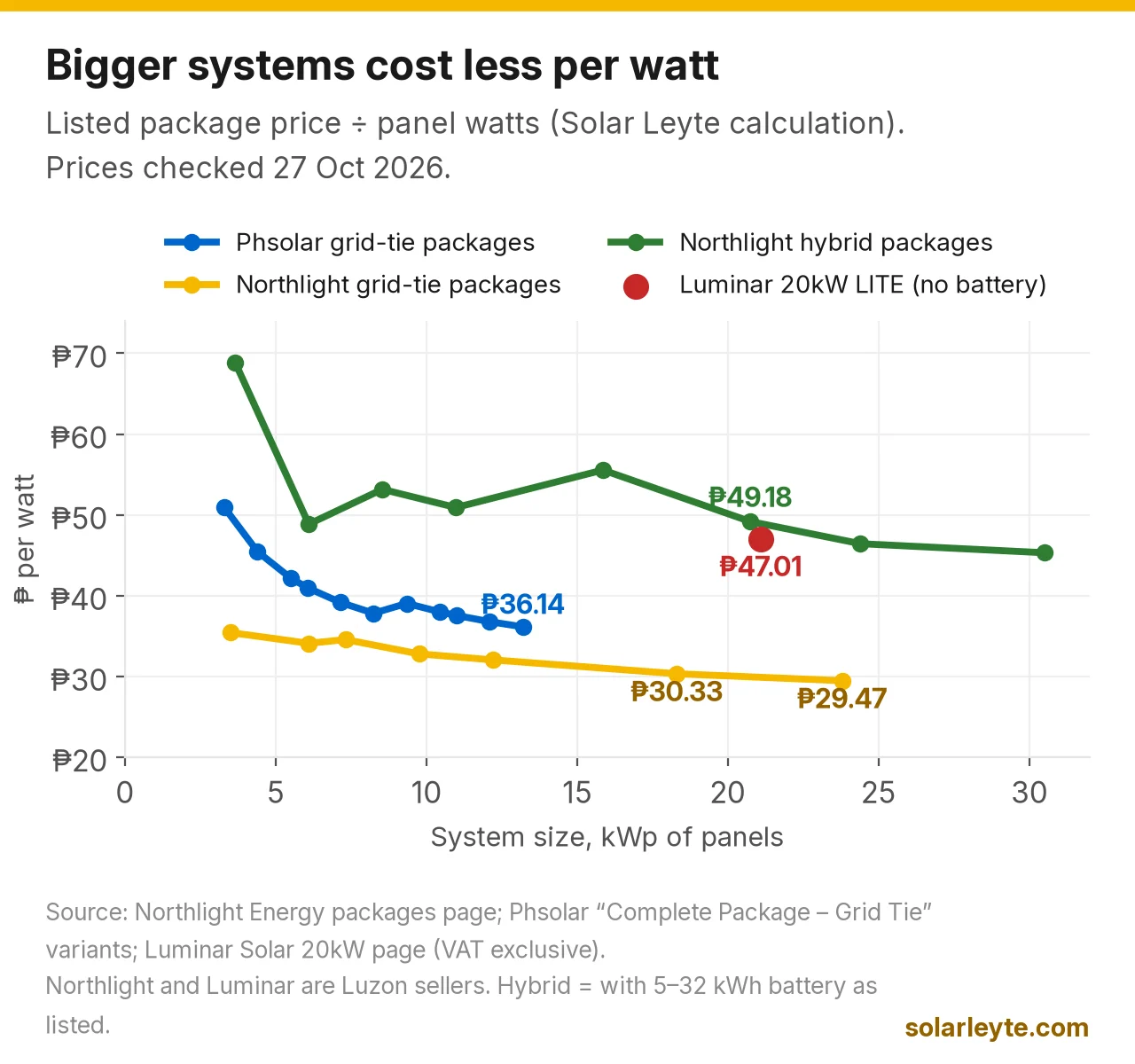
Both package sellers are in Luzon (Northlight in Nueva Ecija; Luminar lists Metro Manila, Cavite, Zambales and North Luzon). Treat them as price benchmarks, not local offers.
Parts build-up: ~20 kW three-phase grid-tie
We used 36 × 550 W panels (19.8 kWp), the same panel class as our 10 kW post, and a 20 kW three-phase grid-tie inverter. Quantities are our own estimate for four rows of nine panels on a metal roof; your installer's layout will differ.
Part | Qty | Listed price | Subtotal (our calculation) | Seller |
|---|---|---|---|---|
550 W mono panel | 36 | ₱6,700 to ₱8,500 each | ₱241,200 to ₱306,000 | ABC Solar Electronics (AE 550 W) and Phsolar (Sunova 550 W) at ₱6,700; Reflections Solar Solutions (AE MD-144) at ₱8,500 |
Solis 20 kW three-phase grid-tie inverter (4G, 220 V) | 1 | ₱162,000 (was ₱250,000; pre-order) | ₱162,000 | Solar Hub PH |
Aluminium rail 2.2 m | 40 | ₱550 | ₱22,000 | Reflections Solar Solutions |
L foot | 80 | ₱89.60 | ₱7,168 | Reflections Solar Solutions |
Mid clamp / end clamp | 64 / 16 | ₱50 / ₱100 | ₱4,800 | Reflections Solar Solutions |
Splice kit | 32 | ₱89.60 | ₱2,867 | Reflections Solar Solutions |
DC PV cable, 50 m roll | 4 | ₱4,000 | ₱16,000 | Reflections Solar Solutions |
MC4 connector pair | 16 | ₱200 | ₱3,200 | LakaSolar |
DC surge protector / DC isolator | 4 each | ₱600 / ₱2,100 | ₱10,800 | Reflections Solar Solutions / LakaSolar |
AC SPD 3-pole 40 kA / AC MCB 3-pole 63 A | 1 each | ₱1,000 / ₱430 | ₱1,430 | Phsolar |
Total, parts only | ₱471,465 to ₱536,265 |
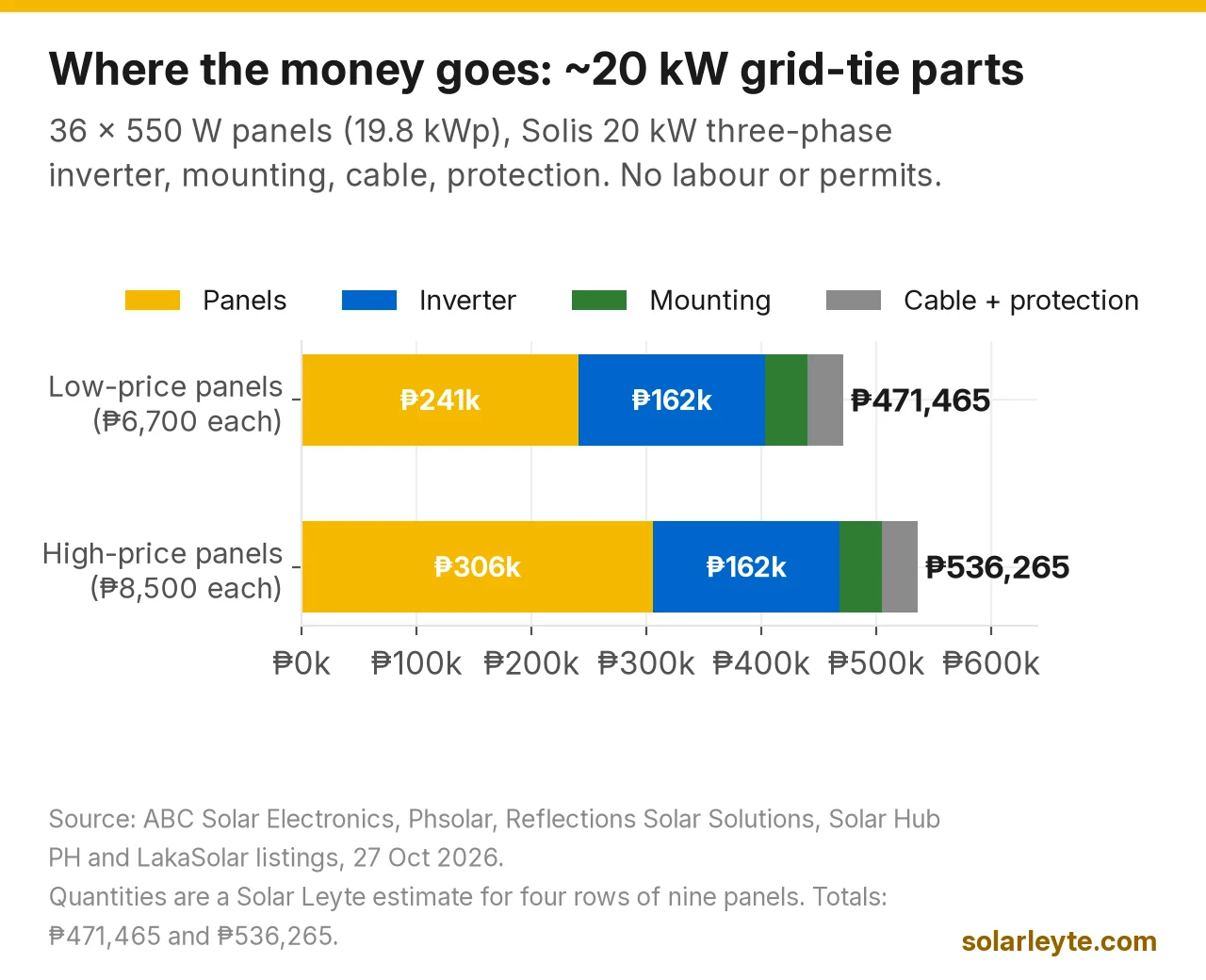
Not included: labour, freight to Leyte or Biliran, grounding, a distribution panel, permits, the net-metering application, and any transformer upgrade the co-op asks for. That's part of why installed packages sit about ₱6–₱7 per watt above our parts total.
About that inverter: Solar Hub lists the Solis 20 kW as a 220 V three-phase unit. Three-phase service in the Philippines comes in more than one voltage, so check the inverter matches your actual service before buying. (Our back-of-envelope: 20,000 W ÷ (√3 × 220 V) ≈ 52 A per phase, which is why we priced a 63 A breaker. Your electrician sizes the real one.) Northlight's packages take another route: two smaller Deye inverters (8 kW or 10 kW each). Ask any seller how the inverters will be connected to your service. For brands and prices, see our grid-tie inverter price post.
Roof space: 36 panels of about 2.278 × 1.133 m (the AE MD-144 datasheet size on the RSS listing) cover about 93 m² of panel area alone, before walkways and edge gaps. A school building or warehouse roof usually has that; a house roof usually doesn't.
Hybrid: when the business needs brownout backup
A hybrid adds batteries and a hybrid inverter, and the price nearly doubles. On 27 October:
- Phsolar listed the Deye hybrid at ₱150,000 (12 kW) and ₱170,000 (16 kW).
- Letovo listed a Deye three-phase 20 kW high-voltage hybrid at ₱164,471. It was marked sold out, and a high-voltage model needs a high-voltage battery stack, not the usual 51.2 V wall batteries.
- Letovo listed a 51.2 V 314 Ah LiFePO4 (about 16 kWh) at ₱108,000. Two of those already cost more than the 20 kW grid-tie inverter.
That's how Northlight's 20.74 kW hybrid with 32.2 kWh reaches ₱1,019,999, and Luminar's 20 kW PRO with 32.2 kWh reaches ₱1,220,000 before VAT. Two things to notice on the Luminar page: the LITE option has hybrid inverters but no battery, and the specs say "20.74 kWp" in one line but "34 × 620W (21.08 kWp array)" in the next. We used 21.08 kWp for the per-watt figure. Ask any seller to confirm the panel count and wattage in writing.
Need backup for only some circuits? A small hybrid plus grid-tie for the rest is often cheaper. Our grid-tie vs hybrid guide and hybrid inverter price post go through the trade-offs.
Commercial rates: what a 20 kW system offsets
Businesses pay commercial or low-voltage rates, not the residential rates in our other price posts. The latest we could verify:
Co-op | Rate | Period | Notes |
|---|---|---|---|
BILECO | ₱16.8353/kWh commercial | July 2026 | BILECO power-rate post; it was ₱11.4404 in May 2026 |
LEYECO IV | ₱15.6838/kWh low voltage, plus ₱68.87/month | September 2026 | High voltage: ₱12.9734/kWh plus demand charges of ₱267.90/kW (distribution), ₱126.84/kW (transmission system) and ₱271.73/kW (ancillary service), plus ₱68.87/month. |
LEYECO V | ₱15.4753/kWh commercial, plus ₱78.86/month | September 2026 | Before distribution VAT |
Rates last checked 27 October 2026. They change every month; see our BILECO and LEYECO IV and V trackers.
High-voltage customers billed on demand (₱/kW): solar cuts the kWh charges, but not reliably the demand charge. One cloudy noon with the aircon on sets the peak.
Worked example: payback for a Biliran business
Assumptions (ours, for illustration): 19.8 kWp makes about 105 kWh per kWp a month (the planning figure from our panel sizing guide), so about 2,079 kWh a month. The business uses 80% of it during the day (1,663.2 kWh), and the other 20% (415.8 kWh) is exported under net metering at about ₱9.50/kWh, our estimate of the September 2026 BILECO blended generation rate from PRESYO-PH. Rates stay flat. No panel degradation, maintenance or financing cost.
- BILECO at ₱16.8353 (July): 1,663.2 × ₱16.8353 + 415.8 × ₱9.50 = about ₱31,951 a month, or ₱383,407 a year.
- LEYECO IV low voltage at ₱15.6838: with exports at its ₱9.3104 generation charge (excluding the ₱0.2531 other generation adjustment, per ERC Res. 15 s.2025 Sec. 13), about ₱29,957 a month.
- Bad-month check (BILECO, May rate ₱11.4404, zero export): 1,663.2 × ₱11.4404 = about ₱19,028 a month, or ₱228,332 a year.
Installed cost (assumed) | Payback at July rate + net metering | Payback at May rate, zero export |
|---|---|---|
₱600,000 (about ₱30/W, in line with the grid-tie packages) | about 1.6 years | about 2.6 years |
₱1,019,999 (the Northlight 20.74 kW hybrid listing) | about 2.7 years | about 4.5 years |
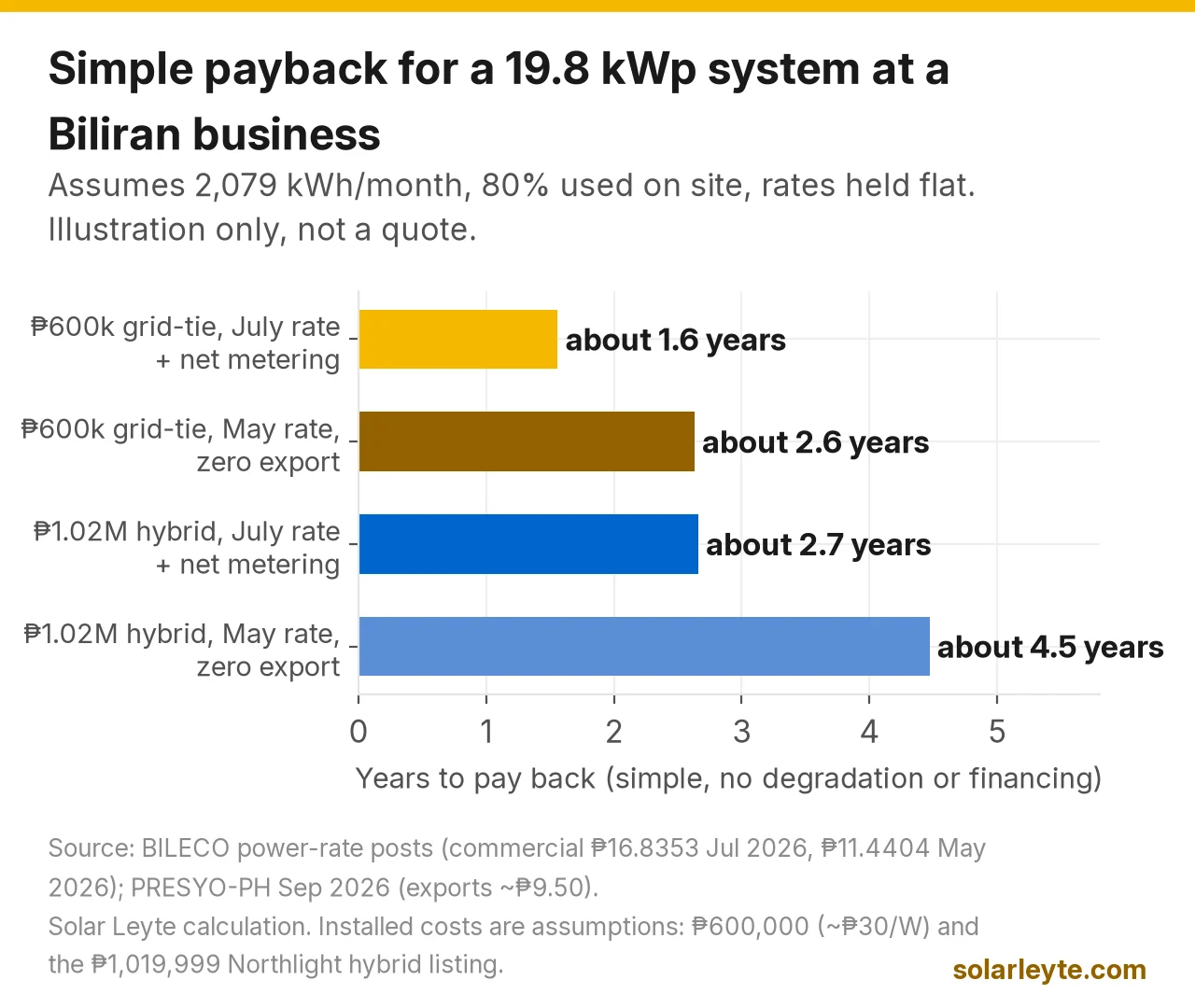
Those short paybacks rest on daytime use. A resort that peaks at night, or a school closed in April and May, uses far less on site. Our beach resort post runs an hour-by-hour model that shows how much this changes things.
Permits and rules that matter at 20 kW
- Net metering goes up to 100 kW. The DOE describes net metering under RA 9513 as covering systems "of up to 100 kilowatts (kW)". A 20 kW system qualifies. Under EO 110, the DOE gave co-ops 10 working days to process applications and LGUs three working days for permits, for the duration of the energy emergency. Steps: net metering guide.
- Zero-export businesses still need an ERC COC. DOE Circular DC2026-08-0017 waives the certificate of compliance for zero-export systems only for households, clinics, hospitals and medical facilities, so a shop or resort doesn't qualify (zero-export rules).
- The co-op checks transformer capacity. A 20 kW system is big next to a small distribution transformer, so the co-op may ask for a study or an upgrade. Our 6–8 kW post shows LEYECO II's example.
- Energy-efficiency law. Under DOE DC2023-12-0036, commercial establishments using 50,001–500,000 kWh-equivalent a year are Type 1 designated establishments under RA 11285. Check your own annual consumption, not the solar system's ~24,950 kWh output. See our RA 11285 post.
- Electrical permit and CFEI: electrical permit post.
How to compare two 20kW quotes
- kWp, not the "20kW" label. 30 × 610 W (18.3 kWp) and 39 × 610 W (23.79 kWp) are both sold near "20 kW".
- One three-phase inverter or several single-phase ones, and how they connect to your service.
- Per-watt price = total ÷ panel watts. On today's listings, grid-tie packages sat near ₱29–₱30/W.
- VAT included or not. Luminar's prices are VAT-exclusive; add 12%.
- Warranties and inclusions. Northlight lists 12-year panel, 5-year inverter and 1-year workmanship warranties; Luminar lists 15 / 5 / 2 years. Ask about freight, permits and the net-metering application.
FAQ
How much is a 20kW solar system in the Philippines?
On 27 October 2026, parts for a ~20 kW grid-tie system came to about ₱471,000 to ₱536,000. Listed grid-tie packages with installation (18.3–23.8 kW) were ₱554,999 to ₱700,999, and 20 kW hybrids with batteries were about ₱1.0 million to ₱1.46 million.
How many panels is 20kW?
About 33 to 36 panels at 550–620 W: 36 × 550 W = 19.8 kWp, 34 × 610 W = 20.74 kWp. Plan on roughly 93 m² of panel area for 36 large panels, before walkways.
How much does a 20kW system produce in Leyte and Biliran?
About 2,000–2,100 kWh a month by our planning figure (105 kWh per kWp a month), more in the dry months, less in the rainy ones.
Can a business net meter a 20kW system?
Yes. Net metering covers systems up to 100 kW. A business that goes zero-export instead still needs an ERC certificate of compliance, because the DC2026-08-0017 waiver covers only households and medical facilities.
Do I need three-phase power for 20kW?
Many 20 kW inverters are three-phase; some packages use two smaller inverters. Your installer and co-op confirm what your service takes.
Solar Leyte is run by MACC Systems & Energy Solutions Inc., a solar installer in Naval, Biliran.
Get a free 20kW solar quote from MACC
Running a school, resort, shop or farm in Leyte or Biliran? Send us your last 12 months of BILECO or LEYECO bills and tell us your daytime hours. We'll size the system, list every part by brand and model, and show the savings math, with no obligation.
- Call/Text: 0955 723 5093
- Email: official@macc-inc.com or benjie@macc-inc.com
- Website: www.macc-inc.com
- Request a quote online: solarleyte.com/quote
- Office: Brgy. Talustusan, Naval, Biliran 6543
Sources (all checked 27 October 2026)
- Packages: Northlight Energy, solar packages (savings on the page assume ₱10/kWh); Luminar Solar, 20kW Solar Package; Phsolar, Complete Package – Grid Tie (3.3–13.2 kWp, ₱168,000–₱477,000)
- Panels: ABC Solar Electronics, AE Solar 550 W; Phsolar, Sunova 550 W and AE 550 W; Reflections Solar Solutions, AE MD-144 530–550 W
- Inverters and batteries: Solar Hub PH, Solis 3-phase 20 kW; Phsolar, Deye hybrid; Letovo, Deye three-phase 20 kW HV
- Mounting, cable and protection: Reflections Solar Solutions, rails, L foot, mid clamp, end clamp, splice kit, DC PV cable, DC SPD; LakaSolar, MC4 pair, DC isolator; Phsolar, AC SPD 3P, AC MCB 3P 63 A
- Rates: BILECO, July 2026 effective rates and power-rate posts; LEYECO IV, September 2026 rates and September 2026 generation charges; LEYECO V, September 2026 unbundled rates; ICSC, PRESYO-PH
- Regulation: DOE, net metering fast-track under EO 110 (1 April 2026); DOE, DC2026-08-0017; DOE, DC2023-12-0036