Short answer: Republic Act No. 11285 (the Energy Efficiency and Conservation Act, approved 12 April 2019) is the national rulebook for energy efficiency. For a commercial business — hotels, resorts, malls, offices, water refilling, cold storage — the DOE's DC2023-12-0036 (in effect 11 January 2024) sets four bands by last year's total energy use in kWh-equivalent (electricity plus fuel converted to kWh). Type 1 starts at 50,001 kWh. Type 1, 2 and 3 commercial sites must file annual reports online, appoint a Certified Energy Manager (CEM), and submit an energy audit in the first compliance year and every three years after that. Homes are outside this Designated Establishment system. Appliance energy labels (PELP) are a separate consumer rule under the same Act.
Rules and DOE pages checked 18 October 2026. This is general information for Leyte and Biliran business owners, not legal advice. Thresholds and practitioner rules differ by sector (commercial vs industrial vs transport). Confirm your typology on the DOE portal or with a DOE-certified EE practitioner.
What RA 11285 actually does
The Act institutionalises energy efficiency as national policy: plans, minimum performance for products and buildings, Designated Establishments, ESCOs, and incentives (RA 11285 on Lawphil; DOE copy). Its IRR is DOE Department Circular DC2019-11-0014, signed 22 November 2019 and effective 21 December 2019 (PE2 policy list, as of 10 May 2026).
Three pieces matter most for local businesses:
- Designated Establishments (DEs) — energy-intensive sites that must report, hire certified staff, and audit (Chapter VI of the Act; commercial detail in DC2023-12-0036).
- Product labels and minimum performance — the Philippine Energy Labeling Program (PELP) and Minimum Energy Performance for Products (MEPP), so the aircon or fridge you buy carries a DOE energy label (DC2020-06-0015 and DC2020-06-0016; DOE PELP overview).
- Incentives and enforcement — BOI-track incentives for EE projects, plus administrative fines and, for wilful cases, criminal penalties (Secs. 25–33).
Section 20(b) of the Act is the solar hook: Designated Establishments must set up programs that promote efficiency, conservation and sufficiency, which may include installation of renewable energy technologies.
Commercial Designated Establishment thresholds (current)
The Act's original bands were Type 1 at 500,000–4,000,000 kWh and Type 2 above 4,000,000 kWh (Sec. 19), with a lighter "other establishments" band at 100,000–under 500,000 kWh (Sec. 22). Those starting numbers were always subject to DOE adjustment.
For the commercial sector, DC2023-12-0036 Section 8 replaced them with this table (previous calendar year's annual energy consumption in kWh-equivalent):
Typology | Annual energy consumption (kWh-equivalent) | Must report AEECR/AEUR? | EE practitioner | Energy audit |
|---|---|---|---|---|
Other DEs | 50,000 and below | Encouraged, not required | None | Encouraged (Level 1) |
Type 1 | 50,001 to 500,000 | Yes | CEM required (CECO recommended support) | Yes — Level 1 until further guidance |
Type 2 | 500,001 to 4,000,000 | Yes | CEM required | Yes — Level 2 on succeeding cycles (see circular table) |
Type 3 | 4,000,001 or more | Yes | CEM required | Yes — Level 2 on succeeding cycles |
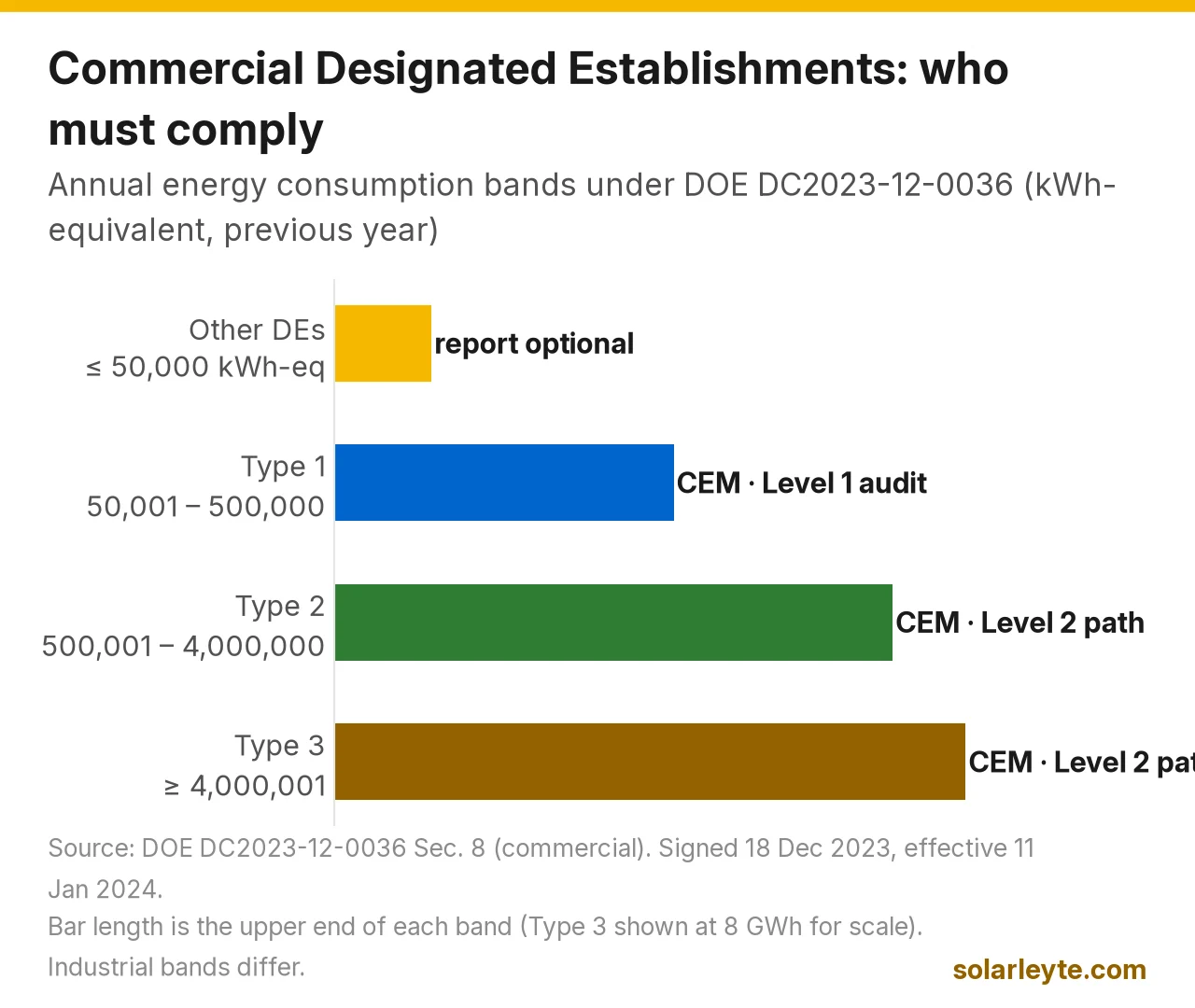
Source: DOE DC2023-12-0036 Secs. 8, 13 and 17 (commercial sector), signed 18 December 2023, effective 11 January 2024. PDF from doe.gov.ph. Industrial and transport sectors have their own circulars (DC2023-12-0037 and DC2023-12-0038) with different kWh bands — do not mix them.
How consumption is counted. Section 11 of the commercial circular adds fuel (petroleum products, converted to kWh-equivalent with DOE factors) to electricity. A resort that burns a lot of diesel for generators can tip into a higher typology even if its co-op kWh looks moderate.
New businesses get one full calendar year (1 January–31 December) to build a consumption profile before typology sticks. A change of ownership at the same site inherits the previous owner's history (Sec. 8).
What Type 1–3 commercial sites must do
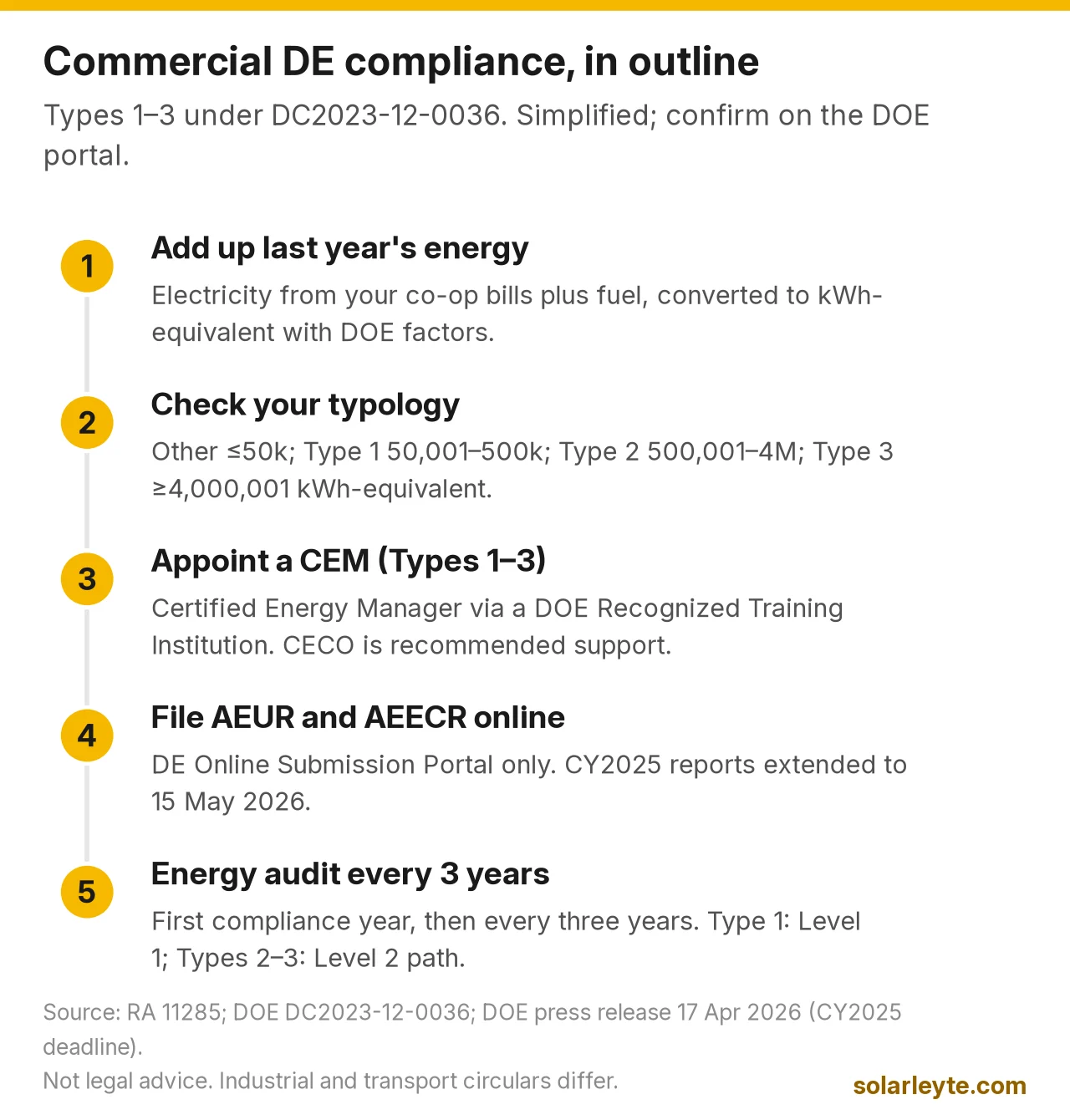
Putting the Act (Sec. 20), the IRR, and DC2023-12-0036 together, a covered commercial DE must, among other things:
- Register and file the Annual Energy Utilization Report (AEUR) and Annual Energy Efficiency and Conservation Report (AEECR) through the DE Online Submission Portal (not by email). Off-portal filings are treated as non-compliant (DOE press release, 17 April 2026; circular Sec. 15).
- Appoint a Certified Energy Manager (CEM) for Types 1–3 commercial (circular Sec. 13). This is stricter than the Act's original Type 1 CECO / Type 2 CEM split — commercial Type 1 now needs a CEM.
- Integrate an energy management system policy based on ISO 50001 or a similar framework (Act Sec. 20(a); circular Sec. 16).
- Keep monthly energy records and pursue annual reduction targets under the National EE&C Plan.
- Submit an energy audit report in the first compliance year and every three years after, using a Certified Energy Auditor (CEA), accredited ESCO, or FPCS as the circular requires. For Types 2 and 3, an in-house CEA audit must be validated by a DOE-registered/certified ESCO, CEA or FPCS (Sec. 17).
- Notify the DOE when a CEM or CECO is appointed or leaves (Act Sec. 20(i): within 10 working days).
CY2025 deadline (as of this writing): the DOE extended CY2025 AEUR, AEECR and applicable Energy Audit Report submissions to 15 May 2026, citing the national energy emergency under Executive Order No. 110. Use the portal at https://de.eumb.ph (the press release also references the DE system; older materials still cite https://de.doe.gov.ph/). Monthly EEC implementation reports still apply (DOE, 17 April 2026).
How big is 50,000 kWh in Leyte money?
At BILECO's September 2026 residential rate of ₱18.93/kWh (PRESYO-PH; also used in our BILECO rate tracker), a pure-electric commercial load at the Type 1 floor looks like this. Commercial tariffs differ from residential; treat the peso column as a rough scale, not your bill:
Annual kWh (electricity only) | Rough monthly kWh | Rough annual cost at ₱18.93/kWh | Commercial typology (if no/low fuel) |
|---|---|---|---|
50,000 | ≈ 4,170 | ≈ ₱946,500 | Just under Type 1 ("Other DEs") |
50,001 | ≈ 4,170 | ≈ ₱946,500 | Type 1 starts here |
120,000 | 10,000 | ≈ ₱2.27 million | Type 1 |
500,000 | ≈ 41,700 | ≈ ₱9.47 million | Top of Type 1 |
500,001 | ≈ 41,700 | ≈ ₱9.47 million | Type 2 starts here |
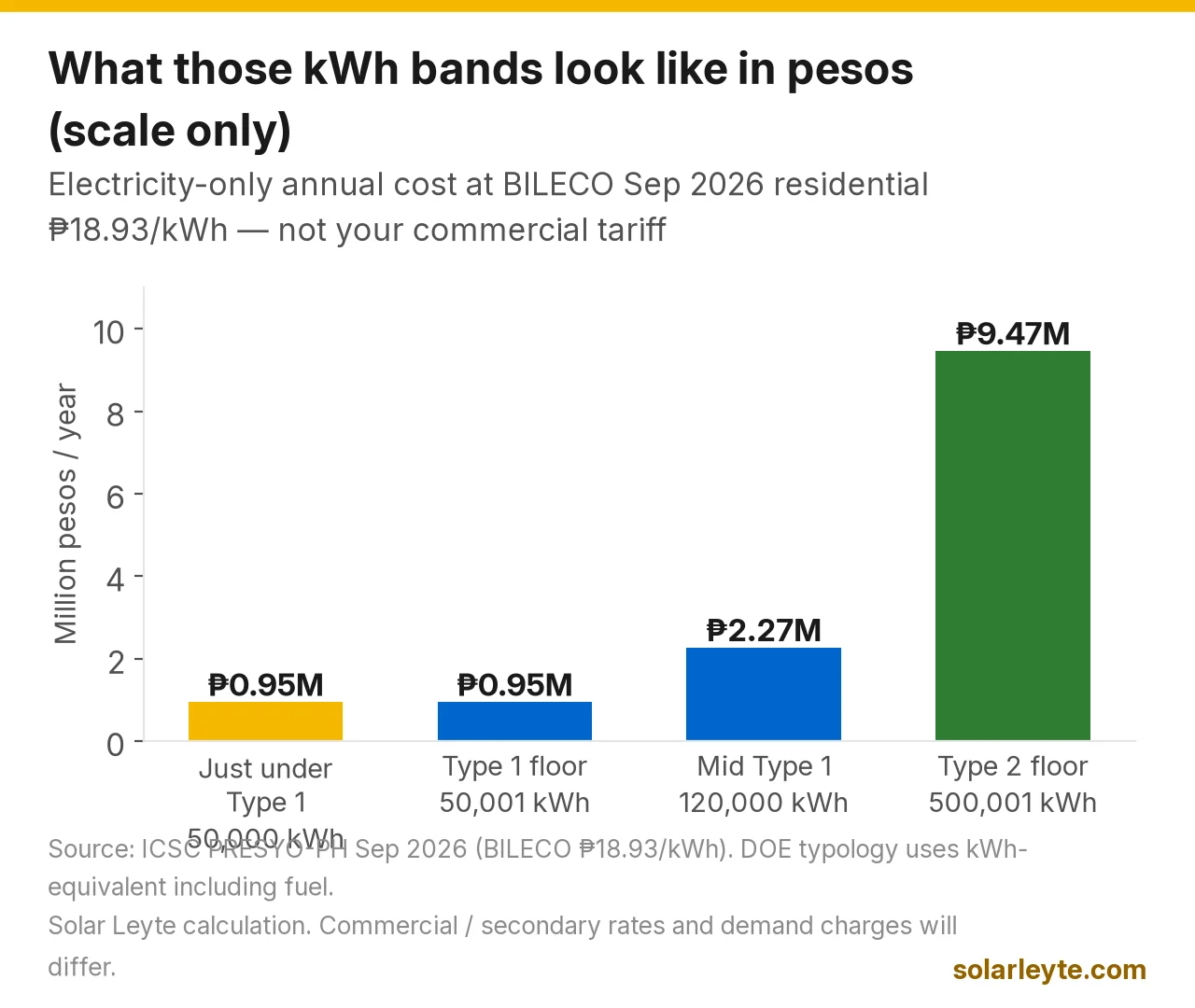
Peso figures are Solar Leyte calculations (kWh × ₱18.93). Your co-op commercial or secondary rate, demand charges and fuel use will change both the bill and the DOE typology.
For context from posts already on this site (electricity only, labelled models — not DOE filings):
- A 12-room Biliran beach resort model at about 1,280 kWh/month (≈ 15,360 kWh/year) sits well under 50,000 kWh and would be "Other DEs" on electricity alone — encouraged to report, not required (solar for beach resorts). Add a diesel generator for brownouts and the fuel can still push the kWh-equivalent up.
- A busy water refilling station or poultry / piggery with daytime pumps and fans often lands in the tens of thousands of kWh per year; check the annual total before you assume you're exempt (water refilling, poultry and piggery).
- A mid-size hotel, mall wing, cold storage or hospital that runs past ~4,200 kWh a month of electricity (plus any generator fuel) should treat Type 1 compliance as likely and verify on the portal.
Where solar fits (and where it doesn't)
RA 11285 is an efficiency and conservation law, not a solar subsidy. It does three useful things for a Leyte or Biliran business thinking about panels:
- It explicitly allows renewable energy inside your EE program (Act Sec. 20(b)). An energy audit that flags daytime aircon, pumps or cold rooms is the natural place to size rooftop PV for self-use.
- It sits beside, not instead of, GEOP and net metering. If your peak demand is 50 kW or more, you may also shop renewable supply under the Green Energy Option Program (GEOP). GEOP replaces generation on the bill; rooftop solar cuts the kWh you buy. Many sites will use efficiency first, then self-generation, then (if eligible) GEOP.
- Appliance labels cut the load you have to cover. When you replace an aircon, refrigerator, TV, washing machine, lighting or electric fan, look for the DOE energy label under PELP / MEPP. Our appliance kWh guide shows how those kWh add up at BILECO and LEYECO rates.
What the Act does not do: it does not give homeowners or MSMEs free panels, and Designated Establishment status is not a building permit or a net-metering approval. For small plug-and-play or zero-export systems, see the DOE micro-solar / zero-export rules. For payback maths at local rates, see is solar worth it. For why Leyte and Biliran bills run high in the first place, see bakit mahal ang kuryente.
Worked example (labelled assumptions, not a quote). Suppose a Leyte hotel uses 90,000 kWh/year of electricity and little fuel → Type 1 commercial. At ₱18.93/kWh that is about ₱1.70 million/year (Solar Leyte calculation). If an energy audit and efficient AC/lighting cut 15% of that load, you save about 13,500 kWh and ≈ ₱255,000/year before any solar. A daytime rooftop system that covers another 30,000 kWh/year of self-use (subject to roof, permits and co-op rules) is another ≈ ₱568,000/year of avoided purchases at the same rate. Those two steps are exactly the kind of plan Sec. 20 expects you to write into the AEECR — efficiency first, renewables as one of the measures.
How many Designated Establishments are there?
As of 31 December 2023, the DOE reported 4,956 Designated Establishments that had submitted annual consumption reports: 3,385 commercial, 1,540 industrial and 31 transport. Completed EE projects among them totalled about ₱6.78 billion in investment and around 466 GWh of energy savings. The same update listed 886 registered EE practitioners (488 CEM, 171 CECO, 227 CEA) (DOE EEC chapter PDF). We did not find a public provincial breakdown for Leyte or Biliran, so we are not inventing local DE counts.
Fines (read the law, don't guess)
Under Sec. 32, the DOE may impose administrative fines from ₱10,000 to ₱1,000,000 for violations of the Act, IRR and related issuances, after the explanation / recommendation / disclosure / order steps in Sec. 31. Sec. 33 adds criminal liability for wilful prohibited acts: imprisonment of 1 to 5 years and/or a fine from ₱100,000 to ₱100,000,000 (or twice the cost avoided, whichever is higher). Prohibited acts include failing to appoint a CEM/CECO, failing to submit required reports, refusing inspection, and selling products that miss MEP / labelling rules (Sec. 30). DC2024-05-0011 and DC2024-05-0015 add administration and administrative-case procedure for DE obligations (PE2 list).
FAQ
Does RA 11285 apply to my house in Naval or Tacloban? No. Designated Establishment rules target energy-intensive commercial, industrial, transport and related sites. Homes still benefit from PELP labels when buying appliances, and from separate solar / net-metering rules.
I'm a small resort under 50,000 kWh — am I free? On electricity alone you are likely "Other DEs" (encouraged to report, not required). Add generator fuel in kWh-equivalent before you relax. If you grow past 50,001 kWh-equivalent, Type 1 obligations apply.
Is a CECO enough for a Type 1 hotel? For commercial Type 1 under DC2023-12-0036 Sec. 13, the required practitioner is a CEM. A CECO is listed as recommended support staff. Industrial rules differ — check the circular for your sector.
Does filing with the DOE replace net metering or a building permit? No. DE reports are a DOE energy-management obligation. Interconnection, electrical permits and CFEI follow co-op and LGU rules separately.
Where do I submit? Through the DE Online Submission Portal (https://de.eumb.ph / https://de.doe.gov.ph/). CY2025 AEUR, AEECR and applicable audit reports were extended to 15 May 2026.
Will solar make me drop a typology? Lower electricity use can move you down a band when the portal recalculates from your reports (circular Sec. 9). That is a side-effect of saving energy, not a reason to under-report. Keep accurate monthly data.
Solar Leyte is run by MACC Systems & Energy Solutions Inc., a solar installer in Naval, Biliran.
Get a free solar quote from MACC
Running a hotel, resort, farm or plant in Leyte or Biliran and want to see how rooftop solar fits beside an energy-efficiency plan? Send a recent bill (and a roof photo if you have one). We'll reply with a free, no-obligation written quote.
- Call/Text: 0955 723 5093
- Email: official@macc-inc.com or benjie@macc-inc.com
- Website: www.macc-inc.com
- Office: Brgy. Talustusan, Naval, Biliran 6543
- Or use the site quote form: /quote
Related guides
- BILECO and LEYECO electricity rates
- Green Energy Option Program (GEOP)
- How many kWh your appliances use
- Is solar worth it in Leyte and Biliran?
- Plug-and-play and zero-export solar
- Solar for beach resorts in Biliran
- Bakit mahal ang kuryente?
Sources (all checked 18 October 2026)
- Republic Act No. 11285 (Energy Efficiency and Conservation Act), approved 12 April 2019: Lawphil full text; DOE page / PDF — Secs. 19–22 (Designated Establishments and other establishments), Sec. 20 (obligations, including renewable energy technologies), Secs. 14–15 (MEP and labelling), Secs. 30–33 (prohibited acts, fines, criminal liability)
- DOE Department Circular DC2019-11-0014 (IRR of RA 11285): signed 22 November 2019, effective 21 December 2019 (PE2 EE policies list; DOE legacy IRR page)
- DOE Department Circular DC2023-12-0036 (commercial DE reclassification): signed 18 December 2023, effective 11 January 2024; Sec. 8 thresholds (Other ≤50,000; Type 1 50,001–500,000; Type 2 500,001–4,000,000; Type 3 ≥4,000,001 kWh-equivalent); Sec. 11 fuel+electricity formula; Sec. 13 CEM for Types 1–3; Sec. 15 portal-only filing; Sec. 17 energy audit cycle (doe.gov.ph circular page; PDF saved locally as `raw/ra-11285-2026-10-18/DC2023-12-0036.pdf`)
- DOE Department Circulars DC2023-12-0037 (industrial) and DC2023-12-0038 (transport): same date/effectivity family; industrial bands summarised by Enviliance ASIA, 8 March 2024 (Others ≤50,000; Type 1 50,001–1,000,000; Type 2 1,000,001–8,000,000; Type 3 ≥8,000,001) — not used for commercial examples in this post
- DOE press release, DOE Extends CY2025 Energy Compliance Deadline (17 April 2026): AEUR, AEECR and applicable Energy Audit Reports due 15 May 2026; portal https://de.eumb.ph; off-portal invalid
- DOE, EEC and Alternative Fuels chapter (PDF): as of 31 December 2023 — 4,956 DEs (3,385 commercial / 1,540 industrial / 31 transport); ₱6.78 billion completed EE investment; ~466 GWh savings; 886 EE practitioners (488 CEM / 171 CECO / 227 CEA); portal https://de.doe.gov.ph/
- DOE, Philippine Energy Labeling Program (PELP): DC2020-06-0015 (guidelines; effective 10 July 2020); DC2020-06-0016 (MEPP); product implementing guidelines for air conditioners, lighting, refrigerators, TVs, washing machines, electric fans, display monitors and energy-saving devices
- Philippine Energy Efficiency Alliance (PE2), EE Policies in the Philippines (as of 10 May 2026): dated list of RA 11285 circulars including DC2024-05-0011 (DE administration/enforcement) and DC2024-05-0015 (administrative cases)
- ICSC PRESYO-PH, national electricity rates, September 2026: BILECO residential ₱18.93/kWh (used only for scale examples)
- Solar Leyte internal models linked above: beach-resort, water-refilling and poultry/piggery load posts (electricity-only examples; not DOE filings)