Yes, you can use solar in a condo or a rented apartment in the Philippines, but in most units it will be a small plug-in "micro-solar" kit, not a rooftop system. Since August 2026, DOE Department Circular DC2026-08-0017 lets anyone run panels of up to 1,000 W with a grid-tied micro-inverter of up to 800 W, plugged into a code-compliant outlet, with no building permit and no ERC Certificate of Compliance. You only notify the power utility. Three things still stand in your way: the condo corporation or landlord (the walls, railings and roof aren't yours), the micro-inverter (it must be built for the Philippine 60 Hz grid), and the sun (a panel hung flat on a balcony railing makes far less than a tilted roof panel).
Pwede ba mag-solar sa condo? Usually yes, in a small way. Here are the rules, the paperwork, and real output numbers for a Tacloban balcony.
Last checked 10 November 2026 (Philippine time). We found no ERC implementing rules and no DOE–DHSUD condo guidelines published under the circular as of that date. This is a plain-language guide, not legal advice. For the full circular, see our plug-and-play and zero-export solar guide.
The short version: what each type of resident can do
You are | Roof or building panels | Balcony plug-in kit (micro-solar) | Who signs the co-op notice |
|---|---|---|---|
Condo unit owner | Only with condo corporation approval; the roof is a common area | Possible, subject to the master deed, house rules and corporation consent | The registered account holder for your unit's meter |
Condo or apartment renter | Very unlikely | Possible with the landlord's written OK and the building's consent | The account holder (often the owner, not you) |
Renter on a submeter | No | Possible, but savings depend on how your submeter is read | The owner of the main meter |
Townhouse or house in a subdivision | Yes, if it's your own roof; HOA rules on common areas still apply | Possible | You, if the account is in your name |
What the DOE micro-solar rules allow
The circular calls a plug-and-play kit a Micro-Solar System (MSS). To qualify it needs all three of these (Section 3.2 of DC2026-08-0017):
- panels with a total of no more than 1,000 W DC;
- a factory-set, grid-tied micro-inverter with a maximum output of 800 W AC, with automatic anti-islanding (it switches off when the grid goes down);
- a connection "via a standard household wall outlet or circuit with PEC-compliant installation", meaning wired to the Philippine Electrical Code.
For an MSS, "end-users shall not be required to secure a Building Permit or a COC" (Section 4.2). You send your distribution utility the one-page notification form in Annex A, and the utility can't impose "pre-installation clearances, technical permits, or inspection fees" (Section 6.1). Any power the kit pushes back to the grid earns nothing unless you're on net metering (Section 4.4).
The circular doesn't override your building. It covers permits and utility paperwork, "without prejudice to compliance with other applicable laws", so the condo law and your lease still apply. Section 8.1 only tells the DOE to coordinate with DHSUD and the agencies over HOAs, "condominium corporations, and building managements" to promote these systems on "balconies, windows, designated building envelopes, rooftops, or available areas, except when there is established proof of structural risk or a direct threat to public safety." We found no resulting guideline as of 10 November 2026.
What your condo corporation can (and can't) say
Under the Condominium Act, RA 4726, your unit ends at "the interior surfaces of the perimeter walls, floors, ceilings, windows and doors" (Section 6(a)). Bearing walls, roofs and "other common structural elements of the building" are not part of your unit. Your own exclusive right is to "paint, repaint, tile, wax, paper or otherwise refinish and decorate the inner surfaces" (Section 6(e)).
What that means for solar:
- The roof and outside walls are common areas. You can't mount panels there without the management body's approval.
- The master deed and declaration of restrictions can say more. Section 6 starts with "unless otherwise expressly provided in the enabling or master deed or the declaration of restrictions", and Section 9 makes those restrictions binding on every owner. Some deeds give a penthouse or terrace unit exclusive use of a roof deck. Others ban anything hung on balconies. Read yours before you buy.
- The management body enforces them. The declaration of restrictions sets up the condominium corporation or association and gives it "power to enforce the provisions of the declarations of restrictions" (Section 9(a)(1)).
In a subdivision, the Magna Carta for Homeowners, RA 9904, lets a homeowners' association "regulate the use, maintenance, repair, replacement and modification of common areas" (Section 10(c)). Your own house roof isn't a common area, but deed restrictions on the look of the house can still apply.
What may change: the proposed Sariling Kuryente Act (House Bill 10431, filed August 2026) would bar homeowners' associations, property managers and developers from stopping residents from installing these systems on their own private property, except for reasonable safety and common-area guidelines (GMA News). The House energy committee approved a substitute bill on 12 October 2026, but it still needs House plenary approval and a Senate version (Energy News PH). It is not law yet.
What to send the building admin
Ask in writing, and attach:
- the kit's datasheets (panel weight and size, micro-inverter model);
- how it will be fixed: clamps on the railing, a floor stand inside the balcony, or a window bracket, and that nothing drills into common walls;
- the outlet it will plug into, and confirmation from a licensed electrician that the circuit meets the PEC;
- a copy of DC2026-08-0017, pointing to Sections 3.2, 4.2 and 8.1.
Renters: the landlord, the account and the submeter
If you rent, the panels may be yours but the wall, the outlet and usually the electricity account are not.
- Get written permission. Under the Civil Code (Article 1678), if a lessee makes useful improvements in good faith without altering the property's form or substance, the lessor pays half their value when the lease ends, or the lessee may remove them. A plug-in kit you take with you is simplest. Put "tenant may remove at move-out" in writing.
- The co-op notice needs an account number. The Annex A form asks for the "Service/Customer Account No" and the end-user's declaration and signature. If the meter is in the owner's name, ask the owner to file it, or agree in writing who does.
- On a submeter, check how you're billed. Your landlord reads the submeter and bills you per kWh. A balcony kit lowers what the submeter counts, so your bill drops, as long as the kit never makes more than your unit is using at that moment. Any extra flows back out through the submeter, and older meters don't all handle that the same way, so ask the landlord what kind of submeter it is. Our submeter bill guide explains the ERC rules on what a landlord may charge.
If none of that works, a portable power station with a folding panel needs no one's permission. It doesn't connect to the building wiring at all. See our solar generator price guide.
The 60 Hz trap: check the micro-inverter before you buy
Most "balcony solar" kits sold online are designed for Europe, where the grid runs at 50 Hz. The Philippine grid runs at 60 Hz: "The nominal fundamental Frequency shall be 60 Hz" (Philippine Grid Code 2016, Section 3.2.2.1). A grid-tied micro-inverter syncs to the grid. A unit built only for 50 Hz can't do that here and shouldn't be connected.
Two real examples:
Micro-inverter | Rated output | Output frequency (per maker) | Fits the 800 W MSS cap? |
|---|---|---|---|
EcoFlow PowerStream (EFWN511) | Up to 800 W | 50 Hz (user manual V1.1 spec table) | Output yes, but check frequency first |
APsystems DS3-L, Philippines version | 730 VA | 60 Hz (59.3–60.5 Hz) | Yes |
APsystems DS3, Philippines version | 880 VA | 60 Hz | No, 880 is over 800 |
Sources: EcoFlow PowerStream user manual V1.1; APsystems DS3 datasheet for the Philippines, Rev 1.3.
A PowerStream bundle (micro-inverter, flat cable and an EU smart plug) was listed at ₱17,990 at Altitude Philippines on 10 November 2026. The listing doesn't state the output frequency, and the manual we read lists 50 Hz, so ask the seller in writing whether the unit you'd get is a 60 Hz version before you buy. More on brands and prices in our microinverter guide.
Also note that the MSS cap is on panel watts too. Two 450 W panels (900 W) fit. Three 400 W panels (1,200 W) don't.
How much a balcony panel really makes
This is where balcony solar gets honest. Leyte and Biliran sit about 11° north of the equator, so the sun is high overhead most of the year. A panel hanging straight down on a railing faces the horizon, not the sky.
We ran the European Commission's PVGIS calculator for Tacloban City (11.244° N, 125.004° E; ERA5 weather data 2005–2023; 14% system losses) for 1 kW of panels at different angles. PVGIS includes terrain but not your building, the balcony slab above you or the tower next door, so real balconies often do worse.
Panel position, Tacloban | kWh per kW of panels per year | Share of a well-tilted roof panel |
|---|---|---|
Roof, best angle (10° tilt, facing slightly east of south) | 1,413 | 100% |
Tilted 60° from flat, facing east | 1,044 | 74% |
Tilted 60°, facing west | 1,032 | 73% |
Tilted 60°, facing south | 1,025 | 73% |
Vertical on a railing, facing east | 679 | 48% |
Vertical, facing west | 664 | 47% |
Vertical, facing south | 532 | 38% |
Vertical, facing north | 320 | 23% |
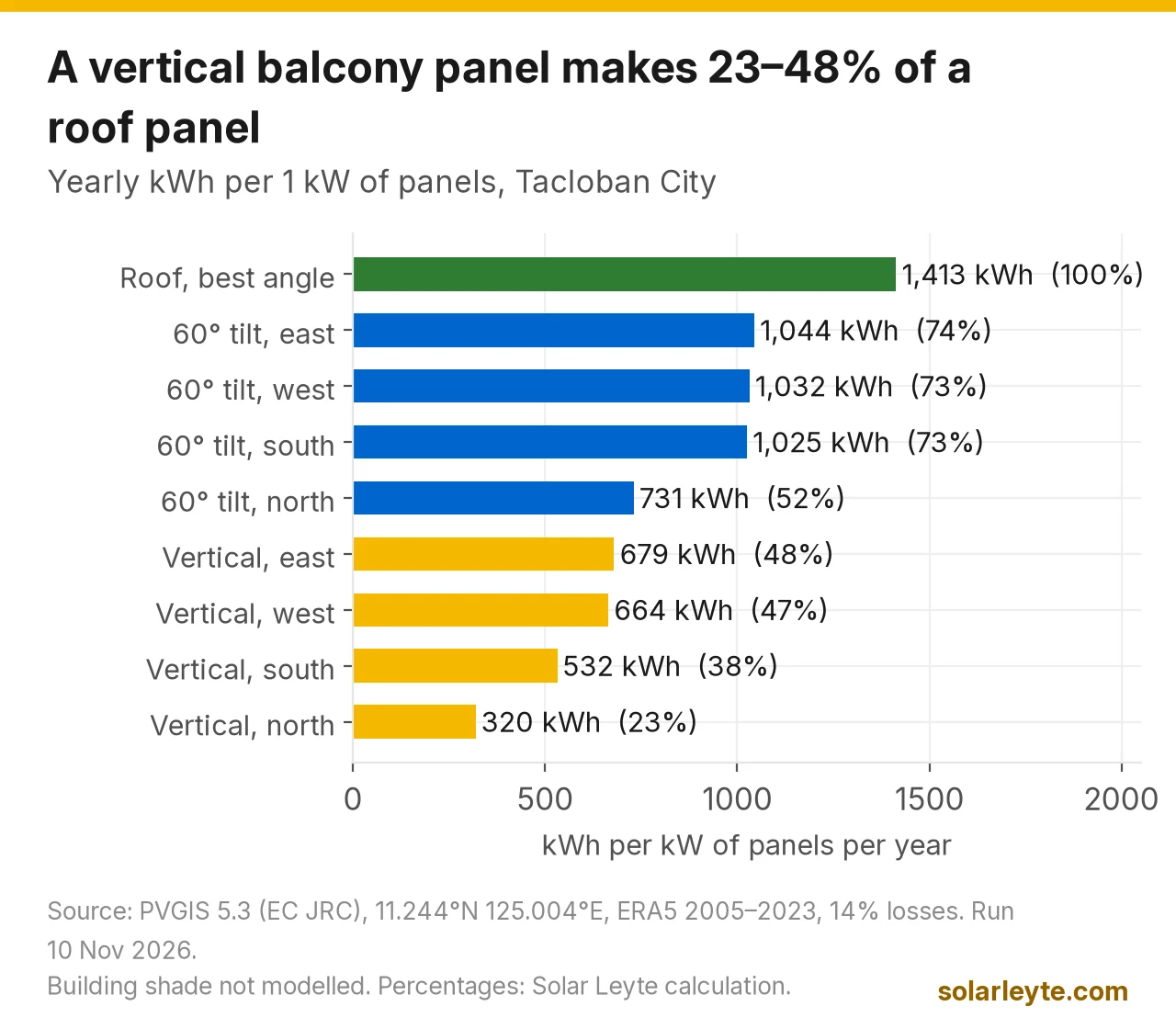
Source: PVGIS 5.3 runs for Tacloban, 10 November 2026; percentages are Solar Leyte calculations.
What surprised us: at this latitude, east and west balconies beat south ones when the panel hangs vertical. A south-facing vertical panel makes most of its power from October to February and very little in May to August, when the sun passes north of overhead. A north-facing one does the opposite and is weak all year. Tilting the panel outward even part of the way (on a stand or an angled bracket, if your building allows it) makes a big difference. For roofs, see our tilt and direction guide. For shade from walls and neighbours, see solar panel shading.
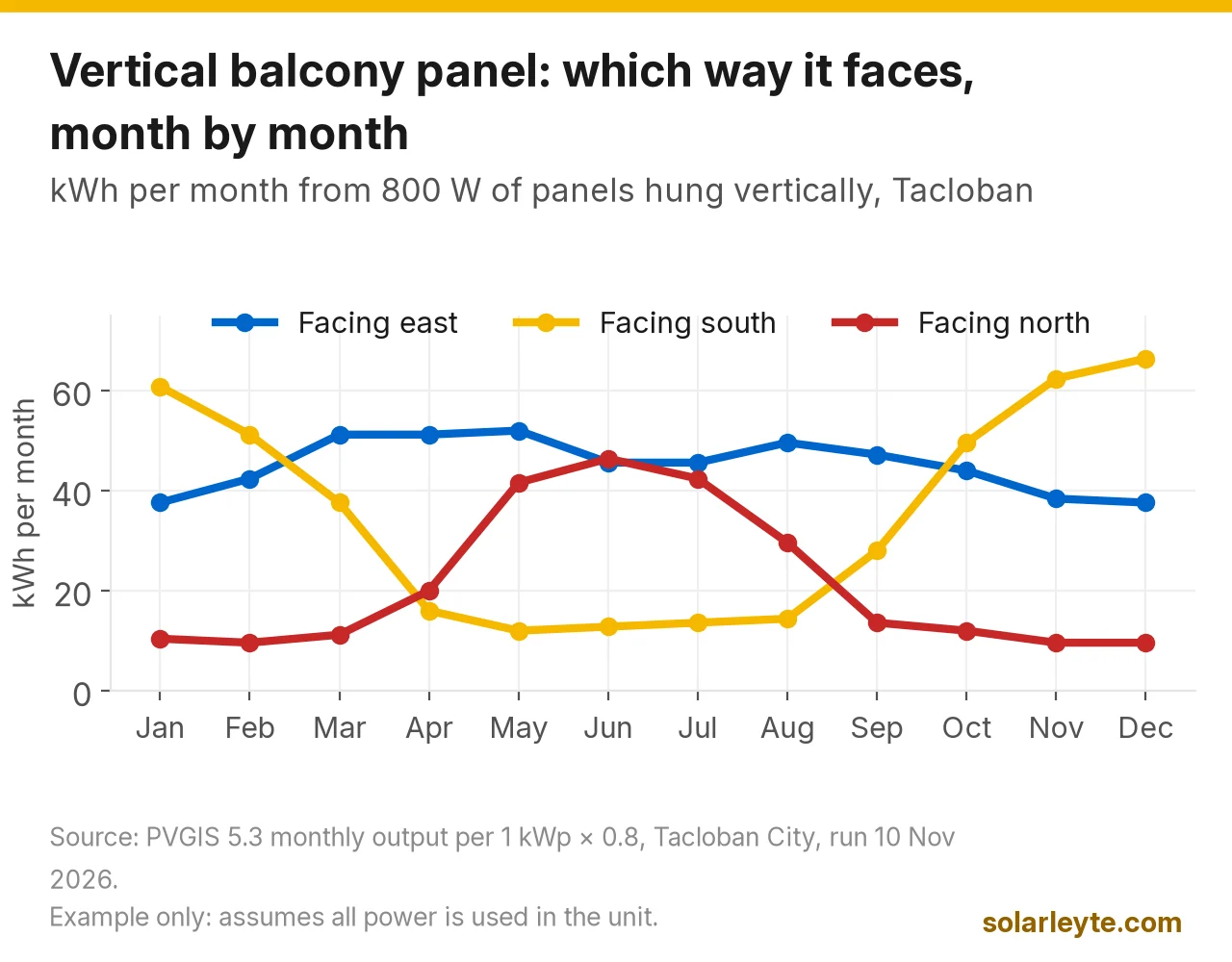
Worked example: two 400 W panels on a Tacloban balcony
This is an example, not a quote. Assumptions: 800 W of panels (2 × 400 W); the PVGIS yields above; every kWh used in the unit as it's made (no export); BILECO's October 2026 residential rate of ₱19.3628/kWh (BILECO) and LEYECO IV's October 2026 rate of ₱17.0099/kWh (LEYECO IV). Tacloban itself is LEYECO II territory, so use your own bill's rate per kWh (see our LEYECO II rate tracker).
Position | kWh per month | Saving at ₱19.3628 | Saving at ₱17.0099 |
|---|---|---|---|
Vertical, east | 45.3 | ₱877 | ₱770 |
Vertical, west | 44.3 | ₱857 | ₱753 |
Vertical, south | 35.5 | ₱687 | ₱603 |
Vertical, north | 21.3 | ₱413 | ₱363 |
Tilted 60°, east | 69.6 | ₱1,348 | ₱1,184 |
Roof, best angle (for comparison) | 94.2 | ₱1,824 | ₱1,602 |
How we got them: kWh per month = yearly kWh per kW × 0.8 kW ÷ 12. For example, 664.18 × 0.8 ÷ 12 is about 44.3 kWh, and that unrounded monthly figure × ₱19.3628 = ₱857.
Break-even check (our calculation): at ₱857 a month, a west-facing vertical kit saves about ₱10,284 a year. To pay for itself in five years, the whole kit, installed, would need to cost under about ₱51,400. If you can only get a north-facing balcony (₱413 a month), the same kit takes about twice as long.
Only count what you use. A kit only saves money while the unit is drawing at least that much power. A ref, an electric fan and Wi-Fi at midday may use less than the kit makes, and the extra "shall be treated as Non-Compensated Export" (Section 4.4). Our appliance kWh guide helps you estimate your daytime load.
Safety on a balcony in typhoon country
- Fix it for wind, not just weight. A panel on a high balcony acts like a sail, and "structural risk" is exactly what your building admin will ask about. Use the panel maker's clamping points, keep it inside the railing line, and plan to take it down when a typhoon signal is raised. See our typhoon checklist.
- Use a proper outlet. The circular requires a "PEC-compliant" outlet or circuit. Have a licensed electrician check it, and don't run the kit through a power strip.
- It won't work in a brownout. Anti-islanding means the micro-inverter switches off when BILECO or LEYECO power goes out. For backup you need a battery: see grid-tie vs hybrid solar.
- Buy from a seller you can reach. Poor DC connectors and wiring are a common cause of solar fires. Read our solar fire safety guide and our tips on buying panels on Lazada and Shopee.
FAQ
Can I put solar panels on my condo balcony in the Philippines?
Often, yes, as a micro-solar kit of up to 1,000 W of panels and an 800 W micro-inverter, which needs no building permit or ERC COC under DOE DC2026-08-0017. But the balcony's outer walls and railings are usually common areas under RA 4726, so you need the condominium corporation's consent and must follow the master deed.
Can a renter install solar in an apartment?
Yes, with the landlord's written consent. A plug-in kit you can remove is the easiest. Under Civil Code Article 1678, useful improvements made in good faith may be removed by the tenant if the landlord doesn't reimburse half their value at the end of the lease. The co-op notice has to come from the account holder.
Will a European balcony solar kit work in the Philippines?
Only if its micro-inverter is rated for 60 Hz. The Philippine Grid Code sets 60 Hz; many European kits are built for 50 Hz. Check the datasheet's output frequency, not just the watts.
How much can a balcony solar panel save?
In our Tacloban example, 800 W of panels hung vertically on an east- or west-facing railing makes about 44 to 45 kWh a month, roughly ₱750 to ₱880 at October 2026 LEYECO IV and BILECO rates, if you use all of it. A north-facing balcony makes about half that.
Solar Leyte is run by MACC Systems & Energy Solutions Inc., a solar installer in Naval, Biliran.
Get a free solar quote from MACC
Own a house, a townhouse or a whole building in Leyte or Biliran and want more than a balcony kit? Send us a recent BILECO or LEYECO bill and we'll get back to you with a free, no-obligation written quote.
- Call/Text: 0955 723 5093
- Email: official@macc-inc.com
- Website: www.macc-inc.com
- Or use the site quote form: /quote
Related guides
- Net metering in the Philippines: a practical guide
- Plug-and-play and zero-export solar: the DOE rules
- Microinverters in the Philippines: prices and brands
Sources (all checked 10 November 2026)
- DOE, Department Circular No. DC2026-08-0017, Streamlined SGF ZESS and MSS Policy (PDF): Sections 3.2 (MSS: 1,000 W DC, 800 W AC micro-inverter, anti-islanding, PEC-compliant outlet), 4.2 (no building permit or COC for MSS; Annex A notice), 4.4 (non-compensated export), 6.1 (no pre-installation clearances or fees), 6.7 (12-month analog meter grace period), 8.1 (DOE–DHSUD coordination on HOAs, condominium corporations and balconies); Annex A form fields.
- Lawphil, Republic Act No. 4726, The Condominium Act (1966): Sections 3, 6(a), 6(e), 9 and 9(a)(1).
- Lawphil, Republic Act No. 9904, Magna Carta for Homeowners and Homeowners' Associations (2010): Section 10(c).
- Lawphil, Republic Act No. 386, Civil Code of the Philippines: Article 1678 (lessee's useful improvements).
- GMA News, Sariling Kuryente Act filed at House after Marcos' push at SONA 2026 (2 Aug 2026): HB 10431 and its HOA/property-manager provision.
- Energy News PH, House energy panel backs bill to strip system-loss charge from power bills (12 Oct 2026): committee approval of the substitute Sariling Kuryente bill; plenary and Senate still needed.
- ERC, Philippine Grid Code, 2016 Edition (Resolution No. 22, s. 2016), PDF via ESCAP: Section 3.2.2.1, nominal frequency 60 Hz (p. 59).
- EcoFlow, PowerStream Microinverter User Manual V1.1 (PDF): model EFWN511/EFWN511B, 220/230/240 V AC, 50 Hz output.
- APsystems, DS3 series microinverter datasheet for the Philippines, Rev 1.3 (4 Mar 2025): DS3-L 730 VA, DS3 880 VA, 240 V, 60 Hz.
- Altitude Philippines, EcoFlow PowerStream + Super Flat Cable + Smart Plug: ₱17,990 listed price.
- European Commission JRC, PVGIS 5.3: grid-connected PV runs for 11.244° N, 125.004° E (Tacloban), 1 kWp, 14% loss, PVGIS-ERA5 2005–2023; slopes 90° and 60° at azimuths south, east, west and north, plus optimised angles (10°, −9°).
- BILECO, October 2026 Effective Rate: residential ₱19.3628/kWh.
- LEYECO IV, October 2026 Rates: residential ₱17.0099/kWh.