Connecting batteries in series adds their voltage; connecting them in parallel adds their amp-hours. The stored energy (kWh) is the same either way, so pick the wiring that matches your inverter's battery voltage. Four 12.8 V 100 Ah lithium batteries make 51.2 V 100 Ah in series or 12.8 V 400 Ah in parallel, and both are 5.12 kWh. What changes is the current: the higher the bank voltage, the lower the amps, the thinner the cables and the less heat.
The three rules that matter most:
- Use identical batteries. Same brand, type, capacity and roughly the same age.
- Charge each one fully before you join them.
- Wire a parallel bank so every battery has the same cable path to the inverter, using busbars or diagonal connections.
Last checked 11 November 2026. Limits and rules are from the makers' own manuals and datasheets (Victron, Trojan, Deye, Pylontech, Wattcycle). The worked example is a Solar Leyte calculation, not a MACC quote.
Series vs parallel at a glance
The examples below use a 12.8 V 100 Ah LiFePO4 battery rated at 1,280 Wh, a common size sold in the Philippines.
Connection | How it's wired | Voltage | Capacity | Energy |
|---|---|---|---|---|
Single battery | – | 12.8 V | 100 Ah | 1,280 Wh |
2 in parallel (2P) | + to +, − to − | 12.8 V | 200 Ah | 2,560 Wh |
2 in series (2S) | + of one to − of the next | 25.6 V | 100 Ah | 2,560 Wh |
4 in series (4S) | chain of four | 51.2 V | 100 Ah | 5,120 Wh |
2S2P | two series pairs, then paralleled | 25.6 V | 200 Ah | 5,120 Wh |
4S4P | four series strings of four, paralleled | 51.2 V | 400 Ah | 20,480 Wh |
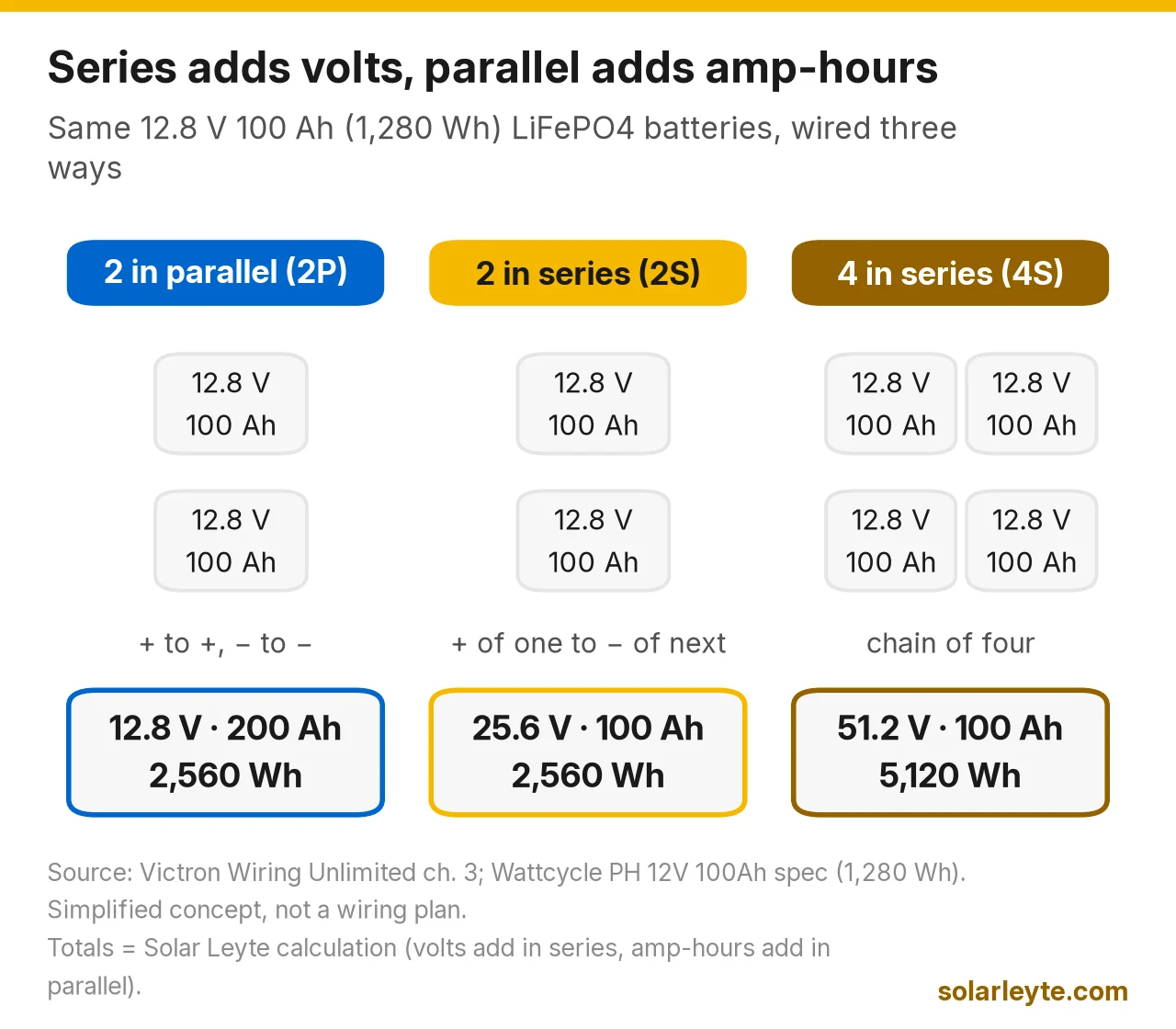
Victron's Wiring Unlimited puts it in one line each: in series the voltage increases, in parallel the capacity increases, and in series/parallel both increase. The 4S4P row is the largest bank Wattcycle allows for its 12 V 100 Ah battery (20.48 kWh).
Why the bank voltage matters more than you think
Your inverter decides the voltage. A 12 V inverter needs a 12 V bank, a 48 V hybrid inverter needs 48 V (51.2 V lithium). You can't "choose" parallel to get more runtime on a 48 V inverter; you add more 48 V strings instead.
The voltage also decides how hard the cables work. Here is the current a 3,000 W load pulls from the battery at each bank voltage (Solar Leyte calculation, watts ÷ volts, ignoring inverter losses, so real current is a little higher):
Bank voltage | Current at 3,000 W | What Trojan's cable table says |
|---|---|---|
12.8 V | about 234 A | Above even 4/0 AWG (107 mm², rated 230 A) |
25.6 V | about 117 A | Needs at least 1 AWG (42.4 mm², rated 130 A) |
51.2 V | about 59 A | 6 AWG (13.3 mm², rated 65 A) carries it |
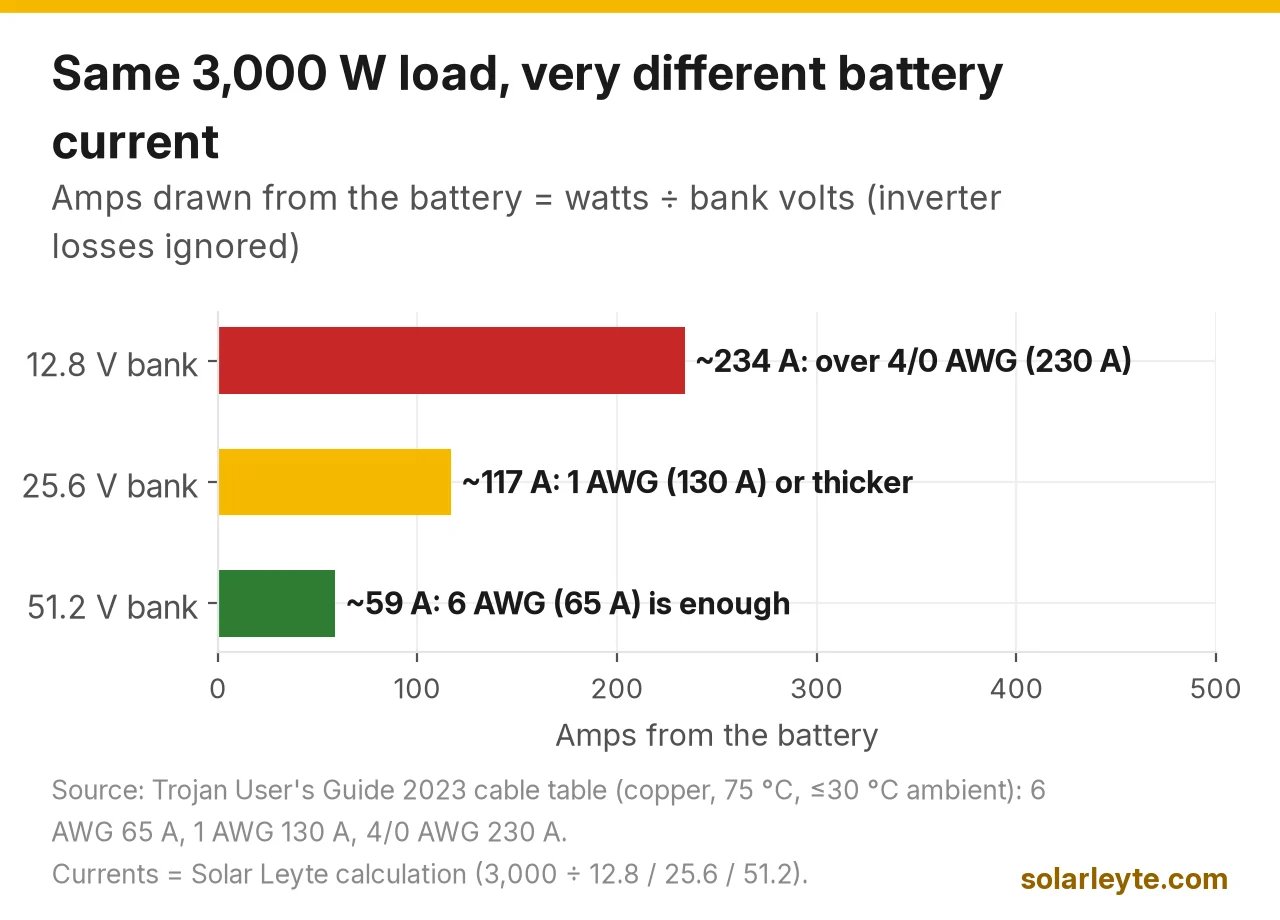
Cable ratings are from Trojan's User's Guide (NEC table, copper at 75 °C, 30 °C ambient; longer runs need thicker cable). Trojan's figures assume no more than 30 °C around the cable, so a hot battery corner needs extra margin; treat these as minimums. That's why bigger home systems go to 48 V: the same energy at a quarter of the current. Our 12 V vs 24 V vs 48 V guide goes deeper on choosing the system voltage.
How to wire a parallel bank so every battery works equally
The most common mistake, according to Victron, is to chain the batteries together and take both main cables off the first battery. Every extra link adds resistance, so the first battery does most of the charging and discharging, and it "will fail prematurely".
Victron's numbers show why this matters. A 20 cm length of 35 mm² cable with its lugs is about 1.5 mΩ. A battery's own internal resistance is typically 3 to 10 mΩ, and Victron's 12.8 V 100 Ah lithium battery is only 0.8 mΩ. So a few short links can add as much resistance as the battery itself.
Illustration (Solar Leyte calculation from Victron's figure): in a chained four-battery bank wired off the first battery, current to and from the fourth battery passes through three links on the positive side and three on the negative, about 6 × 1.5 = 9 mΩ more than the first battery sees.
Victron lists four correct ways to wire a parallel bank. Each makes the current path to every battery the same length:
- Busbars. Run a cable from each battery to a positive and a negative busbar, all the same length and thickness, then one pair of main cables to the inverter.
- Posts. The same idea using positive and negative connection posts.
- Connect halfway. Take the main cables from the middle of the bank.
- Connect diagonally. Main positive on the first battery, main negative on the last. Victron says this is simple and effective but "not perfect".
Trojan adds that in series/parallel banks all series cables should be the same length, and all parallel cables the same length.
Rules before you connect batteries together
Makers agree on most of these. Follow every one:
- Same brand, same type, same capacity. Wattcycle's rules for its 12 V batteries: same brand (different BMS settings), same chemistry, same voltage, same capacity, and bought no more than three months apart.
- Never mix chemistries. No lithium with lead-acid, and no car battery with a deep-cycle battery. Deye's manual says not to combine its lithium batteries with other brands or chemistries, or even with batteries from a different installation.
- Charge each battery fully, on its own, first. Victron says this prevents imbalance from day one. Wattcycle's steps: charge separately, let each rest 15 minutes, check it reads above 13 V, then connect.
- Check polarity twice. Deye's manual warns that reverse polarity at the battery terminals voids the warranty and destroys the batteries.
- Fuse or breaker on the battery side. Wattcycle says to protect the system with a fuse or breaker sized by a qualified electrician. Our solar cable and DC breaker guide covers sizing and local prices.
- Torque the terminals to spec. Trojan warns that loose connections can cause terminal meltdown or fire, and over-tightening can break terminals.
How many batteries can you connect?
Battery | Series | Parallel | Source |
|---|---|---|---|
Lead-acid 12 V (general advice) | to build 24 V or 48 V | about 3 (or 4) strings max | Victron Wiring Unlimited |
Trojan deep-cycle lead-acid | yes | max 3 parallel strings (call Trojan for more) | Trojan User's Guide |
Victron LiFePO4 Smart 12.8 V / 25.6 V | yes, for 24 V or 48 V | yes; max 20 batteries per system | Victron datasheet |
Wattcycle 12 V 100 Ah | up to 4 | up to 4 strings (4S4P, 20.48 kWh) | Wattcycle PH product page |
Pylontech US5000 (48 V rack) | no (it's already 48 V) | up to 16 in one battery group | Pylontech datasheet |
Deye SE-G5.1 Pro-B (51.2 V wall/stack) | no | up to 64 packs (32 without external setup) | Deye user manual |
For lead-acid, Victron's advice is not to build a big bank out of many 12 V batteries at all, because it becomes hard to keep balanced. For four 12 V lithium batteries in series, Victron says it "will work" but needs more balancing time, and recommends two 24 V batteries for a 48 V system instead.
48 V rack and wall batteries: parallel only, with a data cable
If your hybrid system uses a 48 V lithium battery such as the Pylontech US5000 or Deye SE-G5.1 Pro-B, it is already 48 V, so you only ever connect more of them in parallel, and each battery must also be linked by a communication cable so the BMS units work as one bank. From the Deye SE-G5.1 Pro-B manual (v05, March 2026):
- Up to 12 kW inverter ("parallel mode 1"): up to four packs on busbars. For a 12 kW inverter at 51.2 V, Deye says the cables from busbar to inverter must carry at least 240 A, recommending 50 mm² (1/0 AWG) or thicker. Cables that are too thin can cause "severe overheating, fire hazards, and equipment damage".
- Above 12 kW: Deye says you must use "parallel mode 2", its high-power layout.
- Data cable: a standard RJ45 network cable from the OUT port of each battery to the IN port of the next. The first battery's PCS port goes to the inverter's battery communication port, or the inverter can't talk to the bank.
- Start-up order: close the battery's breaker first, then press the power button, so the pre-charge circuit works.
Pylontech's warranty excludes damage when its US-series modules are connected with a different type of module or with non-Pylontech batteries. Adding a battery later? Ask your installer or the brand which models and firmware can share a bank before you buy.
Can you mix different amp-hours, or old and new batteries?
In series: never. The current through every battery in a string is the same, so a smaller or weaker battery gets drained and overcharged first.
In parallel: avoid it. It's a common search ("battery parallel connection different amp"). The batteries will share the load unevenly, and with lithium each BMS can cut out at a different moment. Wattcycle's rules require the same capacity and a purchase gap of no more than three months. Victron explains that even identical lead-acid batteries drift apart because of small differences in internal resistance. An old battery makes that worse.
If one battery in an old bank fails, the safer fix is usually to replace the whole string, or to run the new battery as a separate bank. Our car battery for solar guide explains why starter batteries don't belong in a solar bank at all.
Worked example: about 5 kWh of brownout backup in Naval
Example only, with assumptions: a household in Naval, Biliran wants about 5 kWh of stored energy for evening brownouts and plans four Wattcycle 12 V 100 Ah batteries. The listed price on 11 November 2026 is ₱50,999 for a 4-pack (₱12,999 each).
Option | Bank | Energy | Current at 3,000 W |
|---|---|---|---|
4P on a 12 V inverter | 12.8 V 400 Ah | 5,120 Wh | about 234 A |
2S2P on a 24 V inverter | 25.6 V 200 Ah | 5,120 Wh | about 117 A |
4S on a 48 V inverter | 51.2 V 100 Ah | 5,120 Wh | about 59 A |
Same batteries, same ₱50,999 (about ₱9,961 per kWh stored), same 5.12 kWh. The 48 V option pulls a quarter of the current of the 12 V option. The catch: Victron says four 12 V lithium batteries in series need more balancing than two 24 V ones, and a single 48 V lithium pack with one BMS avoids the issue. Compare pack prices in our solar battery price guide before you decide.
How to check that your bank is balanced
Victron's method, with any multimeter (see our multimeter guide):
- Charge the bank.
- Near the end of the bulk stage, while the charger is still pushing full current, measure each battery's voltage.
- Compare them. A noticeable difference means the bank is unbalanced.
For lead-acid series strings, Victron suggests a battery balancer. For lithium, the battery's app or BMS display shows cell voltages; see our battery care guide for storage and balancing tips in our hot, humid climate. If a battery won't charge at all, start with why your solar battery isn't charging.
FAQ
Is series or parallel better for solar batteries?
Neither stores more energy. Use series to reach your inverter's voltage (24 V or 48 V), and parallel to add hours. Higher voltage means lower current and thinner cables.
Can I connect a 100 Ah and a 200 Ah battery in parallel?
Avoid it. They will share the load unevenly and age differently. Wattcycle, for example, requires the same capacity and brand. In series, never.
How many batteries can I connect in parallel?
It depends on the battery. Trojan says a maximum of three parallel strings for its lead-acid batteries; Victron's general lead-acid advice is about 3 or 4. Lithium limits are higher: 16 for a Pylontech US5000 group, up to 64 for the Deye SE-G5.1 Pro-B. Always check the manual.
Pwede bang i-parallel ang luma at bagong battery?
Hindi inirerekomenda. Ang lumang battery ay mag-a-unbalance sa bangko at paikliin ang buhay ng bago. Wattcycle says batteries in one bank should be bought no more than three months apart.
Related guides
- Grid-tie vs hybrid solar
- 12 V vs 24 V vs 48 V solar system
- Series vs parallel solar panel wiring
- Solar battery brands in the Philippines
- Inverter and battery backup for brownouts
Solar Leyte is run by MACC Systems & Energy Solutions Inc., a solar installer in Naval, Biliran.
Get a free solar quote from MACC
Planning a battery bank, or adding batteries to the one you have? Send us your latest BILECO or LEYECO bill and what you want running during a brownout, and we'll talk you through the options, with no obligation.
- Call/Text: 0955 723 5093
- Email: official@macc-inc.com or benjie@macc-inc.com
- Website: www.macc-inc.com
- Request a quote online: solarleyte.com/quote
- Office: Brgy. Talustusan, Naval, Biliran 6543
Sources (all checked 11 November 2026)
- Victron Energy, Wiring Unlimited, chapter 3: Battery bank wiring (series raises voltage, parallel raises capacity; about 3 (or 4) parallel strings max for 12 V lead-acid; 20 cm 35 mm² cable with lugs ≈ 1.5 mΩ; internal resistance typically 3–10 mΩ; four correct parallel wiring methods; fully charge each battery before connecting; balance check near the end of bulk charge)
- Victron Energy, Lithium Battery Smart 12.8 V / 25.6 V datasheet (series, parallel and series/parallel; max 20 batteries per system; 48 V best built from two 24 V batteries, four 12 V "will work" but need more balancing; 12.8 V 100 Ah internal resistance 0.8 mΩ)
- Trojan Battery, User's Guide: AES, AGM, Gel and Flooded (2023) (maximum of three parallel strings; same-length series and parallel cables; cable ampacity table, copper at 75 °C and ≤30 °C ambient: 6 AWG 65 A, 1 AWG 130 A, 4/0 AWG 230 A; torque warnings)
- Deye, SE-G5.1 Pro-B user manual v05, 14 March 2026 (max 64 packs in parallel, 32 without external setup; parallel mode 1 up to 12 kW with ≥240 A cable, 50 mm² / 1/0 AWG; mode 2 above 12 kW; RJ45 OUT→IN and PCS port; don't combine brands or chemistries or batteries from different installations; reverse polarity voids the warranty; close breaker before power button)
- Pylontech, US5000 / US5000B datasheet, 22 Dec 2025 (max 16 pcs in one battery group) and US-series warranty V1.2 (excludes connection with different type modules or non-Pylontech batteries)
- Wattcycle PH, 12V 100Ah LiFePO4 battery with 100A BMS (₱12,999 single, ₱50,999 4-pack on 11 Nov 2026; 12.8 V, 1,280 Wh; max 4S4P, 20.48 kWh; same brand, type, voltage and capacity, bought ≤3 months apart; charge separately, >13 V after 15 minutes)
- Current at 3,000 W, the 9 mΩ illustration and the ₱/kWh figure: Solar Leyte calculations from the figures above