Solar roof tiles are on sale in the Philippines, but they cost far more per watt than ordinary panels. The only solar roof tile we could find with a public peso price, SCM Roofing's 80 W "Solar Integrated Roof" tile, is listed at ₱3,850 per piece. That works out to about ₱48 per watt for the tile alone. Ordinary 550 W to 620 W panels from Philippine sellers were listed at ₱8 to ₱13 per watt on the same day (9 November 2026). Tiles also fit less power into each square metre of roof, so you get fewer kWh from the same roof.
Sulit ba? For most homes in Leyte and Biliran, no. Tiles make sense mainly when you're building new or replacing the whole roof anyway, you want a flush look, and the extra budget isn't a problem. Below are the real numbers, a worked 3 kW example and the questions to ask before you sign.
Last checked: 9 November 2026. Prices are sellers' listed prices on that date, before delivery and installation.
What a solar roof tile is (and what it isn't)
A solar roof tile is a roofing piece with solar cells built in. It's a form of building-integrated photovoltaics (BIPV): the tile is both the roof covering and the power source. Ordinary panels are "building-attached": they sit on rails above a roof you already have. That's the setup most of our posts cover, including solar on longspan, concrete deck and clay tile roofs.
Don't confuse the two meanings of "solar tile roof" you'll see when searching:
- Solar roof tiles (BIPV): the tile makes power. This post is about these.
- Tile roof hooks and brackets: hardware for putting ordinary panels on a clay or concrete tile roof. That's a mounting question, covered in our roof readiness post.
Solar roof tile price in the Philippines (November 2026)
Product (as listed) | Seller | Listed price | Watts | ₱ per watt (our calculation) |
|---|---|---|---|---|
SCM Solar Integrated Roof, Shingle Tile Design (BIPV) | SCM Roofing Inc. | ₱3,850 per tile | 80 W | ₱48.13 |
Seraphim 620 W TOPCon bifacial panel | Helios Optimum Development | ₱5,000 per panel | 620 W | ₱8.06 |
Letovo 620 W half-cell panel | Letovo | ₱5,700 per panel | 620 W | ₱9.19 |
AE 550 W mono PERC panel | Phsolar | ₱7,000 per panel | 550 W | ₱12.73 |
SCM Stone Coated Metal Shingle Tile (plain roofing, no solar) | SCM Roofing Inc. | ₱290 per sheet ("Distributors Price") | none | n/a |
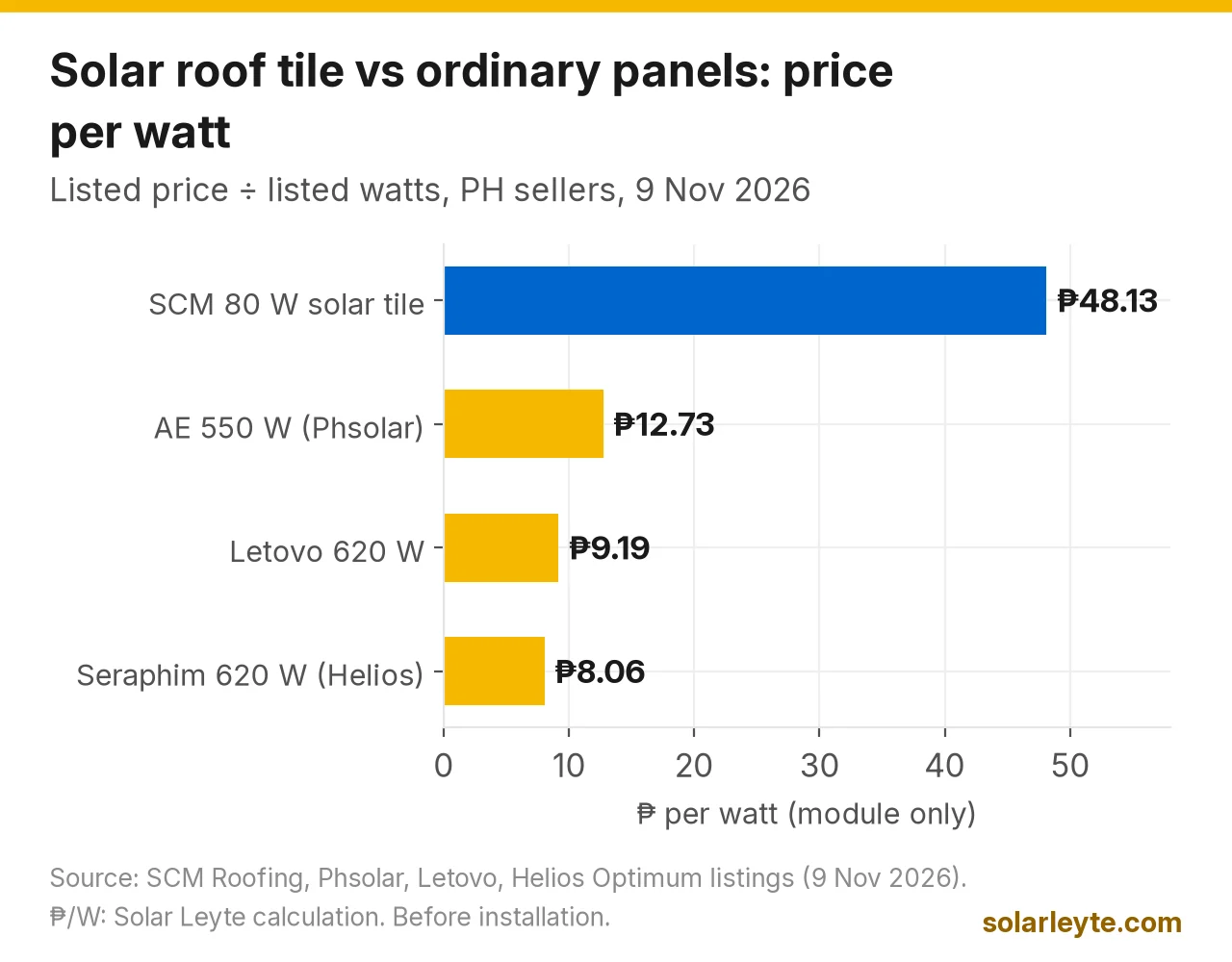
What the table tells you:
- The solar tile costs about 4 to 6 times more per watt than these ordinary panels (₱48.13 against ₱8.06 to ₱12.73).
- The plain roofing it replaces is cheap by comparison. SCM lists its non-solar stone-coated shingle at ₱290 a sheet, and its spec sheet says 2.08 sheets cover a square metre. So the roof you "save" by using solar tiles is worth roughly ₱600 per square metre in material, against about ₱8,260 per square metre for solar tiles (₱3,850 × 2.14 tiles per m², our calculation).
- SCM doesn't publish an installed price. Its BIPV page says pricing depends on roof size, layout and tile count, after a free site inspection. Labour, the inverter, wiring and permits come on top of the tile price.
We found no other solar roof tile with a peso price on a Philippine seller's own page. Chinese factory listings quote US-dollar prices with minimum orders, and those aren't a delivered price for a house in Naval or Tacloban. For panel prices across more sellers, see our 550 W to 620 W panel price guide.
What about the Tesla Solar Roof? Tesla never offered it in the Philippines, and in August 2026 Electrek reported that Tesla had discontinued the Solar Roof altogether. If someone offers you "Tesla solar tiles" here, ask for the import papers and the warranty in writing.
How much power do solar tiles make?
The SCM tile's published specs: 80 W, 19.4% module efficiency, 1340 × 420 mm overall, 1260 × 370 mm effective (the part that shows once laid), 6.5 kg, MC4 connectors, Vmp 15.10 V, Imp 5.30 A, Voc 18.20 V.
Compare that with an ordinary 580 W panel. JinkoSolar's datasheet for the JKM580N gives 2278 × 1134 mm and 31 kg.
Per square metre of roof | SCM 80 W solar tile | Jinko 580 W panel |
|---|---|---|
Watts | about 172 W | about 225 W |
Weight on the roof | about 13.9 kg (replaces the roofing) | about 12.0 kg (on top of the roofing, plus rails) |
Yearly output in Naval (PVGIS, 20° south) | about 244 kWh | about 331 kWh |
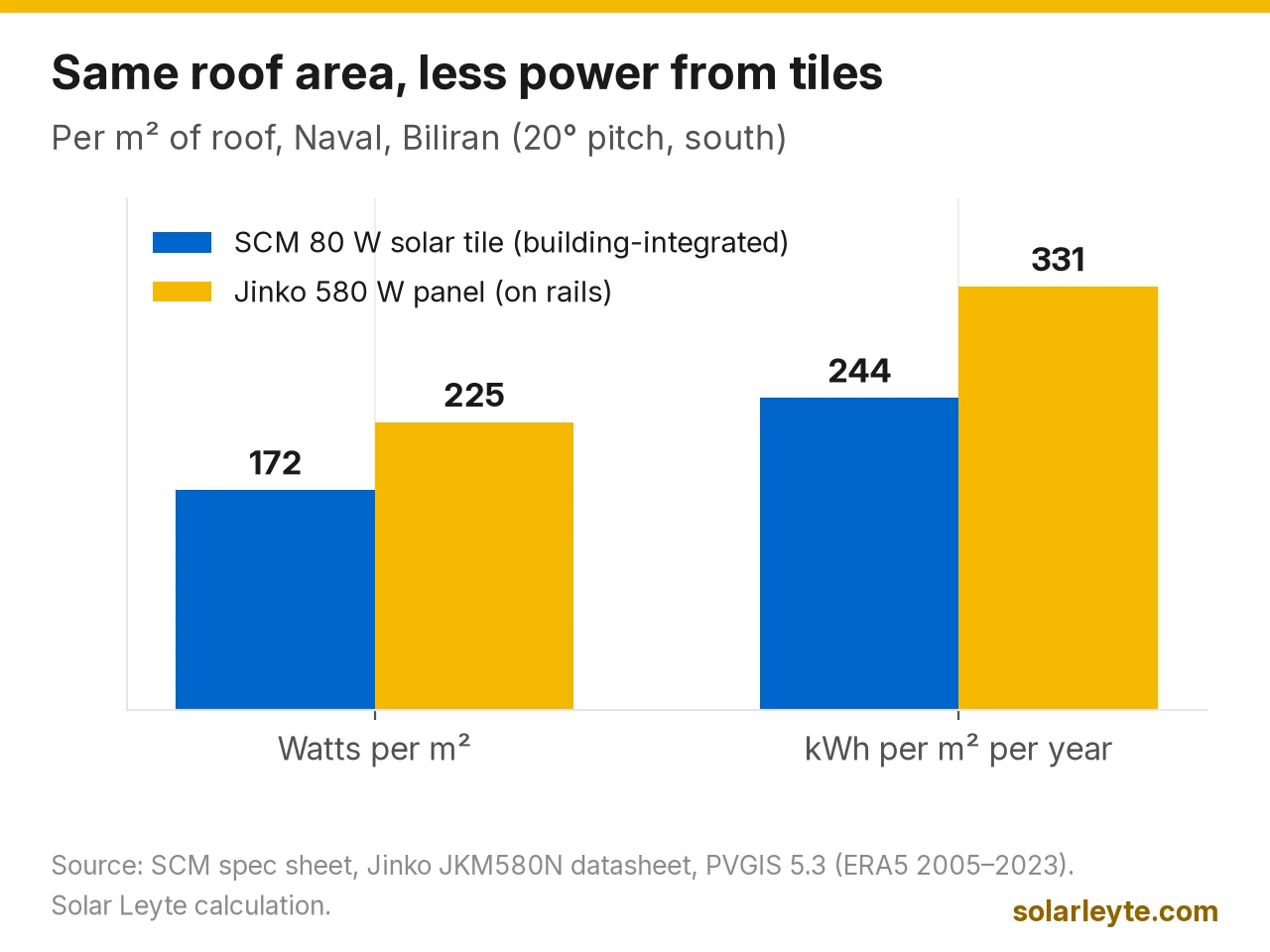
Solar Leyte calculations from the makers' dimensions and PVGIS 5.3. The tile figure uses the 1260 × 370 mm effective area.
So the same roof area gives about 26% less electricity with tiles. Two things cause that:
- Lower watts per m². An 80 W tile has more frame and gap for its size than a big panel.
- More heat. We ran PVGIS (the European Commission's free solar calculator) for Naval at a 20° south-facing pitch. A free-standing 1 kW array made 1,472 kWh a year. A building-integrated 1 kW array, which PVGIS models with no air gap behind it, made 1,421 kWh a year, about 3.5% less, because the hotter cells lose more (temperature loss 12.1% against 9.0%). SCM says its design leaves some airflow underneath, so real tiles may land between the two figures.
For more on how pitch and direction change output here, see our tilt and direction guide.
Worked example: a 3 kW roof in Biliran
Example only. Assumptions: a south-facing 20° roof in Naval; module prices as listed on 9 November 2026; inverter, wiring, labour and permits left out because they're similar for both, except where noted.
Solar roof tiles | Ordinary panels | |
|---|---|---|
Modules | 38 SCM 80 W tiles = 3,040 W | 5 × 620 W panels = 3,100 W |
Module cost | 38 × ₱3,850 = ₱146,300 | 5 × ₱5,000–₱5,700 = ₱25,000–₱28,500 |
Roof area | about 17.7 m² | about 13 m² (5 panels of about 2.6 m² each) |
Roofing you don't buy | about 37 plain shingles, ₱10,730 | none (panels sit on your existing roof) |
Mounting | built into the roof | rails and clamps (extra cost) |
Output in Naval, per year | about 4,320 kWh (PVGIS building-integrated) | about 4,560 kWh (PVGIS free-standing) |
Panel area uses Jinko's 2278 × 1134 mm as a typical size for this class; check your panel's own datasheet.
Even after subtracting the ₱10,730 of plain roofing you don't need, the tile version costs about ₱107,000 to ₱111,000 more in modules for slightly less power. That money would buy a decent LiFePO4 battery for brownouts (see our solar battery price guide) or a much bigger panel array.
Wiring is busier too. Each tile is only about 15 V at full power, so you need many in a row to reach an inverter's working voltage: 19 tiles in series give about 287 V working and 346 V open circuit. A 3 kW tile roof means 38 sets of MC4 connections under the roof, against 5 for panels. Every connection is a place where water or a loose crimp can cause trouble, so ask who checks them and how you'd reach one later.
Typhoons, salt air and heat: what the specs say
- Wind uplift rating: SCM lists a rear static load of 2,400 Pa (wind load) and 5,400 Pa front. Jinko's panel datasheet lists the same 2,400 Pa rear and 5,400 Pa front test loads. On paper, neither is stronger. In a typhoon, what fails first is usually the fixing: screws, purlins, rails and roof sheets. Our typhoon guide covers that.
- Hail and fire: SCM lists hail impact of 25 mm at 23 m/s and a Class A fire rating.
- Warranty: SCM's product pages say "up to 30 years" product warranty, with power loss of no more than 10% at 10 years, 15% at 20 years and 20% at 25 years. Its FAQ says full terms are given at the quotation stage, so get them in writing. Ask specifically about salt mist if you're near the coast, as many homes in Biliran and Leyte are (see solar near the sea).
- Cell type: SCM's product pages say TOPCon cells, while its spec table lists monocrystalline 166 × 83 mm cells. Ask which one your batch has; it affects heat losses.
When solar roof tiles do make sense
- You're building new or re-roofing anyway, so the roofing cost is already in the budget.
- Looks matter a lot, for example a heritage-style house or a resort facade, and you accept paying for that.
- The roof can't take rails, or you'd rather avoid rail penetrations.
- The installer will service it locally. SCM lists branches in Quezon City and Imus, Cavite, and says it serves nationwide. Ask who handles a failed tile in Leyte or Biliran, how long it takes, and who pays the freight.
For everyone else, ordinary panels on your current roof give about 4 to 6 times more watts per peso, and any installer can service them. If the panel look is the worry, all-black panels on black longspan are much less visible than people expect.
Questions to ask before you sign
- What is the installed price per watt, with the inverter, wiring, permits and labour itemised?
- How many tiles, what total watts, and what yearly kWh do you expect for my roof direction?
- Who holds the warranty, and is it a written product warranty plus a power warranty?
- How is a single failed tile found and replaced, and how long does stock take to reach Eastern Visayas?
- Does the system go through the electrical permit and CFEI like any rooftop system? (It should. See our permit and CFEI guide.)
Our installer checklist has the general red flags, and the solar panel price guide explains how to read any quote line by line.
FAQ
How much are solar roof tiles in the Philippines? SCM Roofing lists its 80 W Solar Integrated Roof tile at ₱3,850 per tile (checked 9 November 2026), about ₱48 per watt before installation. We found no other solar tile with a public Philippine price.
Are solar roof tiles better than solar panels? Not for output or cost. On the published specs, an 80 W tile gives about 172 W per square metre against about 225 W for a 580 W panel, and PVGIS shows building-integrated modules losing about 3.5% more to heat in Naval.
Is Tesla Solar Roof available in the Philippines? No. Tesla never sold it here, and Electrek reported in August 2026 that Tesla had discontinued the Solar Roof.
Can solar roof tiles be used for net metering? They're wired to an inverter like any solar array, so the same co-op process applies: the inverter and the paperwork matter, not the tile shape. See our net metering guide.
Solar Leyte is run by MACC Systems & Energy Solutions Inc., a solar installer in Naval, Biliran.
Get a free solar quote from MACC
Weighing solar tiles against ordinary panels for a new house or re-roof? Send a photo of your latest BILECO or LEYECO bill and a few roof photos, and we'll get back to you with a free, no-obligation written quote.
- Call/Text: 0955 723 5093
- Email: official@macc-inc.com
- Website: www.macc-inc.com
- Or use the site quote form: /quote
Sources (all checked 9 November 2026)
- SCM Roofing Inc., SCM Solar Integrated Roof (BIPV) page: 80 W; 19.4% efficiency; Vmp 15.10 V, Imp 5.30 A, Voc 18.20 V, Isc 5.61 A; 1340 × 420 mm, effective 1260 × 370 mm; 6.5 kg; front 5,400 Pa, rear 2,400 Pa; hail 25 mm / 23 m/s; Class A fire; pricing after site inspection; branches in Quezon City and Imus.
- SCM Roofing Inc., Shingle Tile category (Solar Integrated Roof Shingle Tile Design ₱3,850; plain stone-coated shingle ₱290), Solar Integrated Roof Shingle Tile product page (TOPCon; up to 30-year product warranty; ≤10%/15%/20% power loss at 10/20/25 years) and plain shingle product page (2.8 kg; 2.08 sheets per m²).
- Panel listings: Helios Optimum, Seraphim 620 W (₱5,000); Letovo 620 W (₱5,700); Phsolar AE 550 W (₱7,000).
- JinkoSolar, JKM575-600N-72HL4-BDV datasheet: 2278 × 1134 × 30 mm; 31.0 kg; 5,400 Pa front, 2,400 Pa rear test loads.
- European Commission JRC, PVGIS 5.3: Naval (11.563° N, 124.396° E), 1 kWp, 14% system loss, 20° tilt, south, PVGIS-ERA5 2005–2023: free-standing 1,472 kWh/year (temperature loss 8.95%); building-integrated 1,421 kWh/year (12.13%).
- Electrek, How Tesla's solar business works in 2026 after killing Solar Roof, 26 August 2026.
- Solar Leyte calculations: ₱ per watt; watts, kg and kWh per m²; tile counts; 3 kW example costs and PVGIS-based yields.