An SRNE inverter shows faults as a two-digit number in brackets, like 【04】 or 【58】, and most of them are the inverter protecting your battery, not a broken unit. The same numbering is used on SRNE's HF and HFP off-grid all-in-ones and its HESP hybrid inverters. These are the codes people search for most:
- 01 (BatVoltLow): the battery is getting low. It's a warning. Cut loads.
- 03 (BatOpen): the inverter can't see the battery. Usually the battery breaker is off or a cable is loose.
- 04 (BatLowEod): the battery hit the low-voltage cut-off and output stopped. Let it recharge.
- 30 and 32 (BatCapacityLow): the battery's state of charge is low (30 is an alarm, 32 stops output). Lithium with BMS link only.
- 58 (BMSComErr): the inverter and the lithium battery aren't talking. Check the cable and the battery protocol setting.
- 13, 14, 17: overload or short circuit on the output. Switch loads off, then restart.
Last checked 12 November 2026 against SRNE's HF series 3–5 kW manual (v2.0), HFP4850S80-H manual (v3.1) and HESP 4–6 kW EU manual (v2.3). Code lists differ a little between families, so match the code to the manual for your exact model.
First, safety
These units bring solar DC (up to 500 V), battery DC and grid AC into one box. SRNE's HESP manual says: "Do not connect or disconnect any connections when the inverter is working" and "Do not disassembly this unit, for all repair and maintenance, please take it to the professional service center." The HFP manual adds that before any check, "all power supplies of the all-in-one machine have been disconnected, and all capacitors have been discharged."
So below, "you" means no tools and no cables. You can read the screen, switch loads off, check that breakers are on, clear space around the unit, let the battery recharge and do one restart. Battery cables, DC fuses, battery settings, panel strings and AC wiring are a job for a licensed electrician or your installer.
Which SRNE do you have?
The model is printed on the label on the side of the unit. All three families below are 48 V. The HFP4850S80-H and HESP4855S100-H are both listed by Philippine solar shops (see our hybrid inverter price guide).
Family | Example model | What it is | Warranty on SRNE's datasheet |
|---|---|---|---|
HF | HF4850S80-H | 5 kW off-grid all-in-one, indoor only (IP20) | 2 years |
HFP | HFP4850S80-H | 5 kW off-grid all-in-one, up to 6 in parallel, indoor only (IP20) | 2 years |
HESP | HESP4855S100-H (4–6 kW range) | Hybrid that can also feed the grid, IP65 | 5 years |
One difference: the HF manual (v2.0) says code 01 stops output, while the newer HFP (v3.1) and HESP (v2.3) manuals list 01 as a warning only.
Battery codes: 01 to 06
Code | SRNE name | Stops output? | What it means | Who acts |
|---|---|---|---|---|
01 | BatVoltLow | HF: yes. HFP/HESP: no | Battery under-voltage alarm | You: cut loads |
02 | BatOverCurrSw | Yes | Battery discharge current too high (software) | You: cut loads. If it repeats, electrician |
03 | BatOpen | Yes | Battery not connected | Check the battery breaker is on. Loose cable: electrician |
04 | BatLowEod | Yes | Under-voltage, discharge stopped | You: let it recharge |
05 | BatOverCurrHw | Yes | Battery over-current (hardware) | Electrician |
06 | BatOverVolt | Yes | Charging over-voltage | Electrician: check battery type and charge settings |
SRNE's fix for 01 and 04 is simply: "Charge the battery until it returns to the low voltage disconnection recovery voltage." For 03: "Check if the battery is not connected or if the battery circuit breaker is not closed." For 06, SRNE says to measure the battery voltage and switch off the PV and mains breakers, which is why we put it with the electrician.
Why fault 04 hangs around after the sun comes up
The cut-off and the restart point are far apart on purpose. Here are SRNE's default thresholds on the HFP4850S80-H for the two battery types most Leyte and Biliran homes use:
HFP default (48 V bank) | 16-cell LiFePO4 ("L16") | Gel lead-acid ("GEL") |
|---|---|---|
Code 01 alarm | 49.6 V | 44 V |
Code 04 cut-off | 48.8 V | 42 V |
Output restarts at (setting [35]) | 52.8 V | 52 V |
Over-voltage cut-off | 60 V | 60 V |
Worked example A (illustration): a Naval home runs a 16-cell LiFePO4 bank on an HFP through a long evening brownout. At 48.8 V (about 3.05 V per cell, our calculation: 48.8 ÷ 16) the screen shows 04 and the house goes dark. Next morning the panels start charging, but output won't return until the bank reaches 52.8 V, about 3.30 V per cell. On a cloudy morning that can take hours, so the inverter looks stuck. It isn't. If the grid is back, the HFP's mains-priority (UTI) mode will carry the loads in the meantime.
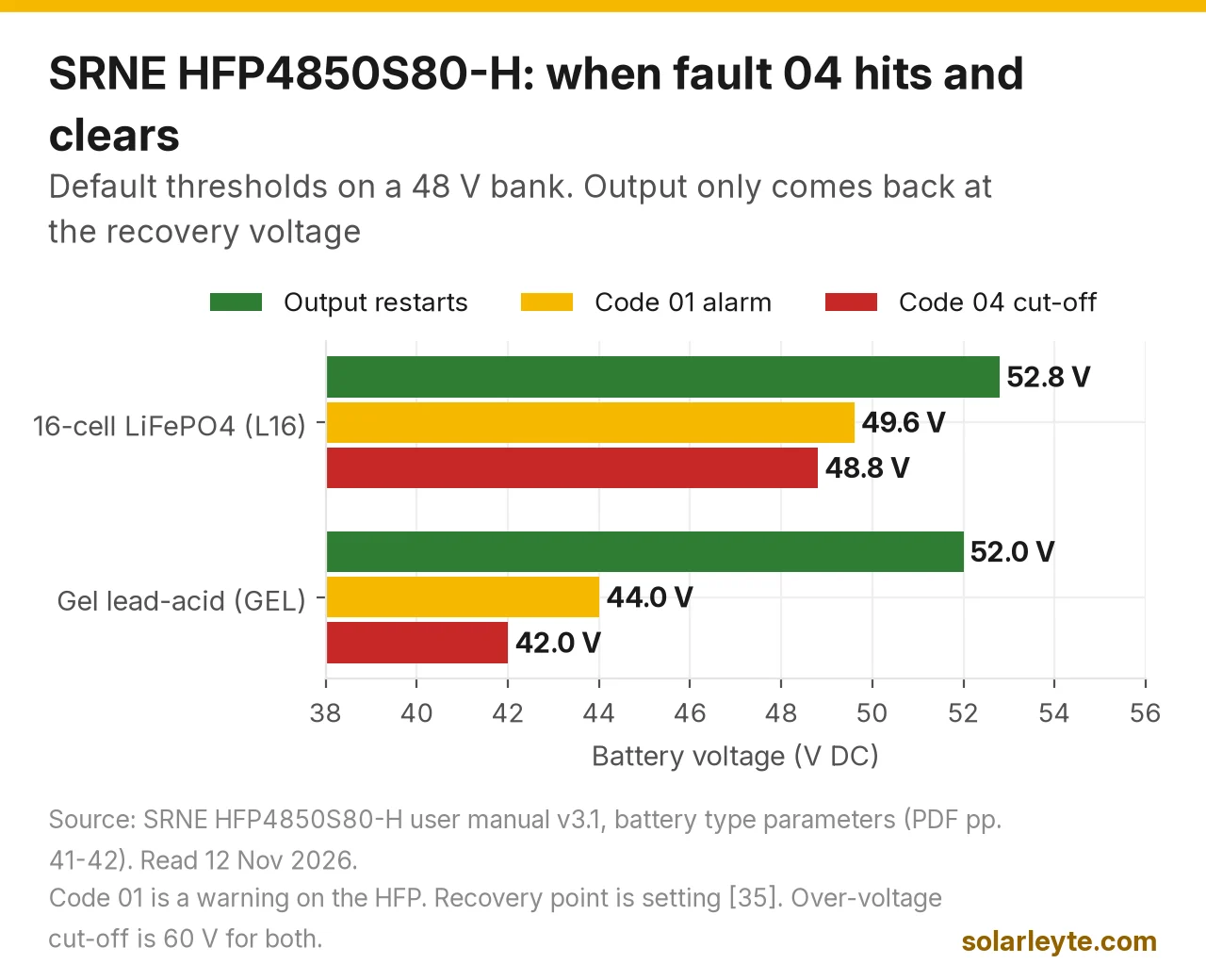
If 04 happens every night, the battery is too small for the load or set to the wrong type (setting [08]; a gel setting on a lithium bank puts every threshold in the wrong place). Changing it is an installer job. Our solar battery not charging guide covers the charging side.
Lithium BMS codes: 30, 31, 32 and 58 to 64
These only appear when the inverter is talking to a lithium battery's BMS (battery management system).
Code | SRNE name | Stops output? | What it means |
|---|---|---|---|
30 | BatCapacityLow1 | No | Battery SOC alarm ("lower than 10%" in the fault table) |
31 | BatCapacityLow2 | No | SOC below 5% (HFP, HESP) |
32 | BatCapacityLowStop | Yes | SOC too low, inverter stops |
58 | BMSComErr | No | No communication with the BMS |
59 | BMS alarm | No | BMS has its own fault (HFP) |
60, 61 | BMS under/over-temperature | No | Battery too cold or too hot, per the BMS |
62 | BMS over-current | No | BMS reports over-current |
63, 64 | BMS under/over-voltage | No | BMS reports low or high battery voltage |
Codes 30 and 32 are set points you can see in the menu. On the HFP, setting [58] (the "discharge alarm SOC") defaults to 15%, [59] (discharge cut-off SOC) to 5%, and [61] switches the house to mains when SOC drops below 10%. SRNE's fault table describes code 30 as "lower than 10%", while the default alarm setting is 15%, so the exact trigger depends on your settings. If you see 30 every night, the battery is simply being used to the bottom. A bigger battery or fewer evening loads will stop it.
Code 58: the battery isn't talking
58 means the inverter has no data from the lithium battery. SRNE's fix: "Check whether the communication line is connected correctly and whether [33] is set to the corresponding lithium battery communication protocol." In practice that's three checks:
- The port. On the HF and HFP, setting [32] must be BMS (RS485) for the battery link. The default, SLA, is for the PC or Wi-Fi monitor.
- The protocol. Setting [33] has to match your battery brand. The HFP list is PAC (PACE), RDA (Ritar), AOG (Allgrand), OLT (Oliter), HWD (Sunwoda), DAQ (Daking), WOW (SRNE), PYL (Pylontech) and UOL (Weilan). The HESP list is longer and adds a CAN option.
- The cable. A battery-to-inverter cable has a specific pin-out. A plain network cable often won't work. Ask the battery seller for the right one.
If your battery brand isn't on the list, ask the battery seller which protocol it emulates before you buy. Our battery brands comparison covers which brands document their compatibility. 58 doesn't stop output, but while it shows, the inverter has no SOC readings or BMS current limits.
Overload and short circuit: 13, 14, 15 and 17
13 is overload while the grid is feeding the loads (bypass), 14 is overload on the inverter, 15 is inverter over-current and 17 is a short circuit on the output. SRNE's fix for 13 and 14 is: "Reduce the use of power equipment" and "Restart the unit to resume load output." For 17: "Check the load connection carefully and clear the short-circuit fault points," then power up again.
The 5 kW HF and HFP manuals give the overload timing:
Load on a 5,000 W unit | SRNE rule | Example load (our calculation) |
|---|---|---|
102% to 125% | Alarm, output off after 5 minutes | 5,500 W (110%) |
125% to 150% | Alarm, output off after 10 seconds | 7,000 W (140%) |
Over 150% | Alarm, output off after 5 seconds | 8,000 W (160%) |
Worked example B (illustration): a 5 kW HFP is carrying a house at 4,000 W when a pump kicks in and the total jumps to 7,000 W. That's 140%, so after 10 seconds the inverter shows 14 and cuts the output. With "restart when overload" ([23]) on, which is the default, it tries again after 3 minutes. After 5 overloads in a row it stays off until you restart it. So if the house keeps blinking off every few minutes, don't keep resetting it. Find the big load and move it off the backup circuit. Our how many kWh appliances use post has typical wattages.
Solar (PV) codes: 09, 10, 11 and 19
09 is PV over-voltage. SRNE says: "Use a multimeter to check if the PV input voltage exceeds the maximum allowable input voltage." On all three families that limit is 500 V open-circuit. The manuals also say SRNE isn't responsible for damage when the panels' open-circuit voltage exceeds the maximum. So 09 is a design problem for the installer, not a reset. 10 and 11 are PV over-current and 19 is the PV heat sink running hot. None of these stop the AC output, but solar charging drops while they're showing.
Worked example C (illustration): using the Jinko JKM580N-72HL4-BDV (Voc 52.50 V, −0.25% per °C) from our series vs parallel wiring guide:
- 9 panels in series: 9 × 52.50 = 472.5 V at 25 °C. On a 17.5 °C morning (Tacloban's record low, PAGASA), 472.5 × (1 + 0.0025 × 7.5) = about 481 V. That's under 500 V, so it's OK.
- 10 panels in series: 525 V at 25 °C. That's already over 500 V before any cold correction. Expect 09, and a risk of damage that isn't covered.
Those are our calculations. Your installer should run the same check with your panel's datasheet.
Heat and fan codes: 19, 20 and 21
20 is the inverter heat sink over temperature and 21 is a fan fault. SRNE says the unit resumes on its own "when the temperature of the device is cooled below the recovery temperature," and for 21: "Check if the fan is not turning or blocked by foreign object." The HF and HFP are rated for −10 °C to 55 °C and are indoor-only units, so a hot, closed-up cabinet or a spot in direct afternoon sun will trigger 20. Clear the space around the vents. A dead fan (21) is a service job.
Grid codes on the HESP hybrid: 49 to 57
Only the HESP connects to the grid as a hybrid, so it has its own grid codes:
- 49 and 50: grid voltage too high or too low. 51 and 52: grid frequency out of range. SRNE's fix is to check that the grid is within the normal range and "wait until the grid voltage is restored." If it happens every evening, ask BILECO or your LEYECO to check your supply voltage. Our brownout vs blackout guide explains the voltage limits.
- 53 (grid loss): expected in a real brownout. If the power is on, check the AC breaker.
- 55 (grid standard un init): the grid standard hasn't been set up. That's commissioning, so call the installer.
- 56 and 57: low insulation resistance and leakage current. SRNE says to check the earthing and that panels and cables aren't worn. Electrician.
Internal and parallel codes
- 07, 08, 22, 23, 26, 29, 41 and 44 are internal: bus over-voltage, memory, model setting, a relay fault (26, "inverted AC output backfills to bypass AC input"), bus under-voltage, inverter DC voltage and serial number. Restart once. If it comes back, it's for the seller or SRNE.
- 34 to 45 only appear on parallel setups: parallel ID clash (35), current sharing (37), different AC sources (39), cable (40, 43) and firmware mismatch (42). They're installer jobs.
When to call someone
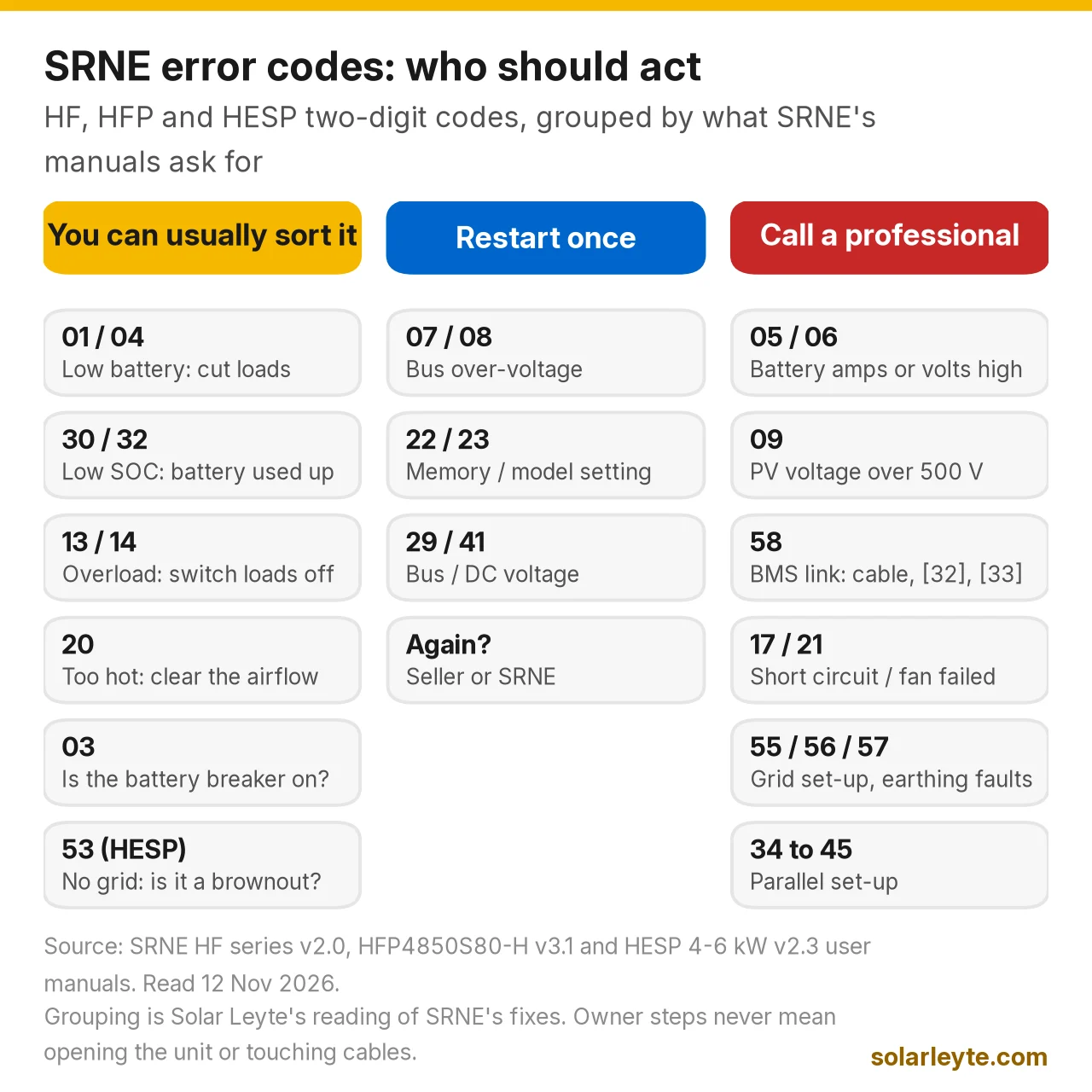
- You can usually sort it: 01 and 04 (recharge, cut loads), 30 and 32 (battery used to the bottom), 13 and 14 (switch loads off), 20 (clear the airflow), 53 in a real brownout.
- Electrician or installer: 03 if the breaker is on, 05, 06, 09, 17 if it comes back, 21, 49 and 50 if daily, 55, 56, 57, 58, and all parallel codes.
- Seller or SRNE: 07, 08, 22, 23, 26, 29, 41, 44, and anything that comes back after one restart.
When you call, have the model and serial number, a photo of the screen with the code, what was running at the time, the battery brand and type, and your panel count. SRNE's only published HESP warranty we found is for Australia, so in the Philippines your claim goes through the shop that sold you the unit (more in our Deye vs Solis vs SRNE comparison). Keep the receipt. If it's out of warranty and you're thinking about a replacement or a bigger battery, you can request a quote and compare.
FAQ
What does error 04 mean on an SRNE inverter?
It's "BatLowEod": the battery hit its low-voltage cut-off and SRNE stopped the output to protect it. Let the battery recharge. Output returns at the recovery voltage, 52.8 V by default for a 16-cell LiFePO4 bank on the HFP.
How do I fix SRNE error 58?
Check that setting [32] is on BMS (or CAN on the HESP if your battery uses CAN), that [33] matches your battery brand, and that you're using the battery maker's communication cable. If the battery isn't on SRNE's protocol list, ask the battery seller.
Ano ang error 30 at 32 sa SRNE?
Low battery SOC (state of charge) ang ibig sabihin, para sa lithium battery na naka-BMS link. Alarm lang ang 30. Sa 32, titigil na ang output. Hintayin mag-charge ang battery, o bawasan ang gamit sa gabi.
Can I reset an SRNE inverter myself?
You can do one restart for overload (13, 14) or an internal code. Don't open the unit or touch the battery or PV cables. If the same code comes back, call your installer.
Solar Leyte is run by MACC Systems & Energy Solutions Inc., a solar installer in Naval, Biliran.
Get a free solar quote from MACC
Planning a hybrid or off-grid system for brownouts, or replacing an old inverter? Send us a recent BILECO or LEYECO bill and we'll get back to you with a free, no-obligation written quote.
- Call/Text: 0955 723 5093
- Email: official@macc-inc.com
- Website: www.macc-inc.com
- Or use the site quote form: /quote
Related guides
- Grid-tie vs hybrid vs off-grid solar: which works in a brownout?
- Growatt inverter error codes
- Deye hybrid inverter error codes
- MUST and Axpert inverter error codes
- Solar inverter not turning on
Sources (all checked 12 November 2026)
- SRNE HF series 3–5 kW all-in-one solar charge inverter manual, v2.0 (PDF): settings [01]–[62] including [32]/[33] BMS protocol list pp. 23–30; battery type thresholds pp. 31–32; protections p. 34; fault codes 01–63 (01 "affects output: Yes") pp. 35–36; troubleshooting p. 36; overload timing, 500 V max PV open-circuit voltage, −10 °C to 55 °C operating range p. 39 (PDF page numbers).
- SRNE HFP4850S80-H manual, v3.1 (PDF): settings [01]–[62] including [23] restart after 3 minutes, 5 times, [32]/[33] protocol list, [35] 52 V, [58] 15%, [59] 5%, [61] 10% pp. 33–40; battery type parameters (L16: 49.6 V alarm, 48.8 V cut-off, 52.8 V recovery; GEL: 44 V, 42 V, 52 V; 60 V over-voltage) pp. 41–42; protections pp. 45–46; fault codes 01–64 pp. 47–50; handling measures p. 51; twice-yearly checks and capacitor warning p. 52; overload timing p. 53; 500 V max PV open-circuit voltage, −10 °C to 55 °C p. 54.
- SRNE HESP 4–6 kW EU hybrid inverter manual, v2.3 (PDF): safety instructions p. 4; 500 V open-circuit warning p. 15; BMS protocol list (RS485 1–15, CAN 16) pp. 36–37; SOC alarm settings p. 38; fault codes 01–63 including grid codes 49–57 (01 "No") pp. 52–55; troubleshooting pp. 56–57; specifications (IP65, 5-year warranty) pp. 61–62.
- SRNE datasheets: HF series 5 kW, V1.0 (PDF) and HFP series 5 kW, V1.2 (PDF) (both IP20 indoor only, 2-year warranty).
- JinkoSolar JKM575–600N-72HL4-BDV datasheet (PDF): 580 W Voc 52.50 V, Voc temperature coefficient −0.25%/°C.
- PAGASA, Tacloban climatological extremes (PDF): record low 17.5 °C.
- Worked examples A–C: Solar Leyte illustrations built from the figures above, not real cases. Per-cell voltages (48.8 ÷ 16 ≈ 3.05 V; 52.8 ÷ 16 = 3.30 V), overload percentages (5,500 W = 110%, 7,000 W = 140%, 8,000 W = 160% of 5,000 W) and string voltages (9 × 52.50 = 472.5 V; × 1.01875 ≈ 481 V; 10 × 52.50 = 525 V) are our calculations.